
Master the Best Way to Structure a Cohort-Based Course
Many individuals start a cohort course in the wrong place.
They open a doc, brainstorm module titles, record a few lessons, pick Zoom, and tell themselves they’ll figure out the community piece later. Then launch week arrives and the whole thing feels disjointed. The lessons are decent. The calls are fine. The chat is quiet. Students consume material, but the transformation feels thinner than it should.
That’s usually a structure problem, not a content problem.
The best way to structure a cohort based course is to design curriculum, community, and facilitation as one system. If those pieces live separately, students feel it. If they reinforce each other, the course gains momentum fast.
I’ve found that strong cohorts don’t feel like a pile of assets with a calendar attached. They feel like a guided experience with a clear destination, the right pace, and enough human interaction to keep people moving when motivation dips.
Laying the Foundation for Transformation
A cohort course only works when the promised outcome is sharp.
If the result is vague, everything downstream gets fuzzy. Your lessons drift. Your live sessions turn into general Q&A. Your assignments become busywork. Students show up, but they don’t always know what they’re building toward.
Start with the before and after
I define the transformation in plain language before I outline a single module.
Write two short statements:
- Before: What is your student struggling with right now?
- After: What can they do, decide, build, or complete by the end?
That second line matters more than most creators realize. “Feel more confident” is too soft on its own. “Leave with a working onboarding sequence” or “publish your first portfolio case study” gives the course a center of gravity.
A good cohort promise has three traits:
- It’s specific enough to shape assignments
- It fits within a fixed time window
- It attracts the right student and repels the wrong one
If you need a useful refresher on the model itself, Mastering Cohort Based Learning is a solid overview of how the format works and why people choose it over self-paced delivery.
Build a student persona around friction
Most student personas are too shallow to be useful.
Age, job title, and industry help a little, but they rarely tell you why someone gets stuck. What matters more is friction. Where do they hesitate, overthink, procrastinate, or quit?
I like to document five things:
- Current reality: What have they already tried?
- False beliefs: What do they assume is the problem?
- Practical constraints: Time, energy, tools, team support
- Desired identity: Who do they want to become in their work?
- Risk tolerance: Are they willing to ship imperfect work or do they need hand-holding first?
Practical rule: If you can’t name what has stopped this student before, you’re not ready to design the course.
That friction map helps you make better decisions later. It tells you what needs examples, where students need accountability, and which parts belong in live sessions instead of pre-recorded lessons.
Write a course promise you can deliver
Keep the final promise short.
A simple format works well:
I help [specific learner] go from [current struggle] to [clear outcome] in [defined timeframe] through [core method].
Example structure, not a script:
I help new consultants go from scattered expertise to a clear signature offer in six weeks through workshops, peer review, and weekly implementation sprints.
If your promise needs a paragraph to explain, it probably isn’t ready.
When this foundation is clear, the rest of the course gets easier. You’re no longer guessing what belongs in the program. You’re building backward from a real change in the learner’s life or work.
Architecting Your Course Blueprint and Timeline
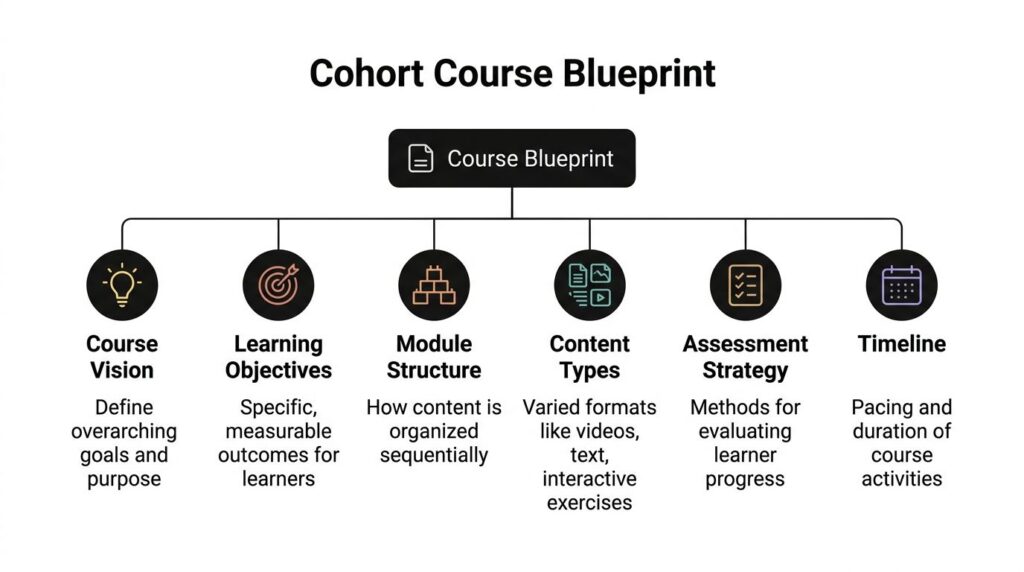
Once the transformation is clear, you can turn it into a path.
Many cohort courses go sideways at this stage. Creators often organize modules by topic instead of by learner progress. The result is tidy on paper and messy in practice. Students learn things in the wrong order, or they hit application tasks before they’ve built enough confidence.
The blueprint should follow the learner’s journey, not your expertise map.
Organize weeks around milestones, not subjects
Each week should answer one question: What meaningful progress should students make by the end of this block?
That usually gives you cleaner pacing than “Week 1 foundations, Week 2 advanced foundations, Week 3 more theory.”
A stronger weekly structure looks like this:
| Week element | What it should do |
|---|---|
| Outcome | Define the result students should leave with |
| Input | Give the minimum teaching needed to support the work |
| Activity | Make them apply the lesson quickly |
| Reflection | Help them notice what worked and what didn’t |
| Support | Provide live guidance or peer discussion around friction |
When I sketch a cohort, I try to make each week feel finishable. Students should feel a small win, not just “covered material.”
Use a fixed schedule and protect the rhythm
A cohort needs a fixed and predictable schedule. That isn’t a nice extra. It’s the operating system.
Clear start and end dates create urgency, shared momentum, and a natural form of accountability that self-paced formats struggle to match, as discussed by Zanfia’s write-up on fixed schedules in cohort-based courses.
The schedule also forces better design decisions from the instructor side. You can’t keep stuffing in bonus lessons forever. You have to decide what matters most.
A simple weekly rhythm often works better than an elaborate one:
- Early week: Release the lesson and assignment
- Midweek: Hold the live workshop or coaching session
- Late week: Collect submissions, peer review, or reflection
- Weekend or reset day: Light catch-up and preview of the next step
Students like knowing what kind of effort each day requires. Predictability lowers cognitive load.
If students have to keep re-learning how your course works each week, they spend less energy on the actual learning.
Balance teaching with doing
One of the most useful benchmarks I’ve seen is the 40/60 content-to-activity ratio, with about 40% of the course focused on teaching materials and 60% devoted to activities, assignments, and peer-based learning, according to Teachfloor’s guidance on building and launching a cohort-based course.
That ratio tracks with what I’ve seen in practice. Passive content feels productive, but it doesn’t create the same traction as doing the work.
For most cohorts, that means:
- Shorter lesson content: Keep recordings tight and relevant
- Workbooks with decision prompts: Don’t just summarize the video
- Live problem-solving: Use calls to unblock action
- Peer review: Let students sharpen judgment by evaluating real work
- Real-world assignments: Tie learning to an output they need.
The trap is over-teaching. Creators add extra videos because they worry students won’t feel the value otherwise. Usually the opposite happens. Students drown in material and delay the assignment that would have moved them forward.
Decide what belongs live and what belongs async
This choice shapes the whole experience.
Use asynchronous content for ideas students can absorb on their own. Use live time for nuance, feedback, coaching, and decision-making.
Here’s a simple filter:
- Async works well for frameworks, examples, walkthroughs, and setup
- Live works well for critique, role play, troubleshooting, discussion, and prioritization
When in doubt, ask one question: does this part get better when learners can react to one another in real time?
If yes, save it for the group.
A sample blueprint that stays lean
A practical cohort often includes:
Pre-course onboarding
Expectations, introductions, setup, and early momentum.Weekly core lesson
One central idea, not five loosely connected ones.Implementation assignment
Something students can submit, discuss, or test.Live session
Workshop, critique, Q&A, or facilitated discussion.Community prompts
Structured conversation, not random posting.Final synthesis
Capstone, presentation, or completed asset.
If you’re trying to find the best way to structure a cohort based course, this is the part to simplify hard. Most weak cohorts don’t fail because they lack content. They fail because the timeline doesn’t support action.
Weaving Community Into Your Course DNA
I can usually tell within a few days whether a cohort will feel alive or transactional.
The difference rarely comes from the curriculum alone. It comes from whether students start seeing each other as useful parts of the experience. A cohort with no real connection is just scheduled content. People may attend, but they won’t lean on the group when the work gets uncomfortable.
That matters because successful cohort programs weave collaboration directly into the curriculum through live discussions, group projects, and peer feedback, which correlates with stronger persistence and learning outcomes, as noted by Group.app’s guide to building a cohort program.

Onboarding should create movement, not just access
A lot of creators treat onboarding like admin.
Students get a welcome email, a login link, and maybe a reminder about the first call. That gets people into the platform, but it doesn’t get them invested.
Good onboarding should answer three questions fast:
- Who is here with me?
- What kind of participation is expected?
- What can I do before day one to feel ready?
I like onboarding that includes a short intro prompt, one early action, and one simple public share. For example, ask students to post what they want to finish by the end of the cohort and what usually gets in their way. That creates relevance immediately.
A good companion resource on this is LearnStream’s piece on building community in an online course, especially if you want to think beyond chat channels and toward repeatable community habits.
Better icebreakers create better cohorts
Most icebreakers are forgettable because they ask for surface-level details.
“Where are you from?” and “What do you do?” aren’t harmful. They just don’t build trust very quickly.
Use prompts that expose working style, goals, and challenges. Things like:
- What have you already tried that didn’t work?
- What are you hoping to complete during this cohort?
- Where do you tend to stall when working alone?
- What kind of feedback helps you most?
Those questions create useful context for future peer interaction. Students start recognizing who might be a good thought partner, not just who lives in the same city.
Community gets stronger when people know how they can help each other.
Rituals beat random engagement
Most communities become quiet because participation has no shape.
Students don’t know when to post, what kinds of updates are useful, or whether anyone will respond. Structure fixes that.
A few rituals consistently work well:
| Ritual | Why it works |
|---|---|
| Weekly wins thread | Normalizes progress sharing and keeps momentum visible |
| Stuck post | Makes it easier to ask for help before falling behind |
| Work-in-progress review | Encourages imperfect sharing and faster feedback |
| Friday reflection | Helps students consolidate lessons from the week |
The key is consistency. If you run one “share your win” post and never repeat it, it feels like filler. If students expect it every week, it becomes part of the course rhythm.
Small groups create real accountability
Large-group discussion is useful, but deeper accountability often happens in smaller circles.
I like using peer pods of a few students with clear expectations. They can review assignments, meet briefly between calls, or check in around goals. The point isn’t to create another complicated layer. It’s to make sure no one disappears unnoticed.
A few practical rules help:
- Match by pace and intent: Similar commitment levels matter more than similar backgrounds
- Give pods a task: “Meet and connect” is too vague
- Keep the first interaction easy: A short prompt or worksheet lowers awkwardness
- Explain the why: Students engage more when they understand the role of peer support
One thing that trips creators up is assuming community will emerge naturally because everyone shares a topic. Sometimes it does. More often, it needs facilitation, repetition, and designed reasons to interact.
If you want students to learn together, the course has to require togetherness in useful ways.
Mastering Live Facilitation and Driving Engagement
A weak live session can drain energy from an otherwise strong cohort.
You’ve probably seen the pattern. The host asks, “Any questions?” No one speaks. A few cameras go off. One brave student finally shares something broad, and the conversation drifts. By the end, people attended, but nothing really moved.
That’s a facilitation issue.
Dead air usually starts before the question
When people don’t talk, creators often assume the group is shy.
Sometimes that’s true. More often, the session didn’t give them enough structure to respond. Broad prompts produce broad silence.
I’ve had much better results with specific participation cues. Instead of “What did you think?”, ask “What part of the assignment took the most time?” or “Drop one sentence in chat about where you got stuck.”
Those are easier to answer and they surface useful teaching material fast.
A simple live session format that keeps momentum
Group.app describes a useful workshop structure built around a clear problem, usually in the 45 to 60-minute range, with time set aside for framing the issue, reframing it with core teaching, and guiding students toward an immediate small win. Their breakdown is worth studying in the article on cohort program structure.
In practice, I like a session flow that feels like this:
Open with a narrow check-in
Ask for one word, one obstacle, or one current status update.Name today’s problem clearly
Students engage more when they know exactly what the session is solving.Teach briefly
Give enough instruction to sharpen their thinking, then move back into participation.Use breakout rooms with a task
Never send people into breakouts with vague instructions.Return for synthesis
Pull out patterns, not just individual stories.Close with a next action
End with what they should do in the next day or two.
Handling common facilitation problems
Here are the issues I see most often:
No one talks at first
Use chat before voice. Ask for a fast written response, then invite one or two people to expand.One person dominates
Thank them, summarize their point, and redirect. “That’s useful. I want to hear how someone else handled the same issue.”The session turns into consulting for one student
Pull the lesson up a level. Ask, “How many others have run into some version of this?” Then teach the shared principle.Breakout rooms feel flat
Give a deliverable. A decision, a draft, a ranked list, or one takeaway to bring back.
The instructor’s job in a live cohort isn’t to fill every minute with teaching. It’s to create conditions where students think, speak, test, and leave clearer than they arrived.
If you want a broader look at format options, LearnStream’s overview of cohort based courses is useful for comparing how creators structure the live component.
A short example helps. Say you’re running a writing cohort and students seem stuck on positioning. Don’t spend the whole call re-teaching the lesson. Ask each student to post their current one-line offer in chat. Put them into pairs to identify what feels muddy. Bring the group back and workshop three examples live. That turns abstract confusion into visible progress.
Here’s a walkthrough that pairs well with that kind of session design:

The main shift is simple. Stop treating live calls like mini-webinars. Run them like working sessions.
Proving Value with Feedback and Assessments
A cohort course gets stronger when proof, improvement, and marketing come from the same loop.
Most creators separate those tasks. They teach first, ask for feedback later, and scramble for testimonials at the end. That creates extra work and weak insight. A better approach is to build assignments and feedback moments that naturally reveal what students are learning and where the course needs adjustment.
Use assessments that mirror real use
Traditional quizzes have a place, but they rarely capture the full value of a cohort course.
If your promise is practical, the assessment should be practical too. Ask students to produce something they’d need outside the course. A draft, a workflow, a pitch, a lesson plan, a strategy memo, a revised portfolio piece.
The best assessments usually do three jobs at once:
- They measure learning
- They force application
- They create visible artifacts of progress
That artifact matters. Students often don’t realize how far they’ve come until they compare what they can produce in the final week with what they had at the start.
Collect feedback while the course is still running
End-of-course surveys are useful, but they come too late to save the current cohort.
Mid-course feedback is where the best improvements happen. Keep it short and practical. Ask things like:
| Ask this | Why it helps |
|---|---|
| What part of the course feels most useful right now? | Shows what to preserve |
| Where are you confused or behind? | Reveals friction before students disappear |
| What feels heavier than it needs to be? | Helps trim overload |
| What would help you complete the next assignment? | Surfaces support needs |
If you want a broader set of approaches for gathering cleaner input, this guide on how to collect feedback from customers is useful beyond product teams. The same principles apply to courses when you want feedback that’s specific enough to act on.
Turn outcomes into usable proof
The easiest time to collect a strong testimonial is right after a student has completed something concrete.
Don’t ask, “Did you enjoy the course?” Ask questions that pull out the transformation:
- What did you have before you joined?
- What did you finish, decide, or change during the cohort?
- What part of the structure helped you keep going?
- Who would get the most value from this experience?
A good testimonial doesn’t need hype. It needs a clear before, a clear after, and a believable reason the course helped.
When assessments are tied to real outputs, this gets much easier. You’re not asking students to invent praise. You’re asking them to describe a result they can see.
That’s also how you improve future cohorts. The same assignment that proves learning can show you whether your instructions were clear, whether students had enough support, and whether the promise still matches the experience you delivered.
Your Essential Cohort-Based Course Tech Stack
A cohort can run on a surprisingly small stack.
What matters isn’t owning every tool. It’s making sure each tool has a clear job and that students don’t have to bounce between too many places to learn, attend, discuss, and submit work.
I usually think in four categories: hosting, community, live delivery, and automation.

Pick tools by function, not hype
Here’s a practical way to evaluate your stack:
| Category | What you need | Common options |
|---|---|---|
| Course hosting | Drip content, organize lessons, track progress | Teachable, Kajabi, Thinkific |
| Community platform | Ongoing discussion, prompts, groups, events | Circle, Heartbeat |
| Live sessions | Reliable calls, breakout rooms, recording | Zoom, Google Meet |
| Automation | Reminders, onboarding, follow-up | ConvertKit, Zapier |
That’s enough for most creators.
If your stack needs a tutorial before students can even find the week one assignment, it’s too complex.
Circle versus Heartbeat
These two come up a lot because they solve a similar problem from slightly different angles.
Circle tends to feel more like a structured community hub. It’s useful when you want spaces, events, member directories, and a cleaner separation between topics.
Heartbeat often feels more intimate and conversation-driven. Some creators prefer it when they want faster interaction and a less formal atmosphere.
The choice usually comes down to how central the community is to the learning experience.
- Choose Circle if your course needs clear spaces, event management, and a more organized home base.
- Choose Heartbeat if you want a lighter feel and expect conversation to happen quickly and often.
Neither platform fixes a weak cohort design. They just make a good design easier to run.
Think carefully about global cohorts
Here, creators often underestimate the challenge.
According to EdisonOS, up to 40% of cohort failures in international groups stem from scheduling friction, and adopting an asynchronous-first with opt-in live model plus timezone-aware tools can improve completion rates for cross-cultural cohorts by over 40% in those settings (source).
That tracks with what many global cohorts experience. A rigid calendar that works beautifully for one region can exclude everyone else.
A few practical adjustments help a lot:
Use async as the default layer
Core lessons, prompts, and assignments should work without requiring a live appearance.Offer live sessions as support, not the whole product
Record calls and make replays easy to find.Use timezone-aware scheduling tools
Even simple tools reduce confusion around meeting times.Create wider submission windows
A full-day window often works better than a narrow deadline.Design culturally neutral participation norms
Some groups jump into discussion quickly. Others need more written reflection first.
A lean sample stack
If I were setting up a practical cohort today, I might choose:
- Thinkific for lesson hosting
- Circle for community and events
- Zoom for live workshops
- ConvertKit for reminders and onboarding emails
That’s only one possible mix.
Another option in the hosting layer is LearnStream, which includes drip scheduling and learner monitoring features that can help instructors keep a group on the same timetable and spot where students may be falling behind. If you’re comparing platforms in more detail, LearnStream’s guide to the best platform for selling cohort-based courses gives a useful side-by-side starting point.
A key rule for tech selection
Choose the simplest stack that supports your teaching model.
If your course depends on peer review, make that frictionless. If live workshops are central, prioritize breakout quality and recording access. If your students are busy professionals, reminders and a clean dashboard matter more than fancy extras.
Tools don’t create transformation on their own. They either support the structure or get in the way of it.
A good cohort course feels coherent from the student side. The promise is clear. The timeline makes sense. The community has a pulse. The live sessions help people move. The assignments prove progress. The tools stay mostly invisible.
That’s the standard I’d aim for.
If you’re building your next program, don’t ask how to pack in more content. Ask how each week can move students toward a real result while making the group itself part of the learning. That’s usually where the course becomes worth joining.