
Course Affiliate Marketing Guide for Course Creators

You’ve got the course built, the sales page is live, and the first launch emails have already gone out. Then traffic slows, social posts get ignored, and the calendar keeps filling with “I’ll buy later” instead of actual enrollments. That’s where course affiliate marketing earns its place, because it gives you another sales force that only gets paid when it helps generate revenue.
Used well, affiliate partnerships bring in people who already trust the creator recommending your course. Used badly, they fill your dashboard with empty clicks, sloppy disclosures, and traffic that never had buying intent in the first place. The difference usually comes down to how you plan, track, and protect the program.
Why Affiliate Programs Matter for Course Creators
A course launch can feel expensive fast. You’ve written lessons, built the checkout flow, maybe paid for design or editing, and now you’re waiting for your audience to convert while the rest of your niche keeps publishing louder content. Affiliate marketing helps break that bottleneck because it turns other people’s audiences into a measurable acquisition channel.
The scale matters too. One 2026 industry estimate puts worldwide affiliate spending at $24.7 billion in 2026, up 26% year over year from $19.6 billion in 2025 (Track360). In other words, this isn’t a side experiment for digital learning businesses anymore, it’s part of the broader way online products get sold.
For course creators, the appeal is straightforward. You don’t pay for eyeballs that bounce. You pay when a partner drives a sale, which makes the channel easier to justify than broad awareness ads when budgets are tight.
Practical rule: if a partner can already speak to your ideal learner, you’re not buying traffic, you’re borrowing trust.
That’s largely why course affiliate marketing keeps growing. It matches the way people buy education, through recommendations, examples, and proof that the course solves a specific problem. When your offer fits that pattern, affiliates can amplify reach without forcing you into upfront media spend you can’t control.
Planning Your Course Affiliate Strategy
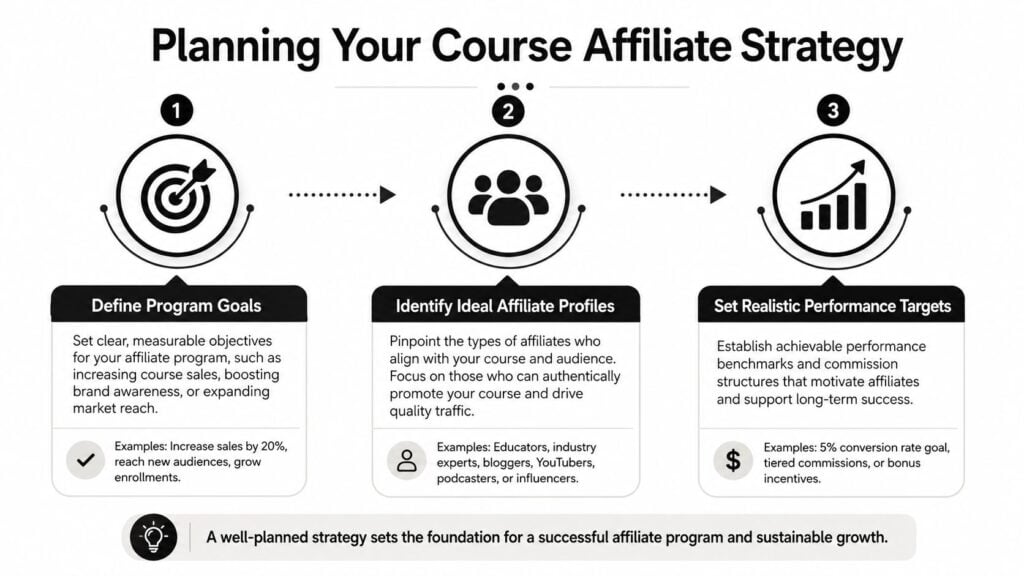
Strong programs start with clear math, not hope. If the offer, the audience, and the commission structure don’t line up, recruitment just creates more noise. The safest way to plan is to work backward from your sales goal, then map the kind of affiliate who can realistically reach the learners you want.
A useful benchmark for education and online course affiliate programs is a 3.5% conversion rate, while broader affiliate traffic typically converts at 1% to 3% and top performers can reach 5% to 10% when the audience fit is strong (GrowSurf). That matters because it gives you a sanity check before you promise commissions or forecast revenue. If your funnel is weak, a bigger affiliate list won’t fix it.
Start with the audience you want
The best affiliates for courses usually already talk to people who are trying to learn something specific. That could mean educators, niche bloggers, consultants, or creators who teach adjacent topics. I’d rather recruit ten relevant partners than fifty broad ones who post generic roundups and never drive qualified clicks.
The first filter is audience-product fit. Everything else is secondary.
Use the numbers to set expectations
If you know your normal conversion rate from the benchmark above, you can estimate how much traffic an affiliate needs to matter. That helps you set commission budgets and decide whether you need a few strong partners or a larger pool of smaller ones. It also keeps you from overpaying for content that looks active but doesn’t convert.
If you want a simple workflow for generating program assets fast, monetize your content with AI can be useful for turning rough ideas into publishable drafts without starting from scratch.
Pick a recruitment model that matches your margins
Some course businesses do better with a small, curated group of partners. Others need broader recruitment and more hands-on management. I’ve found that the more expensive or specialized the course, the more selective the affiliate list should be, because low-quality traffic becomes costly fast.
For creators comparing delivery stacks, the best LMS for affiliate training can also shape how easily partners get access to training materials, updates, and tracking. One platform choice can reduce a lot of support friction later.
Setting Up Tracking and Choosing Tools
The part most creators rush is the part that decides whether the program works. If tracking is fuzzy, you can’t tell which partner deserves credit, which channel is weak, or where fraud is creeping in. That is why setup should happen before you send out a single recruitment email.

Start by choosing a system that can reliably record referrals, cookies, and conversions. A standalone affiliate network can be easier if you want built-in reporting, while an integrated plugin or platform works better when you want tighter control inside your own tech stack. If your course business already runs on a platform with affiliate support, that can simplify setup, but only if the reporting is usable and the attribution rules are clear.
One SaaS affiliate dataset showed only 7.6% of affiliates generated any referral, only 1.28% generated a sale, and the referral-to-sale conversion rate was 0.8% (Rewardful). Those numbers are a warning, not a goal. They show how quickly a program can look busy while producing very little revenue.
Use that lesson to build control points early.
- Track post-click behavior: Watch lead completion, checkout start, and purchase, not just clicks.
- Segment by source quality: Separate review creators, educators, email partners, and broad social promoters.
- Set fraud flags: Review strange click spikes, repeated low-quality referrals, or traffic that never reaches checkout.
- Audit cookies and attribution: Make sure the right affiliate gets credit under the rules you’ve chosen.
If you’re comparing platform options for the course itself, the top digital product platforms for coaches can help you think through how delivery, checkout, and partner tracking fit together. The same comparison also affects how much cleanup you’ll need later if you change tools.
Practical rule: open affiliate enrollment is fine, but open credit assignment is not.
Here’s the operational mindset I use. Measure the behavior that happens after the click, not just the click itself. Low-intent traffic can make dashboards look active, while the actual revenue stays flat. A clean tracking setup keeps you from rewarding the wrong people and gives you evidence when a partner’s traffic looks suspicious.

For course creators who also train affiliates inside a webinar or workshop flow, the mechanics are similar, even if the offer is a course instead of an event. If you also want a better sense of how affiliate operations connect to delivery and onboarding, the best LMS for affiliate training is a useful reference point for organizing links, updates, and partner access.
Designing Commission Models and Handling Legal Disclosure
Commission design and compliance belong in the same conversation. If you set an attractive payout but ignore disclosure language, you can create distrust before the first sale even lands. If you overcomplicate the payout structure, affiliates may skip your offer for something easier to explain and promote.
The strongest course affiliate marketing programs usually keep the structure simple enough for partners to understand quickly. That means choosing between flat-rate, tiered, or performance-bonus commissions based on your margins and the price point of the course.
| Model | Commission Rate | Pros | Cons |
|---|---|---|---|
| Flat-rate | Fixed payout per sale | Easy to explain, predictable budgeting | Less flexible for top performers |
| Tiered | Higher payout after volume thresholds | Rewards consistency and loyalty | Harder to administer |
| Performance-bonus | Base payout plus bonuses for results | Motivates strong partners | Can get complex fast |
For contract language and program terms, the affiliate contract template for course launch is a practical starting point for clarifying payout timing, acceptable traffic, and promotion rules.
Disclosure is the part many beginner guides gloss over. A major underserved angle in course affiliate marketing is compliance and disclosure for course reviewers and bloggers, because most beginner content ignores how to implement clear affiliate disclosures in different formats and markets (YouTube source). That gap matters because a blog post, a video description, and an email recommendation don’t all carry the same context, even though each one can include affiliate links.
A simple working standard is this, the disclosure should be easy to find, easy to understand, and close to the link or recommendation. For video, use the description and mention it in the spoken intro when appropriate. For articles, place it near the first affiliate link or at the top if the entire post is promotional. For newsletters, add the disclosure before the recommendation, not after it.
Clear disclosure protects trust before it protects compliance.
I also suggest making the language plain. A sentence like “This post includes affiliate links, which means I may earn a commission if you buy through them” is straightforward and hard to misunderstand. Keep the wording consistent across markets, then adapt only when local rules require something different.
Creating Promotional Assets and Streamlining Onboarding
Affiliates promote better when you remove friction. If they have to hunt for screenshots, rewrite your offer, or guess how to describe the course, most of them won’t do the work well. That’s why the best programs hand over a complete asset pack on day one.
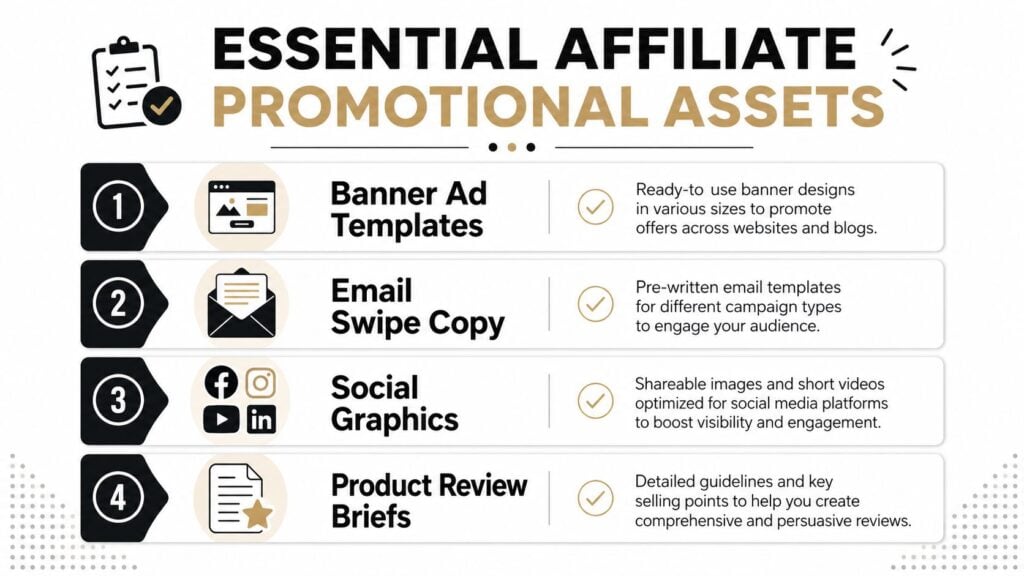
At minimum, I’d prepare four assets. Banner ad templates give partners something visual to place on their site. Email swipe copy helps them promote without rewriting your core message. Social graphics make quick posts easier. Product review briefs give creators the talking points they need for more detailed recommendations.
A clean onboarding flow usually works better than a long welcome dump. Send one message that confirms approval, one that explains the offer, one that shares assets, and one that shows where to get help. If the program is meant to scale, set expectations early about approved traffic, disclosure rules, and where to find updated links.
For creators who use live events as part of their funnel, the affiliate program setup for webinars can also inform how you structure launch materials and timing. The same idea applies, give partners enough context that they can promote without guessing.
I’ve found that a short onboarding checklist reduces support pings later.
- Confirm access: Make sure the affiliate can log in, find links, and see their dashboard.
- Explain the offer: Give them the course promise, ideal learner, and primary objection points.
- Share ready assets: Put banners, copy, and product notes in one folder.
- Set a first action: Ask for one email send, one post, or one review by a specific date.
The smoother the first week feels, the more likely the partner is to stay active. Affiliates rarely disappear because they dislike the offer. They disappear because getting started took too much effort.
Analyzing Performance and Optimizing Your Program
Once the program is live, the job shifts from setup to judgment. Raw clicks can feel encouraging, but they don’t tell you enough. You need to know which partners move revenue, which content formats convert, and where your commission structure is helping or hurting profit.
Some benchmarks show affiliate marketing can deliver up to $15 in return for every $1 spent (DigitalApplied). That kind of return is possible only when the program is managed tightly, with the right partners and enough control over cost, attribution, and quality.
Read the data by content type
I like to segment affiliates by the way they promote. Review posts, tutorial content, email recommendations, comparison pages, and social-first promotions behave differently. That matters because a creator with fewer clicks can still beat a bigger partner if their audience is more qualified.
Watch for quality, not just volume
One high-traffic partner can look strong until you check checkout completion and refund behavior. Another smaller partner may send fewer visitors but convert more cleanly because the audience already wants a course like yours. That’s why I’d rather adjust commissions around proven performance than around vanity reach.
Prune without hesitation
If a partner keeps sending weak traffic, pause their links or lower their incentives. If a content type outperforms the rest, make it easier to produce and reward it more generously. Good optimization is mostly disciplined subtraction.
Practical rule: reward the partners who create revenue, not the ones who create dashboard activity.
The fastest way to improve a course affiliate marketing program is usually boring, repeatable work. Tighten tracking, review the underperforming placements, and reallocate attention toward the affiliates whose audiences already behave like buyers. That’s how the channel stays profitable instead of turning into another marketing chore.
If you’re launching or cleaning up a course affiliate marketing program this week, start with three moves, define your commission rules, audit your tracking for weak spots, and prepare one disclosure template for blogs, videos, and email. Then recruit a small group of relevant partners and review the first results before adding anyone else. If you want a practical next step, open your affiliate dashboard, check your current attribution settings, and fix the gaps before you send out the next promo link.