
How to Make Money with Membership Sites in 2026

You’ve built the lessons, opened the community, and announced the launch. The first members join, and the initial payments feel encouraging. Then renewals arrive, cancellations start to show up, and the number of active members stops telling you whether the business is working.
That’s a common point of frustration for course creators. How to make money with membership sites isn’t mainly a question of which platform to use or what to charge. Sustainable revenue depends on delivering value members keep using, helping new members reach an early win, and understanding which parts of the business retain revenue.
The Membership Money Question Most Creators Get Wrong
A creator launches a paid learning community with a library of lessons and a monthly discussion call. The first wave of sign-ups comes from an email list and a launch promotion. For a while, the member count rises. But new members don’t know where to start, the discussion call feels subdued, and existing members don’t see a clear reason to renew. New sales keep arriving, but cancellations offset them.
That business hasn’t necessarily failed because its price is wrong. It may have a problem with activation, retention, or the value members experience after joining. Lowering the price can make the same problem cheaper, not solve it.
Five forces shape membership revenue
A useful mental model has five parts:
- Acquisition offer: The promise that gives the right person a reason to join.
- Activation: The first meaningful outcome that helps a new member put the offer to use.
- Retention: The ongoing reasons to remain subscribed, such as instruction, feedback, community, or useful updates.
- Expansion: Additional revenue from relevant options, such as workshops, coaching, or team access.
- Save systems: Fair ways to respond when someone considers leaving, including a pause, downgrade, or benefit swap.
Each part affects the next. A strong offer can bring in members, but poor onboarding may keep them from seeing the value. Good lessons can earn trust, but a confusing cancellation process can damage it. Growth is more durable when the full experience works, from joining through renewal.
In practice, more members is a poor north-star metric by itself. It can hide a leaky renewal process, costly acquisition, or a support burden that grows faster than revenue. I’d rather know whether new members activate, which plan renews, and why people leave than celebrate a larger list without those answers.
If you’re comparing the economics of recurring memberships with other models, this explanation of membership revenue share offers useful context on how membership income can be structured. The lesson for an online educator is to focus less on a launch-day total and more on whether the offer continues to earn its place in a member’s routine.
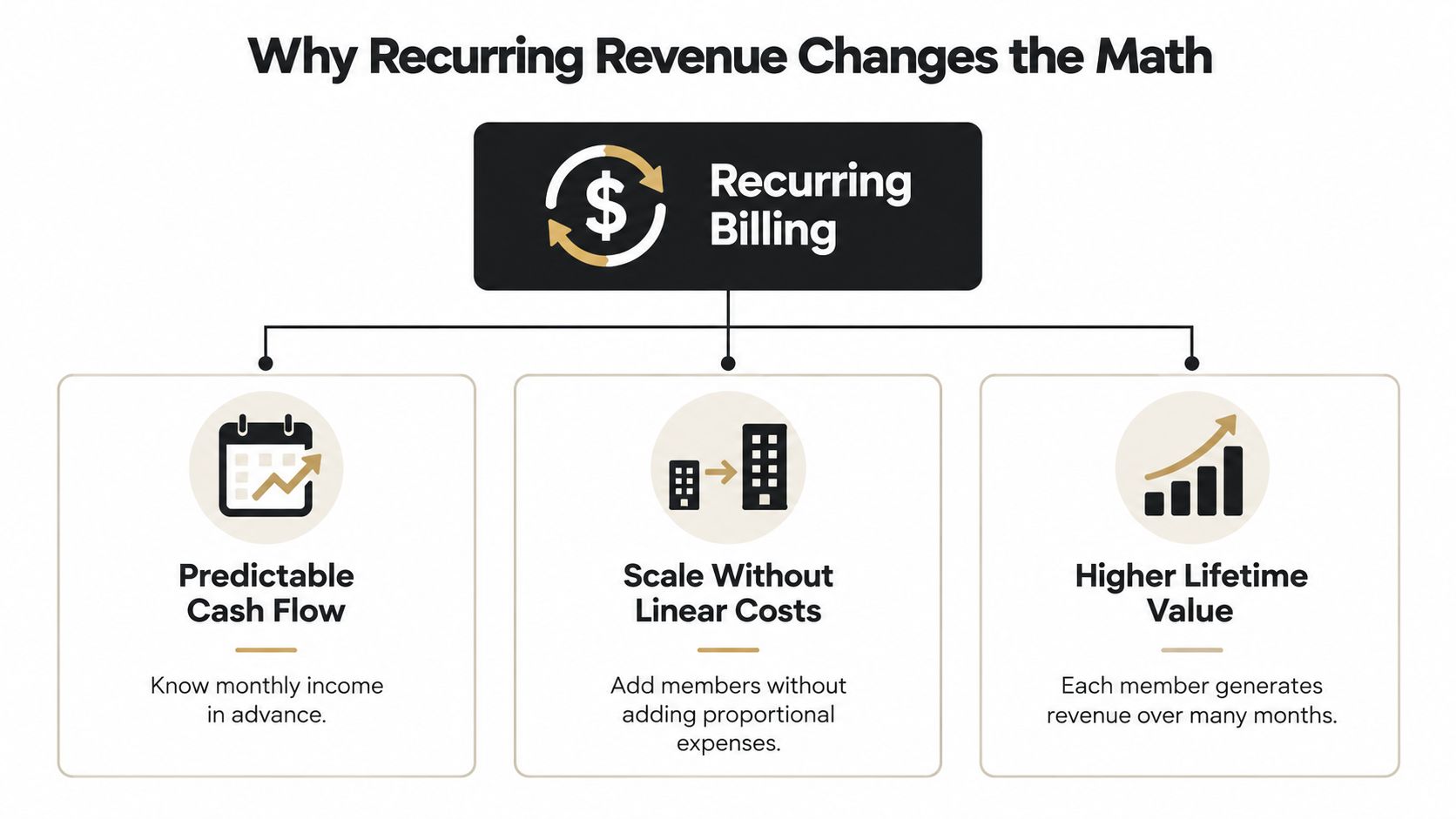
Why Recurring Revenue Changes the Math
A course earns money at purchase; a membership earns it again only when members choose to renew. That changes the economics, but it also raises the bar: renewal has to be earned repeatedly. A reliable membership business depends on ongoing usefulness, not just on billing people again.
Stanford’s Graduate School of Business examined 23 million customer accounts and 35 million subscriptions from 2018 to 2021. For the average subscription plan studied, observed revenue was 85% higher than it would have been if consumers actively reviewed and canceled unwanted subscriptions every month, according to the Stanford analysis of subscription revenue. This finding applies to the plans studied, not every membership. It highlights how recurring billing and subscriber inertia can affect revenue at scale, not a sound retention strategy for an educational business.
Members who return because the service helps them make progress are a stronger foundation than members who haven’t yet noticed a charge. Give them a reason to come back.
Make the ongoing value visible
A membership doesn’t need a constant flow of new material. It does need to connect clearly to the progress members want. Depending on the subject, useful reasons to stay might include:
- New lessons or updated templates that help members apply what they learn.
- Office hours or expert sessions that offer access to feedback.
- Progress tracking that shows completed milestones and next steps.
- An active peer community where members can ask questions and learn from others.
Measure the business as well as the learning experience. Monthly recurring revenue (MRR) and annual recurring revenue (ARR) track recurring income over different periods. Average revenue per member (ARPM) shows the average contribution per member. Activation and cancellation rates help put those figures in context, revealing whether revenue reflects lasting demand or a short-lived sales surge.
At renewal, ask what members received, used, or achieved that makes staying worthwhile. If that value is clear in the product, recurring billing can make income more predictable than relying on one-time course sales alone. That predictability also gives creators room to combine memberships with other relevant revenue streams, while keeping retention and the cost of serving members in view.
Pricing Structure Choices That Actually Convert
There isn’t a universal price or plan structure for a membership. A trial can reduce hesitation, but it can also bring in people who aren’t a fit. Annual billing can improve cash flow, but it asks a new member to make a larger commitment. The right choice depends on the offer, audience, and ability to help people succeed.
Start by deciding what you need a trial to prove. An analysis of more than 2,000 subscription businesses on the Recurly platform found that 66% offered a free trial, the median trial-to-paid conversion rate was 32.2%, business and professional services reached 39.5%, and the average trial lasted 15.6 days, as reported in this subscription trial conversion analysis. These are cross-category planning anchors, not a promise that an educational membership will perform the same way.
Match the plan to the buying decision
A free trial can work when a prospect needs to experience the teaching, community, or support before deciding. A low entry fee may be a better test when members need enough time and commitment to complete an initial lesson. In either case, show the recurring price and the transition to paid access clearly before checkout.
Then decide whether to offer monthly, quarterly, annual, or some combination. Subscription-app data reported in the RevenueCat retention benchmarks showed approximately 27%–28% one-year retention for annual plans, compared with 11.4% for monthly plans and 3.4% for weekly plans. Those figures come from subscription apps, not online learning memberships, so use them as directional evidence rather than a forecast.
| Billing frequency | One-year retention (approx.) | Cash flow timing | Best use case |
|---|---|---|---|
| Annual | 27%–28% | Revenue collected upfront for the billing period | Members who understand the value and are ready to commit |
| Quarterly | Not provided for this comparison | Collected at each quarterly renewal | A middle ground for members who want more time than a monthly plan |
| Monthly | 11.4% | Collected at each monthly renewal | New or uncertain buyers who want a lower commitment |
A quarterly figure isn’t available in these app benchmarks, so don’t fill in the gap with a guess. Test the plan with your own members and track retention by billing frequency. Compare trial conversion separately from 90-day retention. A trial that converts well but brings in members who quickly leave may look successful at checkout while doing little for sustainable revenue.
For the broader trade-offs between recurring billing options, LearnStream’s guide to subscription pricing models can help you think through plan design. If billing operations involve merchant disputes, review the relevant pricing for merchant chargebacks as part of your cost planning. Whatever you choose, make the paid value and renewal terms easy to understand.
Building the Trial to Retention Funnel
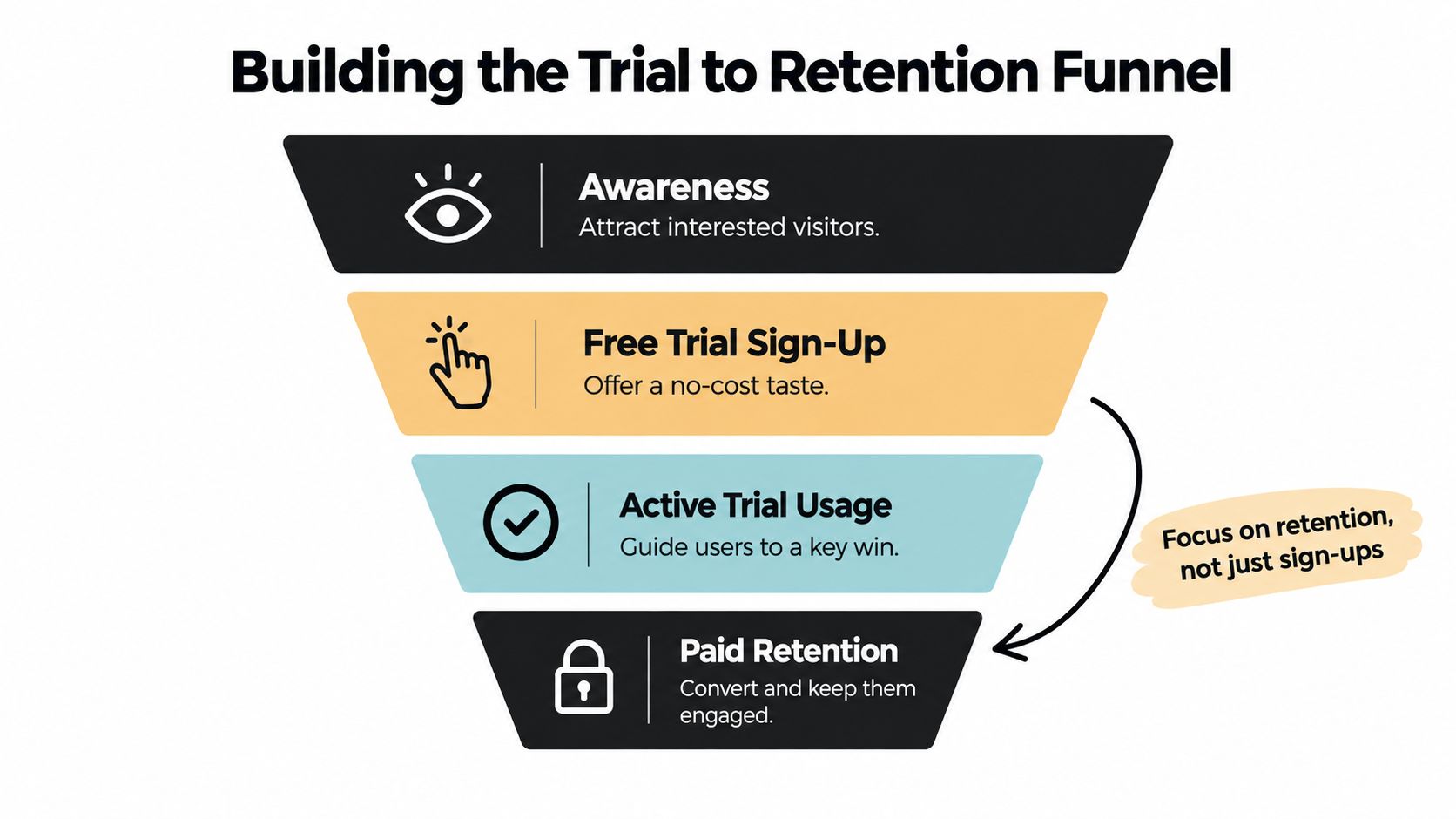
A trial can bring someone through the door, but the first useful result is what gives them a reason to stay. Design the experience around the member’s progress from sign-up to repeated use, and track meaningful actions rather than email opens or page views.
For a learning membership, activation could mean finishing a lesson, joining a live session, or asking a question in the community. Choose an action that signals genuine progress, then make it easy for new members to reach that point.
Make the first win easy to reach
A peer-reviewed study of a discounted subscription trial found that 46.8% of participants remained subscribed after six weeks and converted to full price. One month later, 36.5% of the original trial group remained, and 21.7% remained after 32 weeks, according to the study of discounted subscription trial retention. Those results are not a forecast for a course membership. The study also found a non-linear relationship: excessive premium-side habit strength could reduce retention. More activity, by itself, does not guarantee that members will stay.
Match prompts to what each person has done. If someone has not started a lesson, recommend one clear place to begin. After they finish the opening module, point them toward a related live session or discussion. The prompt should help them make progress, not increase message frequency.
Rather than relying on a standard sequence of emails, build the funnel around four moments: welcome new members with a useful first step; recommend one relevant activity if they have not started; suggest a logical next step after activation; and explain the paid offer and billing terms before the trial ends. Each message should respond to member behavior.
The right access model depends on the outcome prospects need to experience. LearnStream’s comparison of free trials versus low entry fees for memberships can help you weigh those options. A free trial may give people time to experience the offer, while a low entry fee changes the initial commitment. Choose the model your onboarding can support.
Track trial starts, paid conversions, activation, cancellations, and retention at consistent intervals. Review trial-to-paid conversion alongside week-four and week-twelve retention, ARPM, and cohort lifetime value. A strong conversion rate can hide a weak member experience if new subscribers leave soon after paying.
When a member cancels, record the reason where possible. Voluntary cancellation, an unused account, and a failed payment call for different responses. Separating them helps you decide whether to improve onboarding, address a product gap, or fix a billing issue.
Unit Economics That Decide If You Actually Profit
A membership with growing subscriber numbers can still lose money. Lower-priced plans reduce revenue per member, cancellations offset new sales, and add-ons can take more staff time to deliver than they earn. Track unit economics before increasing acquisition spend: the figures show whether income from current members can support the cost of serving them.
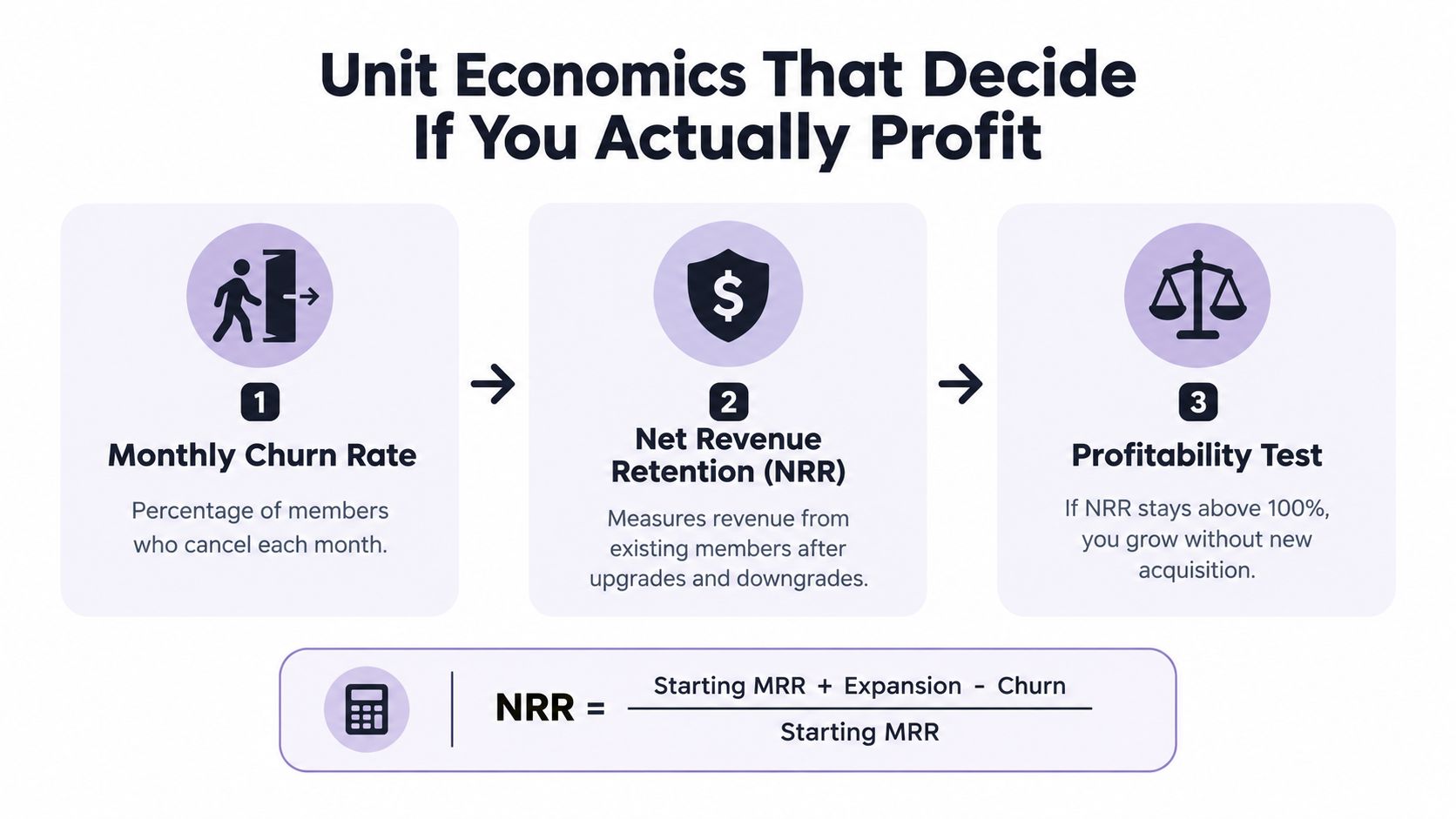
Start with monthly customer churn: divide the customers who leave during the month by the number of customers at the beginning of that month. Pair it with net revenue retention (NRR), which tracks how recurring revenue from existing members changes after upgrades, downgrades, and cancellations.
Financial test: NRR = (starting recurring revenue + expansion revenue − contraction revenue − churned revenue) ÷ starting recurring revenue.
Recurly’s subscription benchmarks classify NRR above 120% as excellent, 100%–120% as good, and below 100% as insufficient expansion to offset losses. Treat these as reference points, not a verdict on profitability. Your margins and delivery costs determine whether expansion revenue is enough to cover losses and keep the service sustainable.
Let member demand justify added complexity
Begin with one core tier. Consider an annual option, then add premium offers when member behavior shows demand. Workshops, coaching, certificates, and team access can bring in more revenue, but each requires time and support. An appealing offer can weaken your margins if few members use it or delivery takes too many staff hours.
A portfolio approach can spread income across related offers without making every feature part of the membership. Keep the recurring offer focused on the outcome members return for, and test additional revenue streams where there is clear interest. The trade-off is straightforward: more offers can raise revenue per member, but they also increase operational work and can distract from the core service.
Classify subscription changes by cause:
- Voluntary cancellation: Ask what stopped feeling useful, then improve the experience or suggest a relevant alternative.
- Failed payment: Try payment recovery instead of treating the account as a deliberate departure.
- Downgrade: Check whether the member still values the service but needs fewer benefits.
- Pause: Keep the relationship open when the member expects to return.
Each cause calls for a different response. A discount may help with affordability, but it cannot fix unclear onboarding or an offer that no longer feels relevant. Judge growth by whether upgrades and added value offset recurring losses at a cost you can afford to deliver.
Save Systems That Build Loyalty Instead of Killing It
A member who is too busy to participate may need a pause, not a discount. Lowering the price can preserve a payment for now, yet leave the reason for disengagement untouched. The better response depends on what has stopped working for that member.
A consumer survey on cancellation and subscription flexibility of 1,454 consumers in the United States and United Kingdom found that 82% were more likely to subscribe when cancellation was easy, 78% wanted pause-or-swap options, and 58% had paused rather than canceled when offered that choice. It also found that 90% noticed a price increase, while 58% considered it justified. The practical takeaway is to make value clear and test flexible options, rather than treating discounts as the default retention tool.

Ask what changed before offering a save
Use a brief cancellation question in plain language. Members may be leaving because the price is too high, they have not used the benefits, onboarding did not help them start, or the material no longer fits their needs. Those answers point to different fixes, and they can show whether the issue is price, time, relevance, or a missing feature.
For example, offer a pause to someone who expects to return but cannot participate now. A downgrade can suit a member who still sees value but no longer needs the full tier. If a format is the problem, offer a benefit swap. For former members, send a win-back message only when a relevant change gives them a concrete reason to reconsider.
Make the options easy to find, while leaving cancellation straightforward. A hidden exit might delay a departure, but it can damage trust and make a later return less likely. LearnStream’s guide to membership-site retention strategies explores ways to build reasons to stay into the member experience.
Measure what happens after each choice. Track how often members accept a pause or downgrade, whether paused members return, and whether saved accounts show lasting participation. These are signals to examine in your own membership, not guaranteed results. A save flow should ask a clear question, offer a relevant choice, and leave the decision with the member. It can protect trust while showing you what needs improvement.
Review the subscription settings from the member’s perspective:
Compliance, Payments, and the Small Tech Stack That Works
Operations can leak revenue even when the offer is sound. A payment failure needs a recovery workflow. A recurring offer needs clear billing terms and a straightforward cancellation path. The technology should support those basics without adding tools the team can’t maintain.
Stripe reports that nearly a quarter of subscription churn is involuntary and that its Smart Retries feature recovers 57% of recurring payments that originally failed, on average, according to Stripe’s recurring billing and Smart Retries information. Set up automated retries, a message asking the member to update payment details, and a reasonable grace period before suspending access. Track failed-payment churn separately from voluntary cancellations.
For U.S. customers, review the status and applicability of the FTC’s click-to-cancel requirements before launching or revising a recurring offer. The FTC’s announcement of its final click-to-cancel rule describes requirements that include clear disclosure of material terms, express informed consent before recurring charges, and a cancellation process as easy as enrollment that stops future charges.
Keep the stack focused. A community platform such as Circle.so or Heartbeat Chat can support discussion and member access. Stripe can handle recurring billing, while lightweight tools can host lessons, templates, or live sessions. Choose the simplest setup that gives members an easy path to learn and gives you a reliable view of payments and cancellations. If you publish music-related membership terms, terms for music creators offer an example of the kind of service-specific terms to review with appropriate legal advice.
Put the next month to work
Start by reviewing your offer, checkout disclosures, and cancellation path. Set up activation tracking and payment-recovery messages, then choose a small set of metrics: trial conversion, retention, churn, ARPM, and NRR. Use what members do and say to decide whether to revise onboarding, pricing, or benefits.
Start with one practical change this week: choose the first success a new member should reach, make it easy to find, and track whether members reach it before renewal. Then review your cancellations and payment failures separately. A membership makes money when the value is clear, the economics hold up, and members have a reason to stay.