Membership Business Models: Choose the Right One for You

Maya teaches yoga online and has a loyal audience. Every month, she creates a new 30-day challenge, turns it into a polished PDF, promotes it for a week, and watches sales arrive in a short burst. Then the revenue disappears, and she has to start selling again.
That pattern is familiar to educators, coaches, newsletter writers, and community builders. One-off products can work well, but they make every launch carry the full weight of the business. Membership business models change the rhythm by turning a single purchase into an ongoing relationship with recurring value.
The hard part is choosing the right structure. A membership can be a simple subscription, a free community with paid upgrades, a guided cohort, a course library, or a blend of several approaches. The best choice depends on the audience pain you solve, the pace at which you deliver value, and the depth of relationship members expect.
Why Membership Models Matter More Than Ever
Maya’s challenge PDFs solve a real problem, but they leave her with a difficult operating cycle. She must repeatedly find attention, persuade people to buy, deliver the product, and begin again. Her customers may love the challenge, yet the business still behaves like a sequence of isolated transactions.
A membership gives her another option. She could provide a monthly practice calendar, live sessions, a growing resource library, and accountability inside a recurring plan. Members would have a reason to return, while Maya could plan around an active base instead of relying entirely on the next launch.
The opportunity is larger than any single creator niche. One recent industry summary estimates the subscription economy at about USD 492 billion in 2024 and USD 557 billion in 2025, with projections above USD 1.5 trillion by 2033 and near USD 2 trillion by 2035. The same summary places annual growth at roughly 13% to 16% and says business-to-business activity represents more than 55% of the category’s value. The subscription economy statistics summary describes a model now used across software, media, services, and loyalty programs.
That growth doesn’t mean every business needs a monthly paywall. Audiences already manage many recurring commitments, and abundant AI-generated content makes raw volume less persuasive. Creators also have less control when discovery depends on social feeds or platform algorithms. A direct member relationship can give an educator more control over communication, renewal moments, and the way value is packaged.
I think of membership architecture as a portfolio decision. You’re choosing how people enter, what they pay for, how they move to a deeper offer, and what keeps them active. Start with two questions:
- Which audience pain are you solving? Is the problem lack of access, lack of structure, lack of accountability, or lack of belonging?
- Which revenue mechanics fit your delivery? Can you publish frequently, facilitate conversation, run live transformations, or deliver discrete expertise?
Those answers will guide the model far better than copying a pricing page that happens to look successful.
The Six Core Membership Model Types Explained
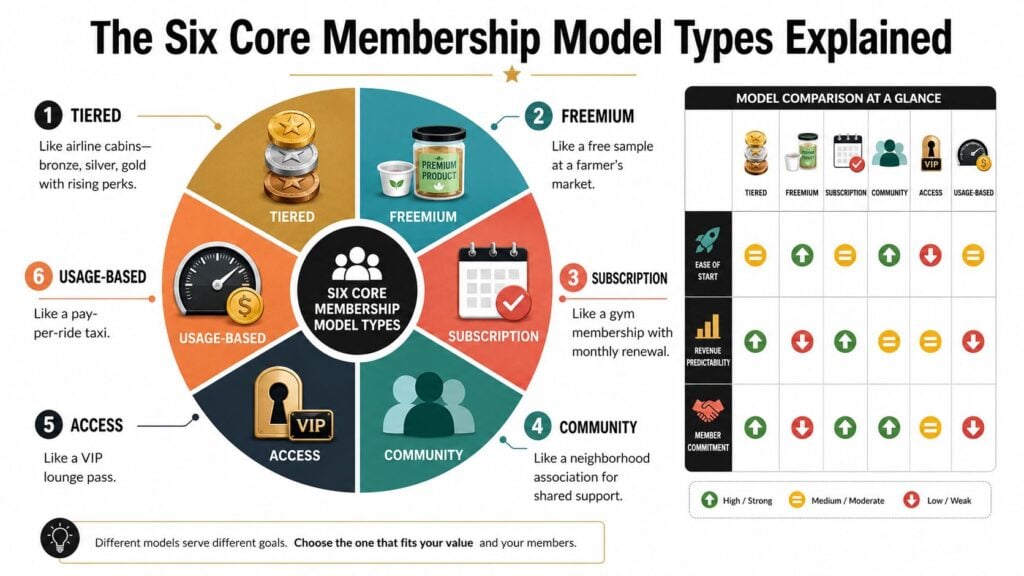
You’ll make better decisions once the basic vocabulary feels familiar. These six models describe the main ways members receive value and the business collects revenue.
Tiered membership
Tiered membership works like airline cabins. Bronze, silver, and gold plans offer progressively stronger benefits, access, or support. A newsletter might offer a basic archive for $19 per month, a middle tier with live sessions, and a premium tier with direct feedback.
This model solves a depth problem. Casual members want affordable access, while committed members want faster help or more personal attention. The risk is creating tiers that differ only by cosmetic features.
Freemium
Freemium resembles a bakery sample. People taste something useful for free, then pay for the full loaf. A creator might publish public essays, templates, or introductory lessons and reserve structured programs, archives, or support for paying members.
Freemium solves an uncertainty problem. Prospects can experience your teaching before committing. You’ll need a clear boundary, because free users still consume support, infrastructure, and your attention.
Subscription
A subscription is the gym membership of digital education. Members pay a recurring fee for continuing access to a defined service, such as a lesson library, monthly workshop, or ongoing practice plan.
This solves a continuity problem. Members don’t need to wait for a new launch to receive value, and you can build habits around a predictable publishing cadence.
Cohort-based membership
A cohort is a graduating class. Everyone begins together, attends the same sequence of sessions, and works toward a defined outcome. A six-week cohort priced at $499 is easier to position around transformation than an open-ended library.
Cohorts solve an implementation problem. Members often know what to do but struggle to follow through alone. Shared deadlines and live facilitation create momentum.
Community-first membership
A community-first model is a clubhouse. The conversations, relationships, peer support, and identity do much of the product’s work. The content may be useful, but members primarily stay because the group helps them make decisions, solve problems, or feel connected.
This solves a belonging and support problem. A forum alone won’t create that result. Members need prompts, rituals, moderation, and visible participation from the host.
Pay-per-course
Pay-per-course is an à la carte menu. A learner buys the dish they want, such as a course on email strategy or a workshop on curriculum design. The purchase is usually one-time, though the buyer can later enter a membership or advanced program.
This solves a specific expertise problem. It suits audiences that want targeted answers rather than an ongoing relationship.
If you’re comparing software for access controls, recurring billing, content delivery, or community features, this guide to the best tools for membership platforms can help you evaluate the practical infrastructure behind each model.
How Each Model Actually Makes Money
The model name matters less than the financial behavior underneath it. A tiered membership earns more when members move upward. Freemium earns when free users convert at a healthy rate without creating an expensive support burden. A subscription earns through renewals, while a cohort earns through filled launches and strong follow-on offers.
Here’s the operating view I use:
| Model | Primary Revenue Lever | Key Metric | Hidden Cost |
|---|---|---|---|
| Tiered | Upgrades into higher-value plans | Movement between tiers | Extra service and delivery time |
| Freemium | Conversion from free to paid | Free-to-paid conversion | Support and infrastructure for non-paying users |
| Subscription | Renewals over time | Churn relative to recurring fee | Ongoing content production |
| Cohort-based | Filled launches and premium pricing | Seats filled and completion | Live teaching and launch workload |
| Community-first | Renewals, events, and premium access | Active participation | Facilitation and moderation hours |
| Pay-per-course | Transaction revenue and follow-on sales | Repeat purchase rate | Launch, support, and refund exposure |
Retention is where recurring revenue becomes more efficient. One independent summary reports that acquiring a new customer costs 5 to 25 times more than retaining an existing one, and that 65% of company revenue comes from repeat business. It also notes that Amazon Prime’s subscription revenue exceeded USD 20 billion annually. These recurring-revenue statistics help explain why onboarding, renewal reminders, and member lifetime value deserve more attention than a constant stream of acquisition campaigns.
Churn deserves a concrete calculation. Independent 2026 benchmarks report monthly churn around 5.8% and median average revenue per user near $42, implying approximately $29,232 in annual revenue at risk per 1,000 members if replacements don’t offset cancellations. The same benchmark places top-quartile communities near 2.0% monthly churn. The membership-community churn benchmarks show why onboarding, regular engagement, and repeatable member habits can control cash flow.
For planning, I’d track contribution after payment fees, production time, community management, refunds, and failed payments. A high-priced cohort can look attractive until live delivery consumes every available hour. A low-priced subscription can appear scalable until the content schedule and support load exceed what members pay.
Use a clear process to measure customer lifetime value, then compare that value with acquisition cost and delivery cost. Referral programs can also reduce dependence on paid acquisition, especially when members naturally know others with the same problem. A practical starting point is to review membership referral programs before building a complex incentive system.
Free Trials vs Low Entry Fees and the Retention Trade-Off
Free trials and low introductory prices attract different kinds of commitment. A free trial removes financial risk, which can increase signups, but it can also bring in people who are curious rather than ready to build a habit. A low entry fee asks for a small commitment immediately, which may filter the audience more effectively while reducing early revenue per member.
The strongest evidence cautions against treating free access as harmless. A peer-reviewed study in the Journal of Marketing Research found that customers acquired through free trials had higher churn and lower customer lifetime value than regular customers, with the negative retention effect continuing after the trial ended. The free-trial retention study makes the downstream cost visible.
Another Management Science study tested different trial lengths and found that the shortest tested period, 7 days, produced the best average results across acquisition, retention, and profitability. The optimal free-trial research supports a precise trial window rather than an indefinite preview.
| Metric | Free Trial | Low Entry Fee |
|---|---|---|
| Initial friction | Very low | Low, but present |
| Likely signup volume | Higher potential volume | More selective volume |
| Main retention risk | Low-intent users | Price-sensitive users |
| Immediate revenue | Delayed until conversion | Collected at entry |
| Best support requirement | Strong activation before billing | Clear value and renewal path |
Offer framing matters too. Research in the Journal of Retailing and Consumer Services found that customers were more likely to stay when a promotion centered on a free monthly fee rather than a free joining fee. The membership promotion study is useful because it shows that equivalent-looking discounts can create different retention intentions.
Use a free trial when your product demonstrates value quickly and your onboarding is tightly designed. Use a low entry fee when members need to show commitment before the benefit becomes clear. The psychology of retention in monthly memberships is especially relevant when your offer depends on repeated use.
Practical rule: Choose the entry strategy your onboarding can support. A trial needs fast activation. A low fee needs an immediate reason to renew.
Three Membership Archetypes and the Models They Blend
The strongest membership businesses usually have one primary engine and several supporting layers. Each layer serves a different audience pain, so the offers complement one another instead of competing for the same buyer.
The creator-course business
A creator-course business often starts with a flagship pay-per-course offer. The course solves a defined expertise problem for learners who want a clear result. A freemium newsletter, podcast, or public lesson can demonstrate the teaching style and attract people who aren’t ready to buy.
The next layer is tiered access. A basic plan might include the course library, while a higher plan adds office hours or feedback. A premium cohort then serves learners who need deadlines, live instruction, and accountability. Substack creators commonly use public writing, paid subscriptions, and additional community experiences in this kind of progression.
The audience pain changes at each stage. Free content reduces uncertainty. The course provides a method. The cohort helps with implementation. Since each offer answers a different question, the premium tier doesn’t need to replace the course.
The B2B community
A B2B community often begins with a freemium network effect. Practitioners join to exchange ideas, find peers, or follow discussions. Once they need deeper access, their employer may pay for tiered seats, private rooms, events, or specialist support.
Usage-based add-ons can fit when value scales with activity. A team might pay for baseline access, then add a private workshop, research package, or extra service tied to a concrete use case. The key is keeping the paid upgrade distinct from the public conversation.
Trade Coffee offers a useful reminder that membership structures can also support ongoing consumer relationships. Its recurring delivery logic addresses convenience and continuity, while a professional community would address peer support and decision-making. The mechanism differs, but the lesson is similar. Members stay when the recurring format removes a repeated problem.
The paid newsletter
A paid newsletter uses subscription delivery as its main model. Readers pay for analysis, reporting, or a reliable editorial point of view. A community-first layer can sit above the core subscription for readers who want discussion, events, or direct interaction.
Patreon tiers demonstrate how creators can separate access levels without giving every subscriber the same experience. The lower tier can support the publication, while higher tiers provide additional participation or recognition. Avoid placing the entire archive and community in every plan if the higher tier is meant to represent a deeper relationship.
A Decision Framework for Picking Your Model
Start with constraints, not features. Ask yourself how large the reachable audience is, how often you can create useful material, how price-sensitive the buyer is, and whether members expect information, implementation, or belonging.
Then score your situation using this simple matrix:
| Audience and delivery pattern | Natural starting model | Reason |
|---|---|---|
| Broad audience, frequent useful updates | Freemium or subscription | Low-friction discovery and repeat delivery |
| Smaller audience, high-touch transformation | Cohort-based | Shared deadlines support implementation |
| Niche audience, strong peer identity | Community-first | Relationships carry much of the value |
| Specific problem, discrete expertise | Pay-per-course | Buyers can purchase the answer they need |
| Mixed willingness to pay | Tiered | Members self-select by depth and support |
| Variable usage or add-on demand | Hybrid blend | Core access stays clear while extras scale |
The next question is whether the model fits your capacity. High-cadence content can support subscriptions, but only if you can sustain a useful rhythm. Low-cadence, high-depth work may suit cohorts or courses better. A community-first offer requires active facilitation, not just a discussion board.
Research on two-tier pricing found that the entry thresholds for the two-tier mechanism meet at a critical point that influences whether consumers buy the membership. The two-tier membership pricing research is a useful reminder that pricing architecture can create a threshold effect. Keep the difference between tiers easy to understand.
Test the smallest version before committing to elaborate infrastructure. Sell a short paid workshop, invite a small founding group, or manually deliver the first version with a basic checkout and private space. After you collect retention data for six months, you’ll have a better basis for adding a second portfolio layer.
Common Misconceptions That Sabotage Membership Growth
One model fits everyone. It doesn’t. A niche audience that values identity and peer support may prefer a community-first membership, while a broad audience may need free educational content before considering a paid plan. A cohort can be excellent for a defined transformation and awkward for people who want flexible timing.
Lower prices always attract more members. Lower friction can increase interest, but it can also attract members who don’t use the product. The benchmark range for access and membership programs is often described as roughly 3% to 7% or 5% to 8% monthly churn in independent coverage. The membership subscription trend analysis connects retention with early value, personalization, and immediate proof of usefulness.
More content means more value. A large archive can overwhelm a new member. A clear first action, a sensible path, and a reason to return are essential. Add content when it strengthens the member outcome, not because the library looks small.
A forum automatically creates community. It doesn’t. Someone must welcome newcomers, ask useful questions, connect members with shared interests, and maintain a rhythm of interaction. Community is a service that needs staffing and design.
Freemium is free money. Free members can expand reach, but they also use hosting, moderation, email delivery, and support resources. Set a deliberate boundary between the free experience and the paid transformation.
Treat each assumption as a testable choice. If members don’t renew, inspect activation and recurring value before adding more features.
Your Next Steps and a Quick Planning Checklist
You can turn the framework into a first version this week. Write down the single outcome your member should achieve, then select one primary model that matches the audience’s preferred way of getting there.
Use this checklist:
- Define the outcome: Name the transformation in one clear sentence.
- Select the primary model: Choose tiered, freemium, subscription, cohort-based, community-first, or pay-per-course.
- Validate with paid members: Recruit a small beta group and charge a realistic price. Payment gives you a clearer demand signal than compliments.
- Set the renewal trigger: Decide what members should receive, complete, or experience before the next billing moment.
- Track the baseline: Monitor conversion rate, monthly churn, and net revenue per member.
Keep the first launch small. You can test the offer with a simple checkout, a focused content plan, and direct onboarding before investing in a large platform. If you need a broader guide to the build process, learn how to build a membership site after you’ve clarified the offer and renewal behavior.
Give yourself a 30-day shipping window. Launch the smallest credible version, collect member feedback, and adjust the cadence, pricing, or access boundary. Revisit the architecture quarterly, because your audience may mature from free content to a course, from a course to a cohort, or from a subscription to a deeper community tier.
Choose one audience, one painful outcome, and one primary membership model today. Draft the offer, invite a small paid founding group, and schedule your first renewal review before you build anything elaborate.

![How to Launch a Membership Site Using Squarespace [Step By Step Guide]](https://learnstream.io/wp-content/uploads/2024/11/image-768x433.png)