
Subscription Model Best Practices for Digital Courses

You launch a polished six-module membership to 400 email subscribers. Sixty people join. The first week feels like proof that the offer works, then the discussion board gets quieter, lessons remain unfinished, and a large share of members disappears before the first renewal.
That pattern is common among course creators who optimize the launch before they design the subscription experience. The sales page, webinar, and launch emails get attention, while the less glamorous decisions, activation, billing cadence, payment recovery, and cancellation flow, determine whether the business survives.
The strongest subscription model best practices start with two questions. What happens during a learner’s first 90 days, and how often should that learner be billed? Everything else, including acquisition, partnerships, and pricing-page polish, depends on those foundations.
Why Most Course Memberships Stall in the First 90 Days
A course can look healthy after launch. Signups arrive, welcome posts receive replies, and the community feels active. Then members face a crowded library, an unclear next step, and another charge before they have built a useful habit. The launch created attention, but the first 90 days determine whether that attention becomes ongoing participation.
A 2026 subscription benchmark found that the first three months can influence whether a subscriber becomes worth 6 to 10 times more over time, while 44% of cancellations happen within the first 90 days. The figures come from Churn.io’s 2026 subscription retention report. For a course creator, the practical takeaway is straightforward: early usage and confidence shape the renewal decision.
Four predictable failure patterns
- The onboarding gap: A member receives login details but no clear first action. They browse, save lessons, and leave without reaching an activation moment.
- Content overload: Six modules, a resource vault, weekly calls, and a community feed create choice fatigue. A large library may strengthen the sales page while delaying the first meaningful result.
- Expectation mismatch: The sales message promises a transformation, while the member experiences a collection of videos. If the route from lesson to outcome is unclear, enthusiasm fades.
- Second-charge friction: A learner sees the next payment before understanding what they completed or what comes next. Even a satisfied customer may cancel when renewal feels unrelated to progress.
Creators remember the launch event. Members remember whether the course helped them do something useful last week.
Practical rule: Design the first billing cycle as a guided learning experience, not a waiting period before renewal.
Start with a narrow path, show progress quickly, and make the next reason to return visible before the first session ends. Billing cadence belongs in that design. Monthly billing creates frequent decision points, which can expose weak engagement sooner. Annual billing gives members more time to build momentum, but requires greater trust and commitment upfront.
The trade-off is economic as well as educational. A short cycle may feel flexible and lower the barrier to joining, yet it gives disengaged members an earlier exit and leaves less time for the course to produce a result. A longer cycle can support habit formation, provided the onboarding experience earns the initial commitment.
Fixing the first 90 days and the billing cadence usually matters more than another launch partnership. Once those decisions support real progress, later advertising has a stronger base to work with. Otherwise, acquisition keeps sending new learners into the same stalled experience.
Retention First Beats Acquisition First Every Time
A membership can add hundreds of new learners and still shrink. If cancellations outpace signups, the launch is buying replacements rather than building a customer base. Retention-first planning makes that pattern visible: track active members at the start of each period, new paid members, voluntary cancellations, and payment failures separately.
The first 90 days deserve their own review. Benchmark research has found that 44% of cancellations occur within the first 90 days. Broader comparisons show median one-year retention of 28% for annual subscriptions, versus 11.4% for monthly plans and 3.4% for weekly plans, according to the subscription retention benchmark. These figures are directional, not a forecast for a particular course. They do show why early learner progress and billing cadence should be managed as separate decisions.
The 85% versus 90% retention example works best as a planning exercise, not as a verified course benchmark. Keep acquisition constant, then compare how many members remain after each billing cycle under both assumptions.
Retention versus acquisition impact on course membership LTV
| Metric | Baseline, 85% retention, 200 new members per month | Retention lift, 90% retention | Acquisition lift, 400 new members per month |
|---|---|---|---|
| New members per month | 200 | 200 | 400 |
| Retention assumption | 85% | 90% | 85% |
| Core question | How many members leave each cycle? | How much longer does each cohort remain? | Can support and onboarding handle the extra volume? |
| LTV implication | Shorter survival curve | Longer survival curve | More revenue only if churn remains controlled |
A retention improvement raises the value of every later acquisition cohort. Doubling acquisition increases support requests, onboarding work, and the number of learners exposed to the same weak experience. Model both options with your own pricing, costs, and payment behavior before choosing where to spend.
Short billing cycles can look attractive because they reduce the initial commitment. They also create earlier cancellation points, leaving less time for a learner to reach a meaningful result. Longer cycles can support habit formation and give the course room to prove its value, but only when the initial commitment matches the trust earned during onboarding.
Separate the reasons members leave
Voluntary churn means a learner cancels because the membership no longer feels worthwhile. Involuntary churn follows a failed payment, expired card, or bank decline. Recurly’s 2026 report covered 2,200 subscription businesses and 76 million unique subscribers, and found that 52% of consumers canceled at least one subscription in the past year. The report also listed 2.5% voluntary churn and 0.9% involuntary churn across merchants in 2024. See Recurly’s State of Subscriptions report.
Use different fixes for each category. Improve course relevance, activation, and visible progress for voluntary churn. Set up payment retries, account updates, and clear payment messages for involuntary churn.
Acquisition spend only becomes trustworthy after retention is honest.
Review learner behavior alongside billing results. A person who rushes through the first module may cancel quickly, while another may stay for weeks before reaching the lesson that demonstrates the offer’s value. Track first-session completion, return visits, milestone completion, and renewal behavior together. A large content library does not prove that members are making progress.
Free Trial or Low Entry Fee for Your Course
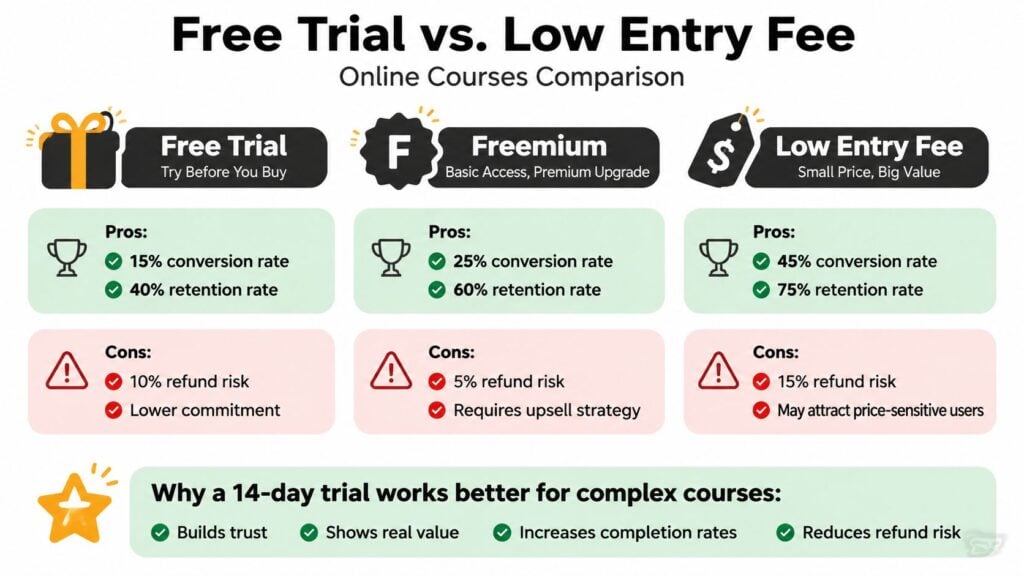
A free trial can lower the emotional cost of joining, but it also lowers the cost of ignoring the course. That distinction matters for self-paced libraries, where a visitor can register, browse the catalog, and never begin a lesson.
The available benchmark shows a wide spread by trial design. Global trial-to-paid conversion was 25.6% overall. Card-gated opt-out trials converted at 48.8%, compared with 18.2% for no-card opt-in trials and 2.6% for freemium, according to Mirava’s free-trial conversion benchmarks. The figures describe benchmark patterns, not guaranteed results for a course business.
Match the offer to the learning format
A 14-day trial can suit a cohort-style course because the schedule supplies urgency. Learners know when calls happen, what the group is working on, and which milestone should come next. A self-paced library needs more deliberate guidance. Without it, the trial becomes a preview catalog rather than a learning experience.
Freemium works when the free layer creates a useful habit and the paid layer deepens the outcome. It fails when the free plan contains enough value for casual learners to stay indefinitely, while the paid upgrade feels like an arbitrary wall.
A low entry fee, such as $1 to $9, can filter for intent and make a later monthly price easier to accept. The trade-off is refund exposure and a higher obligation to communicate exactly what happens after the introductory purchase. Don’t use a small payment as a disguised surprise renewal.
| Model | Strength | Main risk | Better fit |
|---|---|---|---|
| Free trial | Broadens access and captures more interested prospects | Low-intent users may never start | Guided cohorts with visible deadlines |
| Freemium | Lets learners build familiarity before upgrading | Can train users to remain on free access | Products with a strong recurring habit |
| Low entry fee | Filters for purchase intent | Refunds and promotion-seeking behavior can rise | Clear starter outcomes and defined upgrade paths |
For a deeper pricing comparison, see LearnStream’s guide to subscription pricing models.
Use a free trial when your content cadence, community activity, and support capacity can create momentum quickly. Use a low entry fee when you need a stronger intent filter and can explain the renewal clearly. Use freemium only when the free experience naturally leads to a recurring paid need.
Trial-heavy businesses should also watch promotion behavior. If every new cohort begins with a free access period, the audience may delay joining until the next offer. Your decision should reflect refund tolerance, not just signup conversion.
Annual Versus Monthly Billing and Why Cadence Matters
Billing cadence changes when learners judge value. Monthly billing creates frequent renewal decisions. Annual billing gives members more time to use the product, but asks for greater trust before purchase.
The retention difference can be substantial. One benchmark reported 28% median one-year retention for annual subscriptions, compared with 11.4% for monthly and 3.4% for weekly plans. The SubReviver subscription research summary reports similar annual retention of 27% to 28%, alongside 11.4% monthly and 3.4% weekly retention. It also reports that annual plans reduced churn by 51% compared with monthly plans.
These results make annual billing a retention decision, not only a cash-flow choice. The trade-off is conversion friction. A new creator with limited proof may need monthly billing while learners assess the product. The first 90 days matter here: if members have not reached a clear outcome, an annual commitment can feel premature.
Choose cadence by commitment and use case
Monthly plans fit high-ticket cohorts, B2B training paid for by an employer, or communities still testing product-market fit. They also reduce the initial commitment, but create more cancellation points and expose the business to early drop-off.
Annual plans suit a structured learning pathway, a professional library used throughout the year, or a membership built around recurring events and visible progression. They can improve retention when the learner has a reason to return across several months. A short billing cycle can hurt long-term economics if frequent renewal decisions interrupt that habit.
Revenue data reinforces the trade-off. In the $250 to $500 ARPA range, annual plans retained 88% of revenue versus 76% on monthly plans. For accounts under $25 ARPA, annual plans retained 62%, compared with 41% monthly. These figures appear in Churn.io’s annual versus monthly revenue analysis.
| Metric | Annual billing | Monthly billing |
|---|---|---|
| Commitment | Higher upfront commitment | Lower initial commitment |
| Renewal decision | Less frequent | More frequent |
| Retention pattern | Typically stronger in benchmark data | More exposed to early cancellation |
| Cash flow | More revenue collected upfront | Revenue arrives progressively |
| Best use | Structured pathways and sustained learning | Testing fit, cohorts, and employer-funded training |
| Main risk | Purchase hesitation and renewal-payment failure | Shorter commitment and more cancellation points |
Offer both options when the audience has mixed needs. Anchor the annual plan around the complete learning journey, then keep monthly billing available for buyers who need flexibility. A trial-to-annual path should follow a meaningful milestone, not appear immediately after signup. The annual price should represent commitment to progress, while the monthly plan preserves access for learners who are still evaluating fit.
Onboarding That Turns Signups Into Active Learners
The first lesson should answer one question quickly: what can this learner do now that they couldn’t do before joining? If the answer takes several clicks, the member may never reach it.
Build onboarding as a sequence with one visible destination. The five steps below solve different failure modes, so don’t compress them into a generic welcome page.
A five-step activation sequence
- Send the welcome email within five minutes. Give the member one link, one first action, and one sentence explaining the expected result. Watch delivery, click-through, and first-session starts. A long list of resources creates delay.
- Ask for only useful profile information. A role, goal, or experience level can personalize recommendations. Avoid a form that feels like administration before learning begins.
- Guide the first session. Put the learner into a short, complete lesson rather than the entire catalog. The activation moment should arrive when the learner completes a meaningful action, not when they finish account setup.
- Show an early progress marker. A dashboard, checklist, or milestone gives the learner evidence that they’re moving. Track completion and return visits rather than page views alone.
- Invite the learner into a recurring habit. Office hours, cohort calls, feedback threads, or scheduled prompts give members a reason to return. Measure attendance and community participation alongside lesson use.

The day-14 re-engagement message is a useful checkpoint. Write to the learner who signed up but hasn’t started, and write differently to the learner who completed the first milestone. One needs a simpler entry point. The other needs a next challenge.
Keep the sequence connected to your actual course promise. LearnStream’s onboarding process guide can help frame the operational flow, but your activation event must come from the learner outcome you sell.
A short video can also demonstrate how a guided first session should feel.
Don’t add more onboarding messages until you know where learners stop. A smaller path with clear feedback usually beats a large automation sequence that sends information without changing behavior.
Failed Payments and Involuntary Churn as Core Infrastructure
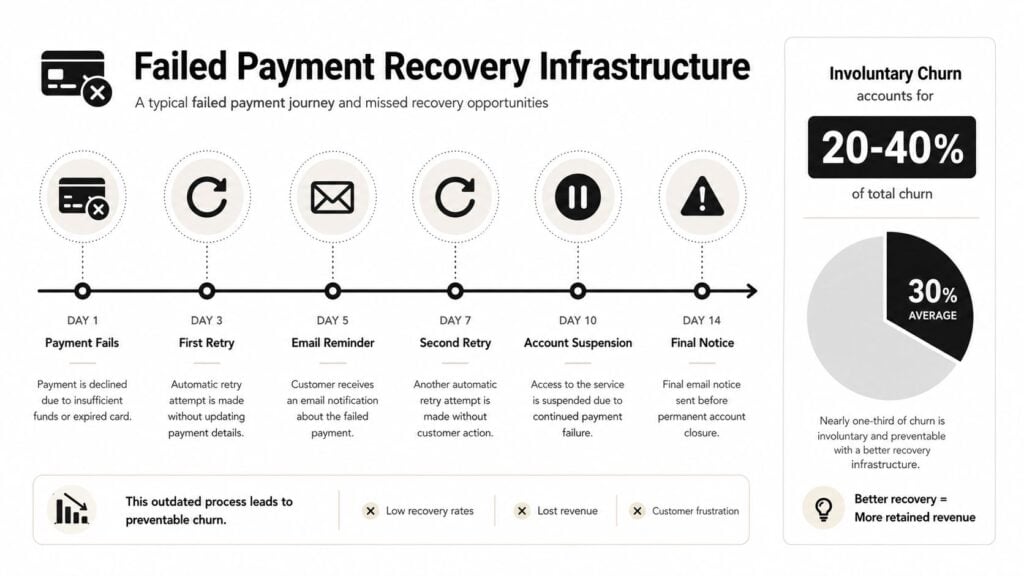
A member can value the course and still disappear because a payment fails. Treating that event as a support ticket leaves recoverable revenue unattended.
A 2026 billing benchmark summary states that payment failures account for up to 48% of all churn across subscription, e-commerce, and SaaS businesses. The same source reports a 47.6% median failed-payment recovery rate, with top performers reaching 70% to 85%. Those figures are summarized by Shno’s subscription retention statistics.
Recovery performance also varies by cadence. Recurly benchmark data reported by SubRevival says 53% of failed monthly subscription payments are successfully recovered, while annual renewal failures recover at about 23%. The broader median failed-payment recovery figure is 47.6%, according to Baremetrics’ payment recovery benchmarks. Monthly and annual dunning should therefore be monitored separately.
Build a recovery path before scaling
Your billing platform should support:
- Smart retries: Retry failed transactions according to payment context rather than repeating the same attempt immediately.
- Card updater support: Let customers update expired or replaced cards before access ends.
- A grace period: Keep learning access available while the member resolves the payment.
- Multi-channel reminders: Use clear email messages, and add SMS where consent and local rules allow it.
- Cadence-specific reporting: Compare recovery for monthly charges, annual renewals, and different payment methods.
A practical dunning sequence might begin with a neutral payment-failure notice, follow with a direct update request, and end with a clear suspension warning. The exact timing should reflect your processor and audience. The message should preserve trust, state what access is affected, and provide one obvious correction path.
When cancellation rises, pair billing data with churn root cause methods so you can distinguish a failed card from a dissatisfied learner. Then connect the billing platform to your course host, customer records, and email automation through a reliable subscription billing software setup.
Hybrid Revenue Models That Grow Without Killing Retention
A subscription doesn’t need to carry every part of the business. In fact, forcing every learning experience into one recurring plan can make the offer less flexible for learners and less profitable for the creator.
Recent industry data reports that companies using 4+ revenue models grew ARPA 2.3% faster than companies using 2 to 3 models, and 4.5% faster than companies using only one. Broader subscription-economy research also reported a 118% increase in PPBS over four years linked to better portfolio alignment. These figures come from Mastercard’s subscription economy research report.
The useful insight for course creators is operational. Keep the core learning journey stable, then charge separately for experiences that require additional labor, personalization, or formal recognition.
Three structures worth testing
- Core membership plus add-ons: Include lessons, community access, and standard events. Sell feedback, private coaching, or specialized implementation separately.
- Subscription plus one-time cohorts: Let members use the library year-round, then offer a focused live cohort as a distinct purchase.
- Multi-course pathways: Bundle related courses into a clearer progression, while preserving a lower-cost entry point for learners who need only one subject.
| Structure | Typical LTV lift | Retention risk | Best fit |
|---|---|---|---|
| Core membership plus add-ons | Qualitative potential for higher account value | Too many paywalls can weaken the core experience | Personalization and coaching |
| Subscription plus one-time cohorts | Creates event-driven revenue | Cohort promotion can distract from recurring use | Structured transformation |
| Multi-course pathway bundles | Makes progression easier to understand | Over-bundling can reduce choice and relevance | Complementary subjects |
Keep core learning journeys inside the subscription. Monetize personalization, certification, and intensive services outside it. Don’t add more than one new paid surface per quarter, or members may spend more time decoding the offer than using it.
Hybrid packaging protects LTV only when billing stays unified. A member should have one reliable account, one clear record of entitlements, and an understandable cancellation process. Flexible management and bundling can reduce friction, but fragmented checkout systems create support problems that eventually show up as churn.
Metrics, Legal Basics, and Your 30 Day Launch Checklist
A course subscription needs a small operating system before it needs more features. Track the numbers that explain acquisition, activation, payment health, and learner value, then connect those numbers to the decisions you can change.
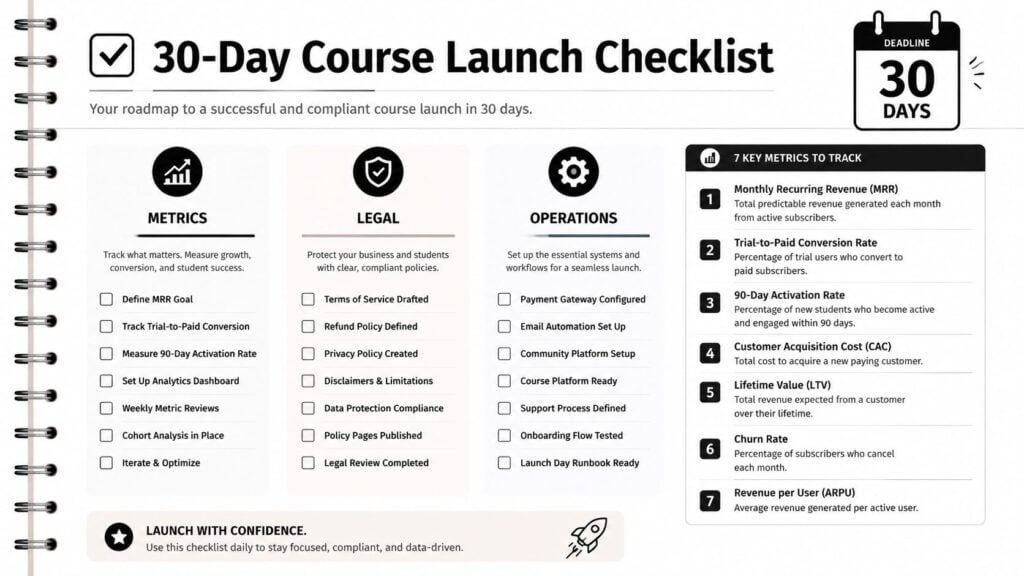
Start with seven metrics:
- MRR: Recurring revenue currently active.
- Trial-to-paid conversion: The share of trial users who become paying subscribers.
- 90-day activation rate: The share of new members who reach your defined activation event within the first 90 days.
- Voluntary churn: Cancellations initiated by the customer.
- Involuntary churn: Lost subscriptions caused by payment failure or related billing issues.
- NPS: A directional measure of how likely members are to recommend the experience.
- Revenue per learner: Revenue viewed against the number of learners served.
Put the operating pieces in place
Your legal review should cover refund disclosures where buyers can see them before payment, clear auto-renewal language, privacy and data handling obligations under GDPR and CCPA where applicable, and a cancellation flow that doesn’t hide the exit. Requirements vary by jurisdiction, so get qualified legal advice for your audience and business structure.
Your stack should include a billing platform with dunning, a course host with API access, an analytics layer, and a single source of truth for subscriber identity. LearnStream is one informational option for researching tools and workflows around digital learning memberships. The 2026 recurring revenue guide from Fundl also provides useful context for separating recurring revenue mechanics from one-time sales.
A practical month can look like this:
- Week one: Choose monthly, annual, or hybrid billing. Define the activation event and write the refund and renewal language.
- Week two: Build the welcome email, guided first lesson, progress marker, and day-14 re-engagement message.
- Week three: Test successful payments, failed payments, retries, card updates, grace periods, cancellation, and reactivation.
- Week four: Open a waitlist, collect objections, verify analytics, and invite a controlled first cohort.
Don’t launch until you can see what a new member does after signup and what happens when a payment fails. Those two paths will tell you more about the health of the subscription than launch-day applause.
Choose one billing cadence, define one activation moment, and build the first 90 days around both. Then test the full journey with a small group before sending a larger audience to your checkout. Fix the first lesson, renewal message, and failed-payment flow this week, and your next course launch will begin with an operating system instead of a hope.