
SCORM vs xAPI vs cmi5 Differences Explained
If you’ve ever built an online course, you know the moment. You’ve poured your expertise into the content, designed beautiful interactions, and now you have to export it. A dropdown menu appears with a few cryptic acronyms: SCORM, xAPI, cmi5. You’re just trying to get your course to work, but it feels like you’re being asked to choose a programming language.
Don’t worry, you’re not alone. Think of these standards as the “language” your course uses to talk to a Learning Management System (LMS). Choosing the right one is a big deal. It dictates everything from whether you can track if someone simply completed a module to whether you can see how they collaborated with a teammate inside a complex simulation.
A Quick Guide to eLearning Standards
Let’s cut through the technical jargon. SCORM is the reliable, old-school standard. It’s fantastic for tracking the basics like completion, scores, and pass/fail status. If you just need to prove someone took the compliance training, SCORM gets the job done perfectly.
Then there’s xAPI, the modern powerhouse. It was built to track almost any learning activity you can imagine, whether it happens inside an LMS, on a mobile app, or even offline.
Finally, cmi5 acts as the bridge. It gives you the deep, flexible tracking power of xAPI but wraps it in a structured package that traditional LMSs can easily understand and manage.
Understanding the differences between SCORM, xAPI, and cmi5 is a cornerstone of creating effective training, sitting alongside other best practices for online learning. The choice is strategic and also technical.
Key Differences at a Glance
So, how do you choose? It really boils down to one question: what kind of data do you need to prove your training is actually working?
If you need simple compliance tracking, SCORM is your dependable workhorse. If you need to track complex, real-world activities and learning that happens everywhere, xAPI offers total freedom. If you want to future-proof your courses with rich data while still working smoothly within an LMS, cmi5 gives you the best of both worlds.
This table provides a high-level summary of the core differences between the three major eLearning standards to help you quickly identify the best fit for your needs.
SCORM vs xAPI vs cmi5 Key Differences at a Glance
| Feature | SCORM | xAPI (Tin Can) | cmi5 |
|---|---|---|---|
| Primary Use | Simple course tracking (completion, scores) | Tracking any learning experience, anywhere | Structured course tracking with xAPI data |
| Data Detail | Basic (e.g., complete, pass/fail) | Granular (e.g., “watched video,” “answered question”) | Granular, but with defined rules for LMSs |
| Offline Tracking | Not supported | Fully supported | Fully supported |
| System Needs | SCORM-compliant LMS | Learning Record Store (LRS) | cmi5-compliant LMS and an LRS |
| Best For | Compliance training, simple online courses | Mobile learning, simulations, complex tracking | Modernizing LMS content, future-proofing courses |
Ultimately, your project’s goals will point you directly to the right standard. A simple checkbox for annual security training has very different needs than a multi-faceted leadership program that blends online modules, a VR simulation, and on-the-job coaching.
To understand where we are with eLearning standards, you really have to look at where we’ve been. For the better part of two decades, SCORM (Sharable Content Object Reference Model) was the standard. It solved a massive headache for everyone creating courses: how to build something once and have it work everywhere.
And for a long time, it did its job beautifully. You could package a course, upload it to almost any Learning Management System (LMS), and breathe a sigh of relief when the “Complete” button actually worked. But while SCORM was keeping the lights on, the way people learn was changing dramatically.
The Rise of Learning Everywhere
Suddenly, learning wasn’t confined to a desktop computer and a clunky LMS interface. We were learning on our phones during the morning commute, using tablets on a factory floor, and diving into complex simulations that looked more like video games than training modules.
SCORM, with its design firmly rooted in the browser-based world of the early 2000s, simply couldn’t keep up. It was like trying to use a flip phone in an iPhone world. This gap created the need for something entirely new, which led to the Experience API (xAPI) showing up around 2012. It was built from the ground up to track learning experiences, no matter where or how they happened. Think of it as a universal translator for learning data, capable of understanding everything from “Jason watched a video” to “Sarah collaborated on a project in Slack.”
The big idea behind xAPI was to break free from the LMS. It gave us the power to see the entire learning journey, capturing valuable data from a huge range of activities that were previously invisible.
But all that freedom turned out to be a double-edged sword. xAPI was so flexible that it was almost too flexible. With no strict rules on how to package or launch content, it created a bit of a Wild West scenario, leaving many LMS administrators scratching their heads.
Finding a Middle Ground with cmi5
This is where cmi5 comes into the picture. As a more recent development, cmi5 was designed to be the “just right” solution. It takes the powerful, granular tracking of xAPI and pairs it with a clear, SCORM-like set of rules for packaging content and telling the LMS how to launch it.
You can think of cmi5 as an xAPI “profile”, which is a specific instruction manual that tells an LMS exactly how to manage xAPI-based courses. This makes it far easier for legacy systems to adopt modern tracking while giving course creators the rich data they want. It’s the detailed reporting of xAPI without the implementation chaos.
The industry has been slowly catching on. A 2020 analysis of over 624,000 course imports revealed that while SCORM 1.2 still accounted for 56.3% of them, the tide is turning. xAPI imports were doubling every year, hitting 36,000 packages, and the newer cmi5 had already surpassed 5,000 imports. You can explore more data on eLearning standards adoption to get the full story. This is a move away from simple completion tracking toward a much richer understanding of the entire learning process.
A Detailed Comparison Of Technical Capabilities

Alright, let’s pop the hood and get into the real technical differences. When I’m trying to decide between SCORM, xAPI, and cmi5, it really boils down to a few critical questions: What kind of data can you actually track? Where can your people learn? And how does the learning content get launched in the first place?
The Granularity of Your Data
First up, let’s talk about data tracking. For most course creators, this is the most important difference and the one that will have the biggest impact on your work.
SCORM is straightforward and, honestly, a bit rigid. It was built to answer a handful of very specific questions:
- Did the learner complete the course? (complete/incomplete)
- Did they pass or fail? (pass/fail)
- What was their score?
And that’s about it. For basic compliance training or simple knowledge checks, this is often all you need. It gives you a clean, no-fuss confirmation that a required task was done.
Then you have xAPI, which basically throws the old rulebook out the window. It doesn’t come with a predefined list of things it can track. Instead, it uses an incredibly flexible format called “Actor-Verb-Object” statements.
This simple structure lets you record almost any interaction imaginable. For example:
- “Maria (actor) watched (verb) the ‘Advanced Sales Techniques’ video (object).”
- “David (actor) answered (verb) Question #7 incorrectly (object).”
- “Team Alpha (actor) collaborated with Team Bravo (verb) on the crisis simulation (object).”
Suddenly, you’re not just seeing a final score. You’re seeing the entire learning journey, every click, every attempt, and even activities happening completely outside of a traditional course.
cmi5 is the thoughtful middle ground here. It takes xAPI’s powerful “Actor-Verb-Object” statements but wraps them in a specific set of rules that an LMS can easily understand, like “passed,” “completed,” “failed,” and “score.” It gives you the rich, granular data of xAPI in a structured way that fits neatly into traditional reporting.
Learning Anywhere, Anytime—Even Offline
Next, where can learning actually happen? With SCORM, your learners are tethered. They need an active internet connection, and they have to be logged into the LMS through a web browser. If their Wi-Fi drops, the tracking stops.
In a world where people learn on the go, this is a massive limitation. This is where both xAPI and cmi5 truly shine.
Both of these newer standards were built for our mobile-first reality. They fully support offline learning. A learner can go through an entire module on a tablet during a flight, and the device will simply store all their activity statements locally. The moment it gets back online, it syncs all that data back to the Learning Record Store (LRS). You don’t lose a single data point.
This unlocks a ton of possibilities:
- Field technicians using a mobile app to complete safety checks on-site.
- Medical students practicing procedures in a simulator that isn’t always connected to the hospital network.
- Sales reps reviewing product guides on their phones minutes before walking into a client meeting.
If you’re digging into the nuances here, you might also get a lot of value from our deeper dive into SCORM vs xAPI and which one you should use for specific kinds of projects.
How Content Is Packaged and Launched
Finally, let’s look at the structure. How is the content actually packaged and launched by the LMS? SCORM uses a very rigid system. Everything has to be bundled into a single ZIP file containing a special manifest file (imsmanifest.xml) that acts as a blueprint for the LMS.
xAPI, true to its flexible nature, has no packaging model at all. The content can live anywhere, like a website, a mobile app, or a virtual reality headset. This offers incredible freedom, but it also created massive adoption headaches because there was no standard way for an LMS to import and launch it.
This is the exact problem cmi5 was designed to solve. It introduces a course structure that feels similar to SCORM but is far more flexible. It defines how to package the content and allows parts of it to be located outside the main package, making it perfect for blended learning experiences. This structure gives LMSs a clear “how-to” guide for launching and tracking modern learning content that SCORM just can’t handle.
To make these differences even clearer, let’s break them down side-by-side.
Technical and Practical Feature Comparison
This table gives you a quick, at-a-glance view of how the three standards stack up on the most important technical and practical features.
| Capability | SCORM | xAPI | cmi5 |
|---|---|---|---|
| Tracking Granularity | Limited to pass/fail, completion, score, and time. | Captures virtually any interaction using “Actor-Verb-Object” statements. Extremely detailed. | Uses xAPI statements but adds specific rules for session management, pass/fail, and completion. |
| Offline Support | No. Requires a constant internet connection to the LMS. | Yes. Statements can be stored locally on a device and synced later to an LRS. | Yes. Designed for mobile and offline use, with defined rules for syncing data. |
| Device Compatibility | Primarily browser-based on desktops and laptops. Mobile support can be unreliable. | Device-agnostic. Works on mobile apps, simulators, VR/AR, wearables, and web browsers. | Device-agnostic, with a strong focus on mobile. The launch mechanism is designed to work anywhere. |
| Content Location | Must be hosted on and launched from the LMS. | Content can live anywhere (web, mobile app, etc.) and send data to an LRS. | Content can be distributed but is launched from the LMS via a structured course package. |
| Data Storage | All data resides within the LMS database. | Data is sent to and stored in a Learning Record Store (LRS), which can be inside or outside an LMS. | Data is sent to an LRS, which is often integrated with the LMS. |
| Team-Based Tracking | No. Designed for individual learners only. | Yes. “Actor” can be defined as a group or team. | Yes. Inherits xAPI’s ability to track group activities. |
As you can see, the choice is about matching the standard’s capabilities to what you actually need to accomplish with your learning programs.
When to Use SCORM, xAPI, or cmi5 in Your Projects

All the technical talk is one thing, but making the right call on a real-world project is something else entirely. Choosing between SCORM, xAPI, and cmi5 is about matching the tool to the job you actually need to do.
The key to understanding the SCORM vs xAPI vs cmi5 differences explained in a practical way is to start with your project’s goals, not the tech specs. You wouldn’t build a race car to make a grocery run, and the same logic applies here.
Let’s walk through a few common scenarios you’re almost certain to run into.
The Reliable Choice for Simple Compliance
Picture this: a corporate client needs their annual mandatory compliance course rolled out. Think data security, workplace safety, or anti-harassment training. The goal is simple and non-negotiable, to prove every single employee completed it.
In this situation, SCORM is your best friend.
It’s the industry workhorse for a reason. It’s simple, dependable, and universally supported. You can build the course in just about any authoring tool, package it up, and have confidence it will work on almost any LMS your client is using. They get exactly what they asked for: a report showing who passed, who failed, and who finished. No more, no less.
Choosing SCORM for basic compliance and completion tracking is a no-brainer. It delivers on the core requirement of proof of completion without saddling you or your client with unnecessary complexity and cost.
If the success of your project boils down to a checkmark in a box, SCORM is the most direct and efficient way to get there. There’s no need for a more complex tool when the job doesn’t demand it.
When You Need to Track Everything, Everywhere
Now, let’s flip the script. Imagine you’re building an immersive language-learning app. This isn’t just a linear course. It’s a rich ecosystem of video lessons, gamified quizzes, and AI-powered conversation simulations. You don’t just care if a user finished a module. You need to know which words they consistently get wrong, how long they hesitate before answering in a simulation, and whether they learn better from video or interactive games.
This is a job for xAPI.
SCORM could never provide this kind of high-fidelity data. With xAPI, you can capture every meaningful micro-interaction as a simple, readable statement:
- “Anna” “attempted” “Quiz 3.”
- “Anna” “answered” “Question 5 incorrectly.”
- “Anna” “watched” “Verb Conjugation Video.”
This granular data is where the magic happens. It allows you to build truly adaptive learning paths. If Anna keeps struggling with verb conjugations, the app can automatically serve up more practice exercises on that specific topic. This is the kind of intelligence that shifts learning from a one-size-fits-all broadcast to a genuinely personal experience.
The Best of Both Worlds for Modern Learning
So, what about the space between those two extremes? Let’s say I manage a membership site with a library of video courses hosted on a traditional LMS. But my learning ecosystem is bigger than that. It includes downloadable workbooks, a community discussion forum, and live weekly webinars. I want a single, unified view of a member’s engagement across all of these activities.
This is where cmi5 shines.
You need more data than SCORM can give you, but you’re not building a completely custom learning platform from the ground up. cmi5 acts as a bridge, letting you harness the power of xAPI’s detailed tracking within the structured, familiar environment of an LMS. It establishes the rules so you can reliably record activities like “attended webinar” or “downloaded workbook” and see that data alongside course completions in a structured, reportable way.
This gives you a much richer picture of learner activity without forcing you to abandon your existing LMS and start from scratch. It’s the pragmatic upgrade for modern learning programs.
Alright, you’ve got a handle on which standard might be the right fit for your project. Now comes the practical part: what do you actually need to make it all work? The tools and effort involved look pretty different for SCORM, xAPI, and cmi5, so let’s unpack the starter kit for each one.
Getting a SCORM course online is often the most straightforward path, which is a huge reason it’s still so popular. For the most part, it’s a plug-and-play experience.
Here’s what that looks like:
- An Authoring Tool: You need software that can package your content into a SCORM-compliant format. The good news is that just about every major tool, like Articulate Storyline, Adobe Captivate, or iSpring Suite, has done this for years. If you’re using a standard authoring tool, it almost certainly supports SCORM.
- A SCORM-Compliant LMS: This is the other half of the puzzle. You need a Learning Management System that knows how to unpack, launch, and track a SCORM package. Again, this is easy because nearly every LMS on the market is SCORM compliant.
Once your course is built, you just export it as a ZIP file and upload it to your LMS. That’s really it. The LMS handles the rest. If you want a deeper look at the tools, check out our guide on the best tools to create SCORM-compliant courses.
The Gear for xAPI and cmi5
This is where things get a bit more complex, but also a lot more powerful. To run xAPI or cmi5, you need to introduce a new piece of technology to your learning ecosystem.
The most critical component is a Learning Record Store (LRS). Think of the LRS as the central brain for all your learning data. While an LMS stores course files and basic completion records, an LRS is a specialized database built from the ground up to receive, store, and query all the granular “Actor-Verb-Object” statements your learning experiences generate.
The LRS is non-negotiable for xAPI. It’s where all that rich learning data lives. Without it, your xAPI statements have nowhere to go, and you won’t be able to track a thing.
So, the shopping list for xAPI and cmi5 gets a little longer:
- An xAPI-Enabled Authoring Tool: You need a tool that can publish content designed to send xAPI statements. Most modern authoring tools are adding this capability.
- A Learning Record Store (LRS): This can be a standalone product (like Veracity LRS or Watershed) or a feature that’s already built into a modern LMS.
- A cmi5-Compliant LMS (for cmi5): If you’re specifically using cmi5, your LMS must support its unique launch and communication rules.
This brings up a key difference. While SCORM has been around since 1999 and needs a constant internet connection for its basic tracking, cmi5 uses the power of xAPI to enable modern features like offline syncing and mobile-first tracking. It acts as a much-needed bridge, giving the wild flexibility of xAPI a set of rules that an LMS can easily understand.
While pure xAPI implementation can present hurdles, like needing developer know-how to get everything talking to the LRS, cmi5’s structured profile tames that complexity. This makes it an excellent, forward-thinking choice for instructional designers who want more than SCORM can offer. You can learn more about the growing adoption of xAPI and cmi5 on xapi.com.
Ultimately, getting started with SCORM is a simple two-part equation: authoring tool + LMS. When you step up to xAPI and cmi5, you introduce a third, crucial element which is the LRS. That LRS is the key to unlocking a much deeper, more insightful view into your learners’ complete journey.
Making the Right Choice for Your Learning Business

Alright, we’ve unpacked the history and the tech. Now comes the hard part: making a decision. Choosing between SCORM, xAPI, and cmi5 is a strategic business decision that directly impacts your product, your customers, and your bottom line.
Forget the technical specs for a moment and think about your business model. Are you selling compliance courses to large corporations with rigid IT departments? Are you trying to build an adaptive learning app that feels like a personal tutor? Or are you running a membership site where tracking engagement is the key to reducing churn?
The right standard for you depends entirely on the answer to those questions.
For Maximum Compatibility and Simplicity
If your business lives and dies by selling courses to corporate clients, and you need a guarantee that your content will work on their ancient, locked-down systems, then SCORM is your workhorse. It’s pragmatic, not sexy. Most companies still run on traditional Learning Management Systems, and SCORM is the one language they all speak fluently.
Choosing SCORM is the path of least resistance. You export your course package, send it to the client’s training department, and your job is done. This is especially true if you’re selling compliance or certification training, where the only data points that really matter are “started,” “in progress,” and “completed.” It’s reliable, predictable, and saves you from endless technical support headaches.
When your business model depends on universal compatibility and simple, proven tracking, sticking with SCORM is a smart and pragmatic business decision. It minimizes friction and ensures a smooth customer experience.
For Data-Driven Products and Deep Insights
Now, if you’re building a learning product where user data is your most valuable asset, you need to go all-in on xAPI. This is the standard for businesses where understanding learner behavior directly shapes the product itself. Think adaptive learning paths, complex simulations, or gamified platforms that need to track every single click.
The rich, granular data xAPI provides can be monetized. We’re seeing an explosion in xAPI data collection, a stark contrast to SCORM’s static simplicity. It powers a shift toward analytics that can track 50-100+ interactions per learning session, compared to the handful of data points SCORM provides. For learning entrepreneurs, this insight helps you see what’s working and what isn’t, which can boost retention by 15-20% through data-driven improvements.
Just know that this path requires a real investment. You can’t just “use” xAPI. You need a Learning Record Store (LRS) to collect, store, and analyze all that data. You can see the latest xAPI adoption numbers and data potential on xapi.com.
The Future-Proof Middle Ground
What if you’re caught in the middle? You want more data than SCORM offers, but you’re not ready to build an entire xAPI ecosystem from the ground up. This is where cmi5 shines as the ideal path forward.
Think of it as the perfect bridge. It lets you start capturing richer data, like how long someone watched a video or if they passed a specific quiz, without completely ditching the familiar structure of an LMS. For membership site owners or course creators who want to see engagement across videos, downloads, and community posts, cmi5 is the logical upgrade that prepares you for the future.
And if you’re in the market for a new platform, make sure to find one that supports these modern standards. Our guide on how to choose an LMS can walk you through finding a system that’s ready for what’s next.
This decision tree gives you a visual path to follow, starting with your primary business need and guiding you to the right standard.
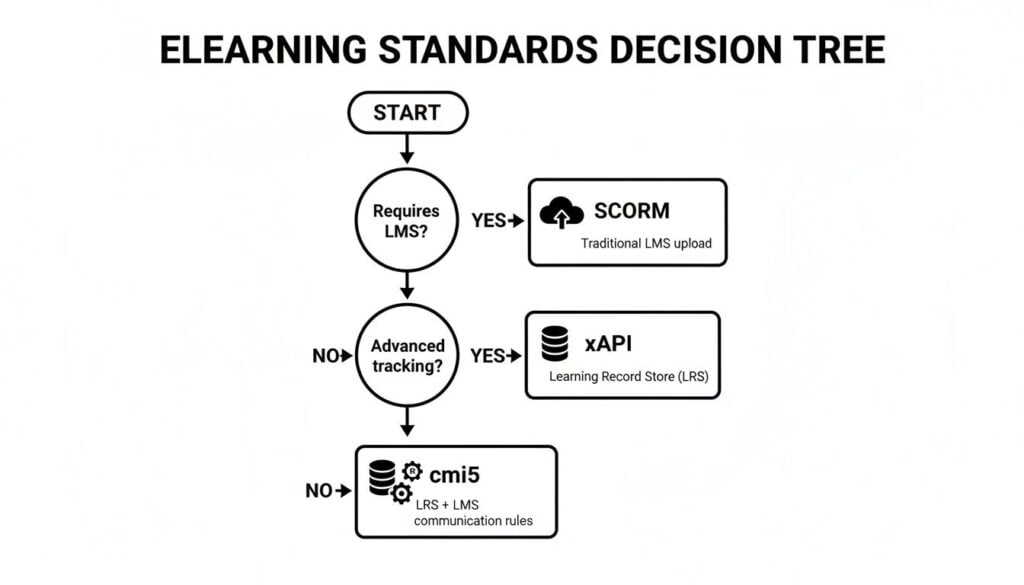
As you can see, the choice flows from SCORM’s simple upload-and-track model to the more advanced data ecosystems required by xAPI and cmi5. Ultimately, the best standard for your business depends entirely on where you want to go and what you need to know about your learners to get there.
Clearing Up the Confusion: Your Top Questions Answered
Whenever I talk about these standards, the same few questions always pop up. People get tangled in the acronyms and what-ifs, so let’s tackle the big ones head-on right now.
Is SCORM Dead in 2026?
Not a chance. I hear this rumor every year, and it’s just not true. SCORM is still the most widely supported standard on the planet, especially inside large corporations where stability and predictability are king. For a huge number of training projects, it’s the right option.
If your goal is straightforward and you need to know if someone finished a course and what they scored on the quiz, SCORM is a rock-solid, cost-effective choice. Its simplicity is a feature, not a bug.
Do I Need an LRS to Use xAPI?
Yes, a Learning Record Store (LRS) is a non-negotiable part of any xAPI ecosystem. You simply can’t have one without the other.
Think of the LRS as the dedicated brain that receives, stores, and makes sense of all the rich learning data your content sends out. Some modern Learning Management Systems (LMS) come with an LRS built right in, but you can also use a standalone LRS to pull in data from virtually anywhere.
The LRS is what gives xAPI its superpower. It acts as the central nervous system for all learning activities, whether they happen in a formal course, on a mobile app, or even during a real-world simulation.
Is cmi5 Just a Better Version of SCORM?
That’s a common way to look at it, but the reality is more nuanced. It’s far more accurate to call cmi5 a more structured, easier-to-implement version of xAPI.
It harnesses all the powerful data-tracking capabilities of xAPI but wraps them in a specific “rulebook” for how content should be packaged, launched, and talk to the LMS. This structure makes it much simpler to adopt than raw xAPI while giving you leagues more capability than old-school SCORM. It truly is the best of both worlds.