
How to Price a B2B Online Training Program

You know the moment.
You’ve been selling a course to individuals just fine, then an email lands from someone in HR, L&D, or operations asking if their company can roll it out to a team. The first reaction is excitement. The second is usually panic.
Most course creators freeze on one question. What do I charge?
If you multiply your public course price by the full employee count, the quote feels ridiculous. If you cut the number too fast, you can underprice the deal so badly that the extra onboarding, reporting, support, and stakeholder management swallow your margin. I’ve seen both mistakes more times than I can count.
Corporate pricing works differently because the buyer isn’t shopping like an individual learner. They’re buying access, rollout confidence, internal adoption, and a result they can defend to a manager or finance lead. That means your pricing has to reflect organizational use.
If you’re packaging training alongside coaching, implementation support, or accountability tools, it also helps to understand how a modern coaching platform fits into the delivery model, because buyers often care as much about reinforcement and support as they do about the core lessons.
That Big B2B Inquiry Just Landed Now What
The most common bad move is answering too quickly.
A buyer asks for pricing and the seller fires back a number pulled from thin air. Sometimes it’s just the retail course price multiplied across seats. Sometimes it’s a discount that “feels fair.” Neither method holds up once the buyer asks what’s included, how long access lasts, who gets reporting, or whether managers can track completion.
Pause before you quote
When a company reaches out, I don’t start with price. I start with scope.
I want to know who the learners are, who owns the budget, what problem triggered the inquiry, and whether they want a library license or a program with rollout support. Those are two very different deals, even if the same course sits at the center.
A useful starting checklist looks like this:
- Team size: How many people need access now, and how many may be added later?
- Access term: Are they thinking in annual budgeting cycles, pilot access, or a phased rollout?
- Use case: Is this onboarding, compliance, manager training, sales enablement, or leadership development?
- Stakeholders: Who besides the original contact needs to approve the purchase?
- Success criteria: What will make them say this worked?
Practical rule: If you can’t describe what the buyer is trying to improve, you’re not ready to price the deal.
What the buyer is really asking
A B2B inquiry sounds like a pricing question, but it’s usually a packaging question first.
They want to know whether your training can fit their environment. Can they onboard a group at once? Can they assign seats over time? Will managers get reports? Can you support internal rollout? Will the content work as-is, or do they need some level of tailoring?
That’s why learning how to price a B2B online training program starts with diagnosing the shape of the deal, not filling in a number on a quote template.
Once you know the problem, the audience, and the delivery expectations, pricing gets much easier.
Forget Cost-Plus Find Your Value Anchor
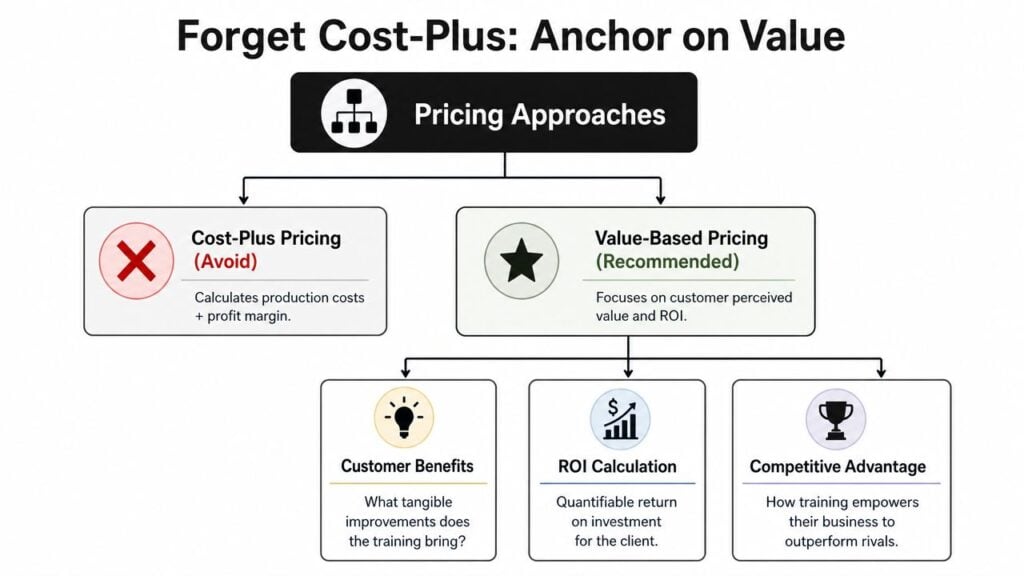
Cost-plus pricing sounds sensible on paper. Add up production costs, add your margin, send the proposal.
For B2B training, that method usually leads to weak pricing.
A company doesn’t care how many hours you spent recording videos in ScreenFlow, editing in Descript, or building quizzes in Articulate Rise. They care about whether the program solves a business problem, reduces risk, or helps a team perform better. Your internal production effort matters to your profitability. It does not give the buyer a reason to pay more.
Why cost-plus breaks in corporate deals
I’ve seen polished programs priced too low because the creator only counted content production time. Then the extensive work began. Stakeholder calls, learner provisioning, custom kickoff sessions, reminder emails, reporting requests, procurement paperwork, and renewal conversations.
None of that shows up in a simple cost-plus formula.
There’s also a bigger issue. Cost-plus keeps your attention on your labor when the buyer is thinking about their exposure. If your training touches compliance, onboarding quality, manager consistency, or role readiness, the buyer is evaluating the cost of getting that wrong.
One useful framing from Coursera’s pricing strategy resources is that lower-risk, standardized training can stay closer to per-user pricing, while higher-stakes programs tied to performance metrics can justify enterprise fees, especially if you provide a credible measurement plan.
That’s the right lens.
Questions that reveal value
I price stronger deals when I ask business questions early.
Not abstract ones. Specific ones.
- What changes if this training works? Faster onboarding, fewer manager escalations, cleaner compliance records, better customer conversations?
- What happens if nothing changes? Delays, inconsistency, rework, audit pain, poor adoption?
- Who feels the impact first? Team leads, HR, operations, compliance, revenue leaders?
- How visible is the outcome internally? Quiet improvement is harder to sell than an initiative tied to a tracked metric.
If you need help tightening the language you use in those conversations, this piece on winning deals with value propositions is a solid reference for sharpening how you frame the offer.
Buyers pay faster when the proposal names the business problem in their language.
Build a value anchor before you build a quote
Here’s the anchor I use in practice:
State the problem clearly
Example. Inconsistent manager training across locations.Define the consequence
Example. Uneven employee experience, more support burden, and poor rollout consistency.Describe the intervention
Example. Self-paced core modules, manager toolkits, reporting, and reinforcement.Name the measurement plan
Completion, manager participation, adoption milestones, or another agreed signal of progress.
If you want a simple way to think about training economics, LearnStream has a helpful piece on training ROI that aligns well with this buyer-side view.
The key shift is simple. Don’t anchor your fee to content hours. Anchor it to implementation risk, stakeholder complexity, and outcome confidence.
Choosing Your B2B Pricing Model
Once the value anchor is clear, you need a charging mechanism the buyer can understand and your team can effectively manage.
I don’t think in terms of “the best model.” I think in terms of the least messy model for this kind of sale.
What the market already expects
In B2B online training, annual access is a familiar structure. Proposal-based pricing is also common. According to Teachable’s guidance on pricing online courses for businesses, a common framework uses three seat bands, up to 25 seats, 25 to 100 seats, and 100+ seats, with larger buyers getting a lower per-seat rate. The same guidance notes that these deals often use annual fees and often start around $5,000+.
That lines up with what buyers expect in practice. They usually want a clear term, a seat allocation, and enough flexibility to manage internal rollout without renegotiating every small change.
B2B Training Pricing Model Comparison
| Model | Best For | Pros | Cons |
|---|---|---|---|
| Per-user pricing | Standardized training with predictable usage | Easy to explain, easy to scale, clean for smaller rollouts | Gets clunky when seat reassignment and uneven usage enter the picture |
| Tiered seat licensing | Teams buying in bands or departments | Helps buyers self-select, rewards volume, simpler quoting | Requires careful boundary setting around overages and access rules |
| Annual subscription | Ongoing training libraries or recurring enablement | Matches corporate budgeting habits and supports renewals | Can feel vague if the offer is not tightly scoped |
| Enterprise license | Large organizations with custom needs | Flexible, supports reporting, support, and custom terms | Longer sales cycle and more negotiation overhead |
If you’re weighing recurring access against one-time licensing, LearnStream’s guide to subscription pricing models is useful for thinking through revenue predictability and buyer fit.
How I choose between models
I use per-user pricing when the training is standardized and the buyer mainly wants clean access control.
I use tiered licensing when the buyer is somewhere between simple and complex. This is often the sweet spot. It gives them a clear bracket and gives you room to shape support, reporting, and admin rules without custom-building the deal from scratch.
I move to an enterprise license when three things show up together:
- Customization needs: They want branded portals, customized learning paths, or internal workflows reflected in the program
- Stakeholder density: HR, compliance, IT, procurement, and department leads all have opinions
- Operational support: They expect implementation help, reporting discussions, and renewal planning
Decision shortcut: The more internal coordination the client needs, the less useful a bare per-seat price becomes.
What usually doesn’t work
Lifetime access rarely works well in corporate training.
Companies budget annually. Their teams change. Their content requirements change. Their compliance expectations change. A perpetual promise creates support and content obligations that outlast the original fee. In most cases, annual access is cleaner for both sides.
The other thing that doesn’t work is hiding the pricing logic. If your quote feels random, procurement will push harder. If your structure is visible, seat band, term, support level, reporting scope, buyers may still negotiate, but they can follow your reasoning.
How to Structure Tiers and Packages
A pricing model tells you how you charge. A package tells the buyer what changes at each level.
That’s where most training businesses either make the offer easy to buy or turn it into mush.
Build the middle package first
I almost always design the middle option before the others.
That package should fit the most common buyer. It needs enough support to deliver a result, not just access. If your middle tier is too thin, buyers either downgrade to a cheap option that won’t work well or jump straight to custom requests because nothing in the core package feels complete.
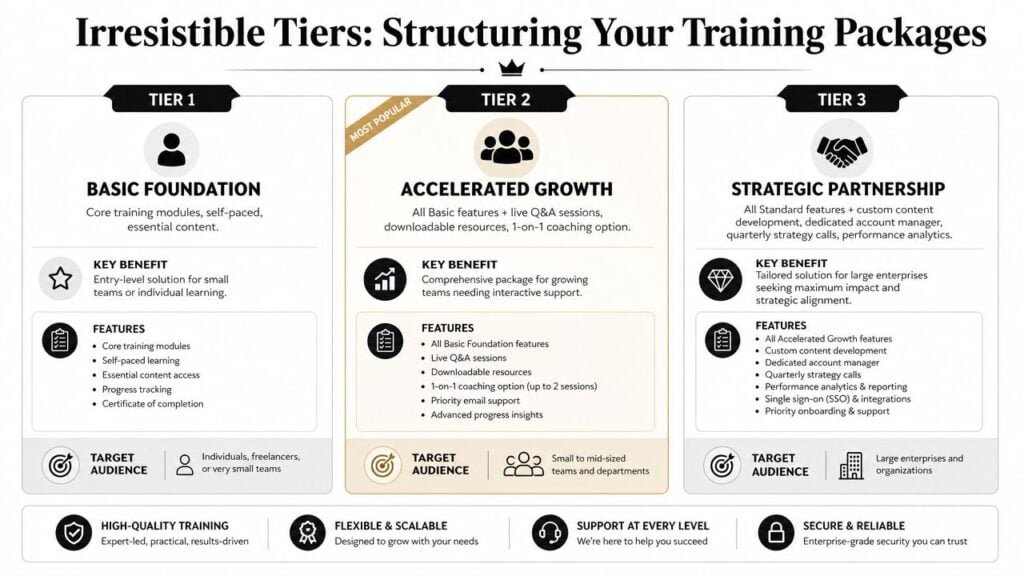
A simple package stack usually works best:
- Basic foundation: Course library access, standard assessments, learner support basics
- Growth package: Everything in basic, plus manager guides, live Q&A, and reporting
- Strategic package: Everything in growth, plus customization, stakeholder reviews, and advanced support
The exact labels matter less than the separation. Each tier should solve a distinct buying situation.
Package by support, not by fluff
Weak packages differ by cosmetic extras.
Strong packages differ by operational value. Reporting. Admin controls. Rollout support. Live sessions. Manager reinforcement. Custom pathways. These are the things buyers discuss internally.
This video gives a useful visual walk-through of offer packaging thinking:

If you want ideas for combining training assets into clearer commercial offers, LearnStream’s article on course bundling techniques for sales is worth a look.
Pricing modern formats without underselling them
Many providers struggle with microlearning and AI-assisted training.
The content units are shorter, so sellers assume the price should drop. That’s often the wrong conclusion. If the format improves workflow fit, keeps learning active between sessions, or reduces manager effort, the value can go up even when the content is shorter.
One current pricing gap is captured well by Oasis LMS’s pricing guide, which notes that as B2B training adds bite-sized modules and AI-powered coaching, providers need to decide whether microlearning should be priced per module, per active user, or as an outcomes-based subscription, separating production cost from enablement value.
That’s exactly the issue.
A practical packaging method
When I price AI coaching or reinforcement tools, I split the offer into layers:
Core learning layer
The foundational course, assessments, and base access.Reinforcement layer
Micro lessons, reminders, nudges, discussion prompts, manager tools.Adaptive layer
AI coaching, personalized feedback, or workflow-embedded support.
The first layer can sit inside a standard license. The second often strengthens your mid-tier package. The third belongs in premium tiers or add-ons because it changes the support model and the perceived value.
Shorter content doesn’t automatically mean cheaper training. In corporate settings, easier adoption often matters more than seat time.
Navigating Discounts and Contract Terms
A buyer asking for a discount doesn’t mean your price is wrong.
It usually means they want movement they can take back to procurement, finance, or a manager who expects negotiation. The mistake is cutting price before you change terms.

Trade concessions, don’t donate margin
When a buyer says, “Can you do better on price?” I try to answer with a trade.
That might mean a longer term, a larger seat commitment, a narrower support scope, or a later start date that fits my delivery capacity better. If you reduce price with no exchange, you teach the buyer that your first number wasn’t real.
A few healthy ways to handle negotiation:
- Tie discounts to term: If they want a better rate, ask for a stronger commitment window.
- Tie discounts to volume: More seats can justify a lower per-seat rate if the admin load stays manageable.
- Swap features instead of fee: Remove live sessions, reduce reporting frequency, or narrow customization.
- Protect the renewal base: Don’t make a one-time concession that becomes the expected standard forever.
Contract points that save you later
Many training providers spend hours polishing the proposal and almost no time tightening the contract language. That’s backwards.
You need clarity on who can access the training, whether seats are named or transferable, what the access term is, what support response looks like, how custom work is handled, and what happens at renewal. If you’re rolling multiple services into one relationship, it helps to understand how an MSA protects your business so the commercial agreement and the actual work order don’t get tangled.
Here are the clauses I pay close attention to:
- Usage rights: Define whether access is limited to the client’s employees, a named team, or a broader internal audience.
- Payment terms: Spell out invoicing timing, late payment expectations, and start conditions.
- Support scope: Be specific about office hours, response expectations, and what counts as out-of-scope support.
- Confidentiality and data handling: Especially important if learner reporting or internal process information is involved.
- Renewal terms: Clarify whether renewal is manual, notice-based, or tied to a fresh statement of work.
The contract should make delivery easier, not create fresh ambiguity after signature.
When to hold firm
I hold price when the buyer wants heavy customization but keeps treating the purchase like a simple content license.
I also hold firm when the admin burden is high. A “small” contract can become expensive to serve if it includes multiple approvers, platform requirements, and recurring reporting calls. In that situation, a discount can turn a decent deal into a frustrating one.
The easiest way to stay confident is to know what part of the offer is premium. If the price reflects implementation help, stakeholder alignment, or advanced support, say that plainly.
Testing Your Price and Measuring Success
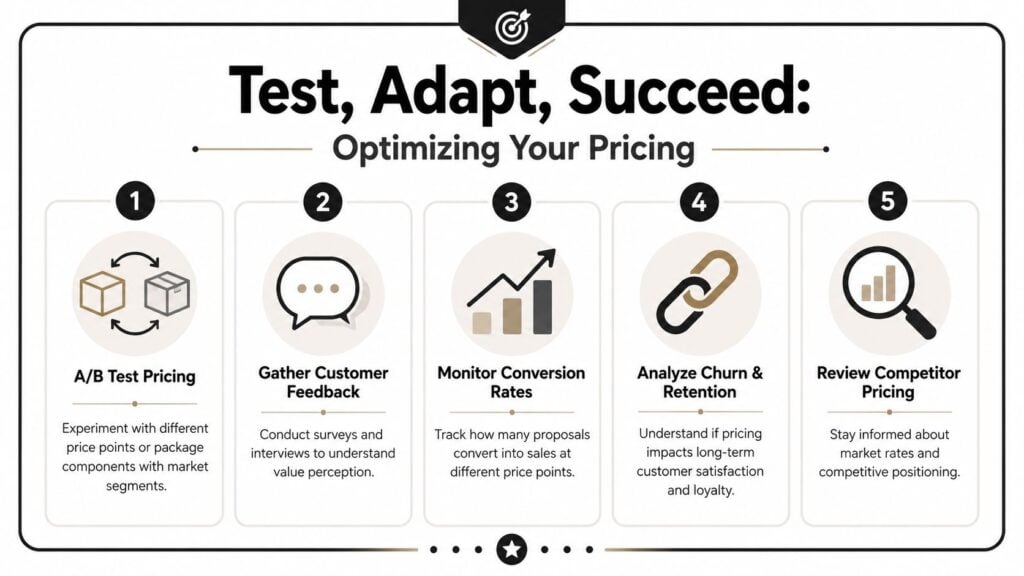
Even a well-built pricing model is still a hypothesis until deals start moving through it.
I don’t treat pricing as a one-time decision. I treat it as an operating system that gets adjusted when buyer behavior tells me something is off.
Start with a pilot you can learn from
A pilot can be useful, but only if you define what it is.
Too many sellers run a “pilot” that is really just a discount with no boundaries. A proper pilot has limited scope, a clear term, agreed feedback points, and a path to full rollout if the program lands well.
What I want from a pilot isn’t just a reference. I want evidence about:
- Buying friction: Did the price create hesitation, or did packaging create hesitation?
- Usage pattern: Did people engage with the format as expected?
- Support intensity: Did the client need more hand-holding than the package assumed?
- Expansion potential: Is there a sensible upsell path into a wider rollout or premium support?
Watch the signals that matter
You don’t need a giant dashboard at the beginning.
You do need a small set of metrics that tell you whether your pricing model is healthy. I look at proposal acceptance trends, discount frequency, time-to-close, renewal conversations, support load, and whether buyers tend to choose the package I hoped they would choose.
A few practical questions surface the truth fast:
| Signal | What it may mean |
|---|---|
| Most buyers ask for a custom quote | Your packages may be too vague or too rigid |
| Buyers always choose the cheapest tier | Your middle tier may lack meaningful support |
| Deals close but renewals feel shaky | The sold promise may exceed actual delivery |
| Negotiations always start with price | Your value anchor may be weak or generic |
If buyers understand the problem you solve, price resistance usually becomes a scope conversation.
Build a simple ROI story for the buyer
This part matters more than many course creators realize.
Even when the contact loves your program, they often still need to justify it internally. Give them language and a framework they can reuse. Not inflated claims. Just a clean business case.
Your ROI story can be simple:
- What problem costs time, risk, or inconsistency today
- What your program changes operationally
- How the client will observe progress
- Why this delivery model is easier to adopt than the alternative
That’s enough to make your price legible inside an organization.
Keep adjusting without becoming erratic
There’s a difference between optimization and random price changes.
If every proposal uses a different logic, buyers get confused and your team loses confidence. Keep the structure stable. Change one thing at a time. Tighten a tier. Raise the floor for custom work. Add a clearer implementation fee. Improve renewal language. Shift AI coaching into an add-on. Those kinds of changes are manageable and teach you something.
The best pricing systems don’t just win the first deal. They make renewals, expansions, and referrals easier because the offer is clear, profitable, and credible.