What is Cmi5 and How is it Different from SCORM?

You’re probably here because SCORM is still doing the basic job, but it’s also starting to get in the way.
A lot of course creators hit the same wall. The course launches fine. The LMS marks people complete. You get a score. Maybe you get pass or fail. But the moment you build something more interesting, like a branching scenario, a software simulation, field training on mobile, or content that should work outside the LMS, the reporting starts to feel thin and the setup starts to feel rigid.
That’s where the question shifts from “What is cmi5?” to something more useful: is switching from SCORM worth it for this project?
The short answer is that cmi5 keeps the LMS launch structure many teams still want, but uses xAPI underneath for more flexible tracking and delivery. For some teams, that’s a major upgrade. For others, it’s extra complexity they don’t need.
If you’ve been trying to sort out what is Cmi5 and how is it different from SCORM without getting buried in standards jargon, this is the practical version.
Is SCORM Holding Your E-Learning Back
SCORM starts feeling restrictive at a specific point. The course itself is getting better, but the tracking is not.
You build a polished module in Articulate Storyline, Adobe Captivate, or another authoring tool. It includes branching decisions, layered feedback, and maybe a realistic simulation. Learners respond well to it. Stakeholders approve it. Then you open the LMS report and get the same small set of outputs you always get: completion, score, pass or fail.
For a course creator, that is the main decision point.
If all you need is proof that someone opened the course, finished it, and passed a quiz, SCORM is still often good enough. A lot of compliance training, annual recertification, and straightforward onboarding programs fit that model just fine. Switching standards for those projects can create more implementation work without giving you much back.
The problem shows up when the course is doing more than the LMS can meaningfully record.
Where the frustration usually shows up
In practice, the pressure to move beyond SCORM usually comes from one or more of these situations:
- You built a richer experience than the LMS can report on. A branching scenario may reveal exactly where a learner makes poor decisions, but SCORM often collapses that into one final status.
- Your training needs to work on mobile or in the field. If learners start, stop, or access training outside a standard LMS browser session, SCORM can become awkward to support.
- You want content to live outside the LMS. SCORM was built around the LMS package model, so distributed or externally hosted content is usually harder to manage.
- You need better learning analytics. Completion data answers whether a learner finished. It usually does not answer what they struggled with, repeated, skipped, or applied.
That trade-off matters more than the technical standard itself. Course creators rarely switch because they suddenly care about standards architecture. They switch because the current setup stops answering useful questions.
SCORM earned its place because it solved a real problem. It standardized how courses launch in an LMS and how basic results get passed back. That model is still serviceable. It is also old enough that its limits show up fast in projects that involve simulations, practice-heavy learning, mobile access, or training that extends beyond a single LMS session.
cmi5 exists for teams that still want structured LMS launching but need more flexible tracking and delivery. That does not make SCORM obsolete. It means you should judge the standard by the project in front of you.
If your reporting needs are simple, your LMS is central to everything, and your team wants the easiest path to deployment, SCORM may still be the sensible choice. If you keep finding yourself designing around SCORM’s limits instead of around the learning experience, the cost of staying put may be higher than the cost of switching.
SCORM and cmi5 Explained in Simple Terms
A course creator usually feels the difference between SCORM and cmi5 at one specific moment. You want to track more than launch, completion, score, and a few status fields, but you still need the LMS to assign the course, launch it, and record an official result. That is the gap cmi5 was built to fill.
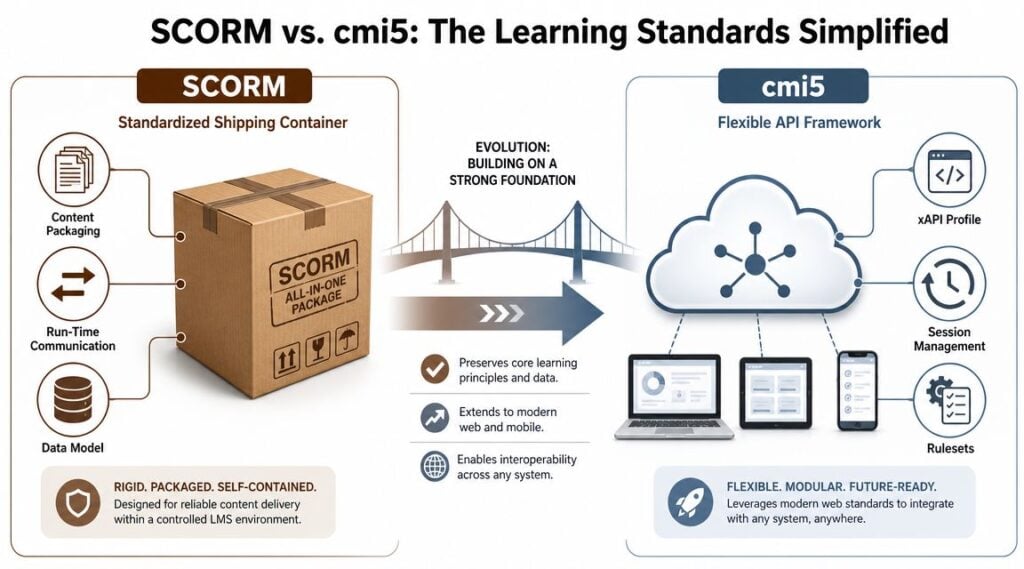
SCORM is the older, simpler model. You package the course, upload it to the LMS, launch it there, and send back a fixed set of data. For a lot of compliance training, policy updates, and basic onboarding, that setup is still perfectly serviceable because it is widely supported and easy to publish.
cmi5 keeps the LMS launch process, but changes what can happen after launch. It uses xAPI rules designed for LMS-delivered learning, which gives course creators more room to track detailed activity and support content that does not have to live entirely inside the LMS. If you need a quick refresher on how xAPI fits into that picture, this guide on SCORM vs xAPI and when to use each helps clarify the relationship.
The practical distinction is simple. SCORM is built for a contained LMS course. cmi5 is built for LMS-managed learning that may involve richer tracking, more flexible hosting, and learning activity that extends beyond a single browser session.
Where xAPI and the LRS fit in
This part trips up a lot of teams because the terms get blurred together.
- SCORM is a standalone LMS content standard.
- xAPI is a method for recording learning activity as statements.
- cmi5 is an xAPI profile that adds rules for LMS-launched courses.
Those rules matter because plain xAPI is flexible to the point of inconsistency. cmi5 adds structure for launch, authentication, course organization, and expected statement behavior, so an LMS and course can work together in a more predictable way.
The learning records typically go to an LRS, or Learning Record Store. In practice, that means you are no longer limited to the narrow set of fields SCORM was designed to pass back. You can capture a broader record of what the learner did, provided your authoring tool, LMS, and reporting setup are ready to use that detail.
That last part is a key decision point. If your team only needs completion and score, cmi5 may add setup work without much payoff. If stakeholders keep asking what learners practiced, skipped, repeated, or completed outside the LMS shell, cmi5 starts to earn its keep fast.
Technical Showdown SCORM vs cmi5
Here’s the quick version first.
| Feature | SCORM | cmi5 |
|---|---|---|
| Core model | Standalone LMS content standard | xAPI profile for LMS-launched learning |
| Data model | Predefined and fixed | Standard data plus custom-defined data |
| Content hosting | Generally inside the LMS | Can be hosted anywhere |
| Launch structure | LMS package launch | LMS launch with cmi5 rules and xAPI-based communication |
| Course structure file | SCORM manifest | cmi5.xml |
| Browser dependence | Browser-based tracking | Supports tracking beyond a browser-only context |
| Mobile and offline fit | Limited | Better suited for mobile, offline, and cross-device use |
| Session handling | Simpler LMS session model | Session-oriented statement rules for consistency |
The biggest technical difference
The cleanest technical split is fixed data versus extensible data.
SCORM is constrained to a predefined data model and generally expects the content to live inside the LMS. cmi5 can track custom-defined data and allows content to be hosted anywhere, using a cmi5.xml file to define course structure and launch rules, as described in the cmi5 specification comparison with SCORM.
That sounds abstract until you apply it to a real course.
If you publish a standard compliance module with a quiz at the end, SCORM’s fixed model is often enough. If you want to record a sequence of choices in a branching conversation, learner actions in a simulation, or activity coming from a remote learning experience, cmi5 gives you a much better foundation.
Why hosting flexibility matters
A lot of teams don’t think content hosting is a strategic issue until they hit a deployment problem.
With SCORM, content is usually tied closely to the LMS environment. With cmi5, the architecture is more distributed. That matters when your course includes web apps, mobile experiences, or learning content that shouldn’t be trapped inside one LMS package.
For a broader look at where SCORM, xAPI, and related approaches differ, this guide on SCORM vs xAPI and when each makes sense is useful context.
The technical question isn’t “Which standard is newer?” It’s “Where does the content live, and what do you need to know about learner behavior?”
Why SCORM struggles outside the browser
SCORM’s model grew up in an LMS-and-browser world. That’s why offline tracking, app-based learning, and cross-device continuity can get messy.
By contrast, cmi5 uses xAPI-based communication and supports session-oriented statement rules, which makes activity grouping and reporting more consistent across devices and sessions. That’s why it’s a better fit when training extends beyond a normal browser launch and return cycle.
For course creators, the practical point is straightforward. If your course will always be launched in the LMS, finished in one browser-based flow, and judged mainly on completion, SCORM’s technical limits may never become a business problem.
If any part of that sentence feels false, cmi5 deserves a serious look.
Practical Differences for Course Creators
Technical differences only matter if they change your day-to-day work. cmi5 does.
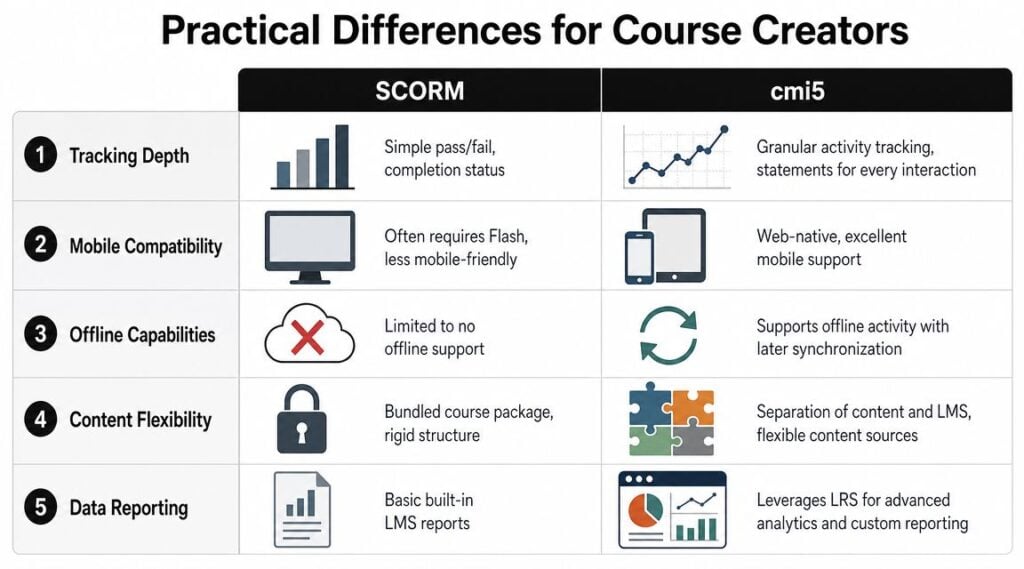
The first change is visibility. With SCORM, you often end up designing around what the LMS can reliably report. With cmi5, you can design for the learning experience first, then decide what parts of that experience you want to capture in more detail.
What this changes in real course work
Say you’ve built a branching scenario for manager training.
In SCORM, the LMS may tell you the learner completed the module and got a final result. In cmi5, you have a better path to capture the actual journey, like which route they took, where they hesitated, and which decisions led to success or failure. For iterative design, that’s gold. You stop guessing which part of the scenario needs improvement.
The same applies to field learning. A technician using a phone, a sales rep reviewing a product module between meetings, or a learner returning on another device creates a workflow that doesn’t map cleanly to old-school browser tracking.
According to xAPI.com’s comparison of SCORM, xAPI, and cmi5, a key practical difference is flexibility. SCORM content typically must reside on the same server as the LMS, whereas cmi5 allows content to be hosted anywhere, including remote domains or local devices, which makes it better suited for mobile, offline, or blended learning programs.
The day-to-day wins and trade-offs
Here’s where course creators usually feel the difference most:
- Branching and simulation design: cmi5 gives you more room to capture meaningful learner actions, not just end states.
- Content delivery options: If your content needs to live outside the LMS package, cmi5 is far more comfortable.
- Mobile and blended programs: cmi5 fits projects that move across devices and contexts more naturally.
- Reporting strategy: You can think beyond “Did they pass?” and move toward “What did they do, and what does that tell us?”
That said, more flexibility creates more decisions.
You need to be clearer about what you want to track. You may need an LRS setup. Your team has to think in terms of data design, not just course publishing. If you’re used to a simple export-upload-launch workflow, that shift is real.
A practical refresher on the old workflow still helps, especially if your team is comparing both paths. This walkthrough on how to import SCORM files into an LMS is a good reminder of why SCORM remains attractive for straightforward deployments.
Here’s a short explainer if you want a visual overview before making a tooling decision.

If your reporting questions are getting smarter, your content standard probably needs to get smarter too.
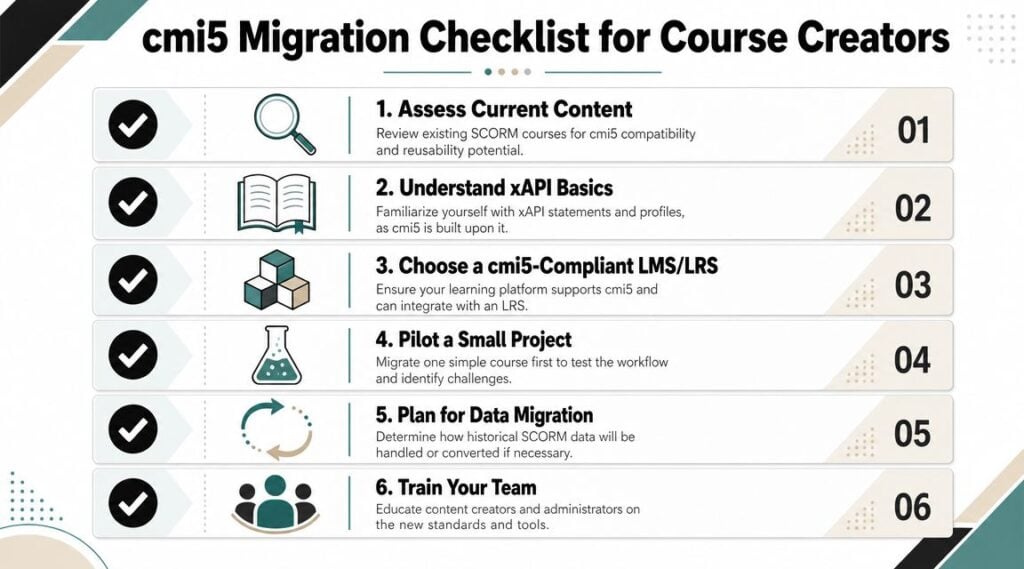
Considering the Switch A cmi5 Migration Checklist
Most migrations go wrong because teams start with the export format instead of the business problem.
If you’re considering cmi5, start by asking what SCORM is failing to do for you right now. If the answer is vague, wait. A standard change without a clear use case usually creates extra work and very little benefit.
Questions worth answering before you move
What are you trying to track that SCORM doesn’t handle well?
Be specific. Branching paths, simulation actions, mobile use, offline activity, remote content launches, or cross-device continuity are strong reasons. “We want something newer” is not.Does your LMS support cmi5 properly?
Vendor language can be loose here. “Supports xAPI” and “supports cmi5 launch workflows well” are not always the same thing.Do you have an LRS plan?
Because cmi5 is built on xAPI, your data strategy matters more. You need to know where statements will live, how they’ll be accessed, and who will use them.Can your authoring tools publish what you need?
Check your actual production stack, not just the marketing page.
A practical rollout approach
I usually recommend a pilot before any broad migration. Pick one course, ideally one that requires cmi5. Don’t waste your pilot on a simple annual policy module.
A solid pilot often includes:
One meaningful use case
Choose something SCORM handles poorly, like a mobile workflow, a branching scenario, or content hosted outside the LMS.A tracking plan
Decide in advance what learner actions matter. If you don’t define that up front, you’ll end up with more data but not more insight.A reporting owner
Someone on the team needs to care about the output. Otherwise, richer tracking becomes shelfware.A fallback path
Keep the original SCORM workflow available until the pilot proves itself operationally.
Migration advice: Don’t convert your entire library first. Prove cmi5 on one course where the extra flexibility pays for itself.
There’s also the less glamorous side of migration. Historical SCORM records don’t magically turn into useful cmi5 data. Team training matters too. Designers, LMS admins, and reporting stakeholders need a shared understanding of what the new workflow changes.
That’s why the smartest cmi5 adoption plans are usually selective, not wholesale.
When to Stick with SCORM and When to Upgrade to cmi5
A team has a new course to launch. The first version is a standard annual compliance module, and SCORM will handle it without drama. Then the scope changes. Now the course needs mobile access, better activity data, and content that does not live neatly inside the LMS. That is usually the point where the SCORM versus cmi5 decision becomes real.
The practical question is simple. Will cmi5 solve a problem you have, or just add work your team has to support?
Stick with SCORM when the course is routine
SCORM is still the better choice for a lot of course libraries. If the course only needs to report launch, completion, pass or fail, and a score, SCORM stays easier to build, test, and hand off to LMS admins.
It is usually the right call when:
- Completion is the main business requirement. Compliance courses, annual recertification, and policy training rarely need richer tracking.
- The course runs fully inside your LMS process. Your team publishes a package, uploads it, tests it, and moves on.
- Your reporting audience is basic. If managers only check who finished and who did not, extra tracking will not change decisions.
- Your platform support is uneven. If your LMS handles SCORM reliably but cmi5 support is partial or new, SCORM reduces operational risk.
That last point matters more than many teams admit. A standard is only as useful as your LMS, authoring tool, and reporting setup allow it to be.
Upgrade to cmi5 when the extra flexibility pays for itself
cmi5 earns its place when SCORM starts forcing compromises in design, delivery, or reporting.
Use cmi5 if your project needs:
- More than completion data. You want to track decisions, attempts, steps in a process, or activity across sessions in a more meaningful way.
- Remote or distributed delivery. The content may live outside the LMS, launch in different contexts, or support learners on mobile and in the field.
- Stronger connections to other systems. You want learning records that can feed a broader reporting setup, especially if you are already planning an xAPI Learning Record Store setup.
- Experiences that break the old package model. Simulations, app-connected tools, and performance support content often fit cmi5 better than SCORM.
Here is the trade-off. cmi5 gives you more flexibility and better data options, but it also asks more from your stack and your team. Someone has to define what to track, confirm the LMS and LRS behavior, and make sure the reports answer a business question.
A useful decision rule
If the course succeeds with “launched, completed, scored,” stick with SCORM.
If the course needs a clearer record of what the learner did, where they did it, or how that activity connects to other systems, cmi5 is worth serious consideration.
I see one mistake often. Teams treat cmi5 as the modern choice and SCORM as the outdated one. That is the wrong frame. SCORM is still the practical workhorse for stable LMS courses. cmi5 is the better fit when the project outgrows that model.
For many organizations, the best answer is mixed. Keep SCORM for plain, repeatable modules. Use cmi5 selectively on projects where better tracking, more flexible delivery, or cross-system reporting will justify the added setup.
The Future of E-Learning Is More Connected
The bigger story here isn’t just SCORM versus cmi5. It’s the shift in how digital learning happens.
Learning no longer sits neatly inside one LMS tab, on one device, in one uninterrupted session. People start on a laptop, continue on a phone, revisit a tool in the field, and interact with content that may live outside the platform that enrolled them. Standards that support that connected reality are naturally becoming more important.
That’s why cmi5 matters. It reflects a broader move toward learning ecosystems that are more flexible, more distributed, and more data-aware.
What that means for course creators
For creators and training teams, this opens up better design choices.
You can build experiences around the learner’s context instead of forcing every experience into a legacy package model. You can think more carefully about what evidence of learning matters. And you can connect delivery decisions to reporting decisions earlier, before launch day exposes the limits.
If you’re exploring the xAPI side of this in more detail, this guide on how to create a Learning Record Store for xAPI is a useful next step.
The useful takeaway
SCORM still has a place. It remains the practical workhorse for a lot of standard LMS content.
But if you’ve been asking what is Cmi5 and how is it different from SCORM, the answer is this: cmi5 gives course creators a way to keep structured LMS delivery while supporting more flexible content and richer learning data. Whether that matters depends on the project in front of you.
Choose the standard that fits the learning experience you’re building, not the one with the louder reputation.