What Is ILT? Guide to Instructor-Led Training

Instructor-Led Training still holds over 55% of corporate training spend in major economies as of 2024, and about 70% of mandatory compliance training still uses live instructor delivery. ILT, or Instructor-Led Training, is the foundational learning method where an instructor teaches learners in real time, giving immediate feedback and adapting as the session unfolds.
If you’re reading this, there’s a good chance you’re building a program right now and stuck on a familiar decision. Do you turn the content into a self-paced course, or do you put a real instructor in front of people and run it live?
I’ve been in that spot more times than I can count. Sometimes the answer is obvious. Sometimes it isn’t. A lot of teams know they need training, but they get fuzzy on what ILT means, when it earns its cost, and how to design it so it doesn’t become two hours of slides and polite silence.
That gap matters. A weak live session wastes everyone’s calendar. A well-built one can move people from confusion to competence fast, especially when the topic is messy, sensitive, technical, or practice-heavy.
So What Exactly Is Instructor-Led Training
A training manager has 25 new hires starting Monday. The process they need to learn has safety implications, judgment calls, and a dozen ways to get tripped up. In that situation, the format question gets practical fast. Do you send people a course link, or do you put a skilled instructor in the room and teach it live?
That second option is Instructor-Led Training.
Instructor-Led Training is a live learning format where an instructor guides learners in real time, adjusts to their questions, and creates practice and feedback on the spot. That live guidance is the heart of it. Articulate’s overview of ILT captures the same basic idea, and it lines up with how I explain it to design teams.
The easiest way to understand ILT is to focus on what the instructor is doing. They are not just presenting content. They are reading the room, checking for confusion, changing examples, asking follow-up questions, and correcting mistakes before those mistakes harden into habits.
That changes the learning experience in a big way.
In practice, ILT can show up in a few familiar forms:
- A classroom session where a trainer demonstrates a process on real equipment
- A workshop where learners practice decisions, discuss tradeoffs, and get coached in the moment
- A compliance session where participants can stop and ask for clarification as soon as policy language gets muddy
- A live online class where the teaching is still real time, even if the room is Zoom or Teams
The common thread is live instruction plus live response.
That distinction matters for instructional design. A self-paced course is built to deliver information consistently. ILT is built to help people understand, practice, and adjust in the moment. If you are weighing live delivery against async options, this guide on instructor-led training vs self-paced learning is a useful companion.
I’ve seen teams miss this and define ILT too narrowly. They treat it as “training in a classroom.” That is incomplete. A core defining feature is synchronous teaching with an instructor who can adapt. The room can be physical or virtual. The design question is whether learners need a live guide to get from explanation to usable skill.
A good analogy is driving lessons. Reading the manual helps. Watching videos helps. Sitting beside an instructor while you merge into traffic is a different kind of learning because feedback happens at the exact moment you need it.
That is why ILT keeps showing up in areas where errors are costly, the content is sensitive, or the work depends on judgment. You see it in onboarding, systems training, leadership practice, safety instruction, and regulated fields where discussion and demonstration carry real weight. If you work in credentialed professions, understanding professional medical certs is a good example of how delivery format can affect readiness and confidence.
The history is simple. ILT is the original workplace training model because it matches how humans have always learned complex tasks. An expert shows, the learner tries, the expert corrects, and the learner tries again. The Association for Talent Development describes instructor-led training as a traditional format built around direct interaction between instructor and learners, which helps explain why it remains so common for skill building and discussion-heavy topics.
For me, that is the practical definition instructional designers should keep in mind. ILT is not just live content delivery. It is a format designed for moments when learners benefit from explanation, practice, correction, and conversation happening together. That is also the standard I use when deciding how to design it and how to prove it worked later.
ILT vs VILT vs eLearning A Simple Breakdown
A lot of the confusion around ILT comes from the acronyms. People use ILT, VILT, and eLearning like they’re interchangeable. They aren’t.
The easiest analogy I know is this:
- ILT is like going to a live concert in person
- VILT is like joining the livestream of that concert
- eLearning is like listening to the recording later when it suits you
All three can teach. They just create very different learning conditions.
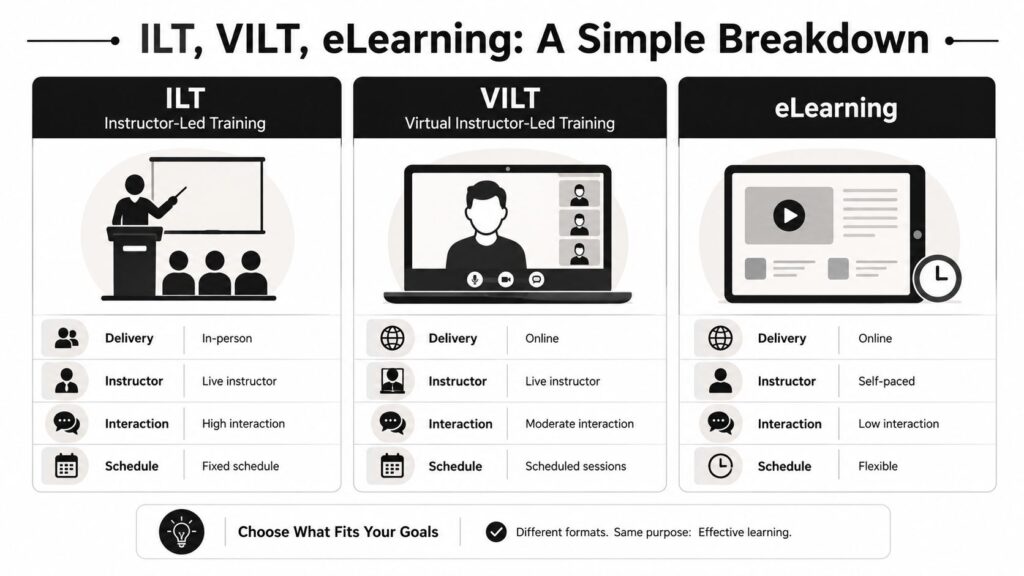
The core differences
ILT usually means face-to-face instruction in a physical room. The instructor is live, the learners are live, and the interaction happens in real time.
VILT stands for Virtual Instructor-Led Training. It keeps the live instructor and the live interaction, but delivers the session through video conferencing. Absorb LMS explains those two official ILT categories clearly.
eLearning is usually self-paced. Learners move through lessons, videos, quizzes, or scenarios on their own schedule. Sometimes it’s interactive, but it isn’t typically synchronous.
A quick comparison table
| Format | Delivery | Instructor presence | Interaction | Schedule |
|---|---|---|---|---|
| ILT | In person | Live | High | Fixed |
| VILT | Online | Live | Moderate to high | Fixed |
| eLearning | Online | Usually not live | Low to moderate | Flexible |
That fixed-versus-flexible difference is a big deal.
If learners need accountability, discussion, and real-time correction, ILT or VILT usually makes more sense. If they need convenience, repeat access, and scale, eLearning starts looking better.
Where people get mixed up
The most common misconception is thinking VILT is just “online eLearning with a teacher.” It isn’t. VILT is still live training. It still depends on a facilitator, a schedule, and active participation. The only thing that changes is the room.
That distinction matters in regulated spaces too. If you work in healthcare, safety, or certification prep, the delivery mode can affect how people practice, demonstrate understanding, and prepare for formal requirements. I liked this piece on understanding professional medical certs because it shows how in-person and online formats create different learning and credentialing experiences without oversimplifying the choice.
If you’re weighing live delivery against independent modules, this guide on instructor-led training vs self-paced learning is also a helpful side-by-side read.
A good design choice starts with the job task, not your content library. The format should serve the performance need.
Why ILT Still Dominates Corporate Training Budgets
A lot of learning teams assume live training is losing ground because digital delivery is easier to scale. That’s only half true.
Instructor-Led Training still accounts for over 55% of total corporate training expenditures in major economies as of 2024, and 82% of corporate leaders cite real-time feedback and social interaction as the primary reason for retaining live training programs, based on Edyoucated’s ILT market overview.
That number tells you something important. Companies are not keeping ILT around out of nostalgia. They’re funding it because it still solves problems digital-only formats struggle with.
Why leaders keep paying for live sessions
When I talk with training managers, the reasons tend to sound pretty consistent.
- They need immediate correction: In a live room, instructors can stop an error before it becomes a habit.
- They need discussion, not just delivery: Some topics become clearer only after learners debate examples, ask follow-ups, and hear how peers think.
- They need behavior practice: Leadership, communication, coaching, de-escalation, and feedback skills are hard to build through click-next modules alone.
- They need commitment: Scheduled live sessions create a container. People show up, participate, and stay with the material.
The hidden value of reading the room
One of ILT’s biggest advantages is also the hardest to capture in a spreadsheet. A good facilitator can sense when a room is lost, disengaged, skeptical, or ready to move on.
That sounds soft, but it has concrete consequences. An instructor can swap examples, ask a probing question, turn a lecture into a quick activity, or pause to correct a dangerous misunderstanding. Self-paced training can be elegant and efficient, but it can’t improvise around the exact confusion learners are feeling at 10:17 a.m.
I’ve watched that make the difference between “they completed the course” and “they can do the thing in practice.”
Where ILT earns its budget
Live training tends to earn its keep when the content is:
- High stakes and mistakes carry real consequences
- Ambiguous and learners need judgment, not just recall
- Interpersonal and the skill shows up in conversation or collaboration
- Hands-on and people need to practice while someone observes
If a course has to change minds, shape behavior, or build confidence under pressure, a live instructor usually improves the odds.
That doesn’t mean every topic deserves a classroom. It means budget follows impact. For many teams, ILT is where they put the material that can’t afford shallow understanding.
When to Choose ILT for Your Training Program
A training team has one week to prepare new supervisors before a policy rollout. The supervisors do not just need information. They need to practice difficult conversations, ask awkward questions, and leave knowing what to do when an employee pushes back. That is the kind of moment where ILT earns its place.
The right question is simple. What format gives people the best chance of doing the job correctly after training?
As noted earlier, ILT shows up again and again in onboarding, technical instruction, and other situations where people need guided practice, not just exposure to content. I have seen that pattern hold across industries. If learners are likely to hesitate, improvise poorly, or misunderstand a step with real consequences, live instruction usually gives you a safer path.
Use ILT when the skill needs live correction
Some skills are hard to fix after a learner has practiced them the wrong way three or four times.
That includes equipment handling, safety steps, regulated workflows, manager coaching, and customer conversations where tone matters as much as wording. In those cases, the instructor is doing more than answering questions. They are catching small errors before those errors become habits.
I use a simple rule here. If poor practice creates risk, confusion, or rework, choose a live format for the first round of learning.
Use ILT when judgment matters more than recall
A click-through course can teach rules. It struggles to teach judgment.
If the work involves gray areas, tradeoffs, or exceptions, learners usually need discussion. They need to hear why one response is better than another, compare interpretations with peers, and test their thinking against realistic scenarios. That makes ILT a strong fit for compliance situations with nuance, leadership training, escalation decisions, and process changes that affect multiple teams.
This is also where a skilled facilitator earns their keep. They can hear a half-right answer and know whether the learner is close or headed for a costly misunderstanding.
Use ILT when group alignment is part of the outcome
Sometimes the true goal is not individual knowledge. It is shared interpretation.
That happens during policy changes, new manager rollouts, sales messaging shifts, and cross-functional process launches. People need a common language for the work ahead. A live session lets them ask, “What does this mean for our team?” and hear how others are applying the same guidance.
That shared conversation saves cleanup later. I have seen one well-run ILT session prevent weeks of inconsistent decisions across departments.
Use ILT when the topic carries emotional or social risk
Sensitive topics rarely benefit from distance and silence.
Manager feedback, conflict conversations, workplace conduct, restructuring communication, and de-escalation training all ask learners to deal with emotion, power, or uncertainty. In those settings, people need room to clarify intent, test wording, and talk through edge cases without feeling stranded inside a self-paced module.
Live instruction also gives the facilitator a chance to set tone. That matters more than many teams expect.
A fast decision filter
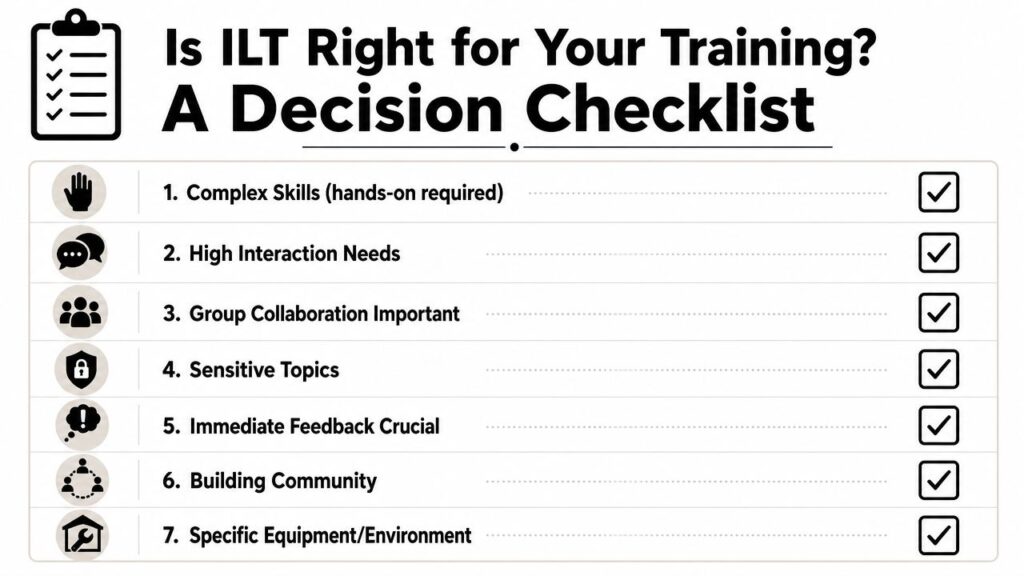
Use ILT if you answer yes to several of these questions:
- Do learners need immediate feedback to avoid practicing it wrong?
- Will discussion, role-play, or coached practice improve performance?
- Is the goal confident behavior on the job, not simple awareness?
- Do learners need to align with each other, not just learn alone?
- Would mistakes create safety, compliance, customer, or culture problems?
If you get two yes answers, ILT is worth serious consideration. If you get four or five, I would usually start with ILT and then decide what can be moved into pre-work or follow-up support.
For teams mixing live sessions with digital reinforcement, these blended learning model examples for corporate training show a practical pattern. Use ILT for practice, feedback, and alignment. Use online content for background knowledge, reminders, and repeatable basics.
How to Design an Unforgettable ILT Session
Good ILT doesn’t start with slides. It starts with decisions.
I’ve seen smart teams pour weeks into a deck, then realize too late that the learners needed practice, not presentation. Live training works when you design for action in the room, not just content coverage.
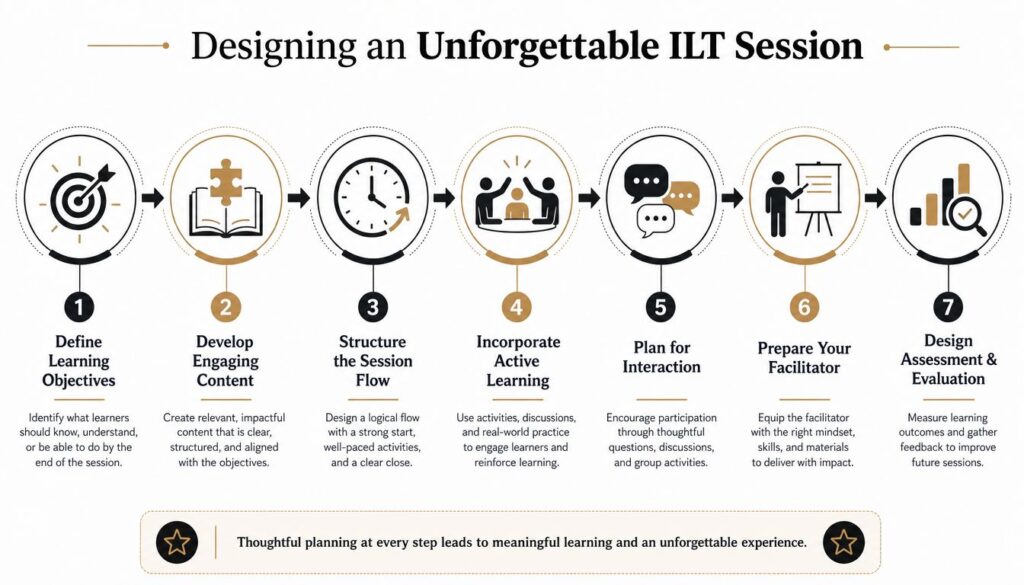
This visual gives you the big-picture flow I use when planning a session.
Start with observable outcomes
Write objectives you can see happen.
Not “understand the escalation process.” Better is “identify the right escalation path for three common customer scenarios” or “demonstrate the handoff steps in the correct order.”
That one move sharpens everything else. It tells you what examples to use, what activities to build, and what success looks like by the end of the session.
Build content in chunks
One of the best pieces of practical guidance on ILT design is simple. Divide sessions into digestible chunks and include replenishing breaks to maintain engagement and social interaction, as noted in Thought Industries’ guide to implementing instructor-led training.
That advice sounds basic because it is. It also fixes a huge number of bad workshops.
I usually think in short learning cycles:
- Introduce the concept
- Show an example
- Let learners try it
- Debrief what happened
- Move to the next piece
People can stay with a live session longer when the rhythm changes. Lecture for too long and energy drops. Ask them to do something every few minutes and the room wakes up again.
A quick walkthrough can help here.

Choose tools that support participation
The same guidance also recommends budgeting for practical teaching tools like whiteboards and polling software.
That doesn’t mean you need a fancy stack. It means you should pick tools that make interaction easier.
A few that work well:
- Whiteboards: Great for sorting ideas, mapping process steps, or capturing learner language in the moment
- Polling tools: Useful for quick checks, opinion questions, and surfacing misconceptions without putting one person on the spot
- Breakout rooms: Helpful in VILT when learners need to practice in pairs or small groups
- Printed job aids or digital worksheets: Good for procedural tasks people will need again later
Design the room, not just the lesson
Live sessions have a physical or social environment. That environment teaches too.
If chairs are bolted in rows and the trainer stands at the front reading bullet points, you’ve created a passive signal. If tables are set for discussion, activities are ready, and the facilitator invites contribution early, you’ve created a different expectation.
Field note: Learners decide within the first stretch of a session whether they’re there to participate or to endure it. The opening activity does more work than the title slide.
A planning checklist I use
Before I sign off on an ILT design, I look for these elements:
- Clear performance objective: Can we observe the outcome in the room?
- Logical flow: Does each part build toward the target skill?
- Active practice: Do learners do something meaningful, not just listen?
- Breaks with intent: Is there space for reset and informal processing?
- Facilitator support: Does the instructor have notes, prompts, and backup examples?
- Simple evaluation: Can we check whether the session changed knowledge or behavior?
When those pieces are in place, the session usually feels better for everyone. More important, it works better.
Simple Facilitation Tips for Keeping Learners Hooked
A strong design gives you the map. Facilitation is how you drive.
Two instructors can use the same agenda and get completely different results. One creates momentum. The other drains the room. That’s why facilitation deserves its own attention.
Open with something learners can react to
Don’t begin with twenty minutes of background. Start with tension.
Use a scenario, a short decision prompt, a common mistake, or a question that reveals how people currently think. If I’m teaching managers how to give feedback, I might open with a rough script and ask, “What would this land like on you?” That gets people talking immediately.
A live session needs learner voices in the room early. If participants don’t speak in the first part of the training, they get comfortable staying quiet.
Ask better questions
A lot of flat sessions come from weak prompts.
Questions like “Any thoughts?” usually get you nothing. Questions tied to a decision, a tradeoff, or a real example work much better.
Try prompts like these:
- “What would make this step fail in real life?”
- “Which part of this process causes the most confusion on your team?”
- “What would you say if the customer pushed back here?”
Those questions give learners something concrete to work with.
Manage the room without shutting it down
Every group has a few patterns. One person talks a lot. One person stays skeptical. A few people won’t jump in unless they’re invited.
Your job isn’t to flatten those differences. It’s to channel them.
A few moves I rely on:
- Redirect the overtalker: “That’s useful. I want to hear how someone else sees it.”
- Invite the quiet learner: “Chris, what are you noticing from your side?”
- Park side issues: Capture them visibly and return if time allows
- Name the energy dip: “So much has been discussed. Take two minutes and compare notes with the person near you.”
Good facilitation feels responsive, but it isn’t random. You’re constantly balancing timing, clarity, participation, and psychological safety.
Stay flexible, keep the objective
One trap newer facilitators fall into is treating the agenda like sacred text. The room may need more time on one concept and less on another. That’s normal.
You can adjust without losing control. The key is knowing what absolutely must happen by the end. If the learning objective is solid, you can flex the path and still arrive where learners need to go.
I’ve seen this work best when facilitators prepare extra examples, backup explanations, and a few optional activities they can use or skip depending on the group.
Measuring Success and Proving the Value of ILT
At some point, somebody asks the question that matters most. Did the training work?
If all you measure is whether people liked the session, you’ll get incomplete answers. Learner satisfaction matters, but it isn’t enough. You need a simple way to connect the live experience to learning, behavior, and results.
I usually lean on a four-level approach because it’s practical and easy to explain to stakeholders.
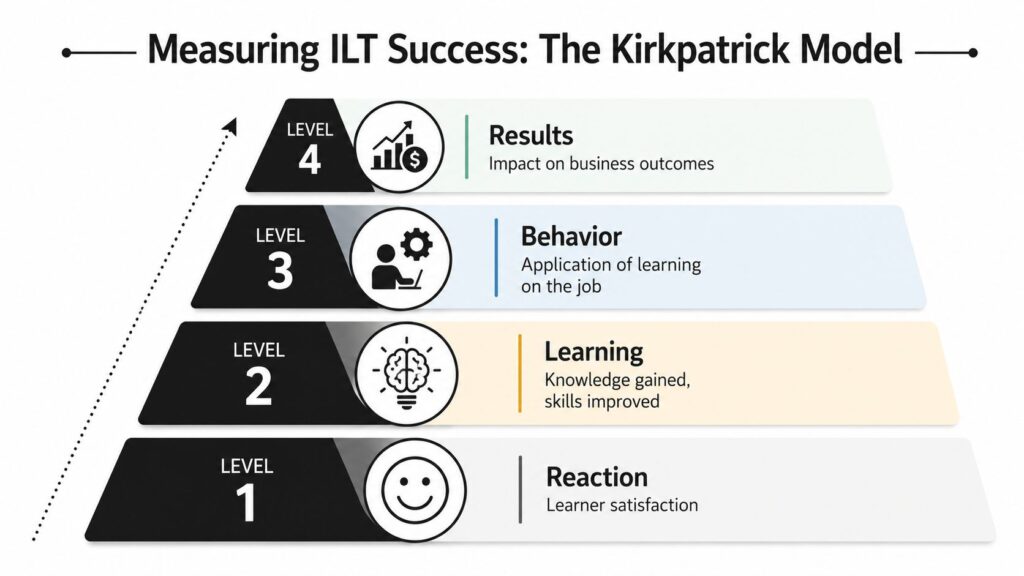
Level 1 and Level 2
Start with the basics.
| Level | What to check | Example methods |
|---|---|---|
| Reaction | Did learners find it relevant and usable? | Post-session survey, quick pulse poll |
| Learning | What did they actually gain? | Short quiz, scenario response, demonstration |
Reaction tells you whether the session landed well. Learning tells you whether they picked up knowledge or skill in the moment.
For ILT, I like quick scenario checks more than generic quizzes whenever possible. If the session is about handling a complaint, ask learners to respond to a complaint. If it’s about a process, have them perform the process.
Level 3 and Level 4
A common mistake many teams make is stopping too early. The stronger question is whether learners used the training back on the job.
- Behavior: Are managers observing the new skill in practice?
- Results: Did the training support the business outcome it was meant to influence?
That might mean checking supervisor observations, quality reviews, coaching notes, or workflow compliance after the session. For business impact, the right measure depends on the purpose of the training. Maybe it’s fewer escalations, smoother onboarding, better customer interactions, or cleaner process execution.
If you need a practical framework for tying learning efforts to business outcomes, this guide on ROI on training is worth bookmarking.
Make attendance and participation easier to track
Measurement gets messy when the administrative side is weak. If you run in-person or blended sessions at scale, even simple attendance tracking can become a pain.
That’s one reason I found this article on collecting attendance data with QR codes useful. Not because QR codes are magical, but because small operational fixes make your evaluation cleaner. When attendance data is reliable, follow-up analysis gets easier too.
One caution on ROI claims
A real gap exists in the market for comparing VILT and self-paced eLearning for complex technical skills. The available material often defines the formats well but doesn’t fully answer whether VILT reduces time-to-proficiency for high-stakes roles. One projection says 40% of corporate training will shift to VILT in 2025, while only 15% of LMS reports include retention metrics for VILT versus self-paced modules, according to Intellum’s discussion of ILT and VILT.
That’s a good reminder to stay honest. Measure what your program changes. Don’t lean on vague claims just because live learning feels valuable. Prove it in your own context.
The best ILT evaluation plan is the one you can actually run after the workshop ends, not the perfect one that lives in a slide deck.
ILT has been around for a long time because it solves a real problem. People learn better when the right instructor helps them make sense of difficult material in real time. The trick isn’t just knowing what ILT is. It’s knowing when to use it, how to build it well, and how to show that it made a difference.