
Are Free Trials Really Free and What They Cost You?

You sign up for a free trial during a busy afternoon. The button says $0, access opens immediately, and you plan to explore the service later. A few weeks pass. Then a payment notification arrives, and you realize the trial became a subscription.
That moment explains why people keep asking, are free trials really free? At signup, the answer may appear to be yes. In the complete customer journey, the answer depends on the renewal terms, the payment method, the reminders, and how easy cancellation is.
Membership owners face the same question from the other side. A trial can bring more people through the door, but it can also attract members who never activate, forget to cancel, request refunds, or leave with a poor impression. The initial price is only one part of the offer.
I’ve tested both free trials and low-entry offers, and the clearest lesson is simple. A free trial is a behavioral and billing design decision, not just a pricing trick. The experience has to help a serious learner reach value quickly while making every future charge visible.
If a renewal creates confusion, document the customer journey and keep clear records of consent, reminders, and cancellation requests. A practical free chargeback prevention guide can help owners think through the evidence and communication needed when a member disputes a charge.
The sections ahead break the decision into plain terms. You’ll see what a free trial commits someone to, where the hidden costs appear, how it compares with a low entry fee, and which design choices protect trust on both sides.
Introduction Why Free Rarely Means Free
A free trial usually feels simple. You enter an email address, create a password, and start using the course, community, software, or streaming service. The business gets a new lead, and you get time to decide whether the offer deserves a place in your budget.
The complication arrives later. Many trials are connected to a subscription that begins automatically when the trial ends. If you don’t cancel before the deadline, the payment method on file is charged according to the recurring terms you accepted.
That arrangement isn’t automatically deceptive. It becomes risky when the customer misses information, misunderstands the renewal date, or encounters a cancellation process that takes more effort than signup. The Federal Trade Commission’s guidance on free trials and automatic renewals tells consumers to check the trial length, understand the future charge, read the terms, and monitor statements for unexpected renewals.
For a learner, the cost can be financial and mental. You may pay for something you barely used, then spend time searching through app-store settings, emails, or account pages to stop the next charge.
For a membership owner, the cost can show up as support conversations, refund requests, payment disputes, and churn. A large European study of more than 16,000 digital TV customers found that people acquired through free trials had a 59% lower average customer lifetime value than regular customers because they retained less effectively and used the service less intensively. The research was also summarized as finding that trial customers stayed only one-third as long as regular customers, disappearing swiftly after the trial period. The Tilburg University research offers a useful historical warning for subscription businesses.
The useful question isn’t only whether signup costs nothing. Ask what happens when the trial ends, who controls that transition, and how easily either side can correct a mistake.
A good trial can still be valuable. It gives a potential member enough access to judge the experience, and it gives the owner a chance to demonstrate real value. The offer works best when the path from signup to activation to renewal is deliberately designed rather than left to chance.
What Free Trials Actually Mean Today
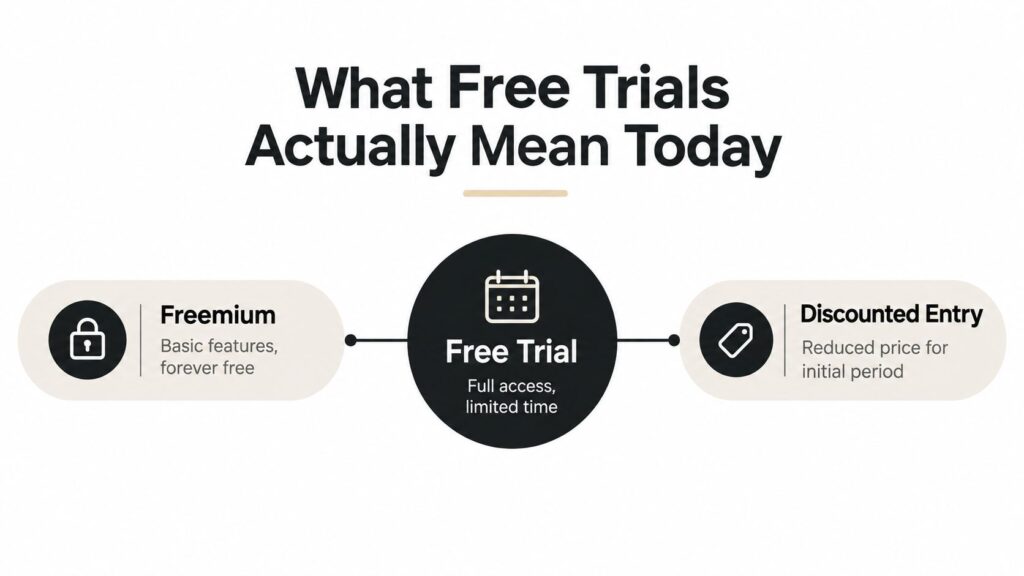
A free trial gives someone access to a product or service for a limited period without an initial charge. The customer may receive the complete experience for that period, including lessons, community features, software tools, or premium content.
That definition differs from two nearby models.
Freemium provides a basic version indefinitely. The customer doesn’t face a trial deadline, but advanced features remain behind a paid plan. Discounted entry charges a reduced amount during an initial period, after which the normal price may apply. A free trial starts at no charge, while a low-entry offer asks for payment immediately.
The negative option model
Many free trials use what regulators call a negative option subscription. The customer receives the product free or at a reduced price for the trial period, then gets charged automatically unless they take action to cancel.
Imagine borrowing a library book that automatically purchases itself if you don’t return it. The arrangement can be convenient, but only if the borrower knows the return date, the purchase price, and the return process before taking the book home.
The same logic applies online. A responsible offer should make these points easy to see:
- Trial length: State when access ends and when the first recurring charge will occur.
- Future price: Display the amount that will be charged after the trial.
- Billing frequency: Explain whether billing happens monthly, annually, or according to another schedule.
- Cancellation method: Tell members where and how they can cancel.
- Consent: Make the agreement clear before collecting payment details.
The CFPB describes trial marketing plans as offers that provide products or services free or at a reduced fee for a trial period, followed by automatic billing unless the consumer cancels. Its guidance also identifies problems such as unclear material terms, inadequate consent, misleading cancellation practices, unreasonable barriers, and failure to honor valid cancellation requests. The CFPB’s overview of negative option marketing is especially useful for owners reviewing their checkout flow.
A customer shouldn’t have to decode a dense paragraph to understand the deal. If the renewal information is technically present but visually buried, the business may still create confusion that damages trust.
The Hidden Costs You Pay Without Noticing
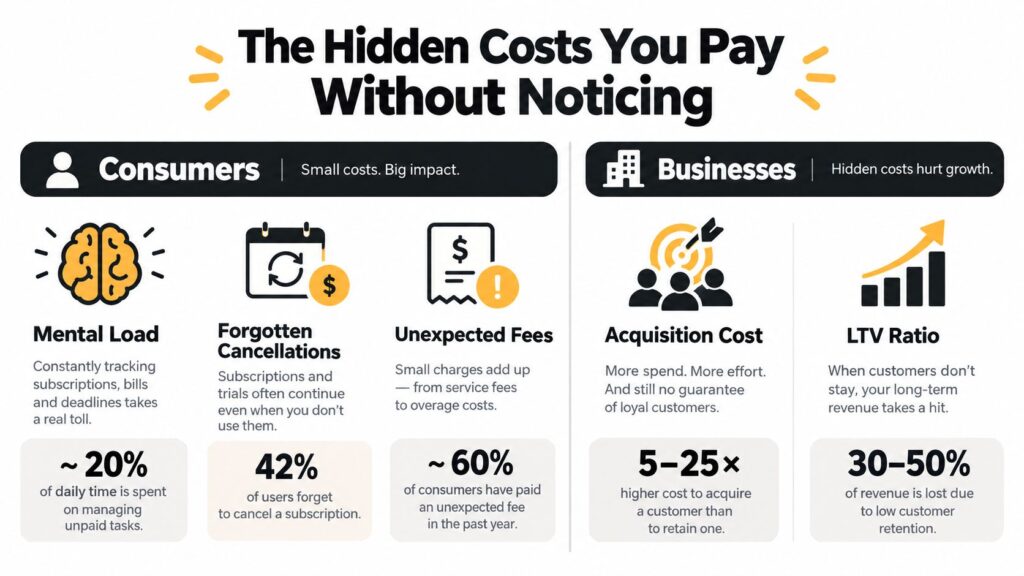
A free trial can become expensive while the member is doing nothing. In the survey summary and streaming data, 48.0% of 1,000 Americans said they had forgotten to cancel a free trial and paid more than expected. Among them, 48.1% said this had happened multiple times. The first missed cancellation may feel like an oversight. Repeated renewals turn it into a billing design problem.
The same source found that 43.7% of respondents whose trials expired were charged between $20 and $50, while 9% reported spending more than $100 on accidental subscriptions. These figures do not describe every customer, but they show why “free” can be misleading when payment continues automatically.
The cost also includes attention. Members track trial dates across cards, bank accounts, app stores, and separate email inboxes. Someone may remember joining a course but forget that the charge is managed through an app store or a different account. Payment rails act like separate lanes. If the member cannot easily see which lane controls the renewal, cancellation becomes harder.
Why owners absorb the consequences
Owners pay for unclear trial design through support work, refunds, disputes, and weaker trust. The European digital TV research cited earlier found lower retention and less intensive usage among free-trial customers. That usage pattern matters because a member who rarely enters the product has fewer opportunities to experience its value before renewal.
Streaming data offers another angle. Industry coverage citing Antenna reported that 68.6% of free-trial users across premium subscription video services converted to paid subscriptions in 2021, compared with 66.3% the year before. The same industry summary indicates that conversion can be healthy, while also leaving open the separate question of whether members stay satisfied.
Support teams then receive predictable questions:
- “I didn’t know this would renew.” Staff must explain what the member saw and accepted.
- “Please refund me.” The owner must assess whether the charge and policy were clear.
- “I cancelled, but I was still charged.” Records need to show when and where cancellation occurred.
- “I never used the service.” A technically valid charge can still create a trust problem.
A clear cancellation path addresses friction before it becomes a dispute. For a specific service, a focused free trial cancellation guide can be more useful than a general instruction to check account settings.
Free at signup can still lead to a paid charge, support burden, or retention problem. Judge the full billing journey, not only the first screen.
Free Trials Versus Low Entry Fees Compared
A member can join a free trial after one quick click, then discover a renewal charge weeks later. Another member may pay a small introductory fee on day one and understand immediately that a purchase has begun. The difference is more than price. It is the design of the signup, payment rail, renewal notice, and cancellation path.
A low entry fee creates an early commitment. Entering payment details and completing a purchase shows clearer intent than selecting a no-cost button. The member may also pay closer attention because money has already changed hands, while the owner gets an early signal that the offer can support paid demand.
Free trials remove price anxiety and give people time to test a teaching style, community, catalog, or workflow. They suit products whose value becomes clear through use. Low-entry offers suit products with a defined audience and an outcome members can recognize quickly.
| Criteria | Free Trial | Low Entry Fee |
|---|---|---|
| Signup friction | Very low, especially without payment details | Higher because payment happens immediately |
| Intent signal | Broad interest, with uncertain commitment | Stronger evidence that the member is willing to pay |
| Perceived risk | Low at the start | Reduced by the introductory price, but not removed |
| Owner’s early task | Activate the member before renewal | Demonstrate value after the first payment |
| Main billing risk | Automatic renewal and forgotten cancellation | Confusion about when the normal price begins |
| Useful setting | Products that need hands-on evaluation | Offers with clear value and a defined audience |
The payment rail changes the owner’s work. A card-based free trial can make renewal easy, but it also creates forgotten-payment disputes when reminders or cancellation controls are unclear. A low entry fee avoids the surprise of a first paid charge, yet the owner must show exactly when the standard price starts and what the member will pay then.
For a streaming service, a free trial lets someone test the catalog and playback experience. For a fitness membership, a low-cost first visit or introductory period may discourage people who only want to browse. In an online course, a short free sample lesson may provide enough evidence without opening the full library.
Pricing should match the value members receive and the costs the owner must cover. LearnStream’s guide to value-based pricing strategy offers a way to connect the offer with outcomes instead of copying a competitor’s trial structure.
Where each model can fail
A free trial fails when the member never reaches a meaningful result. The owner then pays to acquire a signup that has little reason to continue, while an automatic renewal can turn weak activation into a billing complaint.
A low entry fee fails when the discount attracts people who leave as soon as the regular price appears. Confusion grows if the transition is buried in small print or the cancellation route is difficult to find.
I prefer a low entry fee when the audience understands the problem and can recognize value quickly. I prefer a free trial when the experience makes the strongest case for purchase, provided the business sets a clear activation path, renewal notice, and cancellation process.
How Trials Convert and Why Many Members Churn
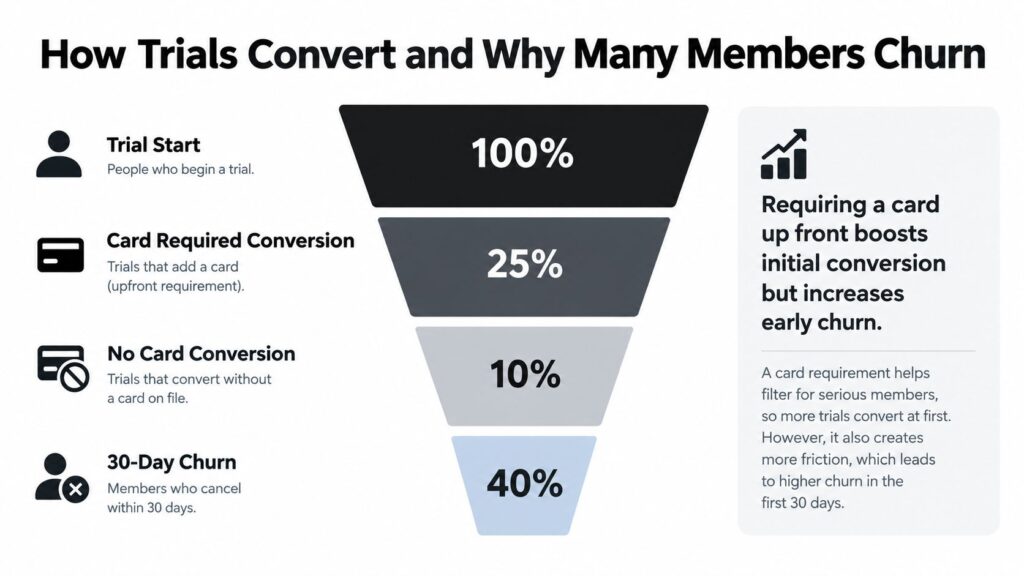
Trial conversion has to be read alongside trial design. ChartMogul’s SaaS benchmark report found that 20% of free-trial products required a credit card at signup, while 80% did not. Among trials that required a card, the report described 25% to 35% as a good trial-to-paid conversion benchmark and 50% to 60% as great. ChartMogul’s SaaS conversion report connects the card requirement with a higher-intent, higher-friction funnel.
A card requirement can improve the percentage of starters who become paying customers because the customer has already completed more of the purchase process. It can also increase the number of people who avoid the trial altogether. A no-card trial usually makes starting easier, but the owner may see more inactive accounts and fewer customers who reach the renewal decision with genuine product experience.
Activation matters before conversion
A trial member rarely renews because the calendar reached its final day. They renew because the product helped them complete something meaningful.
For a course, that might mean finishing a lesson and applying the method. For a community, it might mean receiving a useful answer from another member. For software, it might mean completing a workflow that previously consumed time.
An owner can track a simple sequence:
- Signup: Did the person create an account?
- First value: Did they reach the core experience?
- Repeat use: Did they return and continue?
- Renewal readiness: Do they understand the paid offer and next charge?
A trial without onboarding leaves too much work to the customer. Helpful prompts, a clear first action, and relevant reminders can move someone from curiosity to practical use. Retention planning should continue after the trial begins, which is why membership site retention strategies deserve attention alongside acquisition.
The historical European evidence adds an important caution. Trial customers can convert and still produce less value over time if they use the service lightly or leave quickly. Conversion is a checkpoint, not the finish line.
Best Practices That Keep Trials Honest and Effective
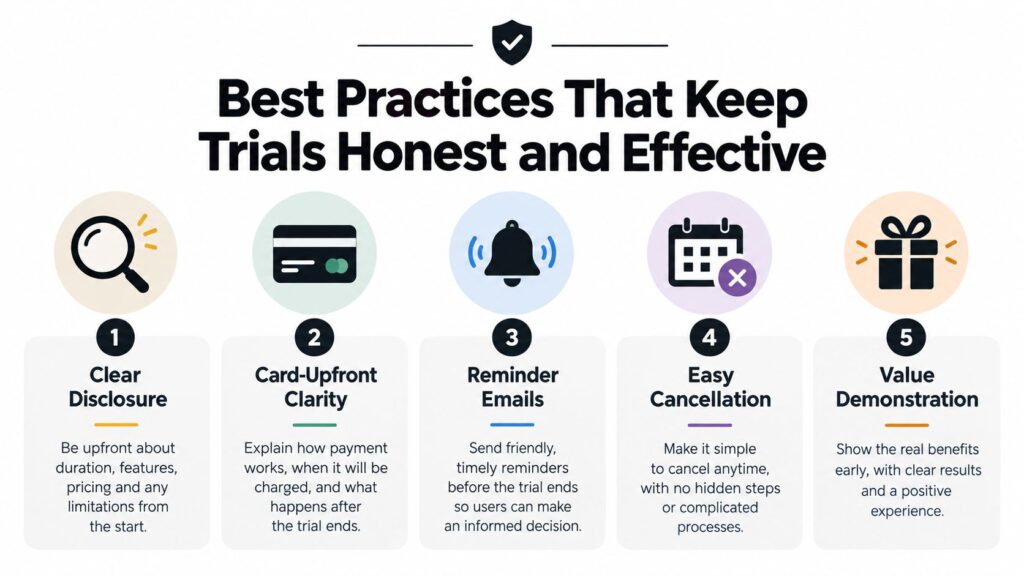
A fair trial starts with a checkout screen that answers the customer’s practical questions before payment details are collected. The FTC’s updated Negative Option Rule, announced on October 16, 2024, applies broadly to subscription services, free trials, and automatic renewals across media. Legal analysis of the rule says sellers must disclose the charge amount, timing or frequency, and cancellation information before collecting billing details, then obtain express informed consent separately from the rest of the transaction. This legal analysis of the FTC rule gives owners a practical checklist for reviewing the flow.
Make the agreement easy to understand
Put the trial length, renewal price, billing frequency, and cancellation method beside the signup action. Don’t rely on a customer finding those details in a separate terms page.
If payment details aren’t required, say so. If they are required, explain why and state exactly when the first charge will occur. ChartMogul’s benchmark shows that card-required trials operate differently from no-card trials, so owners shouldn’t treat both funnels as interchangeable.
Separate consent from distraction
Use a clear consent action for the recurring subscription. Avoid bundling it into unrelated permissions or presenting important billing terms in low-contrast text.
The CFPB identifies informed consent and reasonable cancellation as central concerns in negative-option marketing. A member should be able to show what they agreed to, and the business should be able to retrieve that record.
Send useful reminders
A reminder before renewal gives the customer a fair chance to decide. Include the renewal date, expected charge, account link, and cancellation option. The message should help the member act, not force them to search through support articles.
Match cancellation to signup
If someone can start the trial online, they should be able to cancel through the same account interface without an unnecessary phone call or maze of pages. Recent reporting on U.S. and EU scrutiny of “click to cancel” rules describes problems such as hidden buttons, multi-step flows, and phone-based cancellation. Coverage of the click-to-cancel debate highlights why cancellation friction has become a central part of the customer experience.
Payment rails add another layer. In India, consumers can review and revoke UPI autopay mandates centrally, which matters when a free trial becomes a recurring debit. Reporting on UPI autopay mandate controls shows why owners should explain renewal behavior across cards, app stores, and instant-payment systems.
For membership owners reviewing the wider subscription setup, subscription model best practices can sit alongside a direct audit of checkout, reminders, payment mandates, and cancellation.
Choosing the Right Offer for Your Membership
I’d choose the offer by looking at the member’s decision, not the owner’s wish for more starts.
A free trial fits when the product needs to be experienced before its value becomes obvious. This can suit a learning community, software workflow, or content library where the member must explore the environment. It requires strong onboarding, visible renewal terms, and enough operational capacity to answer billing questions.
A low entry fee fits when the audience understands the problem and the first result arrives quickly. Payment creates a stronger intent signal, while the reduced price lowers the risk of trying the offer. The owner still needs to state when the introductory price ends and what happens afterward.
A hybrid can work when you want to offer evidence without opening everything. Give access to a sample lesson, orientation event, or limited community area, then invite the member into a paid introductory plan. This can reduce the gap between curiosity and commitment.
A simple decision guide
- If members need to feel the experience first, use a free trial with a short path to the first meaningful result.
- If the audience already knows the problem, test a low entry fee that makes the first payment clear.
- If your support team is small, avoid a design that depends on members understanding complicated renewal or cancellation rules.
- If payment rails vary by market, document how recurring mandates work for cards, app stores, and local payment systems.
- If early engagement is weak, improve activation before increasing trial traffic.
Before launch, check the offer from a customer’s screen. Can someone see the future price, renewal date, billing frequency, and cancellation route without hunting? Can your team prove consent and process a valid cancellation request? Can a new member reach value quickly enough to make an informed decision?
The strongest offer may produce fewer trial starts while creating clearer expectations, healthier retention, and less support pressure. For me, that’s the standard worth using. A trial is sustainable when members understand the bargain, experience real value, and remain in control of the next billing decision.
Choose one existing offer today and inspect it as if you were a first-time member. Write down the trial end date, future charge, payment rail, reminder schedule, and exact cancellation path. Then remove any unclear step before sending more traffic to the signup page.