What is Social Learning? An Explanation for Course Creators

You probably know this feeling.
You open your course dashboard, check lesson progress, and see a pattern you were hoping not to see. People bought. A few watched the first module. Almost nobody finished. The discussion area is silent. Your content might be solid, but the learning experience still feels flat.
I’ve seen this happen with polished courses, expensive recordings, and beautifully organized lesson libraries. The problem usually isn’t that the material is bad. It’s that the learner is alone with it.
That’s where what is social learning becomes a useful question for course creators. Not as theory for theory’s sake, but as a practical design lens for building courses and memberships people use, discuss, and stick with.
Why Your Solo-Learning Course Is Quietly Failing
A lot of online courses work like digital libraries.
They give people shelves of valuable material, neat categories, and a login. Then they expect motivation to appear on demand. Sometimes that works for highly driven learners. Most of the time, it doesn’t.
A library and a book club can contain the exact same ideas. The difference is the environment. In a book club, people react, compare notes, ask questions, and notice what others found useful. That social layer changes the experience of learning.
Content alone rarely carries momentum
When learners move through a course in isolation, several things tend to happen.
- They lose context: A lesson can make sense in theory but still feel hard to apply when nobody shows what “doing it well” looks like.
- They lose energy: Without visible progress from peers, it’s easy to postpone the next lesson.
- They lose confidence: If they get stuck, silence can make them assume they’re the only one struggling.
- They lose the habit: A course competes with work, family, messages, and everything else in life.
That’s why many creators keep improving the content while the actual issue sits somewhere else. The issue is often the learning environment.
Practical rule: If your students only consume, they’re less likely to continue. If they observe, respond, copy, test, and share, they’re more likely to keep going.
Social learning gives you a better way to think about course design. It helps you move from “How do I publish more lessons?” to “How do I create situations where learners learn from seeing other learners in action?”
That shift matters for digital products.
A quiet course usually stays quiet. A course where people can see progress, examples, attempts, wins, and feedback starts to feel alive. Once that happens, your course stops being just content and starts becoming a place where people learn with visible momentum.
Unpacking Social Learning Theory from the Start
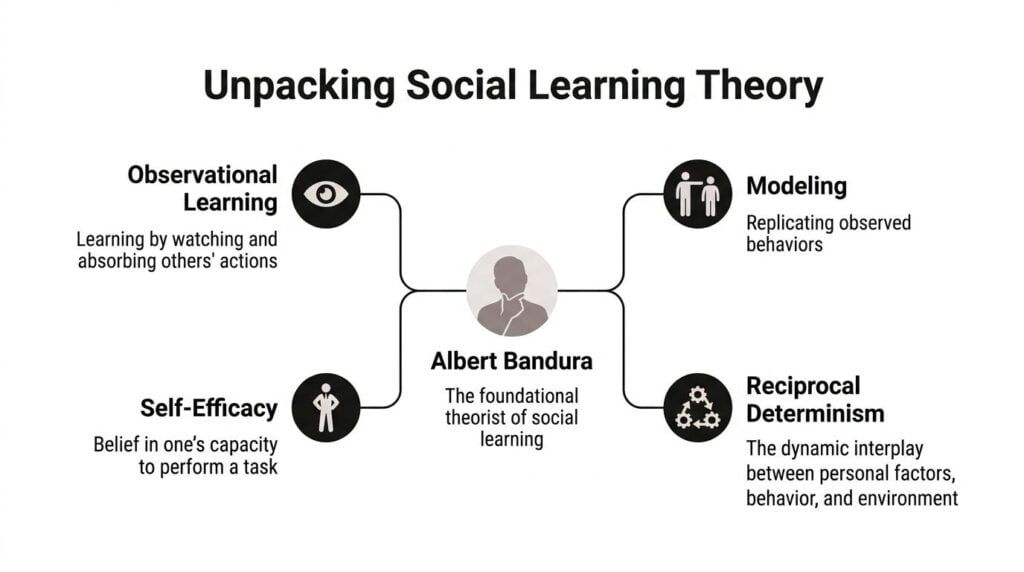
Albert Bandura gave this idea a clear shape when he published Social Learning Theory in 1977. His core point was simple and powerful. People don’t learn only through direct experience. We also learn by observing others, noticing outcomes, and deciding what to imitate.
That sounds obvious once you hear it.
It’s how people learn to use a new app by watching a walkthrough. It’s how a child learns everyday behavior by copying adults. It’s how many course students finally “get it” after seeing a peer explain a concept in plain language.
The Bobo doll study in plain English
The famous example is Bandura’s Bobo doll experiment from 1961.
Children watched an adult interact with a Bobo doll. Some saw aggressive behavior. Later, the children were given the chance to play. According to the Berkeley overview of how social learning theory works, 83% of children who observed aggressive adult behavior later reproduced that same physical aggression, compared with 13% in the control group.
That result matters because it shows something course creators often underestimate. People don’t need long explanations before behavior starts to spread. Often, they need a model.
If learners repeatedly see examples of thoughtful discussion, finished assignments, peer wins, or a clear method for solving a problem, those behaviors become easier to copy.
The four stages that make social learning work
Bandura’s model is especially useful because it breaks learning into four stages. If one stage is weak, the whole experience gets weaker.
Attention
Learners have to notice the behavior first.
Think about watching a Netflix show with your phone in hand. If you half-watch it, you miss the plot. Learning works the same way. If your student never notices a useful example, the lesson won’t land.
In a course, attention is helped by things like:
- A strong demo: a short screen recording that shows a process clearly
- A standout peer example: a student post that makes success visible
- A live walkthrough: an instructor or alumni member solving a problem in public
Retention
Next, learners need to remember what they saw.
Watching isn’t enough. They need a way to store the pattern mentally. This is why quick summaries, checklists, frameworks, and lesson recaps matter so much.
A good tutorial doesn’t just show the clicks. It helps the learner remember the sequence.
Reproduction
Then they try it themselves.
This is the point where many online courses break. They explain concepts well but don’t give learners a small, realistic way to practice. If I watch someone ride a bike, I still need a chance to wobble, try, and adjust.
That’s why social learning works best when observation is paired with action.
Motivation
Finally, learners need a reason to keep doing the behavior.
Sometimes that reason is internal. Sometimes it comes from seeing that the behavior leads somewhere useful. If a student sees peers getting feedback, recognition, progress, or visible wins, motivation gets stronger.
Social learning gets practical when you design for what people can see, remember, try, and feel rewarded for.
If you want more examples of how this works in digital training, this roundup on social learning theory examples in online training is a useful next read.
How Social Learning Boosts Engagement and Sales
When course creators hear “social learning,” they sometimes think about forums that nobody uses or community features that look nice in a demo. That’s too narrow.
In practice, social learning affects three business outcomes that matter a lot. Engagement, completion, and retention.

Engagement rises when learners can see each other learning
A silent course asks every learner to generate momentum alone.
A social course gives them visible cues. Someone posts a win. Someone asks a good question. Someone shares a before-and-after. Suddenly the program feels active, and action becomes easier to imitate.
According to the Cleveland Clinic summary provided in the source material, organizations using social learning approaches report that learner engagement can rise by as much as 60%. That tracks with what many of us see in memberships. People participate more when they can observe progress, not just consume lessons.
If you run workshops or live sessions, peer modeling can matter even more. The same source notes 40% higher completion for webinars that include peer testimonials, which makes sense. Testimonials grab attention and strengthen motivation because learners can picture someone like them succeeding.
Completion improves when the course feels inhabited
People finish more often when they don’t feel like they’re studying inside an empty room.
A course with community signals tells learners, “Others are doing this too.” That changes the emotional experience. It softens uncertainty and adds accountability without making the course feel rigid.
Here are a few design patterns that often help:
- Visible progress threads: learners post what they completed this week
- Peer examples inside lessons: students can see finished work, not just instructions
- Cohort checkpoints: learners respond to one question at the end of each module
If you’re trying to shape this kind of environment, these community engagement best practices are worth reviewing before you add more features.
Retention and sales improve when the community becomes part of the product
In this context, social learning becomes commercially important.
Content can be copied. A living learning environment is harder to replace. If members stay because they value the examples, responses, recognition, and discussion inside your ecosystem, your offer becomes stickier.
That’s one reason gamified participation can work so well when it supports real learning behavior. For language educators, this piece on leveraging gamification in ESL practice shows how game mechanics can reinforce participation and repetition without turning learning into noise.
A short explainer can make this easier to visualize:
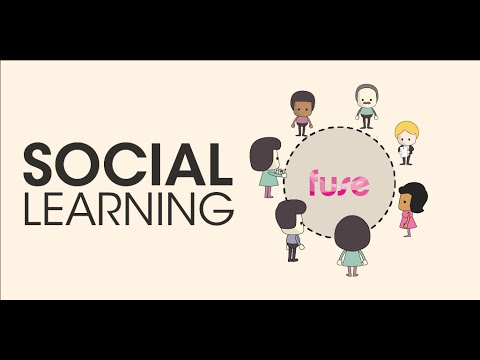
When learners associate your membership with forward motion, they’re more likely to stay subscribed, recommend it, and buy the next offer. That doesn’t happen because “community” sounds trendy. It happens because people keep returning to spaces where progress is socially visible.
Practical Ways to Implement Social Learning
This is the part most course creators care about. How do you turn theory into an actual product experience?
The simplest answer is this. Match your activity design to the four stages of social learning. Don’t just add a forum and hope for magic. Give learners something specific to notice, remember, practice, and feel rewarded for.
Start with activities that create attention
Attention is easiest to build when the behavior you want is visible and concrete.
If you teach design, show side-by-side student revisions. If you teach marketing, post teardown videos of real campaign drafts. If you teach language learning, let learners hear good responses, not just read rules.
Useful formats include:
- Expert or alumni Q&A sessions: Learners watch how an experienced person thinks through a problem.
- Annotated screen recordings: Great for software courses because students can follow the exact sequence.
- Showcase posts: Feature one strong student example each week and explain why it works.
Platforms like Circle.so make this easier when you use separate spaces for wins, work-in-progress, and topic-specific discussion. The tool itself isn’t the strategy, but clean spaces help learners notice the right behaviors faster.
Use retention tools that reduce mental friction
A lot of creators assume memory takes care of itself. It doesn’t.
If learners are going to copy a process later, they need a simple way to hold onto it now. That’s why retention often improves when you pair social interaction with structure.
Try things like:
- Lesson recap prompts: Ask learners to post the one idea they’ll use this week.
- Community-made cheat sheets: Invite members to summarize a framework in their own words.
- Drip prompts: Release short practice tasks over time so the concept comes back into view.
If a learner says, “I understood it when I watched it, but I forgot how to do it later,” you don’t have a motivation problem. You usually have a retention problem.
Build reproduction into the course, not after it
Here, action unfolds.
People need low-risk opportunities to try the skill in public or semi-public. Public doesn’t have to mean high pressure. It can mean a small challenge thread, a peer review lane, or a screen recording posted to a private group.
According to the Digital Learning Institute source in the provided data, D2L’s 2026 implementations found that hybrid social modules, which combine content with peer interaction, can produce up to 35% faster skill acquisition than solitary LMS paths. Since that finding is future-dated, it’s best treated as a reported implementation result for that year rather than a universal rule. Still, the practical lesson is clear. Blending instruction with peer interaction can accelerate applied learning.
Good reproduction activities look like this:
- Peer-review assignments: Learners submit work and review one other submission using a rubric.
- Build in public threads: Members share a draft, prototype, or practice attempt.
- Group problem-solving challenges: Small groups solve one applied task and compare approaches.
If you use Heartbeat Chat, this kind of lightweight interaction can work well in faster-moving communities where short prompts and quick responses fit the culture.
Motivation needs visible rewards, not just encouragement
Motivation gets misunderstood a lot.
Learners don’t always need hype. Often they need evidence that effort leads somewhere. That evidence can be social. A reply from a peer, a featured post, a badge, a round of recognition during a live call, or seeing someone at a similar stage make progress.
A few easy wins:
- Weekly wins threads: Members post one completed action
- Before-and-after showcases: Great for skill-based programs
- Peer nominations: Members highlight someone else’s useful contribution
- Office hours with hot seats: Public coaching turns success patterns into shared material
From theory to action
| Stage | What It Means | Course Activity Example |
|---|---|---|
| Attention | Learners notice a behavior or method | A weekly teardown video or alumni walkthrough |
| Retention | Learners remember what they observed | A recap post, checklist, or learner summary thread |
| Reproduction | Learners attempt the behavior themselves | Peer-reviewed assignment or build-in-public challenge |
| Motivation | Learners see a reason to continue | Wins thread, badges, featured examples, or live recognition |
Pick features based on behavior, not hype
When creators compare tools, they often ask which platform is best. I think a better question is which behavior you want to support.
- For deeper threaded discussion: Circle.so often fits well
- For quick, chat-style momentum: Heartbeat Chat can be a strong option
- For visual explanation and interactive demos: Gamma.app can help you present modeled workflows clearly
- For cohort-based learning: Any platform with structured spaces, events, and prompts can work if the instructional design is right
The biggest mistake is buying a community platform before deciding what learners should do inside it.
Tracking Success and Proving ROI
If you add social learning features, you need to know whether they’re changing behavior or just making your platform busier.
That means looking past vanity metrics. Total members, raw comment counts, and “likes” can be useful signals, but they don’t tell you enough on their own. I’d rather know whether learners are moving from observing to participating to completing.

The KPIs that matter more than noise
A healthy social learning environment usually shows up in behavior patterns like these:
- Time to first community post: How long does it take a new learner to contribute something?
- Percentage of active cohort members: Who is posting, replying, or attending, not just logging in?
- Question-to-answer ratio: Are learners helping each other or only waiting for the instructor?
- Completion rate for social assignments: Do learners finish peer reviews, group work, or challenge prompts?
- Repeat participation: Are the same people returning to discussions week after week?
These KPIs tell you whether your environment is doing what it should. They reveal movement.
Use the 70-20-10 lens carefully
The 70-20-10 framework is helpful here because it reminds us that formal instruction is only part of how people learn. In the verified data provided for this article, social learning is tied to the 20% portion of that model focused on learning with others.
That matters when you explain ROI to a team, client, or co-founder. If your course has strong videos but weak peer interaction, you may be underinvesting in a major part of the learning experience.
Connect behavior to business outcomes
The strongest ROI stories happen when platform activity links to outcomes you already care about.
According to the Learningbank source in the provided data, D2L’s 2026 workplace data reported that peer-awarded badges can increase course completion by 28%. The same source says social learning features can reduce churn in e-learning memberships by 18-22%.
Those numbers are useful because they point to two levers many creators already track. Completion and retention.
Don’t ask only, “Did people talk more?” Ask, “Did more learners finish, return, and stay subscribed after we changed the environment?”
A practical reporting habit is to compare one cohort before and after a specific social feature launch. For example, add peer feedback to one module, then watch whether completion and contribution behavior change. Small experiments make the ROI much easier to see.
Why Social Learning Sometimes Fails
Social learning is powerful, but it isn’t automatic.
A lot of creators add a forum, call it community, and then wonder why nobody shows up. Others choose a tool with lots of features but no clear learner behavior in mind. Both paths usually lead to the same result. A digital ghost town.
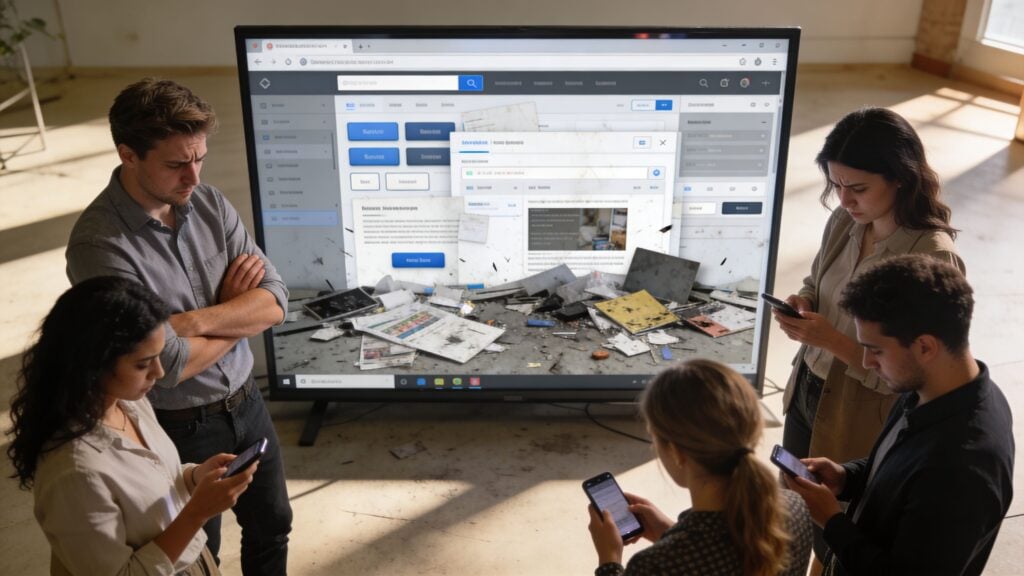
The ghost town problem is usually a design problem
Learners rarely self-organize well at the start.
If you open a discussion area and write “Introduce yourself,” you may get a brief burst of activity. Then it fades. That happens because people still don’t know what kinds of contributions matter, what good participation looks like, or why they should come back.
You have to model the behavior first.
That means:
- Seed better prompts: Ask for a draft, a decision, a reflection, or a concrete example
- Show strong responses: Feature them and explain what makes them useful
- Reply with structure: Don’t just praise. Extend the thinking so learners see how discussion works
- Create recurring rituals: Weekly wins, Friday feedback, monthly teardown calls
Learners often need a script before they can create a habit.
Tool choice can distract from learning design
I’ve seen creators spend weeks comparing platforms while ignoring the more important question. What exact interaction should happen after each lesson?
A bad strategy inside a good tool still fails. A clear strategy inside a simpler tool often works better.
For example, Circle.so can support rich discussion, events, and subgroup structure. Heartbeat Chat can support lighter, faster interaction. But neither one fixes vague prompts, absent facilitation, or weak examples.
Adult learners need more support than many creators expect
The common advice around social learning often gets too simplistic.
The child-focused examples make the theory easy to understand, but adult online learners bring different constraints. They have jobs, interruptions, identity concerns, and less tolerance for unclear participation.
The contrarian data in the provided source material is useful here. According to the WGU article cited in the verified data, neurocognitive studies indicate that adolescents outperform adults in adaptive social learning by 35%, and efficacy can drop by 28% in virtual settings for adults when it isn’t properly mediated.
That doesn’t mean social learning is weak for adults. It means adult remote learning needs more intentional support.
What better mediation looks like
If your learners are adults in remote settings, build more scaffolding than you think you need.
A few examples:
- Give response templates: “Post your draft, your sticking point, and one question.”
- Lower the social risk: Start with small-group channels or asynchronous sharing before live critique.
- Normalize lurking as observation: Some learners learn a lot before they ever post.
- Use facilitator modeling: Record yourself giving good feedback so members can copy the pattern.
- Match rewards to the audience: Some groups care about visibility, others care more about mastery or practical outcomes.
One hidden failure point is assuming all participation has to be loud. It doesn’t. Some members observe passively for a long time and still learn through modeling. If you treat every lurker as disengaged, you may push them too hard and too early.
The better approach is to design paths from observation to low-stakes participation to fuller contribution.
Start Building Your Learning Community Today
The big shift is simple. Stop thinking of your course as a content container. Start treating it like a learning environment.
That’s what social learning changes.
When you understand what is social learning, you stop asking only how to organize lessons. You start asking what learners will see, copy, practice, and get recognized for. That leads to stronger instructional design, better community choices, and a product that feels more alive.
You also don’t need to rebuild everything this week.
Start with one move that makes progress visible. My favorite is a weekly wins thread. Ask learners to post one action they took, one result they noticed, or one obstacle they got past. It’s easy to run, easy to join, and it naturally supports modeling and motivation.
If you work with founders or community-led programs in newer ecosystems, this guide with insights for MENA startup founders has useful ideas on building engaged communities around shared momentum.
And if you want a practical next step for course design, this guide on how to build community in an online course is a strong place to continue.
Start small. Be consistent. Model the behavior you want to see.
That’s usually how the quiet course begins to wake up.
If you’re building courses, memberships, or cohort programs and want more practical guidance like this, LearnStream regularly publishes hands-on advice for designing learning experiences people complete.