How to Build a Course Sales Funnel That Converts
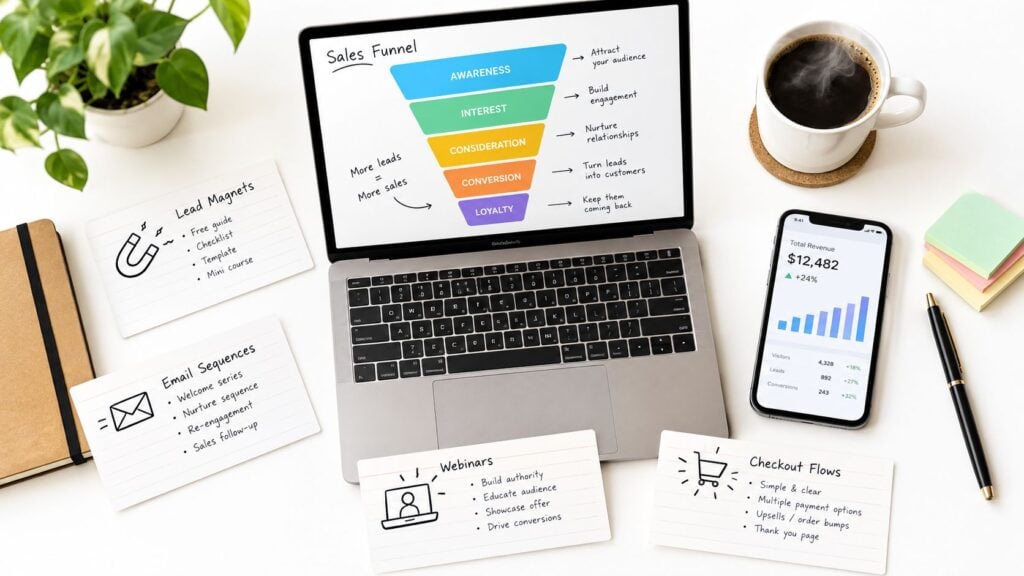
You’ve probably seen this happen. A course page gets visitors, your analytics dashboard looks busy, and yet enrollments barely move. You change the headline, adjust the ad creative, publish another social post, and send more people to the same checkout page. The traffic keeps coming, but the money still leaks out somewhere between interest and payment.
A course sales funnel works when every stage gives the right person a clear reason to continue. That means matching traffic to intent, offering a useful first step, building trust through email, and removing friction when someone is ready to buy. The overlooked part is what happens after the sales page. Checkout, payment options, order bumps, abandoned-cart recovery, and onboarding can influence revenue just as much as the top of the funnel.
Mapping Out Your Course Sales Funnel Stages
A course can attract steady interest and still lose buyers before payment. The leak often sits between a promising sales page and a completed checkout, while the creator keeps trying to increase traffic. Map the full journey before changing the acquisition campaign.
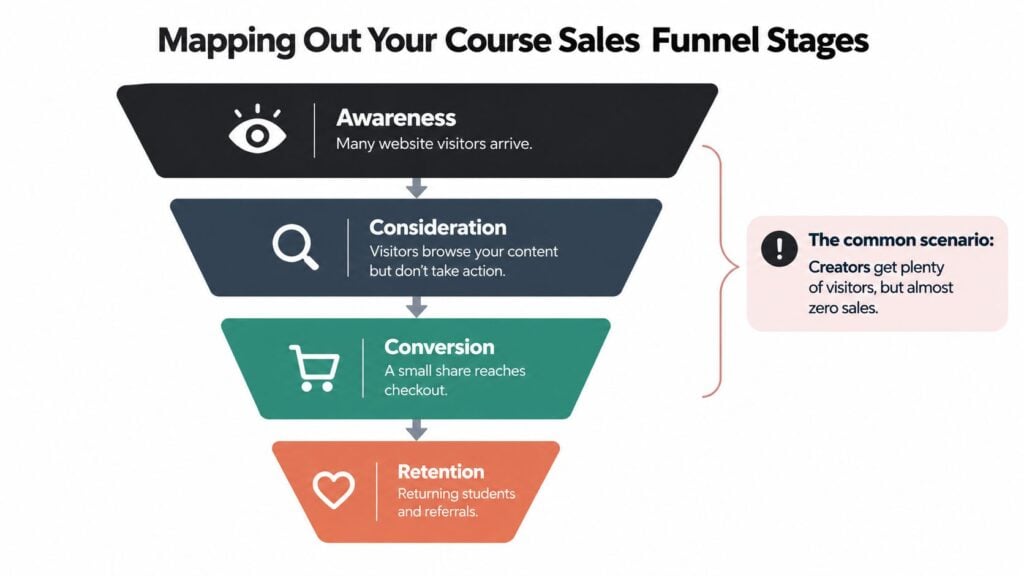
A practical course sales funnel has four stages:
- Awareness: A person discovers your content, advertisement, podcast, or search result.
- Consideration: They read, watch, compare, download, or attend something.
- Conversion: They select the course, assess the offer, and reach checkout.
- Retention: They begin learning, complete lessons, return for more, and may refer others.
Why traffic quality changes the numbers
A visitor from a broad social post has a different level of intent from someone searching for a specific solution. Current course funnel benchmarks place cold-traffic landing-page conversion at 0.75% to 1.5%, while warm audiences can reach 1.5% to 3%. Closely matched search traffic can reach 3% to 5%, according to course funnel benchmarks from AtomicFunnels.
Use these ranges to diagnose performance, not to promise an outcome. A cold audience converting below a warm audience does not automatically indicate a weak page. The offer may be asking unfamiliar visitors to make a decision before they have enough proof or context.
A focused guide, checklist, or workshop can give those visitors a lower-risk next step. The right response depends on where intent drops, not just on how many people arrive.
Track the stages separately. Awareness creates attention, consideration supplies evidence, conversion addresses risk and checkout friction, and retention shows whether the purchase delivered value. Purchase totals alone cannot reveal whether the leak comes from irrelevant traffic, weak follow-up, unclear offer details, or hesitation at payment.
Map the actual path, not the ideal one
Record the route a real prospect follows:
- Search result or short video.
- Educational article or landing page.
- Lead magnet opt-in.
- Welcome and nurture emails.
- Sales page, webinar, or consultation.
- Checkout.
- Course access and first lesson.
For every step, note the intended action and the fallback. A visitor who skips the opt-in may need more educational content. Someone who reaches checkout without paying may enter an abandoned-cart sequence. A user-flow diagram can help you build better products with UX flow, particularly when different audience segments enter through different channels.
Practical rule: Every page should answer one question and make the next action obvious.
Pay special attention to the final steps. Review payment errors, unanswered objections, confusing fields, missing payment choices, and upsell interruptions instead of assuming more traffic will solve the problem. Once the path is visible, you can identify whether attention, trust, payment, or early course engagement is costing revenue.
Designing Lead Magnets That Actually Convert
The first meaningful exchange in a course sales funnel is usually an email address. People won’t give it away for a vague promise, and a huge free module can create the wrong expectation. A useful lead magnet should solve one narrow problem and make the paid course feel like the logical next step.

Think about the first result your student needs. For a course on workplace wellness, a daily habits checklist may be more effective than a long introductory ebook. For a course on freelance writing, a proposal template can create a quick win while revealing why the prospect needs deeper help with positioning, pricing, and client acquisition.
Make the free offer a bridge
A strong lead magnet has three qualities:
- Specific: It addresses one recognizable problem rather than an entire subject.
- Usable: The reader can apply it without needing a lengthy explanation.
- Connected: The next challenge naturally leads into your paid curriculum.
A free mini-workshop can work well when the topic has an obvious outcome. A diagnostic quiz may suit a course where learners need to identify their level or bottleneck. A template, checklist, or short guide can be better when the audience wants something practical immediately.
The opt-in page should keep the decision simple. State what the person will receive, what problem it helps with, and what happens after signup. Ask only for information you need to deliver the resource and segment the subscriber appropriately.
Free trials deserve more care than they usually get. A trial removes financial risk and may increase signups, but research discussed in this membership business model analysis notes that customers acquired through free trials had higher churn and lower customer lifetime value than regular customers. That makes a free trial a poor default if it attracts people who want to browse without committing to the learning outcome.
A targeted resource can filter for stronger intent. Someone who downloads a course-specific worksheet has already shown interest in the problem your curriculum solves. The resource doesn’t need to teach everything. It needs to demonstrate your method and create momentum.
Use the thank-you page well
Don’t end the process at the download button. Use the thank-you page to tell the subscriber what to do first, invite them to a relevant lesson, or explain how the paid course expands on the free resource. Keep the transition helpful rather than turning the page into an aggressive pitch.
A short email sequence can then deliver the resource, show one practical application, address a common obstacle, and introduce the course when the connection is clear.
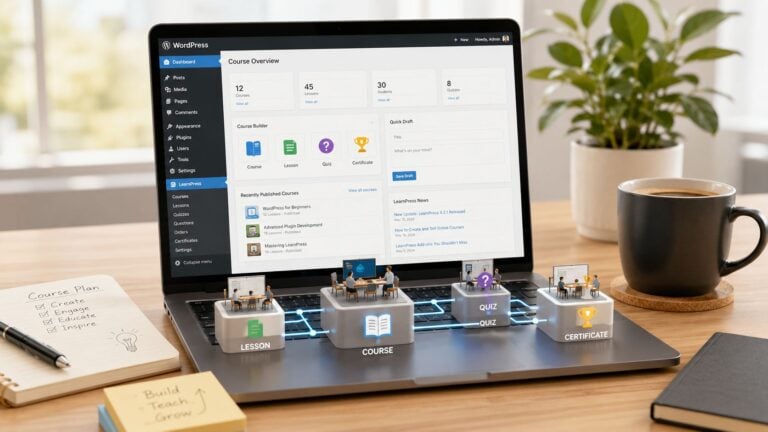
Here’s a visual example of how a simple resource can support a learning journey:
The best lead magnet doesn’t maximize downloads in isolation. It attracts people who are likely to value the full course, then gives them enough progress to understand why structured support may be worthwhile.
Building Email Sequences and Sales Mechanisms
An email list gains value only when messages reflect subscriber behavior. A person who downloads a guide and ignores promotional emails needs a different route from someone who watches a webinar, visits the pricing page, and starts checkout. Treat those actions as signals, not as minor variations inside one broadcast sequence.
Start with delivery and orientation. Tell subscribers what they received, how to use it, and which result to pursue first. Follow with practical teaching around the problem your course solves. Each message should make the paid offer easier to understand, connect the lesson to the course, or remove a specific buying objection.
Route people by behavior
Behavior-based routing gives you more control than a single nurture sequence. A workable system can create paths for:
- New subscribers: Deliver the lead magnet and establish the course’s core promise.
- Engaged readers: Send a deeper lesson, answer an objection, or invite them to a workshop.
- Sales-page visitors: Share relevant proof, clarify the curriculum, and address perceived risk.
- Checkout starters: Offer payment information, answer questions, or send a timely reminder without restarting the full nurture sequence.
- Inactive subscribers: Reduce promotional pressure and provide a useful reason to re-engage.
A course sales funnel should combine retargeting, conditional email automation, and behavior-based routing instead of sending identical messages to every subscriber, as outlined in this course funnel automation guidance from Graphy.
ConvertKit and ActiveCampaign can support tags, conditional branches, and behavior-triggered emails. Choose the platform whose tagging model matches these five segments. If it cannot branch on checkout-start events, it will not support this routing regardless of its feature list. Define the action that moves someone into a higher-intent segment, the next message they should receive, and the event that removes them from a promotion.
Small routing decisions often protect more revenue than another top-of-funnel campaign. A buyer who reaches checkout and receives a generic introductory email may lose confidence, while a warm prospect who gets no follow-up can disappear without raising an obvious warning.
Choose the right sales mechanism
A standard sales page fits an offer that is easy to understand and gives prospects enough context to evaluate it independently. A webinar or live workshop suits a course that requires demonstration, explanation, or a larger trust investment.
The mechanism affects the stage where prospects convert. Warm-audience sales pages are commonly benchmarked at 12% to 24%, while webinar funnels see 2% to 5% of registrants buy, according to online course funnel benchmarks from AtomicFunnels. These figures describe different stages and audiences, so use them as directional benchmarks rather than direct comparisons.
Video testimonials can help prospects recognize themselves in the promised outcome, especially when the course supports personal or professional change. Payment plans can reduce the size of the immediate decision. For high-intent prospects, a personal reply or short consultation may resolve an objection that another automated email cannot.
Trust grows when the message reflects the prospect’s behavior. Someone who has watched the lesson should not receive the same introduction as someone who just joined.
Email should create forward movement without making every interaction feel like a pitch. Teach something useful, show how your process works, and make the buying decision easier to evaluate.
Optimizing Checkout Pages and Upsell Flows
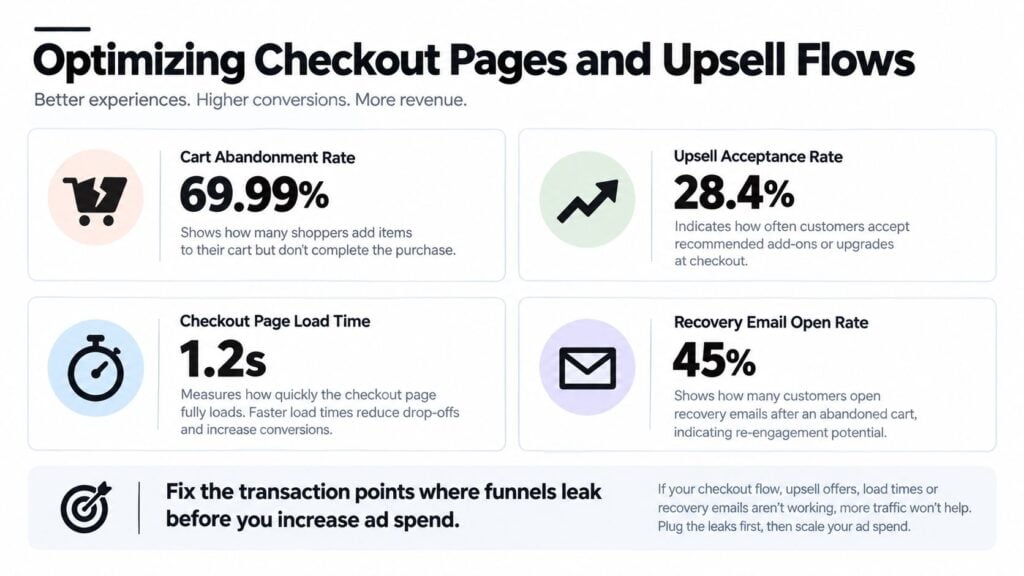
A qualified buyer can reach the payment page, hesitate over one unclear term, and leave without creating an obvious warning. Creators often spend days refining advertisements while giving the checkout only a quick review. That priorities problem matters because leaks near payment can waste demand already generated upstream.
For courses priced above $2,000, average sales-page-to-purchase conversion was reported at 0.1% to 0.5% in 2026, while checkout completion averaged 55% to 65%, according to Accelerоi’s course conversion analysis. These benchmarks describe two separate leaks. Some visitors do not become buyers after viewing the offer. Others show enough intent to start checkout but fail to finish payment.
Remove hesitation before payment
The checkout page should confirm the decision and answer practical questions before the buyer searches elsewhere. Keep the layout focused, with these details easy to find:
- Offer clarity: Restate the course outcome, format, access terms, and what happens immediately after payment.
- Payment flexibility: Show available payment plans plainly when they suit the offer.
- Risk reduction: Explain guarantees, support, refund terms, and access conditions outside hidden fine print.
- Technical reliability: Test the flow on mobile, verify confirmation emails, and ensure the learner reaches the course without confusion.
Payment plans deserve close attention for premium offers. They can recover 20% to 30% of buyers who would otherwise drop off, according to this buyer behavior resource from LinkedIn Learning. Installments will not suit every course. They can, however, separate payment capacity from genuine interest, giving an interested buyer another way to proceed.
An order bump should support the main purchase. A template pack, implementation workbook, or assessment works when it helps the buyer apply the lessons. A loosely related product added at the final step usually creates doubt instead of increasing value.
Build the post-purchase path carefully
Treat order-bump and abandoned-cart performance as directional benchmarks rather than promises. Results depend on the audience, offer, checkout experience, and recovery message. Review the figures alongside your own buyer behavior, especially when the offer or payment process changes.
A post-purchase upsell should address the next problem created by the original purchase. A self-paced course might lead to a feedback session, implementation clinic, or advanced program. Present the offer after confirmation, and state clearly that declining it will not affect access to the original course.
An abandoned-cart email can name what the prospect selected, answer a likely objection, and provide a direct route back to payment. Do not claim that the cart is expiring if it is not. Honest reminders protect trust while giving an interested buyer a practical way to finish.
Checkout test: Complete the purchase yourself from a phone, using the path a first-time buyer follows. Confusing fields, broken redirects, and missing access emails become obvious immediately.
Fixing these details can produce more from existing demand than another round of top-of-funnel promotion.
Tracking Funnel Metrics and Running Split Tests
A dashboard full of numbers can still leave you guessing. Track the event that each stage is supposed to produce, then compare the movement between stages.
At the awareness stage, review traffic source, landing-page visits, and the action that moves a visitor into consideration. At the lead stage, measure opt-ins and the quality of subscribers who continue engaging. During nurture, watch clicks into the sales experience, webinar registrations, and sales-page visits. At checkout, measure starts, completions, payment-plan selections, order bumps, and recovered carts.
Don’t judge a channel only by its first conversion. A source that produces fewer leads but more qualified buyers may be more useful than a channel that fills your list with people who never progress.
Track activation after the sale
The first lesson is an important quality signal because enrollment alone doesn’t prove that the student has started learning. LearnyBox recommends tracking first-lesson starts, with 70% or more of enrollments starting within 48 hours serving as a healthy activation benchmark.
If that figure is weak, inspect the onboarding path before changing your advertisements. The welcome email may bury the login link, the first lesson may feel too demanding, or the learner may not understand what to do next. Activation data helps connect marketing performance with the actual student experience.
For campaign-level measurement, use consistent tracking parameters and a reliable link management system. A practical review of best link tracking tools can help you compare email, paid, partner, and organic traffic without relying on memory.
Test decisions, not decoration
A split test should answer a business question. Test the offer structure, payment options, course promise, proof format, or the order of information before spending time on minor visual changes.
Useful hypotheses include:
- A payment plan will reduce hesitation for a high-consideration offer.
- A specific outcome headline will attract more qualified visitors.
- A video testimonial will clarify the transformation better than a general written endorsement.
- A related implementation bonus will increase order-bump acceptance.
Change one meaningful variable at a time and document the audience, page, dates, and primary metric. If you’re testing a sales page, use this guide to split testing a course sales page as a reference point for structuring the experiment.
Look for the bottleneck rather than chasing a universal conversion target. If opt-ins are healthy but sales-page visits are weak, review the email sequence. If checkout starts are strong but completions lag, review payment friction and reassurance. The metric tells you where to investigate, not automatically what to change.
Choosing the Right Tech Stack for Your Setup
Your technology stack should support the learner journey without making every change a small engineering project. The right setup depends on how comfortable you are with integrations, how much control you need, and whether your current funnel is simple or segmented.
An all-in-one platform reduces the number of connections between landing pages, email, checkout, course access, and reporting. That convenience can be valuable for a solo creator who wants fewer failure points. The trade-off is that you may get less flexibility in a specialized function.
A modular stack gives you more choice. You might pair a dedicated learning platform with ConvertKit or ActiveCampaign, Stripe for payments, a webinar tool, and an analytics layer. This can work well when you already know which tools you prefer, but each connection needs testing and maintenance.
Compare the common configurations
| Stack Type | Best For | Key Tools |
|---|---|---|
| All-in-one | Creators who value simpler administration | LearnStream, Kajabi, or LearnyBox for course delivery, pages, email, and checkout |
| Modular starter | Creators validating an offer with focused needs | WordPress or a landing-page builder, ConvertKit, Stripe, and a hosted course platform |
| Automation-led | Teams using multiple behavior-based segments | ActiveCampaign, a course platform, Stripe, webinar software, and analytics |
| Premium modular | Established businesses needing specialized control | Dedicated LMS, advanced email platform, payment system, CRM, webinar platform, and reporting tools |
The table is a starting point, not a prescription. Review how to choose a tech stack against your actual workflow before buying another subscription.
Design for reliable handoffs
Whatever stack you choose, define the events that connect the systems. A completed purchase should grant access, remove the prospect from sales emails, trigger a welcome message, and record the transaction. A failed payment should create a support path rather than leave the learner in an uncertain state.
Behavioral triggers are useful when they remain understandable. If a subscriber watches a webinar, visits checkout, and clicks a payment-plan link, you can route them toward a more relevant message or personal outreach. Keep a written map of those rules so you can debug the funnel when something changes.
Avoid adding a tool because it offers one attractive feature. Start with the journey, then select the smallest stack that handles the required events reliably. Test the full path before sending traffic, including opt-in delivery, email timing, checkout confirmation, course access, and post-purchase routing.
A stable setup gives you room to improve the offer instead of constantly repairing integrations. That matters more than having the longest list of software.
The fastest way to improve your course sales funnel is to inspect the stages closest to revenue first. Test your checkout on mobile, add a clear payment option where appropriate, create a relevant order bump, and set up a short abandoned-cart sequence. Then track first-lesson starts so you know whether new buyers are moving into the learning experience. Once those foundations work, invest in more traffic with confidence.