Online Course Pricing Strategy

You’ve finished recording the lessons, polished the checkout page, and chosen a launch date. Then the uncomfortable question appears: what should this course cost? Set the price too low and you may attract buyers who don’t commit, while leaving little room for support, marketing, or future improvements. Set it too high without enough proof and your audience may hesitate before they understand the outcome.
A practical online course pricing strategy gives you a way through that tension. You can start with a defensible price, protect access for early students, and raise the offer as your evidence, positioning, and delivery improve. The key is to test pricing as part of the product, rather than treating the number as a permanent verdict on your expertise.
Where Most Creators Get Pricing Wrong
A creator I’ve worked with once priced a substantial self-paced programme at the same level as a short introductory workshop. The logic sounded reasonable. The course had no live calls, the audience was relatively new, and a lower price felt safer for the first launch. Sales came in, but the low price created new problems. Buyers asked for extensive one-to-one help, some treated the course as an impulse purchase, and the creator couldn’t comfortably fund the improvements needed for the next version.
That pattern is common because creators often price content volume instead of the learner’s destination. Hours of video, worksheets, and modules matter, but they don’t automatically determine what the offer is worth. A focused course that helps a buyer complete a valuable task can justify more than a larger library with no clear path to action.
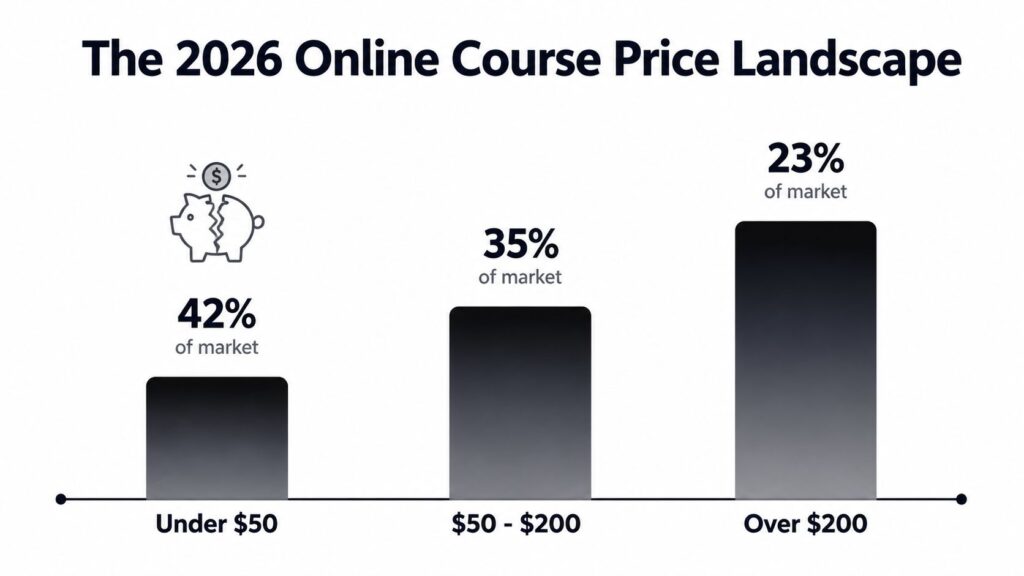
The 2026 market benchmark from Ruzuku shows why a single “average course price” can mislead. Across its large platform sample, the median paid course price was $110, while the mean was $416, with high-ticket coaching, certification, and premium programmes pulling the average upward (Ruzuku’s 2026 online course pricing benchmark). The middle 50% of paid courses sat between $50 and $333, while the median one-time payment was $99.
The under-$100 comfort zone
Most creators still choose the safer-looking end of the market. One 2026 survey of 1,128 course creators found that 85.8% charged less than $100 for their primary course (Ruzuku’s online course statistics). That number is useful as a reality check, but it shouldn’t become a rule that traps every course below $100.
The same survey found that only about 1% of creators combined pricing of $300 or more with more than 50 students. Premium pricing with broad enrolment is unusual, which suggests that higher prices generally need a sharper promise, stronger trust, specialised expertise, or more support.
Practical rule: If your course promises a meaningful transformation, don’t defend a low price simply because most creators use one.
A free entry point can still make sense. Ruzuku reported that 24.6% of all course price options were free, supporting a funnel where a free resource or low-cost offer reduces friction before a paid upgrade, bundle, or subscription. The mistake is allowing the free or introductory offer to become the only version of your business.
Before choosing your number, ask three questions:
- What changes for the learner? Identify the task, result, or capability they’ll gain.
- How costly is the problem? Consider lost time, missed opportunities, risk, or frustration without assigning invented financial values.
- What support does the offer include? Recorded lessons, feedback, live teaching, community access, and certification create different expectations.
Your first price should sit somewhere the audience can understand and the business can sustain. The sweet spot isn’t the market median by default. It’s the point where the promise, proof, delivery, and buyer risk make sense together.
Choosing the Right Pricing Model for Your Course
Choose the pricing model according to how learners receive value, not according to the format other creators use. A one-time fee fits a stable, self-paced product. A payment plan lowers the immediate commitment for a substantial programme while preserving a larger total price. A subscription earns its place only when access keeps producing value through new lessons, live sessions, community participation, or updated resources.
Ruzuku’s course pricing data reports a median payment-plan price of $212 and a median subscription price of $49.99 per month. Use those figures as reference points, not instructions. Audience, support, subject complexity, and the strength of the promised result should determine your offer.
| Course Format | Best Primary Model | Typical Price Range | When to Add Alternatives |
|---|---|---|---|
| Self-paced introductory course | One-time payment | $30–$99 | Add a free sampler or bundle when the audience needs a low-risk entry |
| Self-paced transformation course | One-time payment | $100–$500 | Add a payment plan when the outcome is substantial and the price creates friction |
| Cohort-based course | Payment plan or one-time payment | $200–$1,000 | Add a premium support tier for feedback, coaching, or smaller-group access |
| Certification programme | One-time payment or payment plan | $500–$5,000+ | Add a lower-content preparatory offer or a higher-support option |
| Ongoing membership | Subscription | $49.99 per month as a benchmark | Add annual or one-time workshop options when buyers aren’t ready for recurring access |
One-time payments
A one-time payment is usually the clearest starting point for an evergreen course. Buyers know the full cost, and you collect revenue without making an ongoing service promise. This model works when the material remains useful without frequent updates, live contact, or continuing community activity.
The trade-off is a continuing need for new buyers, upgrades, or related products. Define “lifetime access” with care. Without a clear boundary, buyers may expect permanent access to every future update, support channel, and live event.
Payment plans
Payment plans make a higher total commitment easier to accept by spreading payments across a schedule. They fit programmes with a clear sequence, accountability, feedback, or a transformation that develops over time. The total price should remain visible at every point in the purchase process.
Administrative work and payment risk increase with instalments. State the full payment-plan price, explain each payment date, and publish access and cancellation terms where buyers can find them. If the plan costs more than a one-time purchase, show that difference plainly.
Company buyers evaluate training through organisational results, procurement requirements, and internal use. For that audience, this guide to pricing a B2B online training programme provides a more relevant framework than individual-learner pricing.
Subscriptions
Subscriptions suit subjects that change and communities that remain active. Regular updates, ongoing coaching, a growing resource library, or peer access can justify recurring billing. A finite course that learners complete once usually needs a different model.
Before choosing monthly payments, name the reason a learner stays for another month. If continued access only means that old videos remain available, a one-time purchase is clearer. If you are comparing adjacent technology-education offers, Trendy’s guide to influencer pricing for AI tools offers context for assessing audience, perceived value, and recurring access.
A practical test is to launch the lowest-complexity model that matches the experience, then measure where buyers hesitate. Keep an introductory offer for price-sensitive learners, but give the core programme a price that reflects its outcome and support. That structure lets you learn from early students without treating an under-$100 entry point as the ceiling for the business.
Building Your Price from Outcome Value
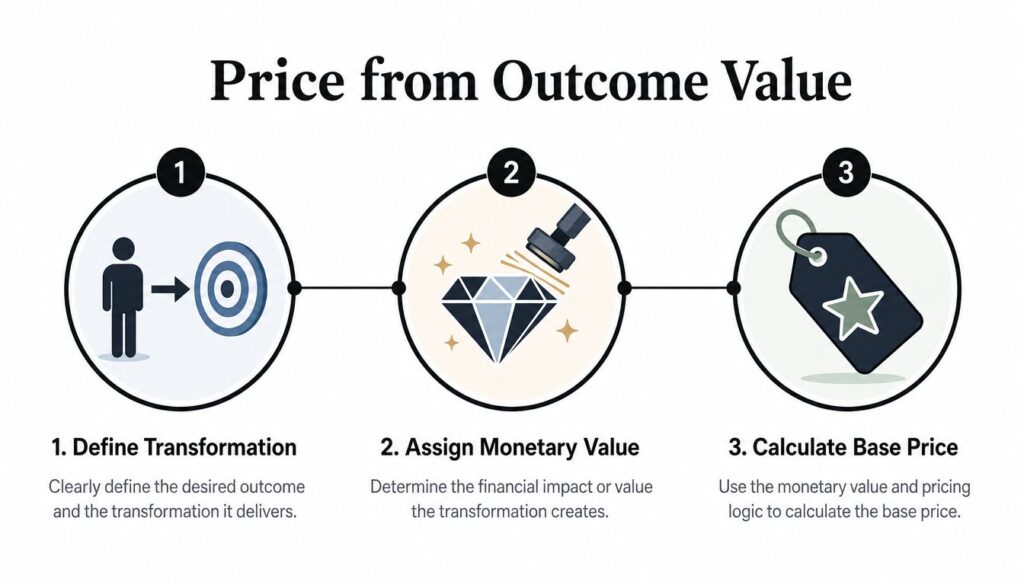
A defensible price starts with the transformation. “Eight modules and six hours of video” describes your production. “Create and launch a repeatable client acquisition system” describes what the learner wants to accomplish.
The distinction matters because buyers compare the course with alternatives, including delay, trial and error, coaching, formal education, and doing nothing. Your offer doesn’t need to be the cheapest route. It needs to make the intended result feel credible and attainable.
Define the transformation
Write the before-and-after state in one sentence. Be specific about who the course serves, what they’ll be able to do, and what evidence will show progress.
A vague promise such as “master content marketing” gives you little pricing power. A narrower promise such as “publish a practical content system for a small consultancy” gives the buyer a clearer reason to consider the offer. Specificity also helps you decide what doesn’t belong in the course.
Then assess the stakes. Beginner learners often need a lower-risk entry point, while experienced buyers may pay more for speed, specialisation, feedback, and access to a proven process. Don’t use audience income as a shortcut for this decision. Look at urgency, prior attempts, and the cost of remaining stuck.
Assign monetary value
You don’t need to invent an exact return for every student. Instead, list the kinds of value the course could create:
- Time value: The learner follows a clear sequence rather than searching through disconnected advice.
- Opportunity value: The new capability may support a job application, client service, launch, or internal project.
- Risk reduction: Templates, feedback, and checkpoints can reduce avoidable mistakes.
- Confidence value: A structured process can help the learner act when uncertainty previously caused delay.
Market context gives you the next boundary. Pricing guidance from LSBA suggests beginner courses around £30–£99, intermediate courses around £99–£299, and advanced transformation courses around £300–£2,500+, with demand tested at each level before scaling (LSBA’s value-based course pricing guidance).
Calculate the base price
Use a three-level ladder:
- Entry: A focused, lower-friction product with a narrow result.
- Core: The complete transformation with the support most students need.
- Premium: More access, feedback, live coaching, certification, or implementation help.
Set a provisional core price first. Then make the entry and premium versions distinct, rather than creating artificial tiers with minor feature changes.
For a new course, validate the number with a small early group. Offer a defined early-bird price in exchange for feedback, participation, and permission to use honest testimonials. After you improve the delivery and collect proof, raise the price for new students. The process described in this value-based pricing strategy guide can help you connect transformation, packaging, and willingness-to-pay research without reducing the decision to content length.
Psychological Pricing Tactics That Work
A polished sales page can still fail when the promise feels weak or the offer seems unclear. Price presentation shapes how buyers read an offer, so apply these tactics only after defining the audience, outcome, and delivery. They also help bridge the gap between the under-$100 course many creators start with and the higher prices a proven transformation can support.
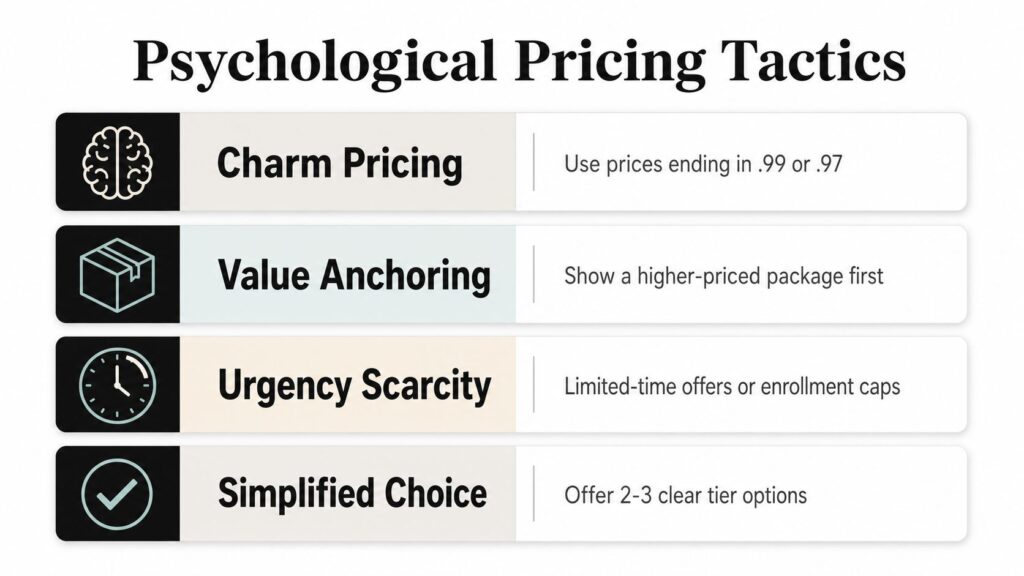
Charm pricing is the familiar example. Threshold prices such as $97 instead of $100, $497 instead of $500, $997 instead of $1,000, and $1,997 instead of $2,000 can create a bargain impression and anchor later offers (Winsome Marketing’s explanation of course pricing psychology). These endings often fit a direct-response sales page. A clean round price may carry more credibility for consulting, institutional training, or a premium advisory offer. Test the presentation against the buyer’s expectations, rather than assuming one ending suits every course.
Set anchors that represent real offers
An anchor gives buyers a reference point. One published framework recommends setting an anchor at two to three times the current price, then presenting three tiers with a decoy option so the intended tier is easier to evaluate (Owwlish’s online course pricing psychology framework).
Every anchor needs a purchasable explanation. If the premium tier includes live feedback, private sessions, or implementation support, display those differences clearly. A fictional “was” price that nobody could buy damages trust and makes the page feel manufactured.
Build a useful choice architecture
Three tiers usually provide enough contrast without turning checkout into a spreadsheet. Label each option by the learner’s situation:
- Self-paced: Core lessons, templates, and platform access.
- Supported: Everything in self-paced, plus group feedback or scheduled sessions.
- Private: Everything in supported, plus individual review or direct implementation help.
Make the middle tier reliable to deliver. The premium tier should serve buyers who need greater access, not merely make the middle option appear inexpensive.
Use urgency without theatrics
A cohort start date, genuine enrolment cap, or real early-bird deadline gives buyers a reason to decide. Do not reset countdown timers, invent limited places, or extend a “launch price” indefinitely. Short-term pressure can cost the trust that supports premium pricing.
Testing and Optimizing Your Prices Over Time
Your launch price is a hypothesis. Treat it that way, while still presenting it confidently. A weak approach is changing the price every time one person hesitates. A stronger approach sets a test period, defines the audience and offer, and records what happens at each stage of the buying journey.
Start with an early-bird round. State the opening price, the closing date, and what changes afterward. Keep the offer stable during the test so you can learn whether the price, the message, or the delivery creates the friction.
Run controlled experiments
Test one meaningful variable at a time where possible:
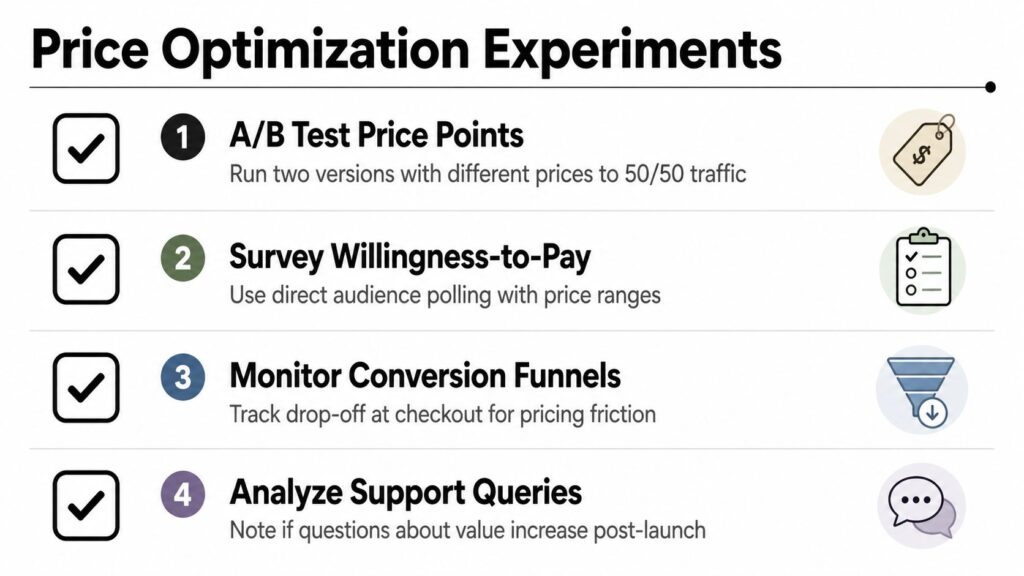
- Price point: Show different prices to comparable audience segments, with the same promise and checkout experience.
- Payment structure: Compare a one-time option with a clearly disclosed payment plan.
- Tier order: Put the premium option first in one version and the core option first in another.
- Offer packaging: Keep the price steady while changing support, templates, or feedback to see whether the perceived value improves.
Use a sales-page testing process such as this guide to split-testing a course sales page to keep the experiment focused. Don’t call a winner after a handful of visits or after a single emotional reaction. You need enough buyer behaviour to distinguish a pattern from noise, although the exact threshold depends on your traffic and sales cycle.
Track the signals that explain price resistance
Revenue alone doesn’t tell you why a test performed well or poorly. Track:
- Checkout progression: Notice whether visitors leave after seeing the price or earlier, when the promise may be unclear.
- Payment-plan selection: Strong interest in a plan can signal that the total value works while the upfront commitment creates friction.
- Questions before purchase: Repeated questions about support, outcomes, access, or refunds reveal missing information.
- Refund and completion feedback: A low price that attracts mismatched buyers can create more support work and weaker learning experiences.
Watch the conversation: If prospects ask what they’ll achieve, improve the promise and proof. If they understand the outcome but need a different payment structure, test the payment structure before cutting the price.
Know when to raise the price
Raise the price when the offer has stronger proof, clearer delivery, and demand that doesn’t depend on constant discounting. You can also raise it when additional support makes the learner experience materially better, provided your capacity can handle the promise.
Lowering the price is appropriate when the audience can’t access the offer, the transformation is too broad for the current proof, or the delivery doesn’t justify the tier. Before reducing the number, check whether the sales page explains the outcome and whether the course is aimed at the right buyer. Many pricing problems are positioning problems wearing a price tag.
If you sell digital services to UK private consumers, review the VAT treatment before publishing your checkout. The UK government states that the supply is liable to UK VAT, while a third-party platform or marketplace may be responsible for accounting for VAT when it sells the service (UK government guidance on VAT for digital services).
Your Complete Pricing Action Plan
A practical pricing plan starts with the learner’s outcome, then connects that outcome to delivery, proof, and buyer access.
Set the first version
- Name the transformation: Describe the learner’s starting point, destination, and evidence of progress.
- Choose the format: Match self-paced, cohort, certification, or membership delivery to the support the outcome requires.
- Benchmark the market: Use comparable offers for context, not as instructions to copy competitors.
- Set three offers: Build entry, core, and premium versions with clear differences in access, feedback, or support.
- Choose the payment structure: Use a one-time fee for stable evergreen value, a payment plan for a larger commitment, or a subscription for continuing value.
- Define the early-bird terms: State the price, deadline, access period, refund policy, and what later buyers will receive.
A low launch price can bring in early students without defining the course’s long-term ceiling. Set the core offer clearly, then reserve premium pricing for added support, access, or accountability.
Avoid predictable pricing mistakes. Module count makes a course sound like a content library. Permanent discounts teach buyers to wait. A premium price without proof creates doubt, while a low price with unlimited support can produce an unmanageable workload.
Review the evidence
After launch, examine sales conversations, checkout behaviour, payment-plan use, refunds, completion feedback, and support volume. Record the questions buyers repeat and the points where students stall. These findings show whether the problem is price, positioning, delivery, or buyer fit.
The creator market remains concentrated below $100, while specialised courses can earn premium prices when outcomes and support justify them. Bridge that gap in stages: test a clear core offer with early students, improve the parts that create friction, add proof, and raise the price when the delivery process is repeatable. Keep an accessible entry option if it serves a distinct buyer without consuming premium-level support.
Choose the transformation and write the three-tier offer this week. Publish defined early-bird terms, collect buyer questions and completion feedback, and schedule a review before the next enrolment window. That evidence will produce a stronger pricing decision than another month of guessing.