Renewal of Membership: A Practical Playbook for Retention

You’re probably looking at a renewal dashboard that should feel encouraging, but doesn’t. The reminders went out, the copy was polished, the timing looked right, and members still drifted away anyway. That gap is where most renewal of membership problems live, not in the send button, but in the value story, the workflow, and the friction sitting between intent and payment.
I’ve seen this pattern enough to trust the diagnosis. The weakest renewal programs usually treat churn like a messaging problem, then wonder why active members leave, why first-year members lag, and why the same people keep slipping through every automated sequence. The fix starts by separating three different failures. Sometimes the message is weak. Sometimes the renewal flow is annoying. Sometimes the member no longer sees a reason to stay.
Why Your Renewal Emails Are Not Working
The most common mistake is assuming the email itself is the problem. You can have a clean subject line, a polite reminder, and perfectly timed automation, and still lose the renewal because the member had already decided the membership was no longer useful. That’s why I look at renewal complaints in layers. If people open but don’t click, the message may be off. If they click but don’t pay, the flow is broken. If they ignore everything, the value proposition has gone soft.
The email was never the whole job
The strongest renewal campaigns do more than ask for payment. They reconnect the member to a reason to stay. When that reason is missing, reminders feel like noise, even if the wording is good.
A lot of operators spend weeks refining copy and almost no time checking whether the member still uses the product, attends events, or sees any practical payoff. That’s a dangerous imbalance because churn doesn’t always happen at the point of renewal. It often happens months earlier, when engagement drops and the member mentally checks out.
Practical rule: if renewal emails are underperforming, audit the member experience before you rewrite the reminder.
That means looking at participation, usage, billing friction, and support history. A renewal message can only recover interest that still exists. It can’t create it from scratch.
Diagnose the failure before you fix it
I split renewal problems into three buckets. Messaging problems show up when members seem interested but need clearer prompting. Value problems show up when members stop engaging long before expiry. Technical problems show up when members mean to renew but get stuck in the checkout path.
Each fix is different. If you treat every lapse as a copywriting issue, you’ll keep sending more reminders to people who don’t want what you’re selling. If you treat every lapse as a pricing issue, you may ignore a broken form or a missing payment method.
A better response is to trace the path from awareness to payment. Find where the drop happens. Then fix that step first. Renewal of membership works best when the ask matches the member’s reality, not when the calendar says it’s time.
What Good Renewal Rates Look Like
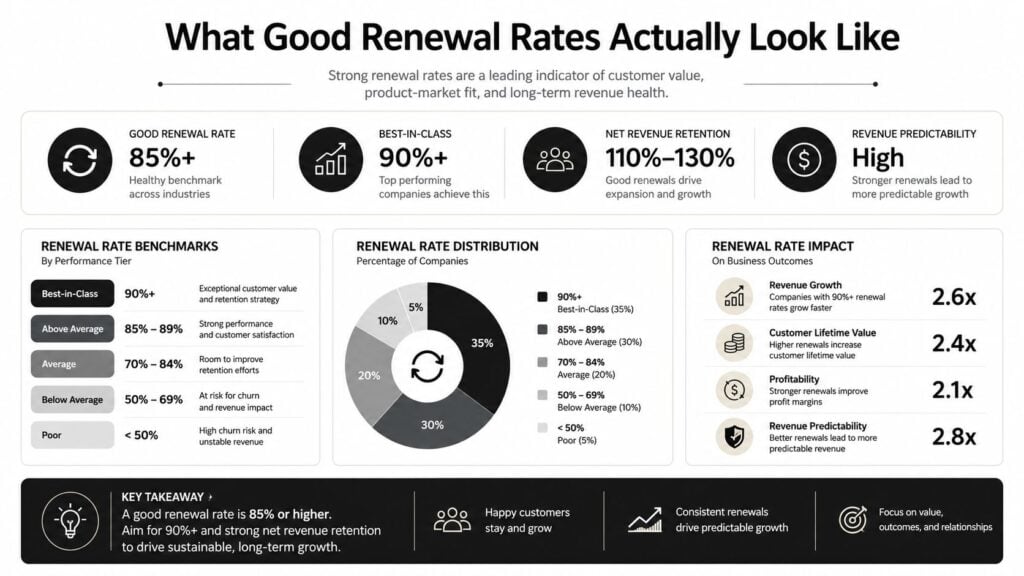
A realistic benchmark matters because renewal numbers can look fine right up until they stop supporting growth. Analysts at the Association of Membership Organizations found a median overall membership renewal rate of 84% and a mean of 83% in a major 2024 benchmark. In that same benchmark, 73% of organizations reported renewal rates at 80% or higher, while 27% were below 80% [Association of Membership Organizations benchmark].
That tells you two things. Renewal is not a side metric, it is a core operating number. The field also clusters around a fairly steady high-80s reference point, which means small changes matter. A few points up or down can move a meaningful share of members between retention and churn.
Member type changes the benchmark
The same 2024 benchmark showed a median of 90% for trade associations. Other segments came in lower. That is a useful reminder that one renewal target does not fit every audience. Professional identity, habit, and the practical utility of membership all shape renewal behavior.
Historical data points in the same sector back this up. In the 2017 benchmark, the median overall renewal rate was 84%, while first-year members renewed at a median of 74%. By 2019, the report again showed a median renewal rate of 85% overall, with 70% of associations reporting renewal rates at or above 80% [2017 and 2019 membership marketing benchmarking report]. That first-year gap is the one I watch most closely, because early lifecycle behavior often predicts the health of the whole base.
If you want a broader retention lens, the customer retention resources at SupportGPT are useful for thinking about recurring value and lifecycle habits across subscription-style businesses.
Read your own number in context
A strong renewal rate on paper can still hide weak segments. New members may be underperforming while long-time members keep the average afloat. One audience type may be thriving while another erodes.
I like to look at renewal by tenure, segment, and engagement level before I celebrate any global rate. That is where the operating story lives. The headline percentage matters, but it does not tell you who is safe, who is drifting, and who needs intervention now.
If you want to reduce churn with SupportGPT, start by comparing renewal outcomes against engagement signals instead of treating every lapse as the same problem. Members who keep logging in, attending, or responding are telling you something different from members who have gone quiet, and your renewal strategy should reflect that difference.
Building a Multi-Touch Renewal Sequence
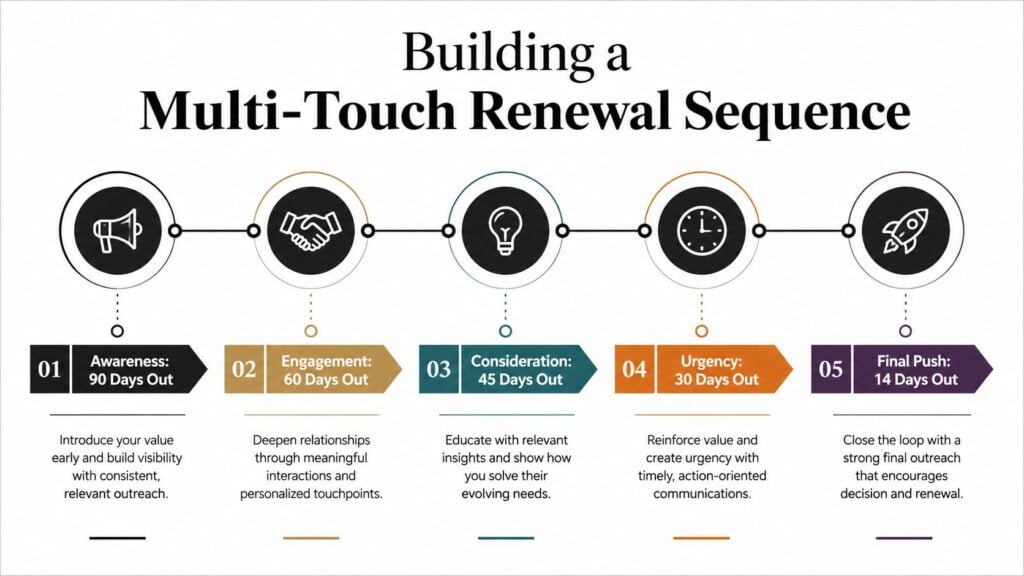
A renewal sequence works best as a guided path, not a single last-minute ask. The cleanest setups start 90 to 60 days before expiry with pre-renewal engagement, move into formal notices at 45 to 30 days, then add closer-in reminders as the deadline approaches, and finish with a grace-period recovery step [renewal workflow guidance].

Start before the member is thinking about lapse
The first touch should feel like a continuation of the relationship, not a bill. A 90-day window gives you room to build awareness, and a 60-day touch gives members time to decide before the pressure starts to rise. That spacing also gives your team time to react when someone goes quiet.
Mailchimp’s timing framework lines up with that same logic, with a first reminder 45 to 60 days before expiry, another at 30 days, a final deadline alert at 7 to 10 days, and a last-chance email 1 to 3 days before the membership ends [Mailchimp renewal email timing]. The exact schedule matters less than the shape of it. Early touches create awareness, later touches create urgency, and the final week is where you ask for action without wasting the member’s time.
A solid sequence usually includes more than email. The ACC retention guidance says automated reminder systems should send at least three reminders, and the channel mix can include direct mail, text messaging, and other outreach when that fits the member base [ACC retention guidance].
Use escalation, not repetition
The mistake I see most often is sending the same reminder three times with different subject lines. That is repetition, not a renewal sequence.
Each touch should do a different job. The early message should restate value in plain language. The middle touch should make the action easy. The deadline touch should remove ambiguity about timing. The grace-period touch should give members one more path back without making them feel punished.
Renewal timing works best when each touch adds a new reason to act.
Segmentation matters here. Active members do not need the same pressure as dormant ones. High-value members may deserve a personal call, while lower-engagement members may do fine with automated reminders and a clean payment path. The channel should match the likelihood of response, not just the calendar. That is also where the psychology of retention in monthly memberships helps, because renewal behavior is usually shaped by habits, perceived value, and how much friction the member has to work through.
If you set the sequence up this way, you are not just reminding members that a date is coming. You are giving them a clear reason to renew, a simple way to do it, and enough prompts to act before the account goes cold.
Why Members Really Leave
Too many renewal programs assume the member is still waiting for the right reminder. That is rarely the full story. One of the strongest pieces of guidance in the renewal space points to lack of engagement, inability to justify cost, leaving the field, and budget pressure as common non-renewal reasons [marketinggeneral.com renewal best practices]. Those are value and relevance problems, not just message problems.
Habit renewal is fragile
Some members renew because it is easier than thinking about it. Others renew because they actively use the membership and can point to a payoff. Those are very different relationships.
I pay close attention to that split. If a large share of your base renews from habit, retention can look stable until one operational change, one price increase, or one career shift breaks the pattern. If a member cannot explain why the membership exists in their life, they are already halfway out.
That is why segmentation matters. The member who attends, logs in, or uses benefits regularly needs a different message from the person who barely touches the account. Same renewal window, different emotional state.
Use value clarity before urgency
A strong reminder sequence cannot rescue a weak value story. If the membership no longer maps to the member’s goals, urgency can feel pushy instead of useful. That is especially true in course and learning environments, where members need to see ongoing progress and not just an access fee.
The better move is to show outcomes more clearly and earlier in the lifecycle. If a member has not used enough of the offering to feel progress, the renewal email becomes the first honest conversation about relevance. That is a hard message, but it is better than masking a value gap with more sends.
Behavior also matters here. Members who keep returning, opening, or completing actions have already signaled that the membership fits into their routine, while quiet accounts often need a different kind of intervention. For a closer look at the habits behind those patterns, the psychology of retention in monthly memberships explains why perceived value and repeated use carry so much weight in renewal decisions.
Reducing Friction in the Renewal Flow
A motivated member can still abandon renewal if the process feels clunky. That happens more often than teams admit. The fix is usually practical, not dramatic. Direct links, pre-filled data, mobile-friendly forms, and flexible payment options remove more friction than another polished paragraph ever will.
Make the payment path obvious
The renewal link should go straight to the member’s account or preloaded checkout path. Don’t make them search for login credentials, membership IDs, or hidden billing pages. If they have to work to find the form, the odds of dropout rise fast.
Pre-filled member information matters because it shortens the decision path. Mobile-friendly forms matter because many members will open the reminder on a phone and act in the moment. Multiple payment methods matter because card-only flows create unnecessary failure points.
The FTC’s guidance around auto-renewal traps makes the broader principle clear. Businesses need to clearly disclose automatic renewal terms, get express consent before billing, and provide simple mechanisms to cancel [FTC on auto-renewal practices]. Even though your renewal flow is the opposite of a cancellation maze, the same clarity standard applies.
Test it like a member, not like an admin
Don’t test the path from inside the CRM and call it done. Open the renewal email on your phone, tap the link, and walk through the flow with fresh eyes. See what happens when the password is forgotten, the card fails, or the member wants to switch payment methods.
That’s also where a product-specific setup matters. The SCGA example in the background research shows a real membership workflow using a renewal window, portal routing, and manual handling for certain payment situations. Even without copying that setup directly, the lesson is useful. Renewal has to match how your members pay, not how your team wishes they would pay.
If you’re reworking checkout language and entry paths together, the thinking behind free trials versus low entry fee for memberships is a helpful companion because friction at the start and friction at renewal usually come from the same design instincts.
Using Behavioral Signals to Predict Renewal
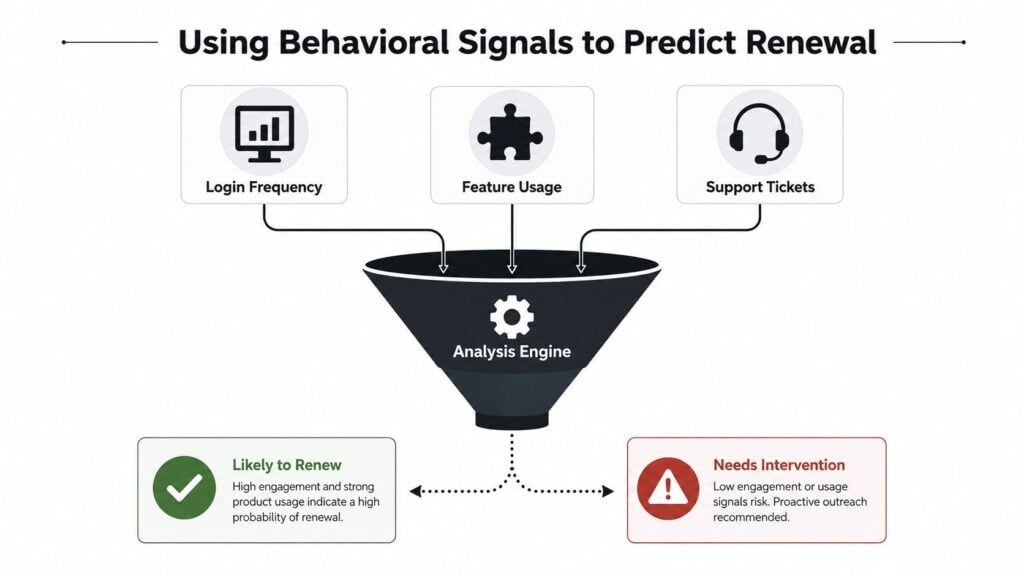
The most useful renewal signal is often not the renewal page. It’s the trail members leave long before that page appears. Logins, event attendance, email engagement, content consumption, and community participation tell you who is still active and who is drifting.
Build a simple risk view
You don’t need a complex model to make this useful. You need a clear way to separate active members from uncertain ones. A regular login pattern, strong event participation, and visible community activity all suggest the member still sees value. Silence suggests the opposite.
That’s where a light scoring approach helps. I’d rather have a rough but consistent risk view than an overbuilt system nobody trusts. If the same member hasn’t logged in, hasn’t attended, and hasn’t clicked in months, they should enter a different renewal path than someone who is still engaged every week.
HigherLogic’s guidance points to using behavioral signals and multi-channel outreach, not email alone, to catch at-risk members earlier [HigherLogic renewal guidance]. That fits what I’ve seen operationally. The earlier you identify drift, the more room you have to reintroduce value before the invoice arrives.
Match the touch to the signal
Active members do not need to be over-messaged. That’s a real mistake. If someone is already participating, hammering them with repeated renewal prompts can create fatigue. At-risk members need more attention, but it should be targeted, not noisy.
A member who is still active needs confirmation. A member who has gone quiet needs re-engagement.
For high-value accounts, personal outreach still beats automation. A quick call from staff or a volunteer can do what a sequence can’t, especially when the member is important to the community. For lower-value or lower-engagement groups, a clean automated sequence is often enough.
This is also where win-back logic belongs. Once someone lapses, a fresh campaign should be separate from the standard renewal path. Treat the lapsed member like a new decision, not a missed reminder.
Your Renewal Implementation Checklist
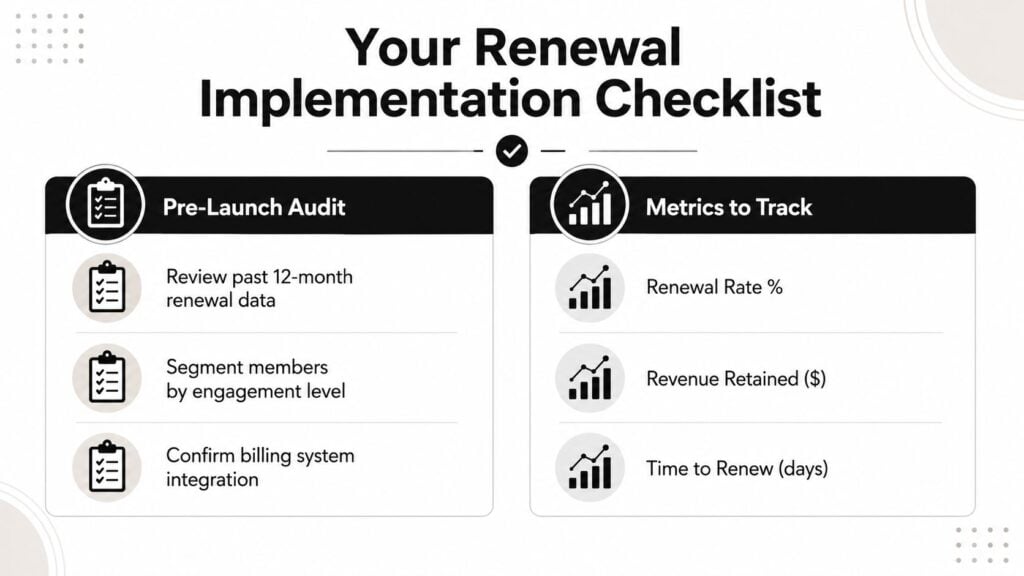
Before you launch another renewal campaign, audit the system you already have. A renewal program improves when the team knows what happened over the last 12 months, how members are segmented, and whether billing works from start to finish.
Pre-launch checks
- Review the past 12 months of renewal data. Look at total renewal rate, first-year behavior, and where lapses cluster.
- Segment members by engagement level. Separate active users, quiet members, and high-value accounts before writing anything.
- Confirm billing system integration. Make sure the renewal link, payment method, and confirmation path all work together.
- Test on mobile. Open the full flow on a phone and fix anything that slows a member down.
The operations side matters as much as the message. If the flow breaks, good timing will not save it. If you need a broader system view, LearnStream’s retention strategy guide is a useful companion for connecting renewal to the rest of the lifecycle.
Metrics to watch every cycle
Track renewal rate, revenue retained, and time to renew. Those three give you a clearer picture than open rate alone. The key question is not just who clicked. It is who paid, how fast they paid, and who needed intervention.
If you are refining onboarding and pricing together, Mara’s onboarding and pricing strategy to prevent churn is worth reading because a weak start often shows up later as a weak renewal.
Practical rule: if a member needs too much chasing, the experience is probably asking for too much work.
Set your next cycle up properly
Use a renewal window that starts well before expiry, keep the reminder sequence multi-touch, and make the payment path easy to complete. Then watch the behavior, not just the inbox. That is how you learn whether the problem is timing, value, or friction.
If you manage memberships, run your next renewal cycle against this checklist before you send the first reminder. Tighten the flow, segment the audience, and review the member value story while there is still time to change the outcome.