What Is Knowledge Retention and How to Improve It

I ran a small experiment on my own course last spring. One student finished a 40 minute module on pricing, scored 9 out of 10 on the quiz at the end, and told me it finally made sense.
Eleven days later she emailed to ask what a price floor was.
Her memory was fine. The module was fine. What failed was my measurement. That quiz told me what she could do while the ideas were still warm in her head, and nothing about what survived the following week.
Most course dashboards have the same blind spot. They report completion rates and quiz averages, and both numbers look healthy right up until a learner tries to use the idea in their actual work. So let's take the question apart properly and rebuild it into something you can test on your own course this week.
What Knowledge Retention Means in Plain Terms
Think of a library. Buying the book is exposure. Shelving it in the right section is learning. Retention is whether you can walk in a week later, go to the right shelf, and open the right page when a client asks you a question.
That's the whole idea behind knowledge retention: the ability to store facts, concepts, and procedures in long-term memory and pull them back out when they're needed. Not when the lesson is open in another tab. When someone asks.
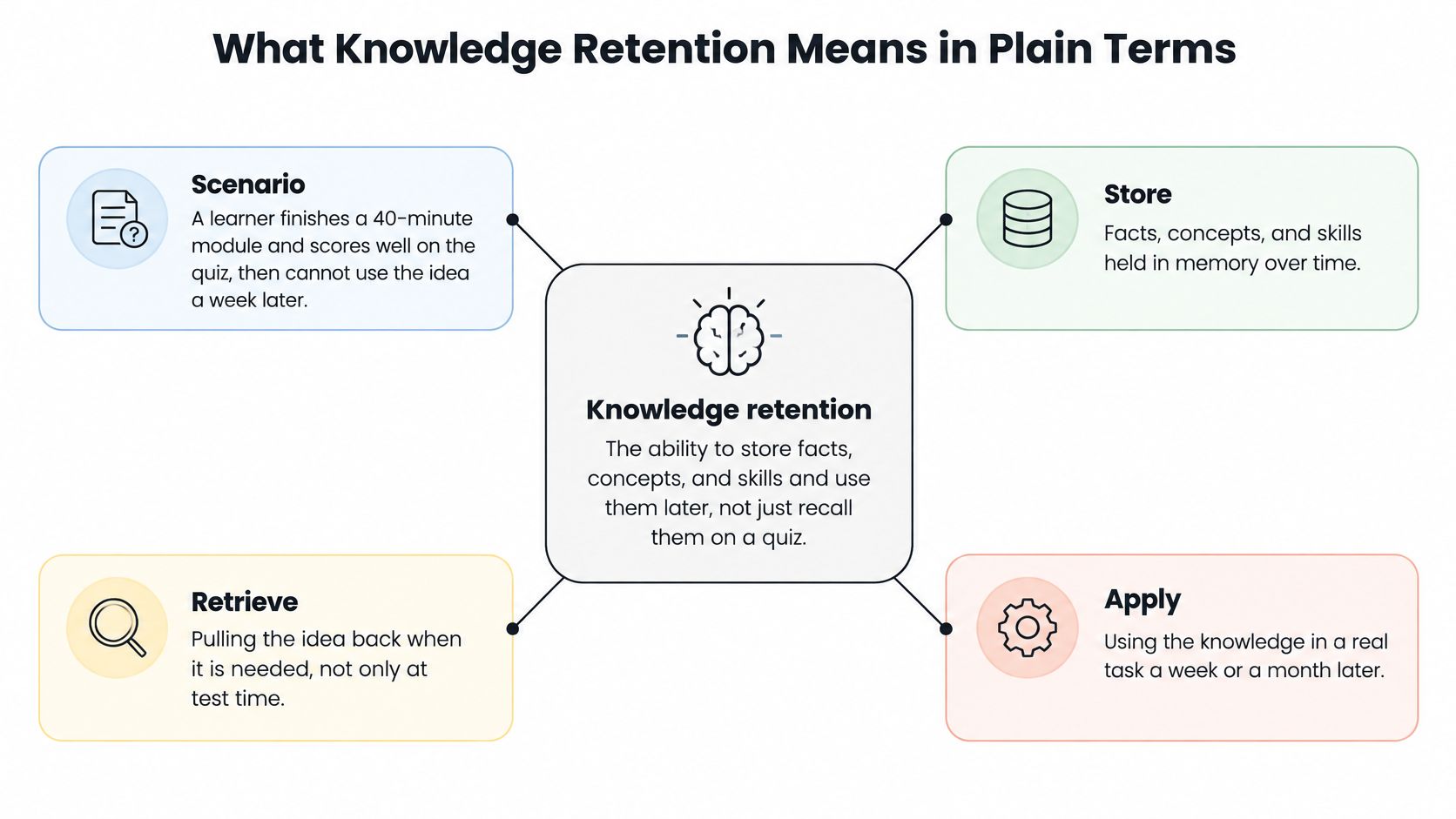
The confusion usually shows up at the quiz screen. A multiple choice question with four options hands your learner the answer and asks them to pick it out of a lineup. That tests recognition. Retention needs recall, which is producing the answer from nothing, with no options and no notes and no lesson summary at the top of the page.
Two different mental events, two very different results.
There are three stages worth naming, and they all fail in different ways. First, taking information in. If a lesson is too dense or the learner is distracted, nothing lands. Second, holding it. Information that's never revisited fades, and I'll show you exactly how fast in the next section. Third, getting it back out. This is the stage course designers forget, because it's the only one that happens after your learner logs off.
I care so much about the third stage because completion rates tell you a person clicked through every lesson. End-of-module quiz scores tell you they could retrieve the idea while sitting inside the lesson that taught it. Neither one tells you what a member can still do in a live client call three weeks later.
So what is knowledge retention, really? It's the answer a learner gives when there's no slide behind them, no options to choose from, and a real problem in front of them.
One question you can ask about any course right now. Could a learner answer your single most important question a week from now, with nothing open and nobody prompting them?
If you can't say yes with confidence, the rest of this is for you.
How Fast Memory Fades and the Forgetting Curve
A learner can finish a lesson feeling confident, then struggle to recall its details days later. The forgetting curve helps explain that gap. In experiments published in 1885, Hermann Ebbinghaus measured how much time people saved when relearning lists of largely meaningless syllables. He called this measure savings.
Plotting savings over time produces a steep early drop followed by a slower decline, as described in a literature review of forgetting-curve research. Its figures offer a useful reference point, not a prediction for every learner.
| Time since learning | Approximate share retained | What it means for a course |
| 20 minutes | About 58% | Add a recall question at the end of the lesson |
| 9 hours | About 36% | Send a same-day recap or a short quiz |
| 31 days | About 21% | Schedule a review a few weeks after the lesson |
The 20-minute figure means roughly 42% is forgotten, not more than half. By nine hours, the estimate is about 36% retained; by 31 days, about 21%. These numbers make the gap between finishing a lesson and remembering it later visible. A completion rate or an end-of-module score cannot show what a learner will recall weeks afterward.
Where the curve stops being a law
Ebbinghaus used nonsense syllables to limit the influence of meaning and prior knowledge. Course material is different: learners bring experience, context, and existing knowledge, all of which can affect what they remember.
The review notes that retention varies with factors such as prior knowledge, material difficulty, sleep, motivation, and practice. A familiar concept may stick more readily than an unfamiliar one, so the curve is best read as a general pattern rather than a fixed forecast.
A 2015 replication examined delays from 20 minutes to 31 days and reproduced the curve, with a small upward shift around the 24-hour mark. The replication study underscores that memory does not decline in a perfectly smooth line. The broad pattern remains useful: forgetting is fastest early on, then slows.
What this changes about your course
A final quiz measures performance near the end of instruction. It does not establish what learners can retrieve later. To see that difference, compare an end-of-module result with a short recall check days or weeks afterward.
Put those delayed checks on the calendar. A brief question soon after a lesson and another later can show whether learners still retrieve the key idea, rather than merely recognizing it while the lesson is fresh.
Why Recalling Beats Rereading Every Time
A learner finishes a lesson, recognizes every answer on the end-of-module quiz, and scores well. A week later, they cannot explain the same ideas without the slides. That gap is why completion and immediate quiz scores are poor measures of lasting learning.
In a Purdue University study published in Science, students who repeatedly retrieved word pairs during learning recalled about 80% on a delayed test. Those who stopped receiving retrieval tests recalled 36% or 33%, depending on the condition. The comparison shows how much delayed recall can differ even when learners have encountered the same material.
The same study found that roughly 80 additional test trials produced more than a 150% improvement in long-term retention. Repeated studying after initial learning produced no comparable benefit. The useful distinction is whether learners have to produce an answer from memory or see it again.
A broader review of retrieval practice research across applied education studies found that the benefit held across education levels, subject areas, and formats. That suggests retrieval practice can be useful beyond tightly controlled lab tasks, though the size of the benefit can vary.
What active retrieval actually means
Active retrieval means producing an answer from memory before seeing feedback. A learner might write a definition, explain a process aloud, or answer a question without looking at the lesson. Highlighting a sentence does not require the same effort because the answer remains in view.
For example, a student preparing for an exam can close the textbook and list the main points they remember, then check what they missed. These active recall tips for GCSE students offer practical examples, and many of the same techniques work in adult courses.
Formats you can drop into a course this week
- A question at the start of the next lesson. Add a brief prompt: “Before you watch, write down what you remember about X.”
- Flashcards for key terms. Put the term on one side and its definition on the other. Shuffle the cards so learners cannot rely on lesson order.
- A two-question check after each concept. Ask about the idea while it is still in context, rather than saving every question for the end of a module.
- A write-from-memory prompt before a new module. Give learners 90 seconds and a blank box to record what they recall.
Putting every quiz at the end of a course leaves learners without a check on what they can recall along the way. If they struggle on that final quiz, it is hard to tell whether a concept was never understood or has become difficult to retrieve.
Keep checks low stakes: use short questions, avoid grade pressure, and give feedback that shows the answer and explains why it is right. Assess recall directly, not just familiarity with the material.
What this sounds like in practice: “Quick question before we move on. What are the three steps in the refund process? Type them out before you check.”
How Spacing and Sleep Lock Knowledge In
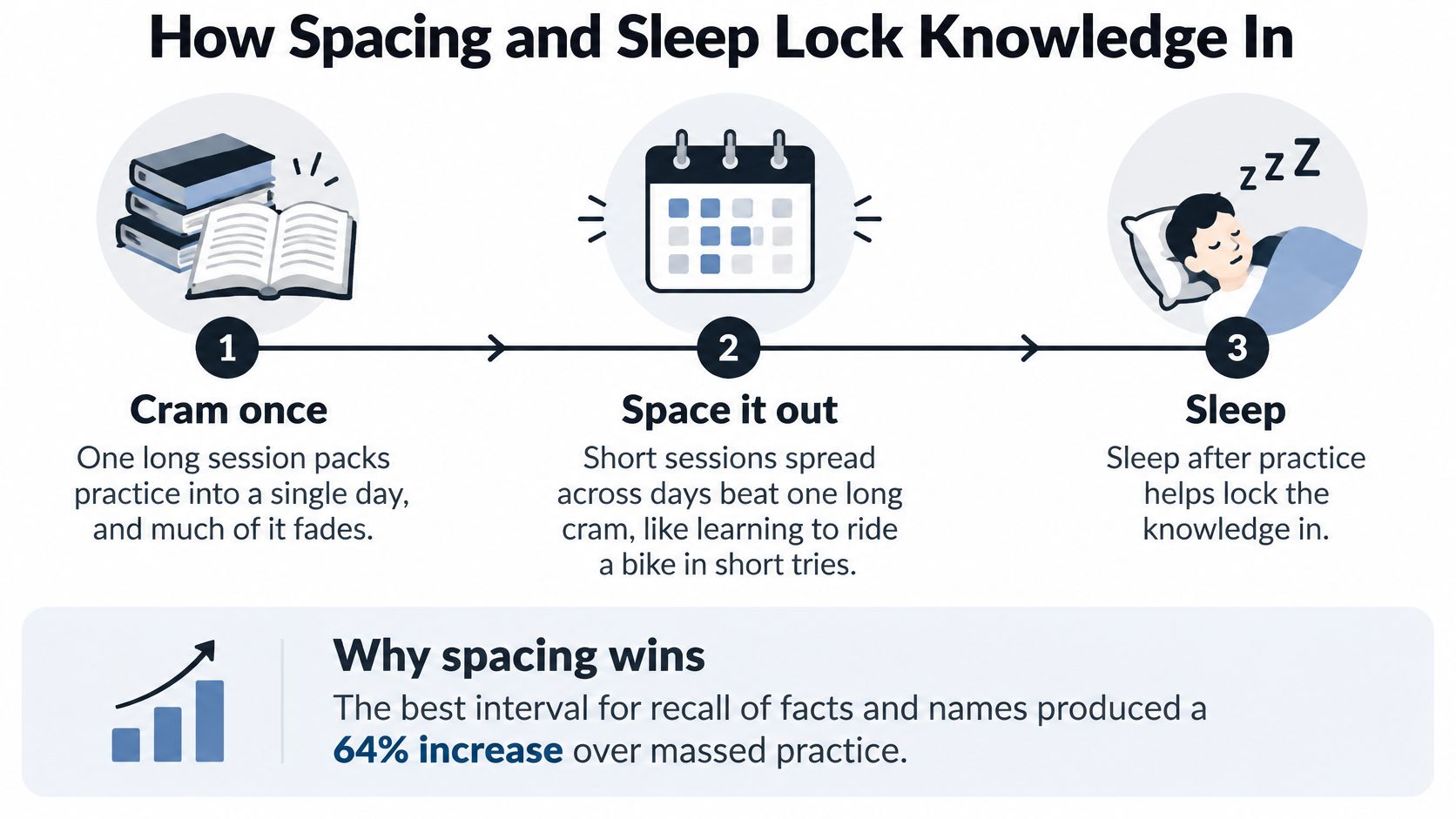
Learning to ride a bike works the same way as learning anything else. Nobody gets on once for four hours and masters it. Short tries, spread across days, and something clicks.
That's spacing. And the research gives it a surprisingly concrete number, in a large study of spacing effects on retention. Recall of facts and names was best with a one month gap under the conditions tested. Compared with a zero day gap, that optimal interval produced a 64% increase in final recall and a 26% increase in final recognition.
Cramming can look impressive. It produces strong short-term performance and weaker delayed access, which is exactly the disguise that fools course dashboards. Spacing adds difficulty in the short term and pays it back later.
Match the gap to the target
The interval should fit the moment you need the knowledge to show up. A review plan built for a one-week assessment needs shorter gaps than one built for annual workplace performance.
Your course should test at a delay that resembles real use. If a member will apply the idea in a monthly client review, testing them the day after the lesson tells you almost nothing.
Here's a three-point schedule I use now, and it works in any platform with drip scheduling.
- Same session. A recall prompt right after the lesson ends, with nothing open.
- A few days later. Two or three short questions, mixed with material from earlier modules.
- Weeks later, in context. A realistic scenario that requires the idea, not a definition question about it.
If you want to go deeper on drip mechanics, this guide to building a spaced repetition strategy into online courses covers the scheduling side in detail.
Why sleep belongs in the plan
Sleep helps consolidate newly learned facts and events, and timing matters more than commonly assumed. A human study on sleep and declarative memory found memory was enhanced when sleep followed learning within a few hours, independent of the time of day. It also observed substantially more forgetting after morning learning than after evening learning, with a reported statistical result of F(1,11) = 9.8 and P < 0.01.
The authors concluded that the benefit is strongest when sleep happens without a long stretch of wakefulness in between.
Practical version. Suggest evening study, then a recall prompt the next morning. The learner wakes up, gets asked to reconstruct the idea, and the retrieval lands on a memory that's just been consolidated overnight.
Practical rule: Schedule review prompts the same way you'd schedule anything a learner has to remember. Put one the next morning and another a week after that.
One caution. Sleep supports consolidation after learning. It doesn't create mastery from a lesson someone skimmed with Netflix on in the background. The encoding has to happen first.
How Too Much Content Overloads Learners
A long lesson can blur together when working memory has too much to handle. That is a design problem, not a test of willpower.
Cognitive load theory explains why: working memory is limited, so learning gets harder when a task asks learners to process more than they can hold at once. If a screen combines dense text, narration, animation, and competing controls, attention gets split before the main idea has time to stick.

A recent analysis of technology-enhanced language learning reported an inverted-U pattern: performance was strongest with roughly three to four concurrent information channels, then appeared to decline as working memory became overwhelmed.
Treat that as a reported pattern, not a universal limit. The right amount depends on the learner and the task. Still, it gives course creators a useful prompt: count what learners must attend to at the same time.
Common sources of overload include narration over dense on-screen text, animation while learners are reading, interface controls that compete for attention, and decorative images that add nothing to the lesson. This guide to cognitive load theory in e-learning design explains how to apply the theory to course pages.
Fixes you can apply to a screen today
- Remove decoration that adds no meaning. A stock photo of people shaking hands asks learners to process an image without helping them understand the lesson.
- Break a 12-minute video into three or four-minute segments. Add a recall question between segments so learners can bring the key idea to mind before continuing.
- Show the key term while you explain it. Let speech carry the explanation rather than placing a full paragraph on screen at the same time.
- Move optional detail into a linked resource. Learners who want more depth can access it without adding to the demands of the main lesson.
Overload can also come from the pace of practice. A study of primary school students learning mathematics compared massed practice, where learning episodes were close together, with spaced practice. Students in the massed condition scored lower on working-memory-capacity tests and reported higher cognitive load. The researchers linked this pattern to the strain of prolonged mental effort.
Too much information on one screen and too much practice in one sitting can both make learning harder. If a video is easier to follow than an article, this short video offers another introduction to cognitive load theory.

Before revising a lesson, audit its hardest screen. Count the narrator, text, animation, timer, chat panel, and progress bar. Then remove or simplify anything that does not help learners understand the main idea.
How to Measure Retention in an Online Course
Here's where most courses go wrong. They measure things that feel like learning and then make decisions from them.
| Measure | What it tells you | Where it misleads |
| Completion rate | Learner reached the last lesson | Says nothing about recall after the lesson |
| End-of-module quiz score | Recall right after instruction | Reflects short-term performance only |
| Delayed unprompted quiz | Recall days or weeks later, with no hints | Closest direct measure of retention |
| Confidence ratings | How sure learners feel about their answers | Can differ from actual accuracy |
| Transfer task on a new problem | Whether learners can apply the idea in a new setting | Shows real use but takes more effort to score |
Completion rates are the worst offender. A learner who clicked through every lesson and a learner who absorbed every lesson produce identical numbers.
The fix is a delayed, unprompted retrieval test, as described in a meta-analysis of spaced retrieval research. No hints, no notes, no lesson summary. Just the question, at a distance from the teaching.
That same meta-analysis of 29 studies found a strong advantage for spaced retrieval over massed retrieval, with an effect size of g = 0.74. Here's the part I found liberating. The evidence did not support a rule that intervals must progressively expand. Expanding versus uniform schedules showed no significant overall difference (g = 0.034). What mattered was the number of retrieval exposures.
Which means you can stop optimising your interval algorithm and start making sure learners get asked again at all.
Designing the test
Run your delayed test at increasing intervals, for example one week, four weeks, and twelve weeks after the lesson. Keep each one short. Three to five questions is plenty.
Track three things, not one.
Delayed accuracy is the obvious one. Confidence ratings tell you whether learners know what they don't know, which affects whether they'll ask for help. Transfer asks whether they can use the idea on a problem they've never seen, and that's the closest thing to real-world performance you can get inside a course.
The difference between testing straight after a lesson and testing later is not a rounding error. A 2024 study of 36 seventh-grade students used both direct and delayed post-tests and reported a statistically significant difference between the two measurements. Two tests, two different answers, same students.
Reading the results without panicking
Compare cohorts over time rather than judging a single group. Then look for the steepest drop between two test points, because that tells you where to move a review earlier.
A simple rule I use: if accuracy falls sharply between week one and week four, put a recall prompt before that gap rather than adding more content to the lesson.
A short low-stakes check also fits naturally alongside other assessment formats. This overview of course assessment methods for online courses covers the wider menu if you want to mix formats.
One more thing worth holding onto. Retention checks double as motivation. Adult learners on creative courses, the kind of student The Online College of Art & Design supports through their creative motivation guide, often need proof of their own progress more than they need more lessons. A delayed test that they pass is that proof.
Build a Retention Plan for Your Next Course
A course that ends with a high quiz score can still leave learners struggling to use the material later. Start your plan with what you want them to remember weeks after the final lesson, then build the course around that goal.
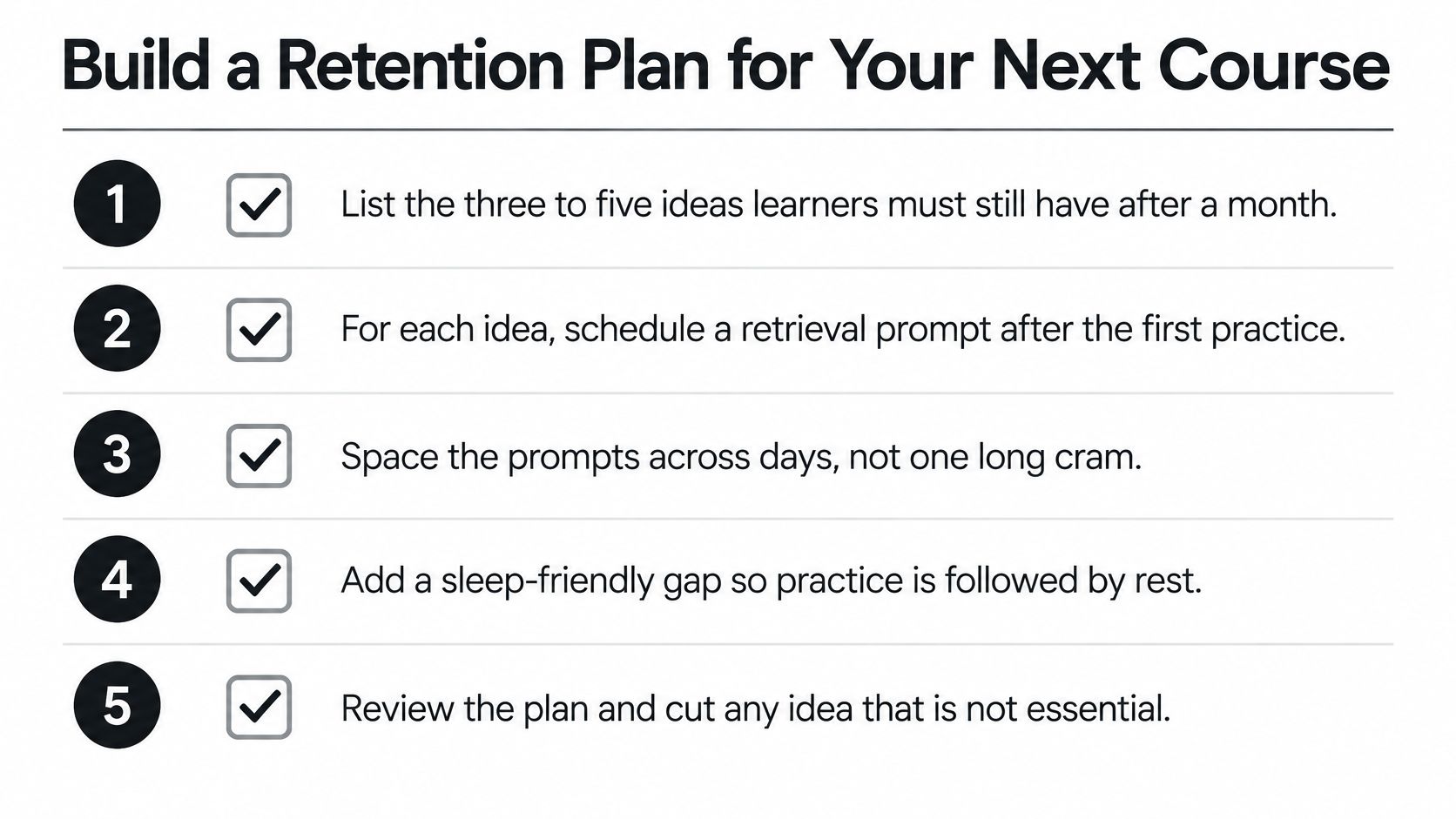
- Choose three to five ideas learners should recall after a month. Write them down. If every detail seems equally important, learners have no clear priorities.
- Plan three retrieval moments for each idea. Place one at the lesson's end, another three days later, and a third two weeks later. Change the question each time, and make the last prompt a scenario.
- Replace one rereading task per module with recall. Swap “review the key points” for a blank space and a prompt that asks learners to reconstruct an idea from memory.
- Simplify screens with too many competing elements. If learners must follow several things at once, split the material. Narration alongside a term is manageable; narration, a paragraph, an animation, and a pop-up can compete for attention.
- Write a delayed test without hints. Use three to five questions and schedule the test four weeks after the lesson, without a summary immediately above it or a same-sitting retake.
- Compare results across cohorts and test points. If scores fall fastest between two checks, place a retrieval prompt before that gap.
The three retrieval moments give learners repeated chances to reconstruct each idea. Keep the prompt focused on recalling the concept, not recognizing wording they have already seen.
A spreadsheet can hold the schedule: list each key idea, its prompts, and the dates of the delayed checks. A platform with drip scheduling, quizzes, and question banks can help organize those tasks, but the plan itself does not depend on a particular tool.
The same principle applies to workplace training. A course built around completion can leave people unable to use what they learned later. Read why annual security modules fail alongside your course outline, and check whether learners have chances to recall and apply the material after the initial session.
Before launch, check three things:
- Each key idea has a recall prompt. Ask learners to reconstruct the idea, rather than select a definition they recognize.
- Each module has a delayed check. Schedule it outside the lesson where the idea was taught.
- Busy screens keep competing elements manageable. Review the course's most crowded moments and simplify where several elements demand attention at once.
Build the delayed test first, then work backward to the lesson. That way, the course is shaped around what learners should still be able to recall weeks later.