
2026 E-Learning Market Size, Growth Forecasts & Drivers

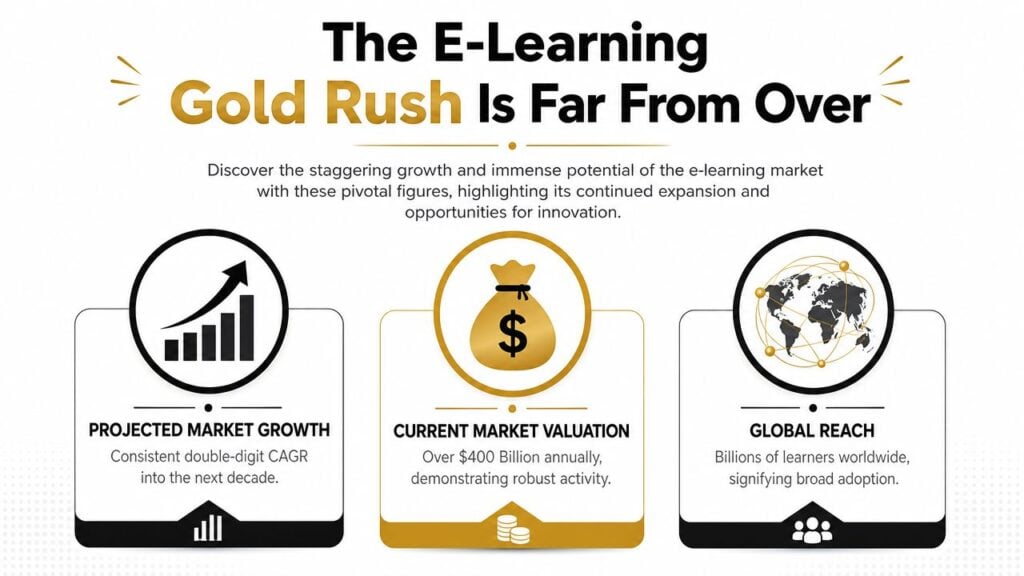
The number that should get your attention isn’t just that e-learning is big. It’s that reputable forecasts already place it in the hundreds of billions of dollars, with one estimate putting the global market at USD 406.13 billion in 2026, up from USD 352.59 billion in 2025, which implies about 15.2% year-over-year growth according to The Business Research Company’s e-learning market report.
That’s large enough to change how I think about opportunity. We’re not talking about a niche for side hustlers with a course and a checkout page. We’re talking about a category with enough scale to support software platforms, independent educators, corporate training vendors, assessment tools, tutoring products, cohort programs, and niche memberships all at once.
The catch is that e-learning market size is one of those phrases that sounds precise but often isn’t. Search for it and you’ll find different reports giving very different totals. That can feel messy, but for entrepreneurs it is useful. The variance tells you what each analyst decided to count, and that tells you how to interpret the opportunity in your own corner of the market.
The E-Learning Gold Rush Is Far From Over
A market already measured in the hundreds of billions changes the math for entrepreneurs. It suggests digital learning has moved from a discretionary experiment to a budget line that schools, employers, and consumers expect to keep funding.
What that really tells me
The useful signal is durability.
If you run a course business, sell training services, or build software for educators, the headline number matters because it points to stable buyer behavior. People now expect to learn online in the same way they expect to bank online or book travel online. Once a habit reaches that stage, the opportunity shifts. Winning stops being mostly about showing up early and starts depending on execution.
That changes which businesses have an edge.
In a small category, speed can carry mediocre products for a while. In a large and still expanding category, buyers compare options more carefully. They ask harder questions about outcomes, completion rates, reporting, support, and whether the product fits into existing workflows. The founders who benefit most are usually the ones building systems they can improve over time, not one-off offers they have to reinvent every quarter.
Practical rule: In a category of this size, demand is usually not the core question. Fit is. The sharper question is which buyer segment you understand well enough to serve better than the ten alternatives they will compare you against.
The entrepreneur’s lens
The top-line market figure works like a city population estimate. It tells you the city is large enough to support many kinds of businesses. It does not tell you whether the best corner is test prep, enterprise compliance training, language learning, tutoring, cohort courses, or study tools such as this review of flashcard apps for students.
That is where many founders misread market size reports. They see a giant number and treat it as proof that their specific idea has obvious room to grow. A better read is more selective. The broad estimate confirms the category is real. The business decision still depends on who is buying, what they pay for, and which slice of the market the report includes.
Three filters matter more than the headline:
- Category definition: Some estimates bundle together formal education, corporate learning, marketplaces, and software. Others measure only a narrower segment.
- Buyer behavior: A university department, an HR team, and a parent shopping for extra help make very different purchase decisions.
- Value driver: In some niches, buyers pay for credentials and compliance. In others, they pay for convenience, engagement, speed, or proof of skill.
For an entrepreneur, that variance is useful. It keeps you from building a strategy around a number that may describe the wrong part of the market.
Why Market Size Reports Never Seem to Agree
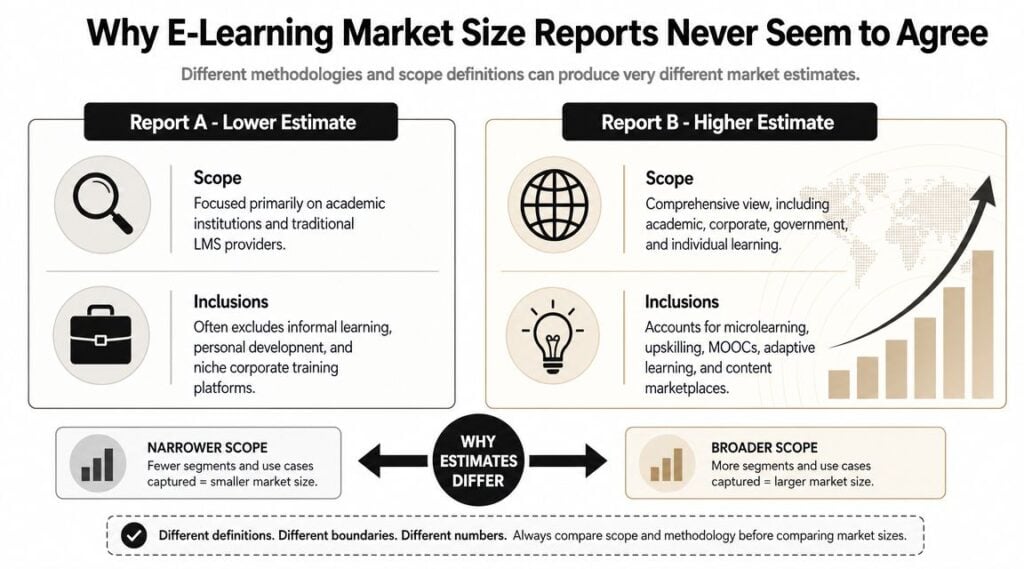
If you’ve looked up e-learning market size before, you’ve probably seen numbers that don’t line up. One report puts the market far lower than another. That doesn’t always mean one analyst is wrong. It often means they measured different things.
Zion Market Research highlights this blind spot directly. It notes that major sources disagree sharply on current value and future trajectory, with estimates for 2024 to 2026 ranging from about USD 231.93 billion in 2024 to USD 399.3 billion in 2022 and USD 369.7 billion in 2025, with forecast CAGRs spanning roughly 7.65% to 15.2% in its e-learning market analysis.
Scope changes the answer
Think about the “car market.” You can measure new car sales only. Or include used vehicles. Or financing, repairs, software, insurance, and fleet management. Each version tells a different story, and each can be valid.
E-learning works the same way.
Some reports lean toward formal education and LMS revenue. Others cast a wider net and include corporate learning, content services, marketplaces, professional training, and consumer education products. If one study counts the platform and another counts the platform plus the courses plus the services around them, you won’t get the same number.
The questions I ask before trusting a market figure
When I read a market report, I want to know the frame before I care about the total.
- What exactly counts as e-learning: Software only, or software plus content and delivery?
- Which buyers are included: Schools, universities, businesses, governments, consumers, or all of them?
- What kind of revenue is measured: Subscription fees, one-time course sales, implementation services, or some combination?
- How broad is the category definition: Does it include adjacent formats like microlearning apps, tutoring platforms, or skills marketplaces?
Those questions matter because they change your usable market more than the headline does.
A broad market estimate can make a niche look tiny. A narrow estimate can hide a very real opportunity sitting right next to the category boundary.
Why this matters in practice
An entrepreneur selling a study tool shouldn’t benchmark against a report centered on enterprise procurement. A consultant building training systems for distributed teams shouldn’t anchor on a consumer-course-heavy estimate.
That’s also why adjacent products deserve attention. If you want to understand how learners use lightweight study tools inside the wider e-learning ecosystem, this review of flashcard apps for students is useful because it shows the kind of practical, focused solutions people adopt outside the classic “full course platform” frame.
The advantage isn’t finding the one perfect number. It’s learning to spot what each number includes, excludes, and assumes.
Where the E-Learning Growth Is Actually Happening
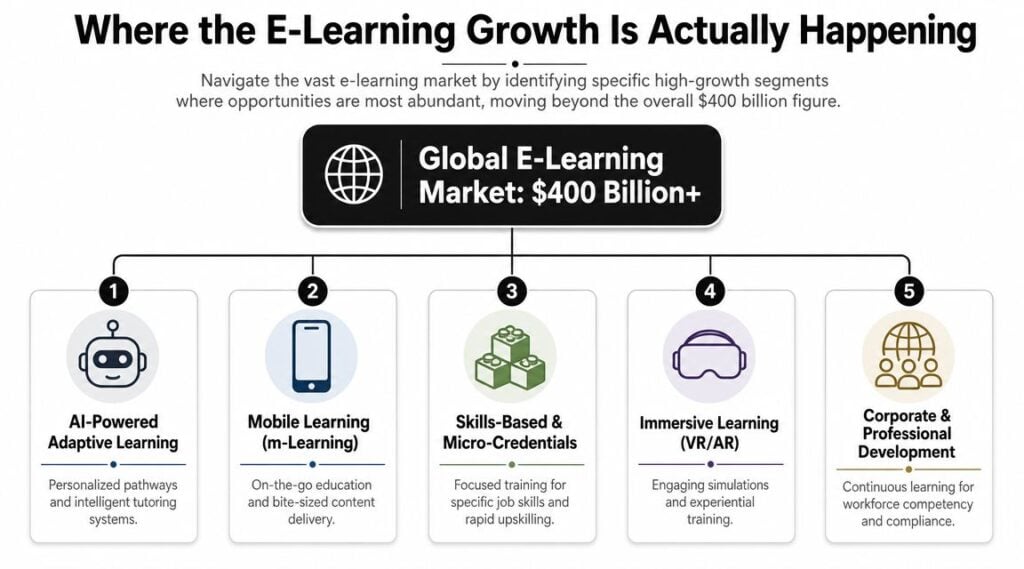
A giant market total is exciting, but it’s not a target. It’s a map without street names.
What matters more is where buyers feel enough pain, ambition, or urgency to pay for digital learning. In my experience, most e-learning businesses end up serving one of three broad arenas: corporate learning, academic learning, or direct-to-consumer education.
Three arenas, three buying logics
Here’s the simplest way I think about them.
| Arena | What buyers usually care about | What tends to win |
|---|---|---|
| Corporate learning | Consistency, reporting, speed to rollout | Clear outcomes, admin control, repeatability |
| Academic learning | Instructional fit, accessibility, student support | Structure, usability, curriculum alignment |
| Direct-to-consumer | Transformation, convenience, trust | Positioning, creator authority, momentum |
The product can look similar across all three. Video lessons, quizzes, communities, templates, certificates. But the reason someone buys is very different.
A company often buys because training has to happen. A consumer buys because they want a result badly enough to pay for help. A school or university often buys inside a longer decision cycle shaped by curriculum, staff workflows, and student needs.
What that means for positioning
The sticking point for many founders is this: They build one offer and try to force it into every lane.
I’d rather pick the lane first.
If you’re selling to employers, your value might sit in onboarding, compliance, process training, or workforce development. If you’re serving individuals, your edge may be accountability, community, or a faster path from confusion to competence. If you work with academic institutions, the conversation usually turns toward implementation fit, faculty adoption, and learner support.
A practical example helps. A remote workforce training product doesn’t need the same messaging as a cohort-based writing course. The first has to reassure managers that teams can use it at scale. The second has to convince a learner that they’ll finish. This guide to remote workforce training LMS choices is a good example of how different the enterprise side becomes once training is tied to distributed operations.
Later in the buying journey, the medium matters too.

The opportunity is usually in the overlap
The most interesting businesses often sit between categories.
A language app can behave like consumer learning while also serving schools. A professional certification product can look consumer-facing but borrow enterprise-grade assessment logic. A creator membership can feel like education, coaching, and community at the same time.
The smartest move is rarely “serve everyone.” It’s “borrow the strongest economics from one segment and the strongest retention mechanics from another.”
That’s how a business escapes commodity pricing. It stops selling generic content and starts delivering a format matched to a specific buying context.
The Biggest Trends Fueling the E-Learning Market
The market isn’t expanding because people suddenly like watching videos online. It’s expanding because digital learning keeps fitting more naturally into how people work, study, and build careers.
That creates a different kind of opportunity. The best products don’t just digitize teaching. They redesign it around convenience, feedback, and progress.

AI is changing expectations
AI has already changed what learners expect from software. Static content feels thinner when people know tools can personalize prompts, generate practice material, and adapt support in real time.
That doesn’t mean every course needs a chatbot bolted onto it. It means learners increasingly notice when a product helps them keep moving. Personalized review cues, smarter search, practice generation, and progress guidance all make a learning experience feel more alive.
A good niche example is this look at innovative AI flash cards for Mandarin learners, which shows how AI becomes useful when it supports repetition, recall, and language-specific practice instead of acting like a gimmick.
Shorter formats fit real schedules
People still want depth. They just don’t always want depth delivered in long, heavy sessions.
That’s why micro-lessons, guided practice, templates, and modular pathways keep showing up across the market. Busy professionals want training that fits into work. Independent learners want visible progress without blocking off half a day. Managers want training people can finish.
I’ve found that this changes product design more than most founders expect:
- Break outcomes into milestones: Learners stay oriented when the path feels finite.
- Use lightweight checkpoints: A quiz, prompt, or practical exercise can reinforce movement without adding friction.
- Design for re-entry: Many users leave and come back. Products should make resuming easy.
Community and accountability are no longer extras
Cheap information is everywhere. Follow-through is not.
That’s why cohort formats, live sessions, peer discussion, office hours, and member communities have become so valuable. A course might attract attention because of content, but people often stay because someone notices whether they’re making progress.
If you want a broader view of where online education formats are heading, this roundup of top online learning trends for 2025 is worth reading because it frames these shifts in terms of format and learner behavior, not just tech features.
Products that combine content with guidance usually feel more expensive to build, but they’re also harder to replace with a search result or a copied curriculum.
The common thread across these trends is straightforward. Buyers don’t just want access anymore. They want motion.
Challenges and Headwinds on the Horizon
A big market attracts builders. It also attracts clutter.
That’s the part glossy market-size articles usually skip. A rising category can still be a hard place to build a durable business if you enter with a me-too offer, weak positioning, or a course that looks finished on launch day and neglected a month later.
Content abundance creates a trust problem
There’s no shortage of lessons, tutorials, memberships, and mini-courses. The practical shortage is confidence.
Buyers have learned that polished sales pages don’t guarantee useful learning experiences. They’ve seen overpromises, abandoned communities, and libraries of videos that never turn into skill. So newer entrants face a tougher job than the market headline suggests. They have to prove relevance, not just existence.
That’s why sharper operators are leaning into specific outcomes, clearer audience fit, and better proof of transformation. Not because broad branding is always bad, but because generic education offers disappear into the background.
Completion is still the hard part
Selling access is one challenge. Helping people continue is another.
Most e-learning businesses deal with some version of the same problem. Learners start with good intentions, then life interrupts. Work gets busy. Motivation slips. The login sits unused. In subscriptions and memberships, that problem turns into churn. In one-off courses, it turns into weak referrals and fewer repeat purchases.
I wouldn’t treat this as a content issue alone. It’s often a product design issue.
Consider where learners usually get stuck:
- At the start: They don’t know what to do first.
- In the middle: The novelty fades and the work becomes harder.
- Near the end: They can’t see how to apply what they learned.
The businesses that handle this well usually add structure. That might be stronger onboarding, milestone emails, live checkpoints, peer accountability, or clearer next-step recommendations.
A crowded market doesn’t punish mediocre information as much as it punishes weak follow-through systems.
Production expectations keep rising
The good news is that creators no longer need a studio-grade setup to ship quality learning. The hard news is that audiences have become less forgiving of messy UX, unclear audio, broken navigation, and confusing curriculum flow.
In other words, competition raises the bar even when budgets stay modest.
That doesn’t mean every founder needs cinematic video. It means the basics now matter more. Clean lesson organization, mobile-friendly delivery, reliable playback, thoughtful exercises, and responsive support do a lot of heavy lifting.
The market is still attractive. I’m bullish on it. But I wouldn’t call it easy money.
How to Use This Data for Your E-Learning Business
A market can be worth hundreds of billions of dollars and still be the wrong market for your company.
That is the practical lesson from the wide spread in e-learning forecasts. One research firm counts only packaged digital course sales. Another includes corporate training platforms, content services, virtual classrooms, learning management systems, and adjacent tools. The variance is not noise. It is a clue about how broad the category is and how carefully you need to define the slice you want to win.
For founders, the useful question is rarely, “What is the global market size?” It is, “Which budget already exists for the problem I solve, and how do buyers compare alternatives?”
A simple framework for using market size data
Define your market narrowly enough to sell into it
“E-learning” is an investor label, not a go-to-market strategy. A better market definition sounds like this: compliance training for mid-sized healthcare employers, onboarding academies for SaaS sales teams, or certification prep for working nurses. Once the segment is specific, pricing, messaging, and product scope get easier to set.Read forecast variance as a planning tool
If one report shows slower growth and another shows a much larger future market, use the lower case for budgeting and the higher case for upside. Entrepreneurs do this in other sectors all the time. A retailer would not sign a lease based on holiday-week traffic. An education business should not build a hiring plan on the most optimistic market estimate either.Match the offer to the buying motion
A company buying training for 2,000 employees cares about reporting, permissions, procurement, and rollout risk. An individual paying out of pocket cares about clarity, trust, speed to value, and proof that the course will help in real life. Those are different products, even if both sit under the same market label.Use growth to justify systems, not vanity
Expanding categories reward infrastructure. Strong onboarding, cleaner curriculum design, better learner communication, and a reliable analytics setup usually produce more durable returns than expensive launch theatrics. Growth gives you room to compound good systems.
One more point matters here. Large market numbers attract founders into crowded categories, but report variance often reveals where the category is still fragmented. Fragmented markets can be attractive because buyers have demand, yet no single provider has locked up the field.
What I would do if I were starting today
I would start with a painful, recurring problem and a buyer who already spends money trying to solve it. Then I would test whether that buyer wants content, software, coaching, credentials, or some mix of the four. That step matters because many e-learning businesses fail from category confusion, not weak demand.
Next, I would build a distribution plan early. Product quality matters, but strong products do not sell themselves. If you need a practical starting point, this guide on how to market online courses does a good job of breaking down channels, positioning, and customer acquisition without drifting into generic advice.
The main takeaway is straightforward. You do not need one perfect number for the e-learning market to make a sound decision. You need to understand why the numbers differ, which definition matches your business, and whether your niche has clear budgets, urgent demand, and room for a better product.
That is how market data becomes useful. It stops being trivia for pitch decks and becomes a filter for choosing the right customers, offer, and growth plan.
If you want more practical breakdowns on course creation, memberships, LMS choices, and digital learning strategy, explore the articles at LearnStream.