
How to Sell Courses Online in 2026
If you have expertise people would pay for and you’re ready to share it, you’ve come to the right place. Selling a course online takes more than just recording some videos and hoping for the best. To do it successfully, you need a plan that covers three core phases: validating your idea, building your content on the right platform, and marketing it to the right people. It takes a smart strategy, but it’s more achievable now than ever.
Your Playbook for Selling Courses Online
Turning your knowledge into a thriving online course business is an exciting journey. I’m here to walk you through it. I’ve been through this process myself, and I’ve learned what truly works and what doesn’t. This guide is all about building a sustainable business from the ground up.
This guide is your step-by-step playbook. We’ll cover how to make sure your course idea is something people will actually pay for. We’ll look at choosing the right tech without getting overwhelmed. And we’ll dig into how to market your course in a way that feels genuine and effective.
The Path from Idea to Income
Think of me as your personal guide on this adventure. Together, we’ll explore finding your specific audience, setting a price that reflects your course’s value, and keeping your students excited and engaged long after they click “buy.” My goal is to give you a clear, actionable plan you can follow.
The entire process boils down to three main stages. I’ve found it’s helpful to visualize it this way, moving from validating your idea, to building the course, and finally, to marketing it.
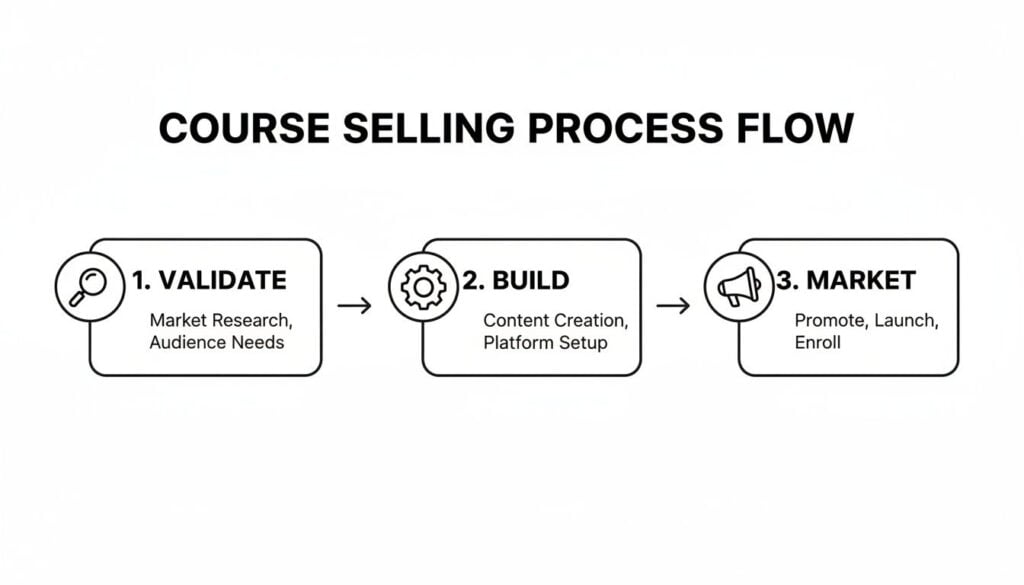
One thing this flowchart makes clear is that marketing isn’t an afterthought. It’s a critical, ongoing part of the process that should start long before your course is even finished.
My Key Takeaway: The most successful course creators don’t just build a great product. They validate their idea first to ensure there’s a hungry audience, then build a marketing engine that consistently attracts the right students.
As we go, you can find more great online course tips to get your gears turning. Now, let’s get started on building your course business.
Validating Your Course Idea Before You Build
I’ve seen it happen more times than I can count. A creator spends months, sometimes a whole year, pouring their heart and soul into building the “perfect” course, only to launch it to the sound of crickets. It’s a devastating, but completely avoidable, trap.
This is all about finding what experts call product-market fit. Think of it as that magical sweet spot where your unique knowledge meets a real, urgent need from a specific group of people. Getting this right is the absolute foundation for selling a course successfully.
Our goal here is simple. We want to get a clear signal that you’re solving a problem people will pay to fix before you invest all that time and energy. We’re testing the waters, not jumping into the deep end blindfolded.
Become a Digital Detective
First things first, you need to get crystal clear on who your ideal student is and what keeps them up at night. You have to understand their challenges in their own words, not just what you assume their problems are. To do this, you’ve got to go where they hang out online and just listen.
This is not about guesswork. It is about being a fly on the wall in the digital spaces where your potential students are already talking.
Niche Subreddits: Hop on Reddit and search for topics related to your course idea. Thinking of teaching sourdough baking? Check out communities like r/Sourdough or r/Breadit. Pay close attention to the questions people ask over and over. What are their biggest frustrations? These are your future course modules.
Facebook Groups: Search for active groups dedicated to your niche. Creating a course on social media for realtors? Join a few groups for real estate agents. Once you’re in, use the group’s search bar to look for keywords like “help,” “struggle,” “question,” or “how do I.”
Quora and Online Forums: People go to Quora to get answers. Search for questions related to your topic and notice the exact language they use. The questions with the most followers and upvotes are a dead giveaway for high demand.
The insights you gather are market research gold. You’ll quickly start to see patterns in their pain points, which will directly shape what you teach and how you talk about your course.
Test the Waters with a Small Offer
Once you have a solid grasp of the problem, it’s time to see if people will actually open their wallets for a solution. The good news? You don’t need a finished course to do this. You just need a simple, low-risk way to test your idea. Before going all-in, it’s critical to understand how to validate a business idea to make sure a real market exists.
This is where you create what’s known as a Minimum Viable Product (MVP). It’s just a small, simple version of your course that delivers a quick win for a small group of people.
For instance, instead of building a 50-lesson epic on “Advanced Excel for Accountants,” your MVP could be a paid, 90-minute live workshop on “5 Excel Formulas to Save Accountants 10 Hours a Week.” You can charge a small fee, say $49, and promote it back in those online communities you’ve been exploring.
If you can’t get 10 people to pay $49 for a live workshop, it’s highly unlikely you’ll get 100 people to pay $499 for a full-blown course on the same topic. This test gives you real data, not just hopeful assumptions.
Check Out the Competition
Finally, take a good look at what other creators in your space are doing. Your goal isn’t to copy them. You want to find a unique angle that makes your course the obvious choice for a very specific person.
Create a simple spreadsheet and analyze a handful of competitors. What are they teaching? Who are they talking to? What do their students say in reviews and testimonials? You’re looking for the gaps. Maybe all the existing courses are super technical, leaving a huge opening for one that’s more beginner-friendly and practical.
And the opportunity is massive. The US online education market is projected to skyrocket from $12.35 billion in 2025 to a staggering $128.54 billion by 2034. This explosive growth proves there’s a huge hunger for specialized digital learning. You can see more data on the booming US online education market.
By following this simple validation process, you shift from hoping your course will sell to knowing it will. You’ll have hard proof that you’re building something people actually want and are more than willing to pay for.
Choosing Your Tech Stack and Packaging Your Content

Alright, you’ve validated your course idea. The hard part is over, right? Well, not quite. Now it’s time to figure out where your course will actually live online. This is a bigger decision than most creators realize.
The technology you choose dictates everything from the student experience to how much of your hard-earned money you actually get to keep. It’s a foundational piece of the puzzle.
When it comes to the tech stack, you’re looking at two main paths. You can either grab an all-in-one platform and get moving quickly, or you can build a more custom solution, usually on top of WordPress. I’ve seen people succeed wildly with both approaches, so there’s no single “right” answer here. The best fit really boils down to your budget, how comfortable you are with tech, and what your long-term plans are.
All-In-One Platforms vs. a Custom WordPress Setup
Let’s unpack these two options.
Think of an all-in-one platform like Kajabi or Teachable as renting a fully-furnished, high-end apartment. Everything you need is already there, including payment gateways, video hosting, and even email marketing tools. You just bring your content and move in. It’s fast and convenient.
Building your course on WordPress with a Learning Management System (LMS) plugin like LearnDash is more like building your own house. You have total control over the layout, the features, and the look and feel. But you’re also the one responsible for the plumbing, the electricity, and fixing the roof when it leaks. It offers ultimate freedom but requires more work.
To help you decide, here’s a breakdown of the most popular course platforms based on your technical skill, budget, and business goals.
Comparing Popular Online Course Platforms
| Platform Type | Best For | Pros | Cons |
|---|---|---|---|
| All-In-One | Beginners and creators who value simplicity and speed. | Simple to set up, includes built-in marketing features, and has dedicated support. You can launch in days, not weeks. | Higher monthly fees, less design flexibility, and some platforms charge transaction fees on top of your subscription. |
| WordPress + LMS | Creators who want maximum control, ownership, and lower long-term costs. | Total design freedom, you own your platform 100%, and it’s often more affordable in the long run. | Requires more technical skill to manage, and you’re responsible for your own security, hosting, and updates. |
Choosing the right platform is a deep topic in itself. For a more detailed look at the specific tools and their features, our guide on the best platforms for selling online courses is a great resource to check out. It really gets into the weeds on the top players.
Packaging Your Course Content for Engagement
Once you’ve picked your platform, you need to think about how to actually package your content. A truly great course is so much more than a collection of video lectures. Your goal is to create an experience that keeps students hooked and motivated all the way to the finish line.
The secret? Variety.
Mixing up your content formats makes the learning process feel dynamic and alive. It also caters to different learning styles. Not everyone learns best just by watching a screen.
Here are a few ways I’ve seen creators successfully package their course content:
- Core Video Lessons: These are the backbone of most courses. Keep them focused and, if you can, short. A series of 10-minute videos is almost always better than a single hour-long lecture.
- Downloadable Resources: Think worksheets, checklists, and templates. These are gold because they help students apply what they’re learning. A course on budgeting, for instance, could include a downloadable expense-tracking spreadsheet.
- Interactive Elements: Quizzes and small assignments are perfect for reinforcing key ideas. They give students a quick win and a tangible sense of progress.
I’ve found that the best courses are the ones that help students achieve a tangible result. Including practical, hands-on resources is one of the easiest ways to ensure your students don’t just consume information but actually use it.
Adding a Community to Your Course
One of the most powerful ways to skyrocket the value of your course is to add a community component. This gives students a dedicated space to ask questions, share their progress, and connect with each other.
It transforms a solo learning journey into a shared, collaborative experience. This simple shift can dramatically boost completion rates and overall student satisfaction.
Modern community platforms like Circle.so or Heartbeat make this incredibly easy to implement. They integrate beautifully with most course platforms, creating a single, seamless environment where the lessons and the discussions live side-by-side. It’s where learning and community truly come together.
Your Marketing Funnel and Course Launch Strategy

Let’s get one thing straight: a great course doesn’t just sell itself. I see it all the time. Creators pour their hearts into building an incredible product, only to get stuck on the other side of the equation, actually selling it.
This is where so many talented people trip up. They’ll post on social media a few times, cross their fingers, and then feel defeated when the sales don’t pour in. If you want to sell courses online and build a real business, you need to think like a marketer. You need to build a repeatable system that brings in the right students, consistently.
That system is your marketing funnel. It’s just a term for the path a stranger takes to become a happy, paying customer. It’s a journey you design to build trust, showcase your expertise, and make your course the obvious next step for them.
Build Your Most Valuable Asset: Your Email List
I can’t stress this enough. Your email list is the single most valuable asset you have. Unlike social media, where you’re at the mercy of algorithms, your email list is a direct line of communication with your biggest fans.
But people are protective of their inboxes. You can’t just ask for an email. You have to earn it by offering something valuable in return. We call this a lead magnet.
A killer lead magnet is a small, high-value freebie that gives your ideal student a quick win related to your course topic. It’s a free sample of the transformation you offer. For instance, if you’re selling a course on vegetarian cooking, your lead magnet could be a “5-Day Vegetarian Meal Plan & Shopping List.”
Here are a few lead magnet ideas that I’ve seen work wonders for course creators:
- A Detailed Checklist: “The Ultimate Podcast Launch Checklist.”
- A Short Video Workshop: “A 15-Minute Guide to Your First Watercolor Painting.”
- A Free Template: “A Plug-and-Play Social Media Content Calendar Template.”
- A Mini-Course: A three-part email series that teaches a foundational skill.
The goal is to create something so useful that someone is genuinely excited to trade their email address for it. Once they’re on your list, the real work, and the real fun, begins.
Nurture Your Audience and Build Trust
Getting an email address is just the first handshake. Now, you need to nurture that new relationship. This is done by consistently providing value and building trust, long before you ever pitch your course.
Start sending regular emails. Once a week is a great starting point. Share helpful tips, tell personal stories, and offer insights about your area of expertise. Don’t just sell. Your focus should be on helping your audience make real progress, even before they pay you a dime.
When your subscribers see you as a trusted guide who consistently delivers value, they’ll be much more receptive when you finally launch your course. You’ve earned their attention and their trust.
This nurturing phase is absolutely crucial. You’re showing them that you understand their struggles and that you have real solutions. This is where you cement yourself as the go-to expert in your niche. For a deeper dive, we’ve laid out more powerful strategies in our guide on how to market online courses.
Crafting Your Course Launch Playbook
When it’s finally time to launch, you need a playbook. A launch is more than one email announcing your course is for sale. It’s a carefully orchestrated event designed to build excitement and create a sense of urgency.
There are many ways to do it, but one of the most effective methods I’ve used is the “open cart/closed cart” launch. This simply means your course is only available for purchase for a limited time, usually 5-7 days. This creates natural scarcity and motivates people to make a decision instead of putting it off.
Here’s a simple launch strategy you can adapt for your own course:
- The Live Workshop: About a week before your cart opens, host a free live workshop or webinar. Teach something incredibly valuable that’s directly related to your course. At the end, you’ll naturally introduce your course as the next logical step for anyone who wants to go deeper.
- The Early-Bird Discount: For the first 24-48 hours of your launch, offer a special “early-bird” discount. This rewards your most engaged followers and creates a huge burst of sales right out of the gate, which builds momentum.
- The Urgency Bonus: As the launch window starts to close, introduce a special bonus that’s only available for a limited time. This could be a private one-on-one coaching call or an extra mini-course. It gives people who are on the fence another compelling reason to join now.
Throughout the launch week, you’ll send a series of emails. You’ll answer common questions, share testimonials from past students, and remind people about the deadline. Your mission is to make a clear, compelling case for why your course is the right investment for them, right now.
Pricing Your Course and Handling Payments

Alright, let’s talk about money. Deciding what to charge for your course can feel like one of the most intimidating steps. It’s a mix of art and science, but nailing your pricing is a critical piece of your entire business strategy.
The price you set sends a powerful signal about the value you’re offering. What I’ve learned over the years is that pricing is about confidently communicating the worth of the transformation your students are about to experience.
We’re going to walk through the most common pricing models so you can find the perfect fit for your course and your audience. By the end of this, you’ll be able to set a price with confidence, maximizing your revenue while delivering incredible value.
Choosing Your Course Pricing Model
There’s no one-size-fits-all answer here, but most successful online courses I’ve seen use one of three core models. Each has its pros and cons, and the right choice really depends on your course structure and what your specific audience is comfortable with.
Let’s break down the main options:
One-Time Payment: This is the most straightforward model out there. Students pay a single fee upfront for lifetime access. It’s simple for you, and it’s easy for customers to understand. This works great for comprehensive, signature courses that teach a specific, finite skill from A to Z.
Payment Plans: This is a game-changer. Offering a payment plan alongside a one-time purchase can seriously boost your sales by making a larger investment feel more manageable. For example, you might offer a $499 course for a single payment or three monthly installments of $179.
Subscriptions or Memberships: This model has exploded in popularity. Instead of selling a single course, you offer access to a library of content or an ongoing community for a recurring monthly or annual fee. This is the path to creating predictable, stable revenue.
From my experience, offering both a one-time payment and a payment plan is often the sweet spot. It makes your course accessible to a wider range of people without devaluing your work.
Finding the Right Price Point
So, how do you land on that perfect number? The single biggest mistake I see new creators make is pricing their course based on the number of videos or the length of the content. Don’t do that. Instead, you need to practice value-based pricing.
This means you set your price based on the value of the outcome you provide. Are you teaching a skill that could help someone earn an extra $1,000 a month? Your course is worth a lot more than one that just teaches a casual hobby.
Don’t be afraid to charge what your course is truly worth. I’ve found that students who pay more are often more committed to doing the work and getting results. That leads to better testimonials and a stronger reputation for you down the road.
When you’re thinking about how to sell courses online, it helps to understand the scale of the opportunity. The global online education market is massive, projected to grow from $82.81 billion in 2025 to $101.09 billion in 2026. Data from thousands of companies also shows that well-structured programs can deliver 218% higher revenue per employee. This is a powerful indicator of the value people place on quality digital training. You can dig into more global online education trends if you love the data.
Setting Up Your Payment Processor
Once you’ve decided on your price, you need a way to actually get paid. This is where a payment processor comes in. They are the secure middlemen that handle the transaction between your customer’s bank and yours.
The two most popular and trusted options are hands-down:
Stripe: This is the gold standard for online businesses. It’s incredibly reliable, integrates with pretty much every course platform, and makes it easy to accept credit card payments from all over the world.
PayPal: Everybody knows PayPal. It’s a trusted name that gives customers another easy way to pay, which can absolutely help increase conversions. Many of the most successful creators offer both Stripe (for cards) and PayPal at checkout.
Most all-in-one course platforms have built-in integrations with both Stripe and PayPal, making the setup process just a few clicks. You’ll also need to think about sales tax, which can be a headache as it varies by location. The good news is that many platforms and payment processors now have tools to help automate sales tax collection, which simplifies things immensely.
Making the sale is a huge milestone, but your work isn’t over. Honestly, it’s just beginning. The real magic happens after someone clicks “buy.” This is where you transform a customer into a successful student. That successful student then becomes your best marketing asset through testimonials, referrals, and future purchases.
I’ve learned this the hard way. A smooth onboarding process sets the tone for everything. It’s your first real chance to reinforce their decision and get them genuinely excited to learn. A messy or confusing start can trigger instant buyer’s remorse before they even watch the first lesson.
The Perfect Welcome Sequence
The moment a student enrolls, your onboarding should kick in automatically. It all starts with the perfect welcome email. This email is more than just a receipt. It’s a celebration.
Here’s my personal checklist for that first crucial email:
- A warm, personal welcome. Say “thank you” and congratulate them on making an investment in themselves.
- Crystal-clear login instructions. Tell them exactly how to access the course materials right away. No friction.
- A quick “what to expect” overview. Briefly outline the course structure and remind them of the transformation they’re about to achieve.
This first interaction is all about making them feel seen and setting them up for a quick win. The goal is to get them logged in and excited within minutes of their purchase.
Your student’s success is your success. A high completion rate means you delivered on your promise, which directly translates into powerful testimonials and a stronger brand. Low completion rates are a red flag that something in the experience needs to be fixed.
Keeping Your Students Engaged and Motivated
Just getting students to start isn’t enough. The real challenge is preventing them from dropping off after that initial excitement wears off. Average online course completion rates can be shockingly low, sometimes less than 15%, so active engagement is non-negotiable.
You have to build an experience that supports and motivates them all the way to the finish line. One of the most effective ways I’ve found to do this is by fostering a genuine sense of community. When students feel like they’re part of a group, they’re far more likely to stick with it. You can get some great ideas on how to build community in an online course to get started.
Beyond community, here are a few other simple, practical ideas I use to boost engagement:
- Host live Q&A sessions. A monthly or bi-weekly live call gives students a chance to get direct feedback and connect with you. It shows you’re invested.
- Send encouraging check-in emails. Automate a few emails to go out to students who haven’t logged in for a week or two. A simple, “Hey, just checking in!” can make a huge difference.
- Celebrate their progress. Acknowledge when students complete key milestones or modules. This small act of recognition can be a powerful motivator to keep them going.
Your Top Questions About Selling Courses Online, Answered

Over the years, I’ve had countless conversations with creators just starting out, and the same questions pop up time and time again. It makes sense. There’s a lot to figure out when you’re turning your expertise into a business.
To wrap things up, I wanted to tackle some of the most common questions I hear. Think of this as a final dose of clarity to help you move forward with confidence. Let’s get into it.
What Is the Most Profitable Type of Online Course to Sell?
This is a great question, and the honest answer is a bit more nuanced than a simple list. From what I’ve seen, topics that have a clear, tangible return on investment for the student almost always perform best. We’re talking about courses on skills that help people make money or advance their careers.
Think about learning digital marketing, coding, sales techniques, or financial management. These sell because the value proposition is crystal clear. If someone pays $500 for your course but that new skill helps them land a raise or secure new clients, the purchase becomes a no-brainer.
But here’s the thing. The most profitable course for you will always live at the intersection of three things: your genuine expertise, what you actually enjoy teaching, and what a specific market is willing to pay to learn. Don’t just chase a trend. Your unique experience is your most valuable asset.
The most successful courses I’ve seen solve a very specific, painful problem for a clearly defined audience. When you can do that, profitability naturally follows.
How Much Money Can You Realistically Make Selling Online Courses?
The real answer? It’s all over the map. Your income potential swings based on so many variables. Your audience size and quality, your course price, your marketing chops, and of course, the quality of your content all play a role.
I’ve seen creators bring in a few hundred dollars a month, which is a fantastic side income that can cover bills or a nice vacation. I also know creators who have built multi-million dollar businesses entirely from their online courses.
For a new creator with a solid plan, aiming for a few thousand dollars in revenue from your first couple of launches is a very realistic goal. The key is to treat it like a business that can scale over time. As your email list grows, your reputation solidifies, and your marketing gets sharper, your income will grow with it. It’s a marathon, not a sprint.
Do I Need a Large Social Media Following to Sell a Course?
Nope. Absolutely not. This might be the single biggest myth holding people back.
While a big social media audience can be helpful, it’s far from a requirement. In fact, I’d argue it’s much, much better to have 100 email subscribers who are genuinely interested and a perfect fit for your course than it is to have 10,000 random social media followers.
Your number one focus from day one should be building an email list by offering a valuable freebie, just like we discussed earlier in the guide. Your email list is a direct, reliable line of communication with your most dedicated potential students. It’s your most important business asset, far more valuable than any vanity metric on social media.