How to Sell an Ebook: A Creator’s Guide for 2026

You’re probably in one of two spots right now.
Either you’ve got a course idea trapped in a giant pile of notes, voice memos, workshop slides, and half-finished Google Docs. Or you already sell courses or a membership, and you want a smaller product that’s easier to make, easier to market, and easier for new buyers to say yes to.
That’s where an ebook fits.
I like ebooks for creators because they sit in a sweet spot. They’re faster to produce than a full course, more valuable than a random PDF freebie, and flexible enough to work as both a paid product and a strategic entry point into your business. If you want to sell an ebook well, you can’t treat it like a lonely file sitting on a checkout page. You need to treat it like a business asset.
For course creators, coaches, and membership owners, that changes everything. The ebook isn’t just something you sell. It can warm up cold leads, grow your list, and move the right readers toward a course, workshop, or paid community later.
Why an Ebook Is Your Secret Weapon as a Creator
A lot of creators hit a wall after their first successful offer.
They know their audience wants help. They know they have more to teach. But building another full course feels heavy. You’re thinking about video production, lesson planning, worksheets, platform setup, support, and the endless polish work that comes with any learning product.
An ebook solves a different problem. It lets you package one clear result without building an entire teaching machine around it.

Why creators keep underestimating ebooks
I’ve seen this happen with online educators over and over. They assume an ebook is too small to matter, so they skip it and go straight to another big build. Then months disappear.
Meanwhile, the better move was often to take one slice of their expertise and turn it into a focused guide. Not a giant encyclopedia. A practical shortcut.
That works because buyers often don’t want your whole methodology on day one. They want help with the next problem in front of them.
The category itself is also far from niche. Statista projects the global ebooks market will generate US$15.14 billion in 2026, with steady forecast growth across 2026 to 2030 according to its ebooks market outlook. That matters because it confirms ebooks are a mature digital product category, not a fading side format.
Practical rule: If your audience keeps asking the same narrow question, you probably don’t need a course first. You may need an ebook with a sharp promise.
Where an ebook fits in a creator business
For course and membership businesses, an ebook often works best in one of these roles:
- Entry offer that helps a new buyer make a small commitment before joining a course or community
- Problem-specific product that solves one issue without overwhelming the buyer
- Lead-generation asset that attracts the right readers and moves them onto your email list
- Authority builder that makes your expertise easier to understand and easier to trust
If you’re exploring other low-lift offers beyond books, this list of digital product ideas for passive income freedom is useful because it shows where an ebook fits among templates, workshops, and mini-offers.
And if your ebook topic overlaps with writing, publishing, or client education, it can also support broader content business goals. I’ve seen that especially with people who are running your freelance writing business and want a paid resource they can sell alongside services.
Preparing Your Ebook for a Flawless Launch
Most ebook problems don’t show up on launch day. They’re baked in long before that.
The topic is too broad. The structure rambles. The design looks homemade in the wrong way. The file is awkward to read. Buyers can feel all of that quickly, even if the ideas are good.
Start with demand, not a blank document
The first mistake is writing the whole thing before confirming that people want it.
Validation doesn’t need to be complicated. Use the signals you already have. Look at the questions people ask in your email replies, community posts, DMs, webinar chats, sales calls, and course Q&A threads. If the same confusion keeps coming up, there’s demand hiding in plain sight.
Then narrow the promise.
A weak ebook idea sounds like “everything you need to know about email marketing.” A stronger one sounds like “the welcome sequence that turns new subscribers into course buyers.” Specific beats broad almost every time when you want to sell an ebook to busy people.
Write for completion, not for ego
Creators often overbuild ebooks because they want the product to prove how much they know.
That instinct hurts sales.
A good ebook is less like a university textbook and more like a guided path through one problem. Organize it so the reader can move from confusion to action without needing your help beside them.
A simple structure usually works best:
- Define the problem so the reader feels understood
- Explain the framework in plain language
- Walk through the steps in a practical order
- Add examples or templates so they can apply it
- Close with a next step that points to your broader offer
If readers need to highlight every sentence to find the useful parts, the ebook isn’t finished. It’s still a draft wearing nicer clothes.
Edit in three passes
Editing isn’t cleanup. It’s product development.
A solid benchmark is the three-stage editorial pass described in Payhip’s guide on how to sell ebooks online. That means:
- Developmental editing for structure, flow, missing sections, and logic
- Copyediting for clarity, grammar, and consistency
- Proofreading for final errors that slipped through
Skipping one of these stages is where a lot of otherwise smart creators lose trust fast.
If you can afford professional help, use it. If you can’t, at least combine automated editing software with a real human reader who can tell you where the writing drags or confuses.
Don’t ignore presentation
Your ebook cover and formatting do sales work before the first page is read.
For nonfiction creators, the cover should signal what problem the ebook solves and who it’s for. Clean typography beats clutter. A simple design with a clear title is usually stronger than a busy cover trying to look “premium.”
Inside the ebook, think like a teacher:
- Use short sections so readers don’t get lost
- Add white space so the page feels readable
- Use callout boxes or checklists when action matters
- Choose export formats carefully based on where and how you’ll sell
PDF works well for direct sales, especially if layout matters. EPUB is worth considering if you want more flexible reading across e-readers and apps.
Add one conversion step inside the ebook
A lot of people stop at “thanks for reading.”
That wastes attention.
At the end of the ebook, give the reader a clear next move. Invite them to join your list for a bonus, watch a workshop, apply your framework with a template, or explore your paid course. If you want to sell an ebook as part of a larger business, the product itself should point forward.
Choosing Where and How to Sell Your Ebook
At this point most advice gets shallow.
A lot of guides treat platform choice like a technical setup question. It’s really a business model question. You’re deciding whether you want more marketplace reach, more customer control, or a mix of both.
For creators with courses, coaching, or memberships, that distinction matters a lot.
The real trade-off
One of the most overlooked questions in this space is whether your ebook belongs on Amazon KDP or on your own site. Design Pickle’s discussion of selling ebooks on Amazon points to that gap clearly. Most content talks about marketplace discovery, but gives less help on the trade-off between reach and owned customer relationships.
That’s the piece course creators need to think through first.
If your ebook is meant to stand alone, Amazon can make sense. If your ebook is meant to feed a funnel into a course or membership, direct sales often make more strategic sense because you control the experience and can connect the purchase to a next offer.
Ebook sales platform comparison
| Platform | Typical Fees/Royalties | Customer Data Access | Best For |
|---|---|---|---|
| Amazon KDP | Royalty-based marketplace model | Limited direct relationship compared with your own checkout | Authors who want marketplace discovery and broad retail presence |
| Payhip or Gumroad | Platform and payment processing costs vary by tool and plan | Better access to buyer information and post-purchase flow control | Creators selling directly with simple setup |
| Your own website | Depends on your cart, payment stack, and tools | Highest control over checkout, branding, and buyer journey | Course creators and membership owners building a full funnel |
The point isn’t that one option is universally better. The point is that each one supports a different strategy.
A simple channel decision filter
Ask yourself these questions before you choose:
Do you need discovery or relationship depth?
Amazon helps with discoverability. Your own site helps you build a customer base you can keep talking to.Is the ebook the product or the first step?
If it’s the first step toward a workshop, course, or community, direct sales give you more room to guide the next action.Do you want a cleaner buyer journey?
On your own site, you can control the sales page, post-purchase email, upsell path, and bonus delivery.
Sell on Amazon when you want shelf space. Sell direct when you want a relationship.
My view for course and membership creators
If you only choose one channel, I’d usually lean direct for education businesses.
That doesn’t mean Amazon is wrong. It means Amazon is often strongest when the ebook itself is the destination. For creators, the ebook is often the doorway. You want the buyer’s journey to continue after checkout, not end there.
If you’re weighing platform ecosystems for digital products more broadly, this comparison of Podia vs Patreon for creators selling digital products helps clarify how audience ownership and recurring revenue fit into tool selection.
You can also use a hybrid model. Put one version or one title on Amazon for reach, then sell a more valuable version directly with bonuses, templates, or workshop access. That split often lines up well with how creators monetize.
How to Price and Package Your Ebook
A lot of creators price from fear.
They assume low pricing will remove friction, so they make the ebook cheap before they’ve even thought about what the buyer is getting. That usually creates a worse problem. The product starts to look disposable.

Price the outcome, not the file
An ebook is not just a document. It’s a shortcut, a framework, a checklist, a teaching tool, or a decision guide.
That’s why I don’t like defaulting to bargain-bin pricing. In the U.S. trade publishing market, ebooks accounted for 12% of total trade sales in March 2025, according to this ebook statistics summary. That tells you ebooks remain a real revenue channel, but also a distinct one. You’re not trying to win a race to the bottom. You’re trying to make your ebook fit into a broader digital sales strategy.
If your ebook helps someone solve a costly, frustrating, or time-sensitive problem, price it like a useful product.
What to consider before naming a price
Here’s what I look at:
Buyer intent
A reader looking for a practical business shortcut will often evaluate value differently than someone browsing casually.Specificity of the promise
Narrow, useful outcomes usually support stronger pricing than broad educational overviews.Closeness to your main offer
If the ebook prepares someone for a course or membership, the price should make the next step feel natural, not disconnected.Competitive context
Look at similar products, but don’t copy them blindly. Their audience, funnel, and positioning may be completely different from yours.
Packaging is where margin improves
The smartest move for many creators isn’t raising the ebook price by itself. It’s creating a better package.
A standalone ebook can work well. But a bundle often gives the buyer faster implementation and gives you more room to position the offer properly.
Examples that pair well with an ebook:
- A worksheet pack that turns reading into action
- A template library with plug-and-play assets
- A private workshop replay that demonstrates the method
- A short companion video for a harder concept
- A resource list with tools and setup suggestions
That extra layer matters because buyers don’t just want information. They want help applying it.
A quick walkthrough like this can help you think through offer structure in a more visual way:

Three packaging models that work well
Standalone guide
Best when the topic is tight and urgent.
Good for first-time buyers, low-friction checkout, and list growth. This model is simple, but it needs a strong sales page and a clear problem-solution promise.
Ebook plus toolkit
This is my favorite format for creators.
The ebook teaches the thinking. The toolkit helps the buyer use it. That might mean templates, prompts, planners, swipe files, or checklists. It feels more complete without requiring course-level production.
Ebook plus next-step offer
This is the funnel version.
The ebook solves one layer of the problem, then naturally points to the course, cohort, consulting offer, or membership for deeper support. When you want to sell an ebook inside a creator business, this is often the cleanest packaging logic.
A low price can reduce hesitation. It can also reduce perceived value. Packaging often solves that tension better than discounting does.
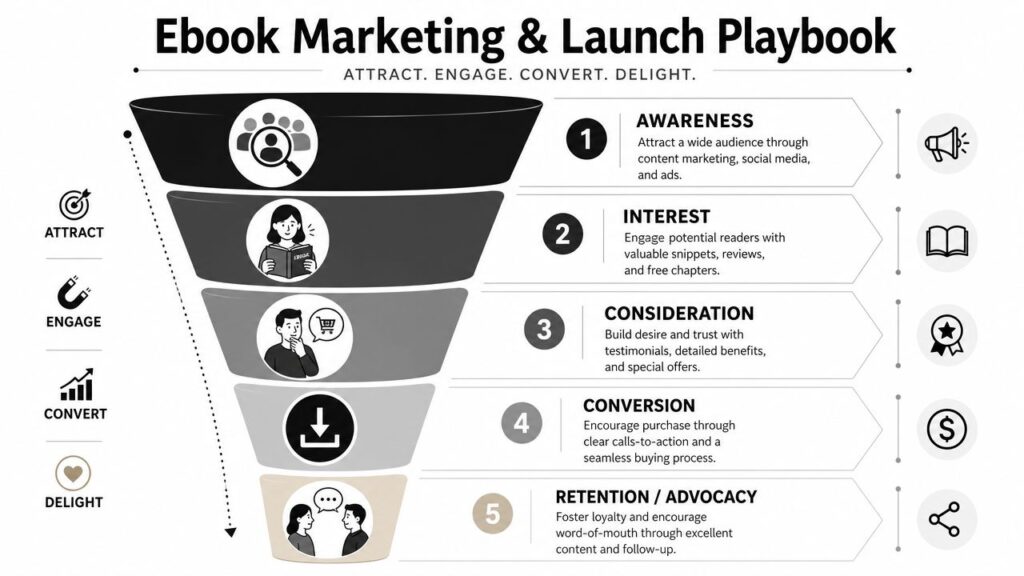
Your Ebook Marketing and Launch Playbook
Most ebook launches fail long before checkout.
Not because the writing is bad. Because the creator waited until the ebook was finished to start talking about it. That’s backwards. Demand needs to be warmed up before the product exists in its final form.
The workflow I trust most is simple. Validate demand first, create the ebook in focused sections, and build a funnel instead of depending on a single direct sale. That funnel approach is highlighted in this ebook launch tutorial on YouTube, and it matters because it lets you capture email addresses, nurture subscribers, and later sell higher-value offers.
Start with a lead magnet, not a sales page
If your audience doesn’t know the ebook is coming, the launch feels cold.
A lead magnet is the easiest way to fix that. Offer a useful asset tied to the ebook topic. A checklist, mini-guide, framework summary, quiz result, or short lesson all work. The key is alignment. The freebie should attract the same person who would buy the ebook.
If your email list is still small, this guide on how to build an email list is worth reading before you launch anything. A list gives you a place to build interest without fighting algorithms every day.
Pre-launch content should do one job
Don’t post random teaser content and hope people connect the dots.
Use your pre-launch content to surface the pain, challenge assumptions, and show your method in small pieces. I like content that makes the buyer think, “If this free post is this useful, the ebook is probably worth paying for.”
Good pre-launch content usually includes:
- Short insight posts that name the problem clearly
- Behind-the-scenes notes that show what the ebook helps people do
- Quick wins pulled from one chapter or framework
- FAQ posts or emails that handle obvious objections
- Early reader feedback if you have beta readers or preview reviewers
Build a simple launch funnel
You do not need a complicated automation maze.
For most creators, a clean funnel looks like this:
Lead magnet opt-in page
Collect emails from people interested in the topic.Nurture emails
Send useful guidance, not nonstop promotion. Teach a little. Build trust.Sales page
Focus on the problem, the outcome, what’s inside, who it’s for, and what happens after purchase.Launch emails
Send a short sequence during launch. One announcement email is rarely enough.Post-purchase next step
Offer the bonus, companion resource, or invitation to your course or community.
Your ebook shouldn’t end the customer journey. It should start a better one.
The sales page has to carry real weight
A weak sales page kills otherwise strong offers.
You need a clear headline, a concise explanation of the problem, and a believable result. Show what’s inside without dumping the entire table of contents on the page. Include who the ebook is for and who it isn’t for. If you have testimonials or preview feedback, use them.
And make buying easy. No cluttered page. No vague button copy. No confusing delivery process.
If you want to show the product in action, a short demo-style walkthrough can help, especially if your bundle includes templates or a workbook. This Smooth Capture product demo guide is a helpful reference for turning a simple walkthrough into something clearer and more persuasive.
Launch week should feel active, not frantic
A good launch has rhythm.
Send your emails. Post more than once. Reuse angles. Some people need the practical angle, some need the emotional angle, and some need to understand the cost of staying stuck.
A few useful launch touches:
- Answer objections live in stories, posts, or email replies
- Share screenshots or reactions from early readers
- Create urgency if a bonus or launch price is temporary
- Partner with aligned creators who reach the same audience
- Mention the next step after the ebook, especially if you sell education offers
If you’re selling direct, this is also where your tools matter. Options like Gumroad, Payhip, or a creator checkout flow on your own site can all work. LearnStream, for example, can fit here if you want a digital product checkout or funnel flow that supports ebook sales alongside other learning products.
Keep promoting after launch
Most creators market hard for a few days, then go silent.
That’s a mistake.
Your ebook can keep selling through evergreen emails, blog content, webinar mentions, podcast interviews, YouTube descriptions, onboarding sequences, and in-product calls to action inside your other offers. An ebook often becomes more valuable over time because it gives you more ways to enter the conversation with buyers at different stages.
The Post-Launch Plan for Long-Term Sales
The launch is not the finish line. It’s your first real feedback loop.
Once buyers start reading, pay close attention to what they say. Their language will tell you how to improve the sales page, what bonus to add, and which parts of the ebook are resonating most. If readers keep praising one chapter or template, feature that more heavily in your marketing.
What to keep doing after launch
A few habits separate a temporary launch from a reliable product:
- Collect testimonials from readers and use them on your sales page, emails, and promo posts
- Track the basics like sales page performance, email clicks, refund patterns, and which traffic sources bring buyers
- Test your delivery flow regularly so buyers get the file smoothly and know what to do next
- Refine the upsell path so the ebook connects logically to your course, membership, or workshop
- Refresh the offer when needed with a bonus, updated examples, or clearer positioning
The best post-launch move is usually not “make something new.” It’s “make the existing offer easier to trust and easier to buy.”
Don’t skip the boring business details
You also need to handle the parts creators love to postpone.
Make sure your checkout, file delivery, and support email are working properly. Know your obligations around taxes, VAT, or business income in your location and the places where you sell. Keep your product files updated and organized so you’re not scrambling every time a buyer needs help.
If you want to sell an ebook for the long haul, professionalism matters just as much after launch as it does before it.