
Master Email Marketing for Course Creators

You’ve probably felt this already.
You build a course, polish the lessons, maybe even make the sales page look good, and then launch to a lot less attention than you expected. Social posts disappear fast. A reel does well one day and tanks the next. People say they’re interested, but checkout stays quiet.
That’s why I keep coming back to email.
For course creators, email is the one channel that gives you direct access to people who already raised their hand and said, “Yes, I want to hear from you.” Done well, email marketing for course creators becomes more than promotion. It becomes your sales system, your onboarding system, and your retention system all at once.
Why Your Email List Is Your Most Valuable Asset
A course without an audience is like opening a classroom in the middle of a field. The content might be excellent. Nobody sees it.
Your email list fixes that problem because it gives you an owned audience. You’re not renting attention from Instagram, YouTube, TikTok, or search. You can reach people directly, on purpose, when you have something useful to say or sell.
There’s also a practical money reason to care. One industry benchmark for education, course, and coaching businesses says early-stage businesses often earn about $0.10 to $0.50 per subscriber per month, with a healthy long-term target of about $1 per subscriber per month. That same benchmark says a 1,000-subscriber list could generate around $1,000 monthly if the funnel is well optimized, based on these email marketing benchmarks for education and course creators.
That changes how you look at list building.
You stop treating subscribers like names in a spreadsheet. You start seeing them as future students, repeat buyers, referral partners, and people who can grow with your business over time.
Why list ownership matters more than reach
Reach feels exciting. Ownership is what pays.
A social audience can help you get attention, but your email list is where interest turns into action. People join a list because they want a deeper relationship with your work. They want the free lesson, the template, the workshop, the updates, or the waitlist notice. That intent matters.
Practical rule: Build your list as if it’s the business asset you’d hate to lose, because it is.
The mindset shift is simple. Don’t just collect emails. Build a group of people who trust your teaching and want the next step from you.
When I’ve seen course creators struggle, it’s rarely because their course topic is terrible. It’s usually because they don’t have a reliable way to bring interested people back into a conversation. Email does that better than anything else.
Building Your Foundation for Success
Most email problems start before the first campaign goes out.
If your lead magnet attracts the wrong person, your emails will feel flat. If your platform makes segmentation hard, you’ll end up blasting everyone with the same message. Both mistakes cost sales later.
Start with a lead magnet that creates momentum
The best lead magnets don’t try to teach the whole course. They solve one small problem and make the next problem obvious.
A weak lead magnet sounds like “Join my newsletter for updates.”
A stronger one sounds like this:
- Mini training: A short video that helps someone get one quick result related to your course topic
- Starter template: A worksheet, script, checklist, or planning board they can use immediately
- Diagnostic quiz: A simple quiz that shows where they’re stuck and points toward the right course path
- Live workshop replay: A focused teaching session that proves your method works in real life
If your course teaches curriculum design, your freebie could help someone outline one lesson. If your course teaches digital illustration, your freebie could help someone choose brushes and complete one simple exercise. If your course teaches membership growth, your freebie could help someone map one month of content.
That first win matters. It sets the tone for everything that follows.
If you want a practical walkthrough on getting people onto your list in the first place, this guide on how to build an email list is a useful companion.
Pick a platform for the next stage, not just today
A lot of course creators choose an email tool based on price alone. I get it. But if the platform can’t tag subscribers properly, trigger automations, or separate leads from buyers, you’ll outgrow it fast.
I’d look for these basics first:
- Automation: You need welcome emails, onboarding emails, launch sequences, and follow-ups that run without manual work
- Tagging and segmentation: You want to group people by interest, behavior, and purchase status
- Landing pages or forms: Simple opt-ins matter if you don’t want to duct-tape extra tools together
- Course and checkout integrations: The fewer handoffs, the fewer chances for things to break
- Reporting you can act on: You don’t need a dashboard with fifty charts. You need enough visibility to see where people stop
Keep the setup boring and reliable
Fancy funnels are tempting. Simple systems usually sell better.
A solid foundation looks like this:
- One clear freebie tied closely to one paid offer
- One signup form on your site, link-in-bio, and key content pages
- One welcome sequence that introduces your teaching and points to the next step
- One main platform where tags, automations, and campaigns live together
If your setup feels confusing to you, it definitely feels confusing to your subscribers.
That’s the part people skip. They chase advanced tactics before the basics are stable. But a plain setup that runs every day will outperform a clever setup that breaks every week.
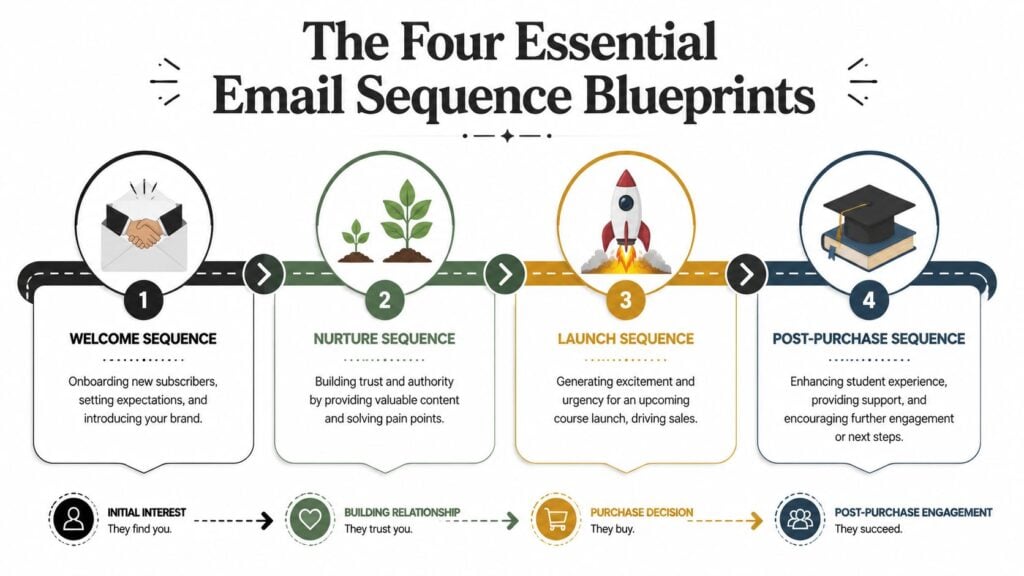
The Four Essential Email Sequence Blueprints
A subscriber joins your list, grabs the freebie, opens one email, and then disappears. Another clicks through to your sales page, reaches checkout, and leaves. A buyer gets access to the course but never finishes lesson one. Those are three different moments, and each needs a different sequence.
That’s why random broadcasts underperform. Course creators need sequences that match buyer intent, stage, and risk. I keep coming back to four blueprints because they cover the full revenue cycle: lead warming, buyer activation, checkout recovery, and list cleanup. They also make launches easier to run because you are not writing from scratch every time. If you want a schedule for plugging these into recurring promotions, this launch calendar for recurring product creators is a useful planning reference.
The welcome sequence
The welcome sequence does more than introduce you. It sets the tone for every sale that follows.
A good version confirms the opt-in right away, delivers a quick win, and creates a reason to open the next message. I treat it like the first class in a paid program. If the first lesson is confusing or self-indulgent, people stop showing up.
A practical welcome sequence usually looks like this:
- Email one: Deliver the freebie quickly and set expectations for what they’ll receive
- Email two: Teach one useful idea they can apply in minutes
- Email three: Show a common mistake and explain your method for fixing it
- Email four: Ask for a reply, invite a click, or point them to a low-friction next step
One of my favorite moves here is a plain-text question such as “What are you stuck on right now?” Replies give you sales copy, lesson ideas, and segmentation data in the exact words your audience already uses.
The student onboarding sequence
The sale is only half the job. The other half is getting students to start.
Low completion hurts more than the refund rate. It weakens testimonials, referrals, renewals, and upsells. Thinkific’s guide to course completion rates explains why early momentum matters so much. Students who feel progress early are more likely to stay engaged.
Your onboarding emails should remove friction fast:
- Orientation: Show where to log in, where to begin, and what to ignore for now
- Quick win: Point them to the first lesson or action that gets visible progress
- Support: Answer predictable blockers before they stall momentum
- Reactivation: Follow up with inactive students and give them an easy way back in
I like onboarding sequences that feel almost overhelpful for the first week. Clear login instructions, a direct link to the first lesson, and one simple milestone beat a long motivational essay every time.
The cart abandonment sequence
This sequence earns its keep during launches because intent is already high. The subscriber clicked, read, and got close enough to the checkout page to matter.
The goal is not pressure. The goal is clarity.
A strong cart sequence usually handles one of four problems: distraction, uncertainty, objections, or timing. Baymard Institute’s research on cart abandonment reasons is focused on ecommerce, but the patterns apply here too. People often leave because they are not ready to decide yet, they hit friction, or they need one more answer before buying.
Try messages like these:
- Reminder: A short note with the checkout link and what they were considering
- Objection email: Answer fit, skill level, time commitment, or format concerns
- Decision email: Help them judge whether the course matches their current goal
- Deadline email: Remind them when enrollment or bonuses end, if you are using a real cutoff
Keep these emails short. During a launch, shorter often converts better because buyers do not need another lecture. They need a clean path back to the decision.
The re-engagement sequence
Every email list decays. That is normal.
What matters is whether you keep mailing people who stopped opening six months ago. During a launch, that can create a technical problem, not just a reporting problem. Low engagement can drag down inbox placement right when you need your launch emails to land. Re-engagement is part sales strategy and part deliverability protection.
This sequence should do three jobs:
- Wake up interested subscribers with a sharper topic, stronger promise, or plain-text check-in
- Let people update preferences so they can choose the content they still want
- Identify cold subscribers who should be suppressed or removed from regular campaigns
I would rather send to 5,000 engaged people than 20,000 ghosts. Bigger lists look good on a dashboard. Smaller engaged lists make it easier to reach the inbox and easier to sell.
| Sequence Name | Primary Goal | Typical Length |
|---|---|---|
| Welcome Sequence | Build trust, create an early win, and guide the next step | 3 to 5 emails |
| Student Onboarding Sequence | Help buyers start quickly and keep progressing | 3 to 5 emails |
| Cart Abandonment Sequence | Recover high-intent leads who left before purchase | 2 to 4 emails |
| Re-Engagement Sequence | Win back attention or remove inactive subscribers | 2 to 4 emails |
Launch Strategies Evergreen vs Live Campaigns
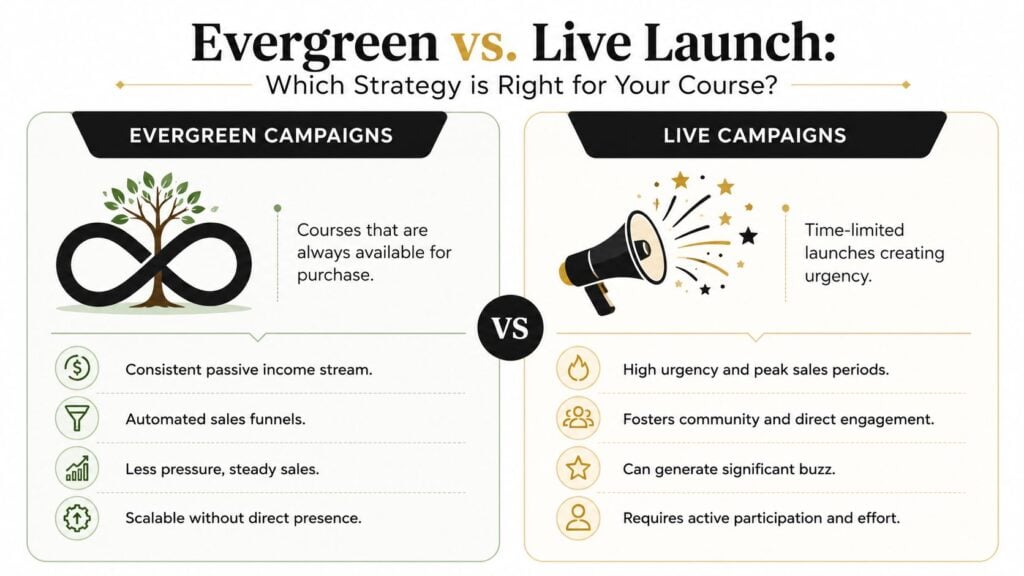
The live launch versus evergreen debate gets framed like one of these is the smart option and the other isn’t. That’s not how it works.
They solve different problems.
Live launches are great when you want focus, energy, urgency, and direct interaction. Evergreen works well when you want a calmer sales system that runs in the background and doesn’t require you to show up at full volume every time you sell.
Live launch when attention peaks around a date
A live launch works best when your audience benefits from a clear start line. Cohort courses, community-driven programs, workshops, and accountability-based offers usually fit this model well.
One practical recommendation is a 14 to 21 day campaign, but a technically stronger cadence for many creators is often a 7 to 10 day launch window with emails every 2 to 3 days, based on this launch guide for course creators. I like that shorter window because it keeps momentum without exhausting the list.
A live campaign often includes:
- Pre-launch emails: Build interest and teach around the problem
- Open cart emails: Announce that enrollment is available
- Mid-cart emails: Handle objections and highlight fit
- Close cart emails: Remind people that the decision window is ending
If you want help mapping the dates and content blocks, this resource on a launch calendar for recurring product creators is handy.
A video can help if you’re deciding which model fits your business style.

Evergreen when buyers need more time
Evergreen is better when your audience doesn’t all reach buying readiness at the same moment.
Someone joins your list today. Another person joins next month. They don’t need to wait for your calendar if the course solves a stable problem and doesn’t rely on a shared cohort rhythm.
This model usually works like a slow handoff:
- Lead magnet opt-in
- Welcome and nurture emails
- Offer introduction
- Follow-up based on clicks and interest
- Post-purchase onboarding if they buy
The upside is consistency. The downside is that evergreen can get lazy fast. A lot of creators set up a funnel once, then stop reading the emails like a real person would.
Send yourself every evergreen sequence and read it on your phone. If it feels generic or repetitive, your subscribers feel that too.
Which one should you choose
Choose live if your teaching style benefits from deadlines, shared momentum, and visible energy.
Choose evergreen if your course solves an ongoing problem and you want a system that keeps working between launches.
A lot of mature businesses end up using both. They sell a core product evergreen, then run live pushes around promotions, events, or cohort enrollments. That hybrid model works because it matches how buyers behave. Some people need time. Others need a reason to act now.
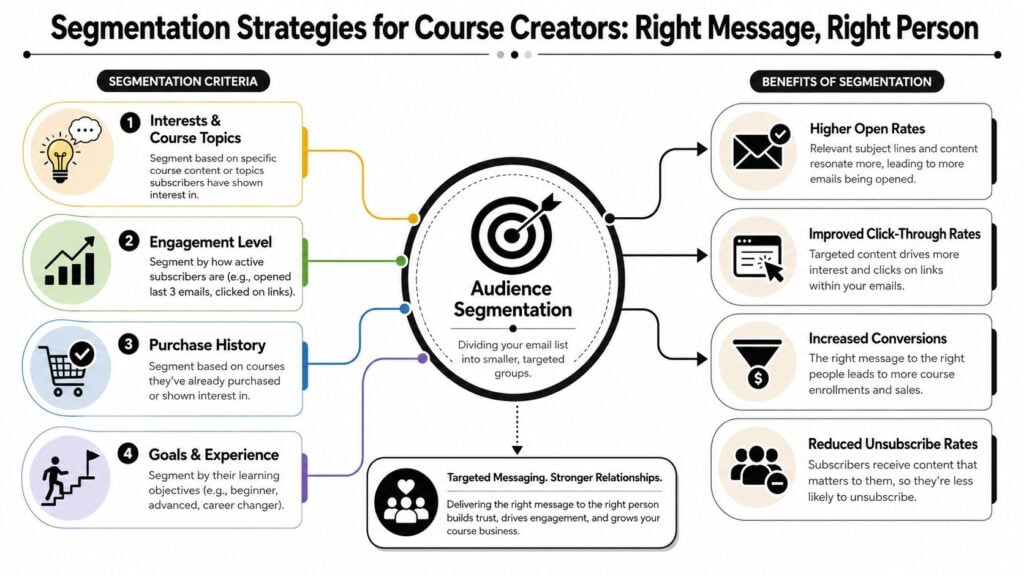
Segmentation That Actually Boosts Sales
If you send the same email to everyone, you flatten your own results.
The subscriber who downloaded your beginner guide shouldn’t get the same message as the student who already bought your advanced workshop. The person who clicked your webinar invite is different from the person who hasn’t opened in months. Good segmentation respects that.
Start with behavior, not demographics
I’d rather know what someone clicked than what job title they typed into a form.
Behavior tells you what people care about right now. That’s what helps you send a relevant next email.
Useful tags often come from:
- Lead magnet topic: What problem they raised their hand for first
- Link clicks: Which subject grabbed their attention
- Webinar actions: Registered, attended, replay viewer, or clicked offer
- Purchase status: Lead, current student, former student, repeat buyer
- Engagement level: Active readers versus fading subscribers
The logic is simple. If someone clicks three emails about building an online workshop, they’re telling you what they want. Believe them.
A few segments that usually pay off
Some segments sound advanced but are easy to build.
One of my favorites is topic interest. If you teach multiple related subjects, group people by the topics they click on. That alone makes newsletters and promotions far more useful.
Another strong one is course stage. Leads need education and trust. Buyers need onboarding and encouragement. Alumni need the next logical offer. When you mix those together, emails feel off.
If you want a clean explanation of the bigger idea behind this, this article on understanding marketing segmentation does a nice job of showing why grouped messaging works better than broad messaging.
The easiest sale often comes from the subscriber who already showed interest, then got a better-timed follow-up.
Keep your segments usable
People often overcomplicate things.
You do not need fifty tags and a whiteboard full of branching logic. You need a few reliable buckets you’ll use in campaigns and automations.
A practical setup might include:
What they want
Tag by lead magnet, clicked topic, or selected interest.How warm they are
Separate active readers from people who haven’t engaged in a while.Where they are in the buyer journey
Keep leads, customers, and past customers apart.What they should see next
Route them toward the most relevant workshop, waitlist, or course.
When email marketing for course creators starts feeling personal, it usually isn’t because the copywriter used someone’s first name. It’s because the offer and timing made sense.
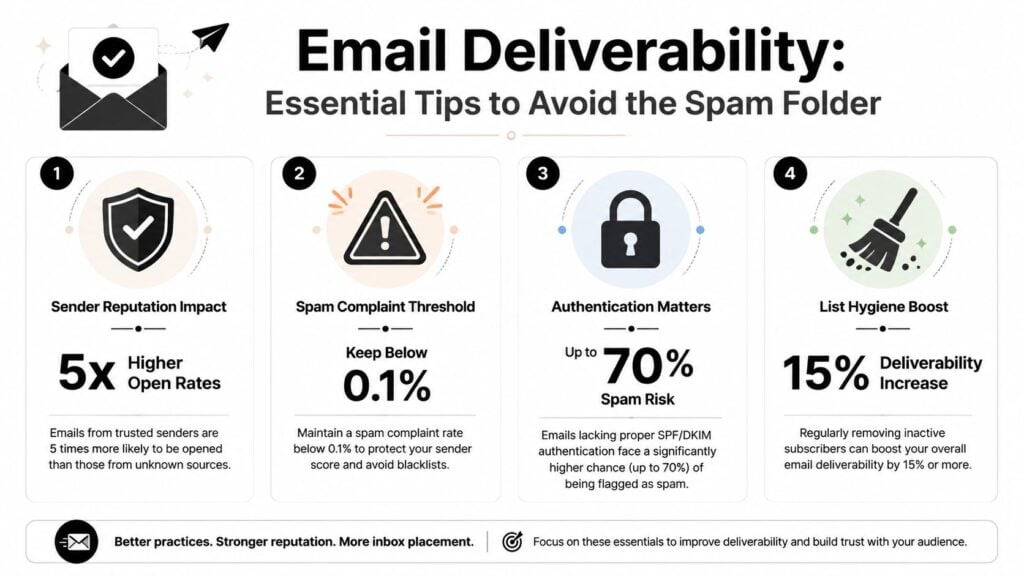
Keeping Your Emails Out of the Spam Folder
You can write a sharp launch email, nail the offer, and still watch sales stall because Gmail tucked the campaign into Promotions or Spam.
That is the part many course creators learn only after a weak launch. Copy matters. Inbox placement decides whether the copy even gets a chance to work.
Deliverability comes from sending behavior
Inbox providers watch patterns. If your list suddenly goes from one weekly email to two weeks of aggressive launch messaging, they notice. If a cold chunk of your list ignores those emails, deletes them, or marks them as spam, future sends get harder to place well.
That is why deliverability is not a technical cleanup job you do once and forget. It is a launch skill.
Course creators often spend hours refining sales copy and almost no time preparing their sending reputation. I handle it the other way around. Before a launch, I want the list active, the domain healthy, and the automations tested. Revenue depends on all three.
What to clean up before launch week
You do not need a full deliverability audit. You need a short pre-launch checklist and the discipline to use it every time.
- Cut or suppress cold subscribers: If someone has not opened or clicked in months, they should not get the full launch sequence
- Increase volume gradually: A launch should feel like a ramp, not a switch flipping from quiet to constant promotion
- Prompt replies early: A simple question in pre-launch emails helps build positive engagement before sales emails stack up
- Test every path: Confirm tags, links, timers, and checkout redirects before traffic spikes
- Watch the right actions: Clicks, replies, registrations, and purchases tell you more than opens alone
If you want a practical outside checklist, this guide on how to prevent emails from spam is useful.
Metrics that signal inbox trouble
Open rate still has some value, but it is a blunt instrument.
The patterns worth watching are more specific. A drop in replies from welcome emails usually shows up before a bigger deliverability problem. Rising unsubscribes after you increase frequency can mean the cadence is off. Weak clicks from a segment that usually engages can point to placement issues, list fatigue, or a mismatched message.
This is also where your email platform matters. Some tools are easier for simple newsletters, while others give you better control over automations, segmentation, and launch operations. If you are weighing those trade-offs, this comparison of MailerLite vs Mailchimp for course creators is a good place to start.
Good deliverability comes from list hygiene, steady sending, clean automations, and emails that give subscribers a reason to interact.
A launch tests more than your sales page. It tests the health of your email system.
Email marketing for course creators works best when you treat it like infrastructure, not an afterthought.
You need a list built on real interest. You need a few reliable sequences that move people from signup to purchase to progress. You need segmentation that keeps emails relevant. And you need deliverability habits that protect your launches when revenue is on the line.
Do that well, and email stops feeling like one more thing to manage. It becomes the engine behind your course business.