
How to Monetize an Online Community in 2026

You’ve built the audience. The posts get reactions, the Discord keeps filling up, and your email list looks healthy. Yet revenue still depends on occasional sponsorships or a course launch that takes weeks to prepare. That gap is where most community businesses get stuck.
Learning how to monetize an online community requires a different lens. Member count creates potential, but retention, member outcomes, and delivery capacity determine whether that potential becomes dependable income. A small group that renews can be more valuable than a large audience that rarely participates.
The practical path combines recurring memberships with courses, events, services, or carefully selected partnerships. The right mix depends on what members already value, what they’ll pay to receive consistently, and whether your operation can deliver that value without exhausting its team.
The Moment You Realize Followers Are Not Revenue
A founder I know once watched a free Discord reach 12,000 members while activity slowly flattened. New people joined, skimmed a few channels, and disappeared. The paid cohort had only 400 members, but those members attended sessions, asked focused questions, and renewed because the community helped them make progress.
The revenue lesson arrived during a routine review of the numbers. The free audience created reach, but the paid group created a business. The founder had spent months treating visibility as the main growth metric, even though the members who paid were responding to a clearer promise and a more active experience.
That pattern appears across the market. The creator economy’s subscription and membership earnings reportedly tripled between 2021 and 2024, and by 2026, about 88% of community builders said they monetized with paid memberships. In the same dataset, 53% sold courses and 37% sold digital products. Yet 21% of communities were still pre-revenue, while 40% earned at least $10,000 annually and 27% exceeded $50,000, according to Circle’s creator economy statistics. The progression matters. Many operators begin with a small paid tier, then add complementary offers once the renewal engine works.
Operator rule: Treat every new member as a retention question before treating them as a growth win.
Churn often hides behind impressive acquisition numbers. If new members replace departing members, the community can look healthy while the paid base remains stagnant. I now review activation, participation, renewal intent, and cancellation reasons alongside sign-ups.
Four paths usually deserve consideration:
- Memberships, for ongoing support and interaction.
- Courses, for structured knowledge with a defined endpoint.
- Events, for concentrated experiences and launch-related revenue.
- Sponsorships, for audiences with clear reach and strong trust.
The rest of the decision comes down to member value, pricing, capacity, and the number of renewals required to make the model viable.
Map Member Value Before You Pick a Revenue Model
Pricing becomes guesswork when you haven’t identified the result members are buying. Start with a one-page value map. The exercise works particularly well for educators because participation usually falls into visible groups.
A real educator cohort might begin with 1,800 newsletter readers and sort them into three segments:
- Lurkers, who read lessons and rarely interact.
- Casual commenters, who ask occasional questions and join selected discussions.
- Active contributors, who share work, attend sessions, and help peers.
Next, record what each segment receives today. Don’t describe vague benefits such as “access to a supportive community.” Write observable experiences, such as feedback on an assignment, a completed project, a peer introduction, or a live review session.
Then run a doubling thought experiment. If a member received twice the useful outcome, what would change? A lurker might receive a guided starter path. A casual commenter might receive regular feedback. An active contributor might receive small-group coaching, accountability, or opportunities to present work.
The price anchor should follow the outcome and delivery burden. Use the table to make assumptions visible before building tiers.
Member value map for an educator cohort
| Member Segment | What They Get Today | Doubling That Value Looks Like | Realistic Price Anchor |
|---|---|---|---|
| Lurkers | Resource access and occasional updates | Guided onboarding, a clear learning path, and starter templates | Entry membership |
| Casual commenters | Discussions, selected answers, and periodic prompts | Regular feedback, structured practice, and live group support | Core membership |
| Active contributors | Peer exchange, visibility, and direct participation | Small-group coaching, accountability, and advanced feedback | Premium cohort or mastermind |
The map should connect to outcomes you can observe, such as cohort graduation, job placement, or a product launch. These outcomes help members understand why a paid offer exists, and they help you decide whether a subscription, cohort, or one-time product fits the promise.
Use membership business models for educators and community owners as a reference when comparing tiered, freemium, subscription, cohort-based, and pay-per-course structures. Your final offer should still come from the value map, not from a template.
Keep one distinction clear. A member may appreciate access without needing a recurring relationship. If the value arrives in a finished package, a course or workshop may be the cleaner offer. If members need feedback, accountability, and changing resources, recurring access has a stronger foundation.
Four Real Ways Communities Actually Make Money
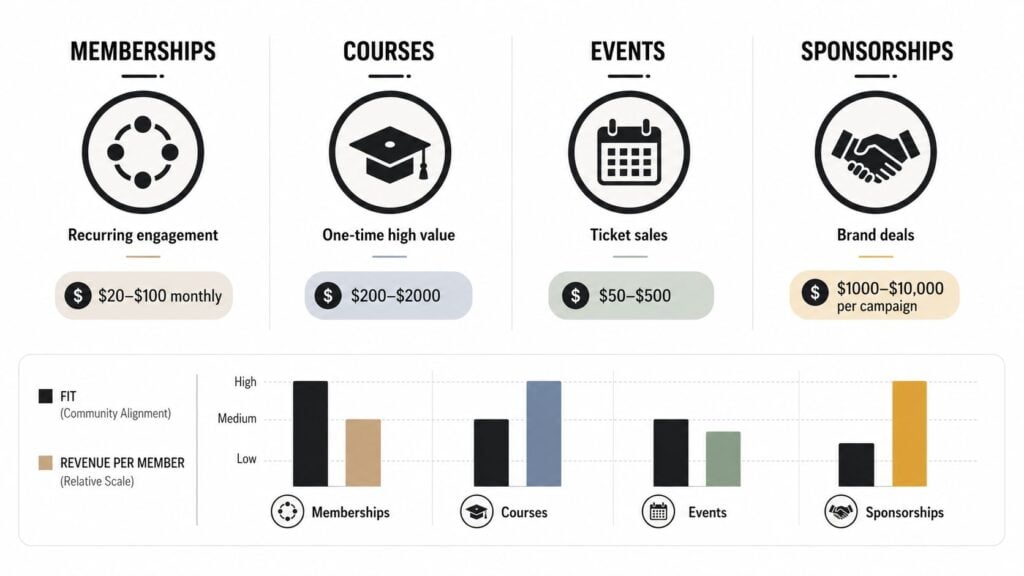
The four main models behave differently under pressure. Memberships create recurring revenue but demand ongoing engagement. Courses can produce strong cash flow without constant moderation, but the relationship often ends after completion. Events concentrate sales into a short period and require promotion. Sponsorships can add income, yet they can damage trust when the audience sees the brand as an interruption.
Memberships
Memberships fit communities where the value changes through interaction. A recurring access model can include office hours, feedback, discussion, templates, and member introductions. Pricing guides commonly place recurring community access around $20 to $100 per month, while another 2026 roundup reports that many paid memberships sit around $10 to $50 per member per month, with positioning and value depth driving the difference. See the 2026 community pricing roundup for the broader range.
The failure mode is a static library. Members join, consume a few resources, and find no reason to return. Memberships work best when the calendar gives people a reason to participate this month.
Courses
Courses suit a defined transformation, such as learning a tool, passing an assessment, or completing a project. They can be sold once, bundled with a community, or used as the entry point into a recurring support tier.
The trade-off is lifetime value. A course may create a useful initial purchase, but you need another offer if the relationship ends at completion. A course also fails when the material promises information instead of a result.
Events
Events create urgency and can deepen relationships quickly. Live workshops, retreats, and focused virtual sessions work well when members want access to a person, a room, or a concentrated outcome.
Events require operational discipline. Promotion, registration, delivery, recordings, support, and follow-up all add work. They’re often better as a periodic revenue stream or a premium layer than as the only business model.
Sponsorships
Sponsorships fit audiences with clear buying intent and a strong match between the sponsor and the community. They backfire when trust is the product, especially in regulated, professional, or learning-focused niches where members expect careful recommendations.
Before accepting a deal, assess whether the sponsor improves the member experience. For broader context on earning potential for creators, compare audience reach with the deeper trust and interaction that a private community provides.
A hybrid model often produces a steadier operation. Memberships can fund the ongoing experience, courses can package repeatable knowledge, events can create focused peaks, and sponsorships can remain selective rather than essential.
Pricing, Unit Economics, and the Small Community Trap
A price only works when it covers delivery. I’ve seen creators set a low membership fee because the audience felt small, then discover that support requests and moderation consumed more time than the tier could fund.
Useful starting anchors include $9 to $29 per month for a low-ticket membership, $97 to $297 for a mid-tier mastermind, and $997 or more for a high-touch cohort. Those are positioning anchors, not universal answers. A low price still needs a repeatable delivery system, while a premium price requires a result members can recognize.
Calculate contribution margin before launch:
Monthly revenue minus refunds, payment processing, platform fees, support labor, moderation, and content production.
Community platforms commonly combine a monthly software charge with a transaction fee. A 2026 comparison found fees ranging from 10% on a low tier to 0% on higher tiers, depending on the plan, according to this platform fee comparison. Don’t treat that percentage as an administrative detail. It changes the number of members you need.
Pricing tiers and unit economics for paid communities
| Tier | Monthly price | Members needed to breakeven | Estimated gross margin | Best fit |
|---|---|---|---|---|
| Entry membership | $9 to $29 | Depends on delivery costs and fees | Lower when support is manual | Resource access and light interaction |
| Core membership | $20 to $100 | Depends on staffing and retention | Moderate when content and discussions are repeatable | Ongoing learning and peer support |
| Mastermind | $97 to $297 | Depends on group size and facilitator time | Higher when sessions are tightly structured | Feedback, accountability, and expertise |
| High-touch cohort | $997 and above | Depends on enrollment and delivery capacity | Variable, often constrained by personal labor | Defined transformation with direct support |
The small-community trap becomes serious when fewer than 80 to 150 paid members can’t cover even one part-time manager. That threshold isn’t a universal law. It depends on price, fees, refunds, and how much work the operator performs personally. It does provide a useful warning. A $19 tier with 100 members produces $1,900 in monthly gross revenue before costs, which can disappear quickly once support and platform expenses arrive.
A $197 tier needs fewer buyers to create meaningful revenue, but it also creates a higher service expectation. If the offer includes personal feedback, you may run out of capacity before you reach a comfortable margin.
Pricing test: Write down the member count required to fund delivery before you announce the price. If the number feels unrealistic for your active audience, change the offer, not just the checkout page.
Building a Funnel That Moves Free Members Into Paying
Free members rarely upgrade because a sales page suddenly becomes persuasive. They upgrade after a sequence of useful experiences shows them what paid participation will feel like.
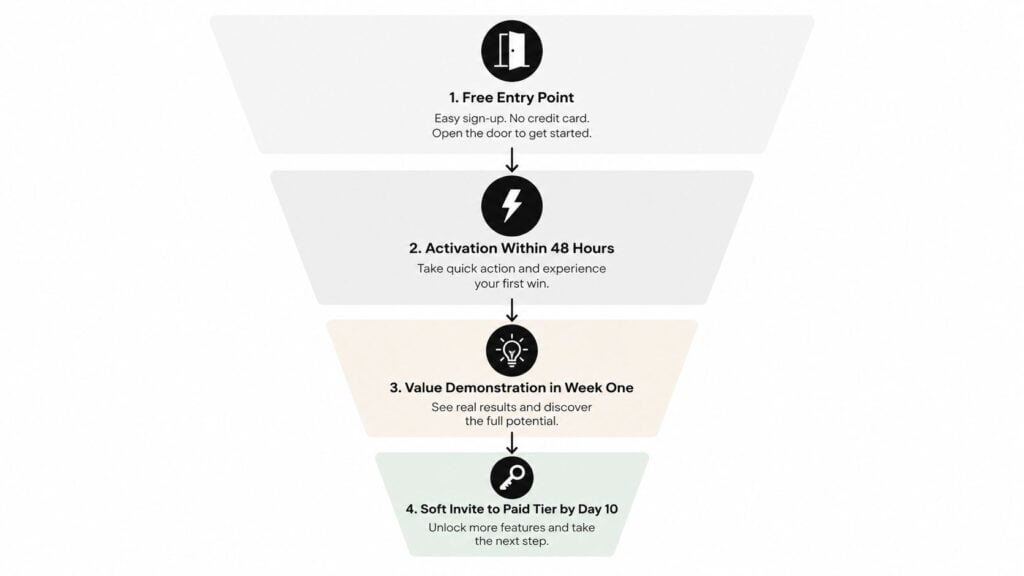
Start with an entry point that solves a small problem. Then create an activation moment within 48 hours, such as a short introduction, a diagnostic prompt, or a first template submission. The member should produce a visible reply or complete a small action that gives them evidence of progress.
The activation sequence
In the first week, demonstrate value in public. Run a weekly thread that asks members to share one practical artifact, decision, or problem. Respond with useful examples, invite peer feedback, and surface the expertise already inside the group.
By day 10, make a soft invitation. Explain who the paid tier helps, what members do there, and what support free members won’t receive. Avoid turning every discussion into a pitch. The invitation should follow a real pattern of need.
By day 21, give members a concrete reason to upgrade. That might be a live review, a workshop, a private feedback thread, or access to a structured implementation path. The offer should extend the win they’ve already experienced.
A simple welcome message can say:
Welcome: Start with the pinned guide, reply to the weekly prompt with your current goal, and look for feedback from another member. The paid space adds live review and structured support for people who want help applying the material.
Cold audiences need a nurture funnel that builds trust over time. Existing followers need an activation funnel because they may already trust you but have never been shown a clear way to pay. Those groups shouldn’t receive identical messaging.
Use this membership site sales funnel guide to structure the handoffs between free content, activation, and paid access. Track the path manually at first. You need to know which action precedes an upgrade before automating the sequence.
Retention Is the Real Monetization Engine
Recurring revenue depends on the renewal decision. Acquisition fills the top of the funnel, but retention determines whether each new member becomes an asset or a temporary accounting entry.
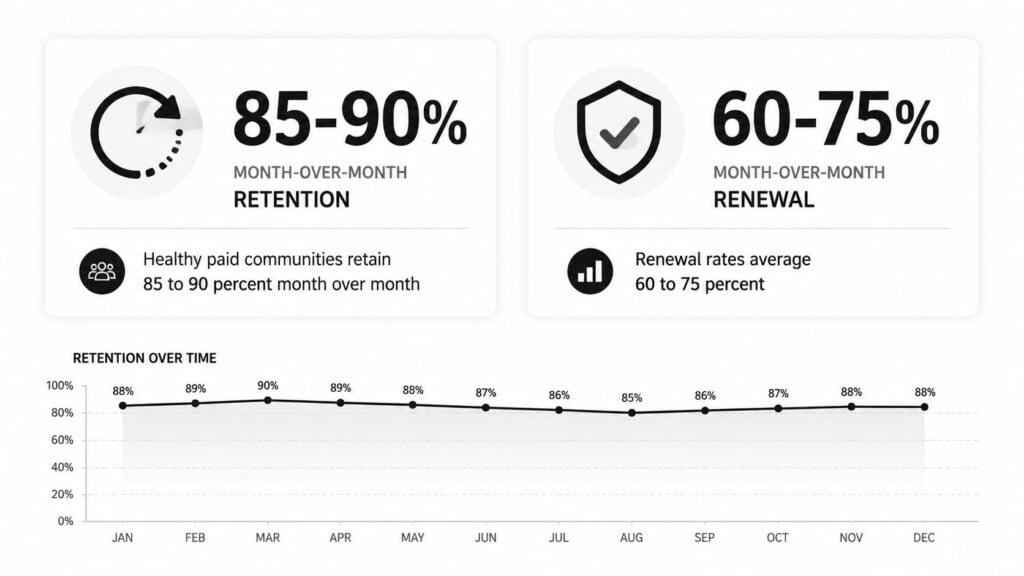
A 2026 benchmark cited communities with dedicated memberships as generating 40% more recurring revenue and three times higher retention than platform-only creators. It also reported 85% to 92% retention for community-driven memberships, compared with 60% to 70% for content-only models, as documented in community-building statistics for 2026. Those figures should guide your questions, not become promises you make to customers.
The practical difference is interaction. A library can be useful, but members renew when they see progress, receive recognition, and know what they can do next.
Build renewal into the calendar
A reliable cadence might include:
- Monthly office hours: Give members a recurring opportunity to ask questions and get unstuck.
- Quarterly content refreshes: Replace outdated examples, templates, and exercises.
- A 60-day human touch point: Ask members what they’ve used, where they’re blocked, and what outcome they want next.
The 60-day check-in matters because initial enthusiasm may have faded by then. A personal message can reveal whether the member needs a clearer path, a smaller commitment, or a different offer. It also gives you cancellation insight before the renewal problem becomes a spreadsheet surprise.
A community that loses members faster than it replaces them can spend heavily on acquisition and still go nowhere. A community that improves the existing experience can grow revenue without constantly increasing promotional volume.
For a deeper operating framework, review these membership site retention strategies.
One independent 2026 report estimates that online communities generate about $12 billion annually from subscriptions, and says 70% of subscription-based communities see renewal rates above 50%, according to subscription community statistics. The exact benchmark matters less than the operating conclusion. Track renewal, cancellation reasons, activation completion, and participation by cohort.
A short video can help your team think about retention as an operating habit rather than a dashboard metric.
Your 30-Day Monetization Plan and Quick Checklist
A practical launch can happen in 30 days, provided you treat it as a forecast exercise. You’re testing whether member value, price, delivery effort, and retention expectations fit together.
Week 1, map
Pull member data from your platform, newsletter, or CRM. Score participation qualitatively, then identify the top three value moments members already experience. They might include feedback, introductions, completed projects, or live problem-solving.
Checkpoint: Can you name the member segment most likely to pay and the outcome they want?
Week 2, activate
Give free members one clear action that produces a visible win. Improve the welcome message, pin a getting-started prompt, and create a recurring thread that demonstrates the quality of discussion you want to protect.
Checkpoint: Can a new member complete the first useful action without asking where to begin?
Week 3, offer
Choose one primary monetization path. Set the price against delivery time, platform fees, support costs, and the number of members required to break even. Keep the first paid offer narrow enough that you can deliver it consistently.
Checkpoint: Can you explain the paid outcome in one sentence without listing every feature?
Week 4, optimize
Launch the paid tier publicly, then track the signals that precede renewal. Watch activation, meaningful participation, attendance at recurring touchpoints, cancellations, and the reasons members give for leaving.
Checkpoint: Do you know which behaviors indicate that a member is receiving enough value to renew?
Don’t judge the model by launch-day purchases alone. A community becomes a business when members continue to find value after the initial excitement fades. Keep the free space useful, protect the paid experience from overcrowding, and add courses, events, or products only when members’ needs justify them.
If you’re ready to start, build the value map today, select one audience segment, and invite a small group into a clearly defined paid experience. Review participation and renewal signals every week, then adjust the offer before adding complexity.
Want to turn your community into dependable revenue? Start with the member outcome, calculate the break-even point, and launch a focused paid tier that you can support for the long term.