Build Your Customer Success Strategy for Online Courses

You launch your course, welcome a burst of new students, and feel that mix of relief and adrenaline that comes after weeks or months of building.
Then a few weeks pass.
You check your dashboard and notice a pattern you didn’t expect. Students bought, but many haven’t logged in lately. A few started strong and faded out. Some never made it past the first module. Support inbox volume might be low, yet something still feels off.
I’ve seen this happen over and over in online education. The problem usually isn’t that the course is bad. It’s that the business has no real customer success strategy behind it.
For creators, that strategy isn’t corporate fluff. It’s the system that helps students keep moving, keep learning, and get the result you promised.
Rethinking What Customer Success Means for Creators
A lot of creators hear customer success strategy and assume it belongs to software companies with account managers, dashboards, and board meetings.
In course businesses, it shows up in much simpler places. It lives in your welcome flow. It lives in your lesson order. It lives in the email you send when someone stalls out in week two. It lives in the way your community manager notices silence before cancellation.

Support solves problems after they happen
Support matters. If a student can’t log in, can’t reset a password, or can’t find a worksheet, someone needs to help.
Customer success is broader than that.
It asks a different question. What needs to happen for this student to reach the outcome that made them enroll in the first place? For a membership owner, that might mean helping members build a habit of showing up weekly. For a course creator, it might mean getting students to their first practical win within days, not someday.
Practical rule: If your only student contact happens when they open a ticket, you’re running support, not success.
This shift changes how you build. Instead of saying, “My course has twelve modules,” you start asking, “Where do students usually lose momentum?” Instead of saying, “I sent the login details,” you start asking, “Did they get started?”
Success starts before the lesson starts
One of the most useful ways to think about this is as a business-wide framework, not a department. A projection for 2026 says companies that treat customer success as a strategic go-to-market framework achieve 35% higher revenue expansion because they align success plans with the entire customer journey from day one, according to this analysis of customer success as a go-to-market framework.
For creators, that means your promise, sales page, onboarding emails, curriculum design, office hours, and renewal messaging all need to work together.
A simple example:
- Marketing promise: “Finish your first portfolio piece in 14 days”
- Onboarding action: Ask students to choose one project idea on day one
- Lesson design: Put the first visible result early
- Community prompt: Invite a progress screenshot by the end of week one
- Renewal or upsell path: Offer the advanced workshop once the first result is complete
That’s customer success in creator terms.
If you’re also trying to keep your audience warm before and after enrollment, a practical guide to content creator social media can help you connect your audience-building work to the student journey, instead of treating social media and learning experience as two separate jobs.
Why a Success Strategy Is Your Best Growth Strategy
Most creators spend more energy on getting the next sale than protecting the value of the last one.
I get why. Acquisition is visible. You can see clicks, launches, signups, and revenue spikes. Student success feels quieter. But the quiet work is often where the stronger business gets built.
Here’s the business case in plain language. A student who gets a result is easier to retain, more likely to renew, and much more likely to trust your next offer. They also become your best marketing asset because their progress does the selling for you.
A strong customer success program can yield 91% return on investment over three years, according to Velaris customer success statistics. That same source notes that companies prioritizing customer-centricity are 60% more profitable, profitability can increase by 25–95% with just a 5% increase in customer retention, and keeping an existing customer is 5–25 times more cost-effective than acquiring a new one.
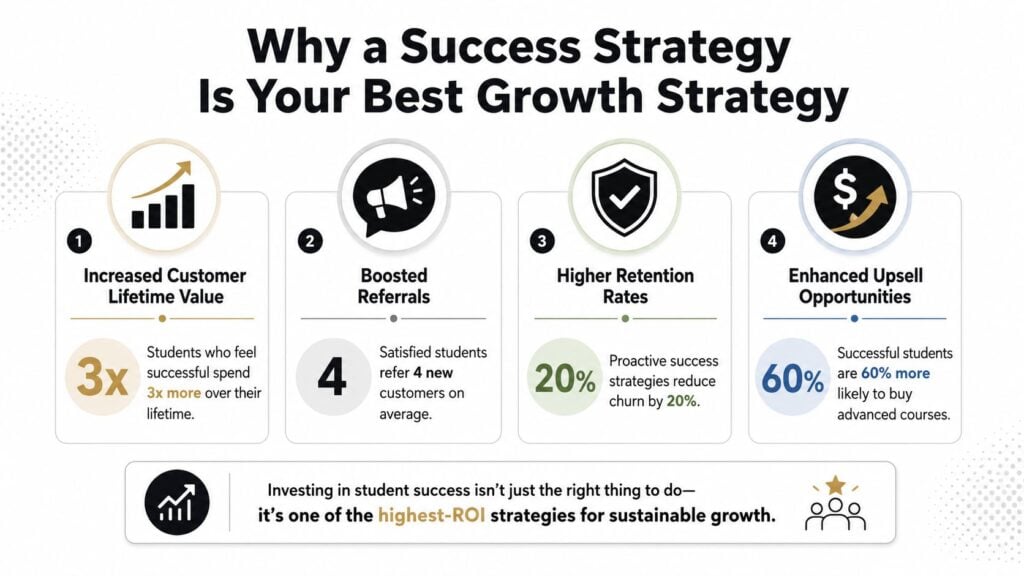
Those numbers come from the business world, but creators can feel them in very practical ways.
What retention looks like in a course business
When retention improves, a few things usually happen at once:
- Students stay long enough to benefit: They finish key lessons, join live sessions, and get a real outcome.
- Your launch pressure eases: You’re not starting from zero every month because renewals and repeat buyers create a steadier base.
- Your testimonials improve: Specific wins beat vague praise every time.
- Upsells feel natural: Students buy the next step because they trust your process.
If you run a membership, this is even more obvious. One member who stays, participates, and renews can be more valuable than several new signups who leave before they ever experience the core value.
A lot of creators know they have a churn issue but don’t know where to begin. If that’s where you are, this guide on how to reduce churn rate is a useful next read because it connects retention problems to practical actions you can take.
Here’s another way I think about it. Marketing gets people to raise their hand. Success gives them a reason to stay in the room.
The video below gives useful context on why customer success deserves a real place in your growth plan.
The creator version of ROI
You don’t need to build a formal finance model to apply this.
Ask yourself:
| Question | What it tells you |
|---|---|
| Are students getting an early win? | Whether onboarding is working |
| Are they still active after the first burst of motivation? | Whether engagement systems exist |
| Do they finish, renew, or buy the next thing? | Whether your learning experience creates trust |
| Do they recommend you without being pushed? | Whether success is visible and meaningful |
If too many students disappear before the first meaningful result, you don’t have a traffic problem first. You have a success problem that will keep making your acquisition more expensive.
The Four Pillars of Student Success
When creators hear strategy, they often imagine some huge operating manual.
I prefer a simpler model. For online courses and memberships, student success usually stands on four pillars: onboarding, value realization, engagement, and celebration. If one of those is weak, the whole experience starts wobbling.
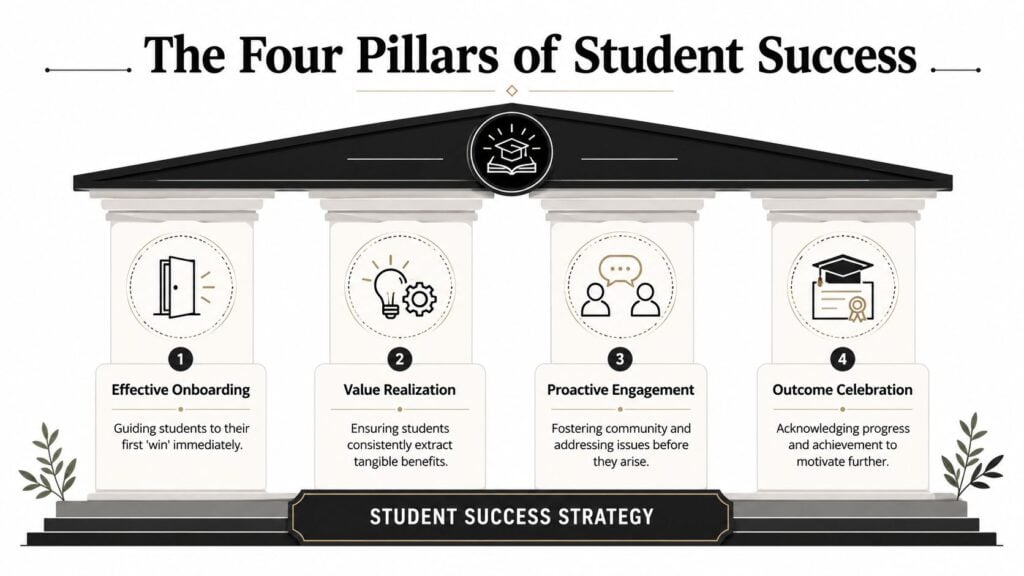
Onboarding gives students their first win
Good onboarding feels like a good tour guide. It doesn’t dump every detail on the visitor in the first minute. It points to the next step that matters.
For a course creator, that might mean:
- Reducing choice: Tell students exactly which lesson to start with
- Creating a tiny milestone: Help them complete one action fast
- Removing setup friction: Provide templates, examples, and a checklist
- Setting expectations: Explain how long lessons take and what success looks like this week
A student who gets a quick win thinks, “I can do this.” That moment matters more than most creators realize.
Value realization turns content into results
This part gets skipped all the time. Delivering content isn’t the same as helping students use it.
A photography course, for example, creates value when the student shares a better photo, not when they merely watch six lessons on lighting. A membership creates value when the member applies an idea, gets feedback, and sees progress.
That’s why smart creators build assignments, reflection prompts, office hours, implementation weeks, and examples into the experience. If you need a resource that supports the learner side of this, the Access Courses Online study guide has practical ideas students can use to study more effectively at home.
Students rarely quit because they hate learning. They often quit because the path from lesson to result feels fuzzy.
Engagement catches the silent drop-off
At this stage, many memberships lose people. The student doesn’t complain. They just slowly stop showing up.
Recent data says 62% of churn in digital learning platforms comes from subtle early engagement dips such as declining course completion rates, and that using digital journey maps can reduce unexpected churn by 28% when implemented, according to ChurnZero on digital customer success strategy.
That lines up with what I’ve seen. Most at-risk students don’t wave a red flag. They give quieter signals:
- They stop finishing lessons
- They visit the dashboard but don’t start new material
- They stop posting in the community
- They miss live sessions they used to attend
- They open fewer emails about implementation
A digital journey map sounds fancy, but for creators it can be simple. Track where students commonly stall. Notice what happens just before they disengage. Add a response there. Maybe it’s a check-in email, a short encouragement video, or a “reply if you’re stuck” prompt.
Celebration keeps momentum alive
People need evidence that their effort means something.
That’s why completion badges, shout-outs, milestone emails, student spotlights, and progress recaps work so well. They don’t just feel nice. They reinforce identity. A student starts to think, “I’m someone who follows through here.”
You can keep this lightweight:
- Celebrate starts: Welcome people publicly when they join.
- Celebrate progress: Recognize key milestones, not just completion.
- Celebrate outcomes: Share wins that show real transformation.
- Celebrate next steps: Point successful students toward the next logical offer.
That final piece matters. Expansion should feel like continued progress, not a random pitch.
Measuring What Matters for Your Students
Creators often drown in platform data and still miss the few signals that help.
You do not need a giant analytics stack to track student success well. You need a handful of useful indicators, clear definitions, and a habit of checking them before problems get expensive.
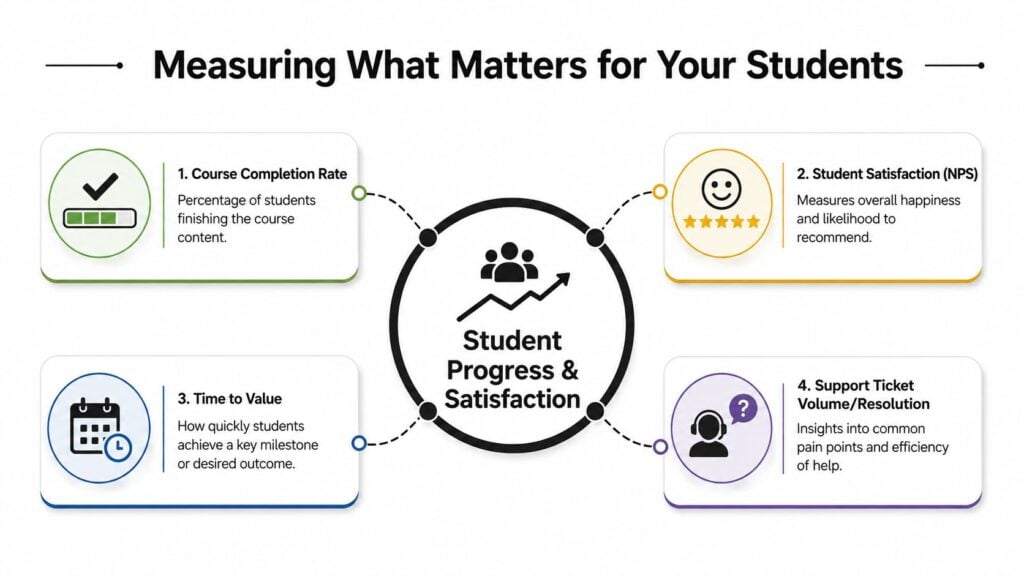
Start with a student health score
A health score gives you a quick way to sort students into groups. Who is thriving? Who needs a nudge? Who is close to leaving?
A basic version uses weighted factors for usage 40%, support health 30%, and business results 30%, based on HubSpot’s customer success metrics guide. Scores below 50 flag at-risk customers, while scores above 80 help identify expansion candidates.
For creators, you can translate those categories like this:
| Health score input | What it could mean in a course or membership |
|---|---|
| Usage | Login frequency, lesson completion, event attendance, community visits |
| Support health | Repeated confusion, unresolved help requests, refund-risk conversations |
| Business results | Milestones reached, assignments submitted, visible outcomes achieved |
You don’t need perfect math on day one. You need consistency.
For example, if a student logs in often, submits work, and says they’re making progress, they probably land in your green zone. If another student hasn’t finished a lesson, opened multiple help threads, and hasn’t reported any result, they likely need intervention fast.
Simple benchmark: If a student’s behavior says “inactive” but your gut says “fine,” trust the behavior first and investigate.
If you want a practical companion piece on this side of the work, this article on tracking student progress pairs well with a health-score mindset.
Satisfaction matters, but only with context
Creators love testimonials, and I do too. But broad satisfaction alone can fool you.
A student might say they enjoyed the course while still failing to implement anything. Another might give tough feedback while making strong progress. That’s why sentiment works best when paired with behavior.
High-performing customer success teams build health scores by combining behavioral signals like usage frequency and feature adoption with sentiment indicators such as CSAT and NPS to predict churn risk and expansion opportunities. In creator terms, that means combining what students say with what they do.
A few useful prompts:
- After onboarding: “Was it easy to get started?”
- After first milestone: “Have you seen a meaningful result yet?”
- Midway through: “What nearly slowed you down?”
- Near renewal: “Would you recommend this to a peer, and why?”
Translate NRR into creator language
Net Revenue Retention, or NRR, sounds like boardroom jargon, but it’s useful for memberships and course ecosystems.
The formula is [(Starting recurring revenue + Expansion revenue − Churn) ÷ Starting recurring revenue] × 100, and best-in-class companies aim for greater than 110%, according to Contentsquare’s guide to customer success metrics.
For a creator, this tracks whether your existing student base is shrinking, staying flat, or growing through renewals and upsells.
If members renew and some buy an advanced cohort, your retained revenue rises. If too many cancel or downgrade, it falls. This metric helps you see whether your audience is deepening with you over time or leaking out the back.
A Simple Customer Success Playbook for Creators
Most creators don’t need a big team. They need repeatable plays they can run with the tools they already have.
I like to think in three layers: tech-touch, low-touch, and high-touch. That keeps the experience matched to the price point and the level of support students need.
Tech-touch for self-serve courses
This layer runs through automation. Your course platform, email tool, and simple tagging rules do most of the work.
Good tech-touch plays include:
- Welcome sequence: Clarify where to start, how to get help, and what first success looks like
- Inactivity nudge: Trigger a check-in when a student stops progressing
- Milestone email: Celebrate a completed module and suggest the next action
- Completion path: Invite the student to share a win, leave feedback, or explore the next offer
Here’s a plain email template you can adapt.
Subject: Quick check-in on your progress
Hey [First Name],
I noticed you haven’t made progress recently, so I wanted to check in.
Most students get stuck for one of three reasons: not enough time, uncertainty about the next step, or trying to make the work perfect too early.
If that’s where you are, start with this one action today: [small next step].
If you reply and tell me where you’re stuck, I’ll point you to the best lesson or resource.
You don’t need to catch up on everything. You just need one clean step forward.
Jason
That kind of email works because it sounds human and lowers the restart barrier.
Low-touch for memberships and group programs
Low-touch isn’t low-value. It usually means the support is shared and structured.
A few plays work well here:
- Weekly prompts that spark participation without demanding a long response
- Monthly check-in calls where members can surface blockers live
- Progress threads inside Circle, Heartbeat, or your community platform
- Theme-based sprints that focus the group on one visible outcome
Here, rhythm matters more than complexity. Members stay when they know what happens here each week and why it helps them.
High-touch for premium offers
For coaching containers, mastermind programs, or done-with-you education offers, success needs more personalization.
That can include a lightweight success plan with:
| Element | What to define |
|---|---|
| Desired outcome | What result the client wants most |
| Key milestone | The first sign of meaningful progress |
| Risk factor | What could slow them down |
| Review cadence | When you’ll check in and adjust |
An adapted approach works best when you’re realistic about capacity. According to Simon-Kucher’s benchmarks for top-tier customer success teams, coverage should match engagement level, with one CSM typically covering 5–20 high-touch accounts, 20–60 mid-touch accounts, or 100–250 low or tech-touch accounts. Their guidance also notes customer success teams should cost 10% of ARR or less, with teams under 15% of ARR still considered within benchmark.
Creators won’t map this one-to-one, but the lesson is clear. Don’t sell a high-touch promise if your calendar only supports low-touch delivery.
One metric that helps you judge whether your retained audience is becoming more valuable over time is NRR. As covered earlier, the formula is [(Starting recurring revenue + Expansion revenue − Churn) ÷ Starting recurring revenue] × 100, and best-in-class companies target above 110%. For creators, that’s a clean way to ask whether your current students are fueling growth or draining it.
Putting It All Together with the Right Tech
You don’t need a pile of disconnected software to run a smart customer success strategy.
You need your core systems to talk to each other well enough that behavior leads to action. In most creator businesses, the key categories are your LMS, your email platform, and your community tool.
Let your LMS do more than host lessons
Your learning platform should tell you who started, who stalled, who completed, and where students tend to drop off.
That information becomes useful when you stop treating it as passive reporting. If someone finishes module one, your LMS should trigger the next encouragement. If they disappear after lesson three, that should trigger a re-engagement email or a personal check-in depending on the program type.
If you’re still evaluating platforms, this guide on how to choose an LMS is worth bookmarking because the right system affects far more than content delivery.
Email carries the nudges
Email is where a lot of success work happens. Not broad newsletters. Timely nudges.
A good setup lets you send messages based on behavior:
- Started but didn’t complete onboarding
- Attended a live session but missed the replay follow-up
- Reached a milestone and may be ready for the next offer
- Went inactive after strong early momentum
Tags, segments, and automations become useful instead of overwhelming. The message should match the moment.
The best automation doesn’t feel automated to the student. It feels well-timed.
Community adds context that dashboards miss
A student can look healthy in your LMS and still feel lost. Community signals often reveal that first.
Someone may be logging in but posting confused questions. Another person may stop commenting after being active for weeks. Those human cues matter because strong customer success teams combine behavioral metrics with sentiment indicators like CSAT and NPS to predict churn risk and expansion opportunities, as explained in Contentsquare’s guide to customer success strategy.
This is the core strength of a connected setup. Your systems don’t just store activity. They help you interpret it.
A practical stack might look like this:
| Tool category | Job in the success system |
|---|---|
| LMS | Tracks progress and milestone completion |
| Email platform | Sends triggered nudges and celebrations |
| Community platform | Surfaces friction, motivation, and peer support |
| Integration layer like Zapier | Moves signals between tools |
Keep it simple at first. One stalled-student automation, one milestone celebration, one renewal check-in, and one community prompt can go a long way.
What matters is consistency. Students stay engaged when your business notices them at the right moments.
If you want more practical guidance on building stronger digital learning experiences, explore more creator-focused tutorials and strategy articles at LearnStream.