Crafting a Membership Value Proposition That Converts

You’ve probably had this conversation before. A member reaches the renewal date, tells you they loved the lessons, enjoyed the community, and found the sessions useful, then cancels anyway. When you ask what they expected from the membership, the answer is often vague. They remember the features, but they can’t describe the continuing result.
I’ve seen this happen with course communities that looked healthy on the surface. The content was solid, the price was reasonable, and the team kept publishing. Still, members drifted because the offer stopped making sense in their everyday lives. A clear membership value proposition gives people a simple reason to join, participate, and renew.
When Your Members Cannot Explain What They Pay For
A few months after launching a learning membership, I reviewed member feedback and noticed a pattern. People wrote things like “I liked the access,” “the group was helpful,” and “there was a lot to explore.” Those comments sounded positive, but they didn’t identify a concrete outcome.
Renewal conversations exposed the problem more clearly. Members weren’t angry. They weren’t complaining about broken features. Some even said they’d enjoyed everything. They still left because the membership had become difficult to justify against competing priorities.
That’s a dangerous kind of churn. A dissatisfied member gives you a problem to solve. A member who decides the offer no longer fits gives you very little to work with.
The missing sentence
Try asking a member this question:
“What do you get from this membership that helps you enough to keep paying for it?”
A strong answer might mention a weekly practice routine, feedback from experienced peers, or a clear path toward a professional skill. A weak answer usually lists a library, a chat group, or occasional live calls without explaining why those things matter.
The difference is the bridge between member identity and the renewal moment. Someone may join as “a designer who wants to improve,” but they renew when the membership helps them keep becoming that person through regular action, visible progress, and meaningful connection.
Your membership onboarding process should introduce that promise early. If members don’t understand what success looks like during their first interactions, they’ll struggle to recognize value later.
Retention starts before the billing date
Value proposition problems appear in several places:
- Survey answers: Members praise the experience without naming a result.
- Onboarding confusion: New members click around but don’t know what to do first.
- Renewal hesitation: Members ask whether they’ve used “enough” of the offer.
- Silent churn: Members leave without identifying a single feature they disliked.
These signals point to the same issue. Your value proposition sits behind activation, engagement, retention, and renewal because it tells members what to notice. Headline copy introduces the promise, but the promise has to remain visible throughout the member journey.
What a Membership Value Proposition Actually Is
Think of your membership value proposition as a renewal-stage contract. It tells a member what they can expect to receive, how often they’ll receive it, and who they’ll become through continued participation.
That contract is written from the member’s viewpoint. It answers four practical questions:
- Who is this for?
- What problem does it solve?
- What outcome should the member expect?
- Why does the membership deliver that outcome better than the available alternatives?
A library of lessons is an inventory. A value proposition explains what the inventory helps someone accomplish.
For example, “access to weekly language lessons and a private community” describes components. “Build a consistent speaking habit with guided weekly practice and feedback from other learners” describes a reason to join and continue.
Include outcome, frequency, and identity
The most useful propositions combine three elements.
Outcome describes the change a member wants. This could be completing portfolio projects, speaking with more confidence, or following a reliable fitness routine.
Frequency makes the value tangible. Weekly feedback, monthly workshops, daily prompts, and regular progress reviews give members a reason to return.
Identity connects the offer to the person the member wants to become. A learner may want to see themselves as a working developer, a confident speaker, or someone who follows through on creative goals.
Clarity at signup reduces the gap between expectation and experience. Members know what to do, what progress looks like, and why the recurring payment exists. That clarity can reduce buyer’s remorse and make automatic renewal feel like a continuation of progress rather than a fresh purchase.
Write for the future renewal conversation
A useful test is to imagine the renewal email. Could you complete this sentence in the member’s own words?
“I’m renewing because this membership helps me…”
If the answer only mentions access, add the practical result. If it only mentions a result, show the mechanism that produces it. If it ignores the emotional experience, identify the community, confidence, recognition, or belonging that makes participation worth maintaining.
Why Value Proposition Is a Retention Lever, Not Just Copy
A weak proposition can drain renewals even when your lessons, pricing, and community are all competent. The problem usually begins with unstated success criteria.
Suppose a language cohort promises access to lessons, conversation practice, and a peer group. Members join because they want to speak more comfortably, but nobody defines the weekly output. Some watch lessons. Others post occasionally. A few attend live practice. At renewal time, everyone has had a different experience, so each person makes a different value judgment.
A design membership can create the same confusion. If the offer promises inspiration, tutorials, templates, critiques, and networking, a member may enjoy all of it without knowing which behavior should lead to a meaningful result. The member doesn’t necessarily need more content. They need a clear path through the content.
Three mechanisms behind quiet churn
Mismatched expectations create the first problem. Your sales page may emphasize flexible access, while the buyer expects structured accountability. Both sides think they agreed to the same offer, but they’re measuring different outcomes.
Confusing onboarding creates the second. When the first week contains too many choices, members postpone participation. The membership then feels less useful, even if the material is excellent.
Unclear renewal messaging creates the third. If your renewal email lists new features instead of reminding members of the original transformation, the offer feels like a product catalog. Members start comparing volume and price instead of progress and belonging.
A practical churn analysis for DTC brands can help you separate cancellation reasons, timing, and behavior patterns. For learning memberships, apply the same discipline to cohorts. Look for the point where members stop completing lessons, replying to peers, attending sessions, or using the next recommended resource.
Small language changes can outperform feature releases
You might improve retention by changing “explore our growing resource library” to “complete one guided project each month and receive feedback before you move on.” The second promise sets an action, a rhythm, and an expected result.
Renewal copy should echo that promise. A member who joined for guided projects should see their completed work, feedback history, and next project reflected in the renewal experience. Consistency gives the payment a clear purpose.
The Rational and Emotional Drivers That Keep Members
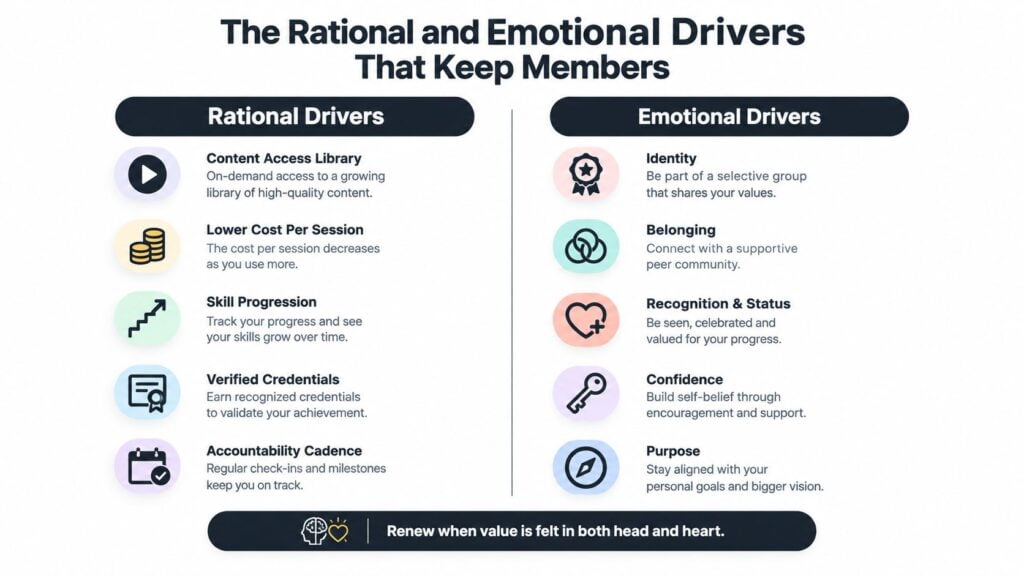
Members usually need two kinds of justification. The first is rational. They want to know whether the membership earns its place in the budget and schedule. The second is emotional. They want to feel that participation supports the person they’re trying to become.
Rational drivers make the purchase easier to explain:
- Content access: A focused curriculum, templates, or lessons that solve a defined problem.
- Cost per session: Frequent use makes the recurring fee feel more reasonable.
- Skill progression: Members can see what they’ve learned and what comes next.
- Certificates: A credential or completion record can make progress visible.
- Accountability cadence: Scheduled prompts, reviews, or feedback create useful structure.
Emotional drivers make renewal feel personally meaningful:
- Identity: The member sees themselves as part of a serious group.
- Belonging: Peers understand the same challenges and goals.
- Recognition: Progress receives visible acknowledgment.
- Safety to fail: Moderated spaces let members ask basic questions and share unfinished work.
- Purpose: The membership connects daily practice with a larger personal goal.
A coding cohort might track weekly projects, giving members proof of technical progress. A language membership might celebrate fluency milestones, turning practice into a visible identity shift. A wellness community might provide a moderated space where members can discuss setbacks without feeling judged.
Use both sides in your proposition
Rational value tends to support the initial decision. Emotional value often carries more weight after a member has lived with the offer for several months.
Ask two diagnostic questions:
- “What practical result makes this worth paying for?”
- “What would you miss personally if this membership disappeared?”
If a member can answer only the first, the offer may feel transactional and replaceable. If they can answer only the second, the community may feel warm but lack enough structure to justify the recurring fee.
Diagnostic rule: A complete membership value proposition gives members a logical reason to stay and a felt reason to care.
How to Craft Your Membership Value Proposition Step by Step
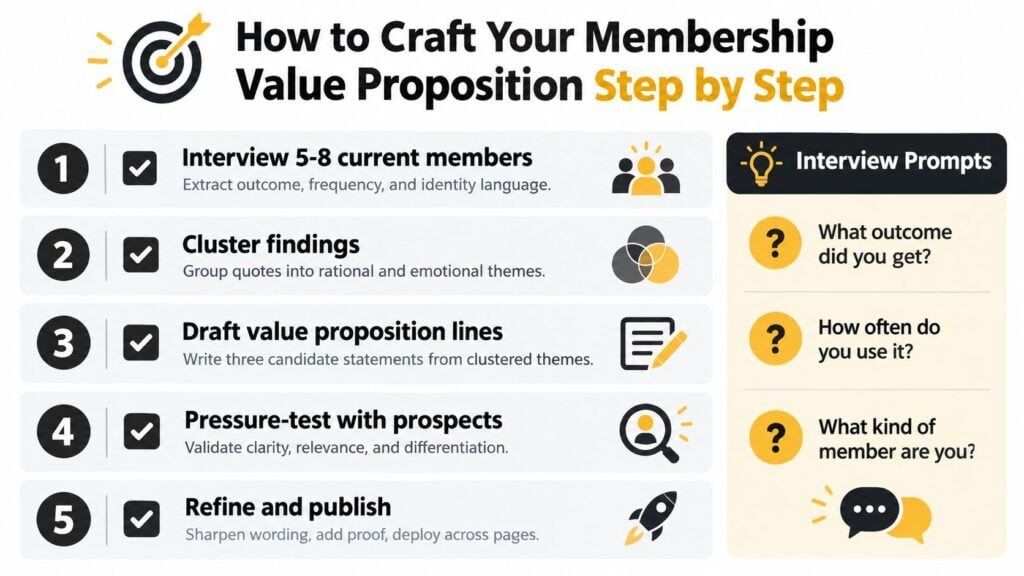
Start with member language, not your own assumptions. Interview five to eight current members, preferably people at different stages of participation. Ask what outcome they wanted, how often they use the membership, and what changed after joining.
Gather the raw material
Use open questions:
- What were you trying to achieve before joining?
- Which part of the membership do you return to most often?
- What would be harder without this membership?
- When did the membership first feel useful?
- What kind of learner or professional do you feel you are becoming?
Cluster the answers into rational themes and emotional themes. If several members mention weekly feedback, that may be your mechanism. If they mention feeling less alone, that may be your emotional differentiator.
Draft several versions with this structure:
For [member] who [struggle], [membership] delivers [outcome] through [mechanism] so they [transformation].
A cohort-based course community might produce:
For independent designers who struggle to finish portfolio work, the membership delivers one completed case study at a time through guided projects, weekly critique, and peer accountability so they can present their skills with confidence.
Pressure-test every draft
Use three filters:
- Specificity: Could a stranger understand the member, problem, and outcome?
- Renewability: Does the promise create ongoing value rather than a one-time result?
- Proof: Can you show activity, progress, examples, feedback, or another credible signal?
Avoid leading with library size. A large archive can overwhelm new members and doesn’t explain what they’ll accomplish. Also avoid competitor language. Similar words make your offer easier to compare and harder to remember.
Adapt the message to the member journey
Your proposition should have variants for different moments:
- Landing page: Lead with the problem and desired transformation.
- Day-one email: Tell the member what to do first and when to expect value.
- Renewal email: Show the progress already made and the next useful cycle.
- Cancellation flow: Ask which part of the promise failed to materialize.
A simple rollout checklist keeps the work grounded:
- Research: Interview members and review cancellation comments.
- Draft: Write three candidate promises from real member language.
- Pressure-test: Ask prospects what they think each version means.
- Deploy: Update the sales page, onboarding sequence, dashboard, and renewal message.
- Review: Compare behavior and renewal outcomes by cohort.
Adapting the Proposition for Different Membership Models
The same wording won’t work for every membership structure. A course-only offer must prove progression. A community-first offer must prove belonging. A hybrid offer has to explain how content and people work together.
| Membership Model | Sample Proposition | Strongest Proof Asset | Renewal Risk |
|---|---|---|---|
| Course-only | “Build practical analytics skills through a guided path, projects, and visible completion milestones.” | Completed projects and progress records | Members finish the path and see no next step |
| Hybrid course and community | “Apply each lesson through monthly projects, live feedback, and accountability from peers working toward similar goals.” | Member work, critique recordings, and participation history | Members use the lessons but never connect with people |
| Community-first | “Belong to a focused group of practitioners who exchange feedback, opportunities, and support throughout the year.” | Quality of discussions, introductions, and member recognition | The community becomes quiet or difficult to navigate |
| Tiered membership | “Choose the level of guidance that matches your goal, from self-directed resources to direct review and accountability.” | Clear differences in access and documented outcomes | Higher tiers add features without a sharper result |
Course-only memberships should foreground completion and evidence. If a member can finish the material quickly, give them a continuing practice loop, advanced projects, or feedback that remains useful after completion.
Hybrid memberships need named accountability. “Community access” is vague. “One live critique each month, peer check-ins, and a guided project” tells members how the two parts reinforce each other.
Community-first programs should lead with identity before curriculum. People join because they want access to a particular group and its standards, conversations, or opportunities. A resource library can support that promise, but it shouldn’t replace it.
Tiered memberships need a stable core promise. Each higher tier should add a distinct mechanism, such as review, personalization, or access to a smaller group. If you’re comparing structures in more detail, this guide to membership business models provides useful context for matching the offer to how members receive value.
Testing and Measuring Whether It Survives Renewal
A successful signup test can still produce disappointing renewals. I prefer to judge a new proposition by whether members recognize value after they’ve had time to use the membership.
Start with three measurement tracks.
Messaging tests compare versions on the sales page and renewal page. A headline focused on “weekly portfolio progress” may attract a different member from one focused on “access to a design resource library.” Track which promise brings in members who activate and renew, not only which one earns more clicks.
Early behavior signals show whether the promise is becoming real. Watch logins, lesson completion, replies to other members, attendance, project submissions, and use of the next recommended activity.
The first 90 days deserve special attention. The Baseline Pro membership report says the first 90 days accounted for over half of preventable cancellations, while annual billing retained 82% after one year compared with 35% for monthly payers. Those figures come from sports facility memberships, so treat them as directional context rather than a direct forecast for a learning business. They still point to a practical lesson, early value must become visible quickly.
Match each test to the signal it should move
| Test Type | Where It Runs | Leading Renewal Indicator |
|---|---|---|
| Promise headline test | Sales page | Qualified activation after signup |
| First-week path test | Onboarding email and dashboard | Completion of the first meaningful action |
| Community prompt test | Member space | Replies, introductions, and peer interaction |
| Progress summary test | Monthly account message | Return visits and continued participation |
| Renewal reminder test | Renewal email and account page | Renewal clicks and retained members |
Run a four-week proof test on one tier before changing every plan. Keep the offer stable, change the proposition and supporting onboarding language, then compare the cohort’s behavior with a similar earlier group. Review retention cohorts weekly rather than relying on an average that hides when members disengage.
Useful renewal indicators include the member’s day-30 satisfaction response, second-month activation, and the number of meaningful community replies. These aren’t universal guarantees. They’re signals that help you test whether the promise is producing repeated action.
For a broader measurement framework, use LearnStream’s guide to retention metrics and connect each metric to a specific member behavior.
Common Mistakes and a Simple Plan to Start This Week
More content rarely solves an unclear promise. A longer catalog can increase choice without increasing use. Members often value a reliable rhythm, useful feedback, recognition, and access to people they couldn’t easily reach alone.
A course creator may add another module when members really need a weekly recommendation. A community manager may publish more resources when members really need introductions or clearer conversation prompts. The right question is whether the new material strengthens the recurring outcome.
Avoid these recurring traps
- Copying a competitor’s tagline: Similar language makes your membership interchangeable.
- Writing a slogan instead of a promise: A memorable phrase doesn’t tell members what happens after payment.
- Burying the community benefit: Peer access should appear wherever the renewal decision is made.
- Skipping behavior tests: Positive survey comments don’t prove members will continue paying.
- Ignoring the first-use experience: Members can’t renew value they never activated.
A five-item plan for this week
- Interview two current members: Ask what outcome they wanted, what they use, and what they would miss.
- Rewrite the one-sentence promise: Include the member, struggle, outcome, mechanism, and transformation.
- Update the renewal-page headline: Show the next cycle of value, not just the list of available features.
- Set a 30-day activation metric: Choose one behavior that demonstrates the promise has started.
- Schedule a 60-day cohort check-in: Review participation, feedback, and early cancellation intent before renewal arrives.
Renewal questions educators ask
Should I change pricing at renewal? Explain the reason clearly and show what remains included. A price change feels less disruptive when members can connect it to a stronger ongoing outcome.
What should I do when someone downgrades? Preserve the core promise at the lower tier and remove a clearly defined layer of access, guidance, or personalization. Don’t make the downgrade feel like losing the entire relationship.
When should I retire a proposition? Retire it when member interviews, usage patterns, and renewal behavior repeatedly show that the promise no longer matches the experience. Test a sharper version before replacing it across every page.
Your next step is simple. Interview two members this week, rewrite the promise in their language, and place it on the renewal page where the decision happens. Then track the first meaningful action within 30 days and review that cohort before the next billing cycle. A membership value proposition becomes useful when members can repeat it, experience it, and recognize why it still matters.




![How to Launch a Membership Site Using Squarespace [Step By Step Guide]](https://learnstream.io/wp-content/uploads/2024/11/image-768x433.png)