
Membership Lifecycle Guide: Stages, Metrics, and Tactics
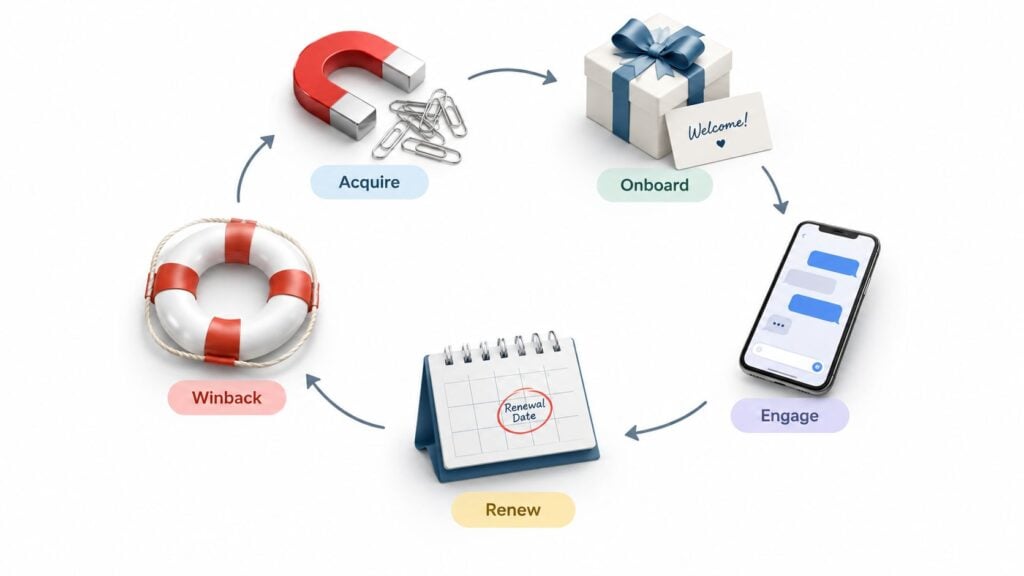
A membership can lose 44% of its cancellations within the first 90 days, with most churn happening during the first 60 days, according to subscription retention data from SHNO. That changes how I think about the membership lifecycle. The biggest retention problem usually isn’t hiding at the end of a long customer relationship. It starts shortly after signup, while the member is still deciding whether your offer belongs in their routine.
A creator can spend a weekend promoting a new membership, celebrate a wave of signups, and then discover weeks later that many new members haven’t logged in again. The checkout worked. The acquisition campaign worked. The lifecycle didn’t.
The practical work sits between those moments. You need to help members reach a first win, form a usage habit, recognize value before renewal, and leave through a pause or reactivation path when their circumstances change. Here’s how I approach each stage, the metrics I watch, and the recovery flows that often produce more value than another round of acquisition.
Why the Membership Lifecycle Matters More Than Acquisition
A new member joins a course library after seeing your promotion. They watch one lesson, bookmark three more, and tell themselves they’ll return on the weekend. Two months later, the bookmark is still there, the community feels unfamiliar, and the recurring charge becomes easier to question.
That pattern is common because acquisition creates a transaction, not a relationship. The member still has to understand where to start, experience useful progress, build a habit, and see a reason to renew. A polished sales funnel can’t compensate for a confusing first week or a quiet member experience.
The economics make the timing especially important. Subscription businesses often report an average monthly churn rate of 5.3%, while top-performing companies keep churn below 3%, according to the SHNO subscription retention benchmark. The same analysis reports that high-performing SaaS subscriptions retain 90% or more annually, which reinforces the importance of the early authority-building period.
Acquisition opens the door
I still care about acquisition quality. A member who joins the wrong offer creates problems that onboarding can’t solve. Your sales page should explain the audience, outcome, format, publishing rhythm, access terms, and cancellation experience clearly enough that the buyer knows what they’re committing to.
After payment, though, the work changes. The member wants a fast answer to a simple question: what should I do first?
Give them a clear first action. Then give them a reason to return. A useful dashboard, a short starter lesson, a scheduled live session, or a personal progress checkpoint can turn passive access into an active routine.
Practical rule: Treat every new signup as unfinished business until the member reaches a meaningful first win.
Retention creates the compounding value
Membership performance is usually measured through renewal, retention, and churn. A 2026 membership benchmark reports average member retention of 90% for trade associations, 83% for combination associations, and 81% for associations recruiting only individuals. The models differ from digital learning businesses, but the lesson carries over. Clear value and consistent engagement support renewal.
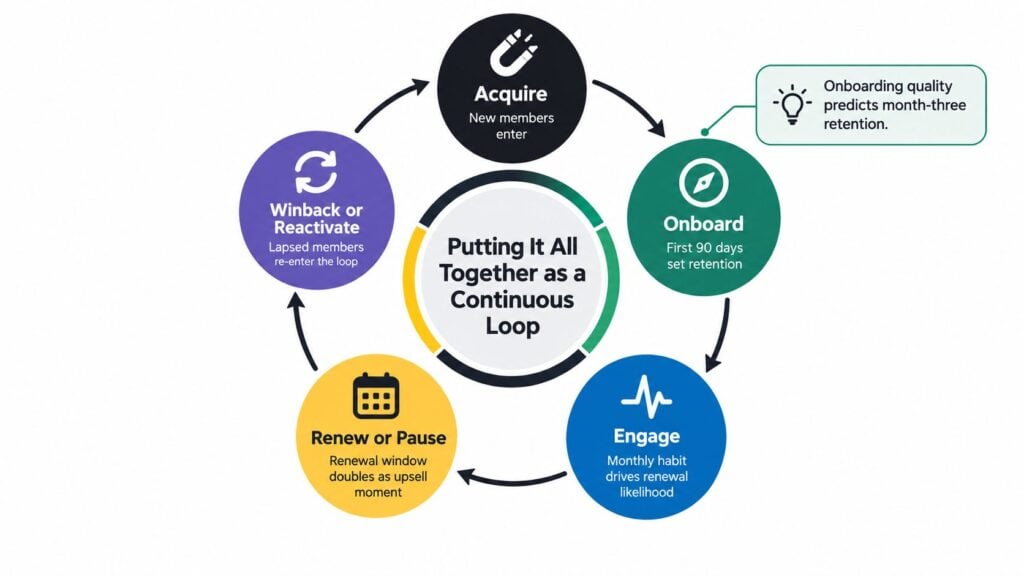
The lifecycle is therefore a loop:
- Acquisition brings the member in.
- Onboarding helps them reach value quickly.
- Engagement turns value into a habit.
- Renewal or pause preserves the relationship at the decision point.
- Winback or reactivation gives former members a route back.
I don’t try to rebuild all five stages at once. I look for the leak with the clearest evidence, fix that stage, and then measure what changes in the next cohort. A good lifecycle dashboard makes that process manageable for a creator or small team.
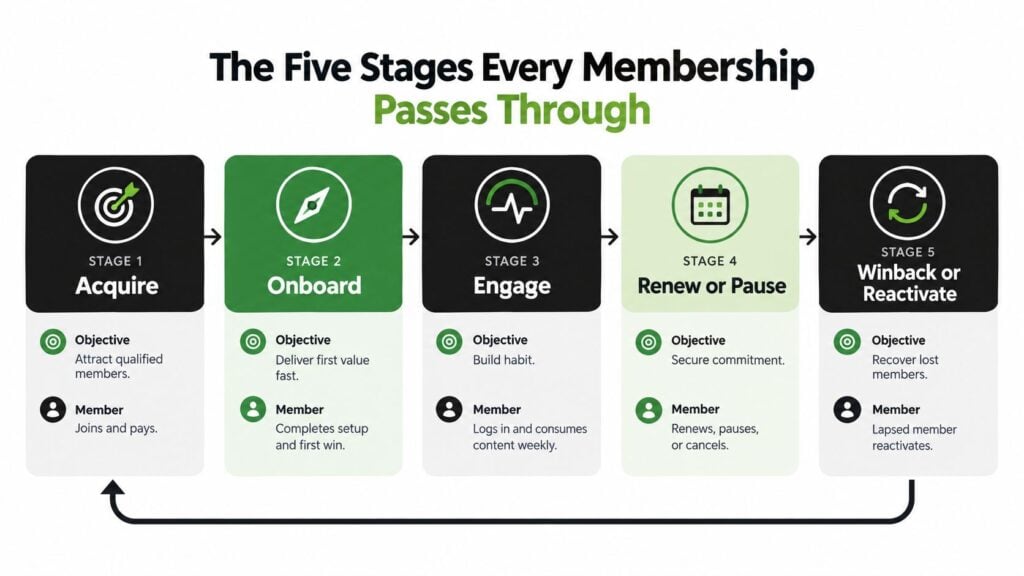
The Five Stages Every Membership Passes Through
A membership lifecycle usually moves through acquisition, onboarding, engagement, renewal or retention, and reinstatement or reactivation, as outlined in this membership lifecycle overview. The stages overlap, and members can move backward or forward depending on their behavior.
Acquire
The acquisition stage runs from first contact to checkout. The member sees your content, evaluates the promise, compares the price and format with alternatives, and decides whether to commit.
Your objective is qualified commitment, not a large signup count at any cost. Make the offer specific. Explain who it’s for, what the member will receive, how often new value appears, and how they can manage or cancel the subscription.
A member who understands the product at checkout arrives with useful expectations. That makes the next stage easier.
Onboard
Onboarding covers the first days after payment. The member opens the welcome email, logs in, finds the dashboard, and looks for a first task that feels achievable.
Your objective is fast first value. Don’t make new members browse a large archive without direction. Give them a recommended path, a short setup checklist, and one concrete action that confirms they’ve made progress.
The first lesson, profile completion, community introduction, or live-call booking can all work as activation events. Choose one or two signals that show the member has started using the product.
Engage
Engagement is the steady period between the first win and the next billing decision. The member consumes lessons, attends live sessions, asks questions, saves resources, or participates in the community.
Your objective is habit formation. A growing content library alone doesn’t create a habit. Members need prompts, recurring events, visible progress, and a reason to return this week rather than someday.
Renew or pause
At renewal, the member evaluates continued value against time, price, and current priorities. Monthly members reach this decision frequently, while annual members face a concentrated renewal window.
Your objective is a clear next commitment. That may be renewal, a lower tier, or a temporary pause. A pause option gives members a way to preserve their relationship when the problem is timing, workload, or temporary budget pressure.
Winback or reactivate
Winback begins after cancellation or lapse. The former member already knows the product, so your message can be more relevant than a cold acquisition pitch.
Your objective is a credible return path. Remind the person what has changed, offer a simple way back, and match the message to the reason they left. A former member who paused because of workload needs a different invitation from someone who found the content too advanced.
These stages form a loop. A reactivated member may need a lighter onboarding sequence, while a long-standing member can move directly into a new engagement path. Your automation should reflect those differences rather than forcing everyone through the same campaign.
Retention and Churn Benchmarks by Membership Model
Retention benchmarks only help when the comparison matches the product. A low-cost community, course library, hybrid offer, and coaching membership create different patterns of accountability, usage, and switching cost. For a broader view of how these structures differ, review membership business models.
Available model-specific benchmarks place typical monthly churn at 6% to 9% for paid communities, 8% to 12% for course-bundle memberships, 4% to 6% for hybrid memberships, and 3% to 5% for coaching memberships, according to Kourses’ member retention benchmarks. Treat those ranges as planning references, not targets. Audience fit, pricing, delivery quality, and billing terms can shift the result.
| Membership Model | Price Range | Monthly Churn | Annual Retention | Key Driver |
|---|---|---|---|---|
| Paid community | Qualitative low-price model | 6%–9% | Model-specific | Belonging and frequent participation |
| Course-bundle membership | Qualitative mid-price model | 8%–12% | Model-specific | Perceived course utility and completion |
| Hybrid membership | Qualitative mixed model | 4%–6% | Model-specific | Combined content, community, or support |
| Coaching membership | Qualitative high-touch model | 3%–5% | Model-specific | Accountability and personal attention |
Monthly churn becomes expensive through repetition. At 5% monthly churn, annual churn is roughly 46%, while 10% monthly churn compounds to about 72% annual churn, using the calculation described in the membership retention benchmark. A modest improvement early in the relationship can protect many later billing cycles, which is why activation and early value clarity deserve attention before elaborate loyalty campaigns.
Use the right comparison
A community may lose members who participate infrequently. A course library may lose buyers after they finish the material they wanted, or because the archive feels difficult to browse through. Coaching can retain members through scheduled accountability even when they consume less content.
Blended churn hides these differences. Segment results by product, plan, acquisition source, tenure, and cancellation reason. If a course bundle churns faster than coaching, do not copy the coaching emails. Improve the course path, clarify the next useful outcome, or offer a pause when timing is the main issue.
Annual retention adds another useful view. At 82% retention, annual churn is about 18%, implying expected tenure of roughly 5.6 years if churn remains constant. The calculation is directional, because real members do not behave at a fixed rate. Use it to compare priorities, not to forecast revenue without qualification.
Cancellation should also be treated as a routing decision. A member leaving because of workload may accept a pause, while someone who completed the library may respond better to a lighter reactivation offer. A winback sequence can acknowledge the reason for leaving, show what has changed, and provide a clear return path. That recovery work often matters more than another renewal reminder.
For wider context, industry figures cited by membership industry statistics from MemberPress include a 6% churn rate in 2023, down from 6.61% in 2022, plus a 95.9% median customer retention rate and 4.1% median subscriber churn across industries. These figures span varied subscription businesses, so use them as context rather than a direct membership target.
Onboarding and the First Renewal Window
The first 90 days deserve a deliberate operating plan. An industry guide to membership retention identifies the first 90 days as the most important period and recommends renewal reminders at 90, 60, 30, and 14 days, with 5 to 7 total emails that include expiration day and the grace period.
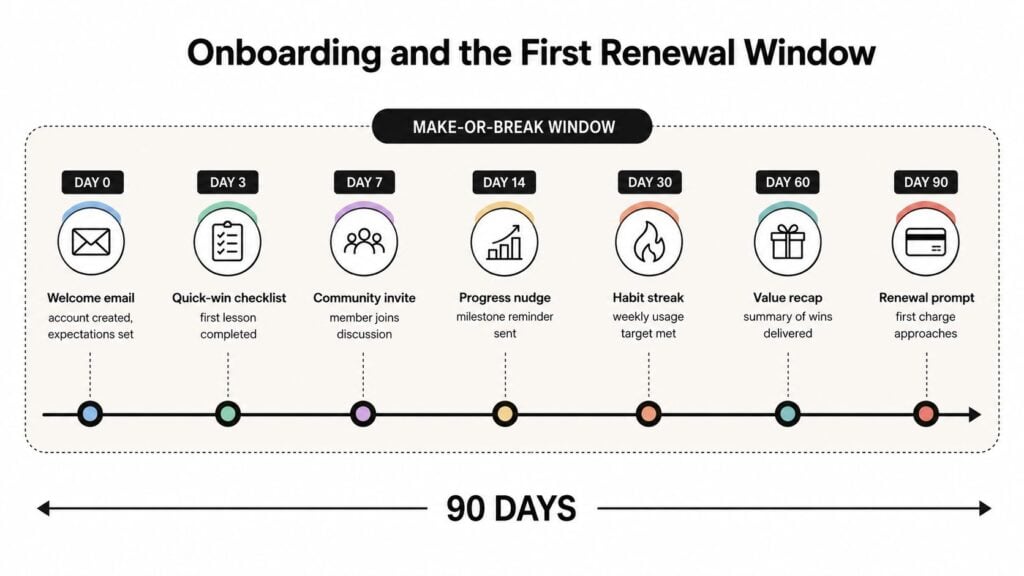
I prefer to design onboarding around behavior rather than a pile of emails. A welcome message matters, but it won’t rescue a member who can’t find the first lesson or doesn’t know what success looks like.
The first two weeks
Start with one clear path:
- Welcome immediately: Confirm access, explain the first step, and link directly to the member dashboard.
- Create a quick win: Ask the member to complete a short lesson, download a starter resource, or attend an upcoming call.
- Invite participation: Introduce the community only after the member knows why it matters. A specific discussion prompt works better than a generic invitation.
- Check progress: Ask what they’ve completed and direct them to the next useful action.
For example, you might place a signature course module behind a profile-completion action. The point isn’t to create a frustrating gate. The point is to turn setup into a visible commitment and use the completed profile to personalize future recommendations.
You can also offer a 15-minute office-hours slot as a renewal incentive if personal access fits your delivery model. That reward works because it reinforces the outcome of the membership, rather than discounting the subscription without addressing value.
Days 30 through 90
By the second month, the member should see a pattern of useful activity. Send a recap of completed lessons, point out relevant upcoming sessions, and recommend the next module based on what they started.
Before the first billing date, use reminders at 14, 7, and 3 days if that cadence matches your billing system. Explain what the member has achieved, what remains available, and what happens at renewal. Avoid surprise charges and avoid burying cancellation information.
If you send onboarding and renewal email from a new or recently changed sending setup, technical delivery deserves attention too. A practical guide on how to warm up an SMTP server can help you understand the preparation involved before increasing sending volume.
LearnStream’s membership onboarding process is another useful reference for connecting checkout, the first post-signup screen, dashboard navigation, and account management.
Designing Pause and Winback Flows That Recover Revenue
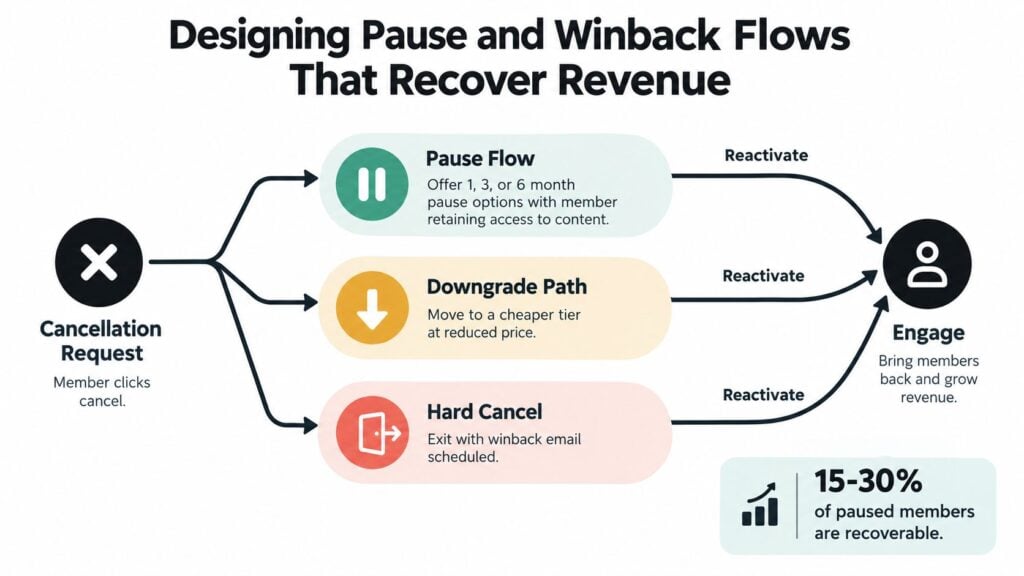
Cancellation should open a decision tree, not close the relationship. The member may be leaving because of price, timing, lack of progress, or a mismatch between the offer and their needs. Each reason suggests a different next step.
Recurly reports that 20% of acquisitions are returning subscribers, and that more than $200 million was generated from users who had previously paused and later resubscribed. Its report also says businesses offering a pause option saw 25% of subscribers pause instead of canceling, while acquisition rates fell from 4.1% in 2021 to 2.8% in 2024. These figures appear in Recurly’s 2025 industry report announcement.
Build the fork before the cancel button
Offer a pause for 1, 3, or 6 months, and show the reactivation date clearly. If the member’s problem is temporary, a pause preserves goodwill and gives them a defined return point. If the price is the issue, consider a lower tier with fewer benefits.
During the pause, send one useful value reminder. Show new lessons, upcoming sessions, or changes that relate to the member’s previous interests. Don’t send the full newsletter. A paused member needs a reason to return, not another crowded inbox.
For a 30-day pause, a warm winback message around day 25 gives the member time to prepare for reactivation. A simple sequence might look like this:
- Pause confirmation: “Your access is paused until [date].”
- Mid-pause reminder: “Here’s what changed while you were away.”
- Day 25 return prompt: “Want to restart with the new member path?”
- Post-lapse follow-up: “Your restart bundle is ready.”
A restart bundle can include two new courses released during the member’s absence, provided those courses match the reason they joined. Don’t use a generic discount as your default. A relevant new outcome is usually a stronger reactivation argument.
A pause flow earns its place when it respects the member’s reason for leaving and makes the next return simple.
The cancellation experience still needs to be transparent. Explain access end dates, billing status, and how to reactivate. Guidance on renewal of membership can help you think through renewal communication and member control.
The Lifecycle Dashboard You Should Actually Track
A useful dashboard should help you decide what to change this month. It doesn’t need to become a data warehouse. A spreadsheet, payment platform, email system, learning platform, and community analytics can provide enough information for a small membership business.
Start with stage-specific measures. Don’t combine acquisition success and retention success into one headline number.
Acquisition and onboarding
Track how many qualified prospects become paying members, then watch whether new members complete the first meaningful action. Your data sources may include checkout records, analytics events, email activity, and lesson completion data.
For onboarding, activation at day 7 and first-lesson completion are practical signals. If activation falls, inspect the first screen, welcome email, login experience, and recommended path before changing your sales copy.
Engagement and retention
Weekly active members show whether people are returning. Content consumption per member helps distinguish a busy library from an actively used one. Add separate logo churn and revenue churn so a lost high-value account doesn’t disappear inside a single member count.
Retention is the percentage of members who renew rather than lapse. One published formula calculates it as (members at the end of the period minus new members during the period) divided by members at the start of the period, multiplied by 100, as explained in this membership retention formula guide.
| Lifecycle Stage | Primary Metric | Target Threshold | Action If Below Target |
|---|---|---|---|
| Acquisition | Trial-to-paid conversion | Establish a baseline by source | Review promise, qualification, and checkout friction |
| Onboarding | Day 7 activation | Set a cohort baseline | Simplify the first action and improve welcome guidance |
| Engagement | Weekly active members | Track the trend by plan | Add behavior-based nudges and recurring reasons to return |
| Retention | Logo churn | Compare by model and tenure | Review value delivery and cancellation reasons |
| Renewal | First-cycle renewal rate | Set a cohort baseline | Improve pre-renewal recap and save options |
Renewal and action thresholds
Track first, second, and annual renewal separately. A strong annual number can hide a weak first renewal, and a healthy second-cycle cohort may reflect members who survived a difficult first year.
For churn reporting, Sona’s membership benchmarking guide defines churn as the percentage of members who don’t renew, calculated as (1 minus renewal rate) multiplied by 100. It places typical churn between 10% and 20%, depending on the sector and model.
Review the dashboard monthly. Mark the stage with the largest movement, identify one likely cause, and ship one intervention. A dashboard that produces no action is just a report.
Putting It All Together as a Continuous Loop
A membership lifecycle works best when each stage prepares the next one. Acquisition sets expectations. Onboarding creates the first proof of value. Engagement gives the member a reason to return. Renewal becomes easier when the member can see that progress, while pause and winback flows keep the relationship available when circumstances change.
The first renewal window deserves special attention because early retention is weaker than long-term loyalty in many membership organizations. The 2025 Membership Marketing Benchmarking Report summary reports 84% median renewal overall, compared with 74% after a member’s first year. The practical implication is straightforward. Improve the first experience before investing heavily in late-stage loyalty mechanics.
Five jobs to start this week
- Audit the welcome sequence: Remove extra choices and make the first useful action obvious.
- Instrument activation: Record the event that proves a new member has started, such as a completed lesson or booked session.
- Review renewal reminders: Make the price, date, value recap, and cancellation route easy to find.
- Build a pause form: Ask for the reason, offer defined pause lengths, and display the return date.
- Schedule a winback campaign: Segment former members by reason for leaving and show each group what has changed.
A 5% churn reduction can compound across cohorts, but I wouldn’t begin by trying to optimize every message and metric. Find the first serious leak. If members join but don’t activate, fix onboarding. If they engage but cancel at renewal, improve value recaps and decision support. If they cancel for timing reasons, build the pause path before offering another acquisition discount.
The best improvements I’ve seen come from shipping one playbook at a time. A working pause flow can recover a member that an acquisition funnel would have to replace. A clear first lesson can do more for retention than another content launch. The loop gets stronger when each small fix makes the next stage easier.
LearnStream can be one reference point for creators comparing membership site flows, billing experiences, and digital learning operations. Use the principles here to audit your own product, then choose the smallest change that can improve a visible stage of the lifecycle.
Start this week by exporting your latest member list, grouping people by lifecycle stage, and marking the point where each group stops moving forward. Then rewrite the first message, renewal reminder, or cancellation flow connected to that leak. Give the change a clear owner and review the next cohort before adding another tactic.





![How to Launch a Membership Site Using Squarespace [Step By Step Guide]](https://learnstream.io/wp-content/uploads/2024/11/image-768x433.png)