Difference Between Quiz and Test: Mastering Assessment Types
You’ve probably had this moment in your LMS.
The lesson is done. The video is uploaded. The worksheet looks solid. Then you reach the final setup screen and hit a tiny decision that somehow feels bigger than it should. Do you label the next step a quiz or a test?
A lot of course creators shrug and pick whichever word sounds better. I wouldn’t. That label changes what learners expect, how much pressure they feel, and whether the next click feels manageable or intimidating.
That’s why the difference between quiz and test matters more than people think. In online learning, assessment isn’t just about measuring knowledge. It shapes pacing, confidence, momentum, and whether the course feels supportive or punishing.
The Question Every Course Creator Asks
I’ve seen this come up most often right after a creator finishes a strong lesson sequence. They know they need a knowledge check, but they’re stuck on what kind. If they call it a test, it sounds formal. If they call it a quiz, it sounds lighter. Same questions, maybe. Very different learner reaction.
That reaction matters.
A student who sees Quiz 1 usually expects a quick check-in. A student who sees Module 1 Test expects consequences. They prepare differently. They delay differently. They sometimes avoid clicking altogether.
The label sets the emotional tone
In practice, the choice is rarely about vocabulary. It’s about signaling.
If your course promises approachable progress and then drops a “test” after every lesson, learners can start to feel like they’re being judged nonstop. On the other hand, if your certification course uses only “quizzes” all the way through, the learning experience can feel flimsy, even when the material is good.
That’s why I treat assessment names as design tools.
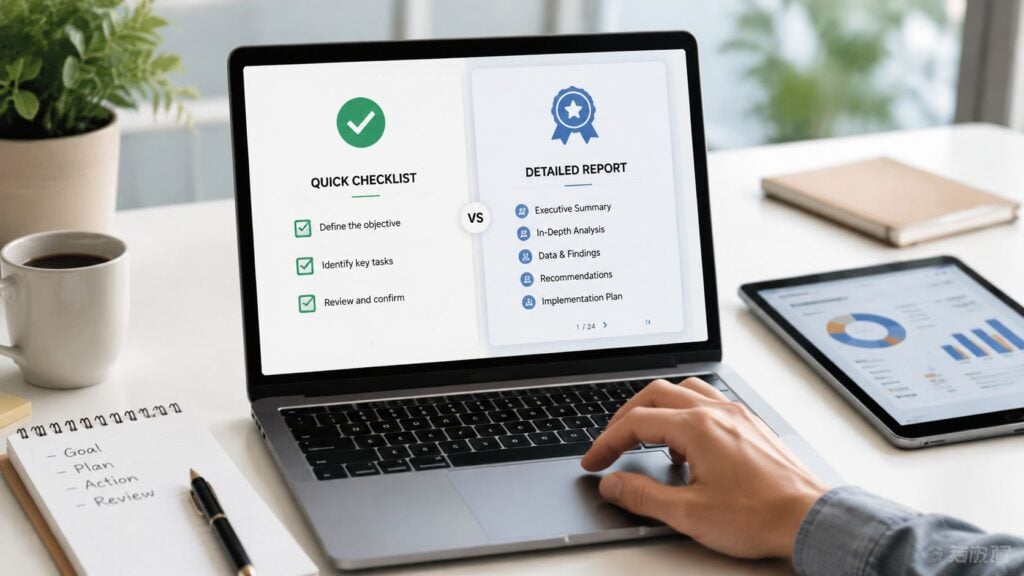
Here’s a quick side-by-side view to anchor the rest of this article:
| Criteria | Quiz | Test |
|---|---|---|
| Main purpose | Quick understanding check | Broader mastery check |
| Typical learner feeling | Low pressure | Higher pressure |
| Best timing | After a lesson or concept | After a unit or module |
| Scope | Narrow | Broad |
| Feedback style | Immediate correction | Formal evaluation |
| Course impact | Keeps momentum going | Marks progress milestones |
A good assessment doesn’t just measure learning. It changes how learning feels.
If you’re still shaping the structure of your program, it helps to think about assessments early rather than bolting them on at the end. That’s one reason I like building them into the course plan itself, the same way you’d map content, pacing, and offers in a guide to creating an online course to sell.
Once you start looking at learner experience first, the quiz versus test decision gets much easier.
Quizzes for Quick and Frequent Pulse Checks
A quiz works best when you want a fast read on whether the last lesson landed.
That’s the practical job. Not to prove mastery. Not to gatekeep progress. Just to tell both you and the learner, “Yes, this point is sticking,” or “No, we need another pass at this.”
Keep quizzes short and narrow
There’s a clean definition worth using here. A quiz is defined as a short, quick assessment limited to no more than 15 questions and designed to take no more than 5 minutes to complete according to EducateMe’s breakdown of quiz, test, and exam formats. That cap is useful because it forces focus.
When creators ignore that and build a “quiz” that takes a long time and jumps across multiple lessons, learners feel the mismatch right away. They don’t experience it as a helpful check. They experience it as hidden friction.
I like to think of quizzes as pulse checks during instruction. You’re not asking the learner to defend their whole understanding. You’re checking whether the heart of the lesson is beating.
What quizzes do well
Quizzes are strong when you need to support momentum.
They let learners pause, retrieve, answer, and move on. That small cycle matters because it keeps people active in the material instead of drifting through passive videos.
A strong quiz often does three things:
- Checks one idea: Ask about the exact concept the learner just encountered, not a pile of related topics.
- Gives fast feedback: The learner should know quickly what they got right and what needs review.
- Creates a low-pressure win: Even when someone misses a question, the experience should feel recoverable.
Practical rule: If the learner should be able to complete it between lessons without bracing for impact, you’re probably building a quiz.
For creators who want a better process for helping students prepare, I’ve found that a simple quiz study framework can make the whole experience feel more supportive, especially when learners tend to rush through check-ins without reviewing key terms first.
What usually goes wrong
Most bad quizzes fail for simple reasons.
Sometimes they ask trick questions. Sometimes they test wording instead of understanding. Sometimes they include too many items, which turns a quick checkpoint into a grind. And sometimes creators attach too much emotional weight to something that should feel routine.
If your quiz is there to reinforce learning, build it like a helpful interruption, not a courtroom.
A few practical fixes help:
- Use familiar context: Don’t introduce a totally new scenario unless the lesson prepared the learner for it.
- Limit answer ambiguity: If two answers seem defensible, learners stop trusting the assessment.
- Place quizzes where attention naturally dips: After a dense video or a concept-heavy reading is usually the right spot.
If you want ideas for format and interaction style, this guide on making online course quizzes interactive and engaging is useful because it focuses on quiz design as part of the learning experience, not just as a grading feature.
Tests as Meaningful Learning Milestones
A test should feel different because it serves a different purpose.
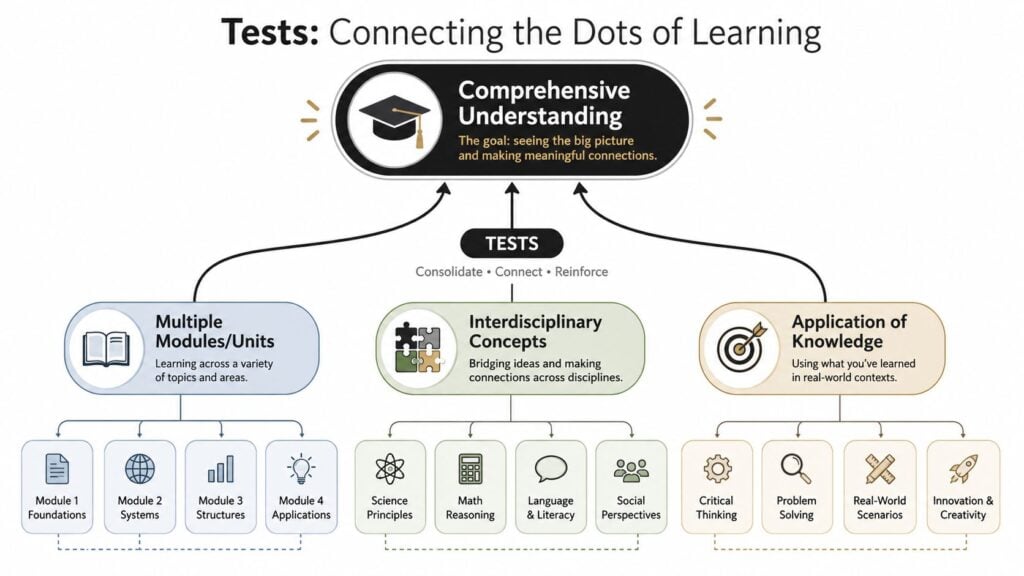
If a quiz is a pulse check, a test is a milestone. It asks the learner to pull together multiple lessons, connect ideas, and show that the material holds up beyond immediate recall.
Tests validate broader understanding
Formal tests carry more structure for a reason. Formal tests require an Assessment Management System (AMS) to establish the rigor necessary for determining course progression or certification, as they cover broader course material spanning whole units. While quizzes are for immediate checks, tests generate empirical data aligned with education standards to measure skills and knowledge over extended durations, as explained in TAO Testing’s discussion of quizzes and assessments.
That’s a big shift in function.
A test isn’t just asking whether the learner remembers the previous video. It’s asking whether they can handle a larger body of material with enough consistency to move forward, complete a module, or qualify for some form of recognition.
Why tests need more weight
Learners usually accept a more formal assessment when the course has earned it.
If they’ve worked through a full module on project management, client communication, or compliance procedures, they expect a moment where they demonstrate what they can do with that body of knowledge. That moment creates perceived value. It tells them the course takes mastery seriously.
Question design also changes. On a test, I want fewer “did you notice this term?” prompts and more “can you use this idea in context?” prompts.
Tests should ask learners to connect the dots, not just point at them.
That doesn’t mean every test needs to be intimidating. It means it should feel substantial enough to match the promise of the course.
Build tests with criteria in mind
A solid test usually benefits from a clear scoring approach before you ever write the questions. That matters even more if your course includes scenario responses, projects, written explanations, or performance-based work.
When I want consistency, I build the evaluation logic first and then write the assessment to fit it. If you’re doing that kind of grading, a practical guide on how to create rubrics helps keep the standard visible for both instructor and learner.
Tests work well when they mark real progress. They work poorly when they appear too often, cover too little, or show up without any clear connection to the course outcome.
A Head-to-Head Comparison of Quizzes and Tests
The difference between quiz and test becomes easiest to see. Placing them next to each other makes the design trade-offs obvious.
Start with the visual summary, then I’ll unpack what matters in course creation.
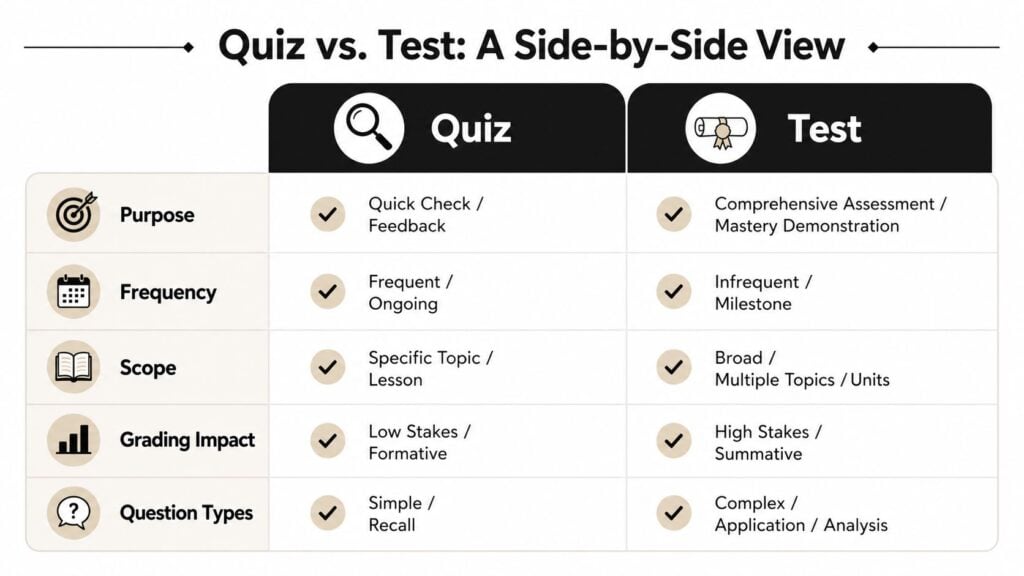
Side-by-side comparison
A useful benchmark comes from iSpring. A quiz typically contains 5–15 questions on a single concept and contributes less than 10% to a final grade. In contrast, a test is a structured evaluation with 20–50 questions covering a broader unit, contributing significantly to a final grade and serving as a standard method for performance review, according to iSpring’s comparison of quizzes, tests, and exams.
That one distinction alone explains a lot of learner behavior.
| Area | Quiz | Test |
|---|---|---|
| Question count | 5 to 15 questions | 20 to 50 questions |
| Scope | Single concept | Broader unit |
| Stakes | Usually light | More significant |
| Grade impact | Often less than 10% | Significant role |
| Learner goal | Check recent understanding | Demonstrate broader competence |
The numbers matter, but the learner experience matters just as much. A quiz usually says, “Stay with me.” A test says, “Show me what you can do.”
The real trade-off is momentum versus proof
Quizzes protect momentum.
A learner finishes a video, answers a few questions, gets feedback, and keeps moving. Even when they miss something, the interruption is short. That makes quizzes great for reducing drop-off inside a module.
Tests do something else. They create proof.
A course with no meaningful milestone can feel easy to consume but hard to trust. Learners may enjoy it, yet still wonder whether they’ve achieved anything. A well-placed test gives them a formal checkpoint that says their progress is real.
Key distinction: Use quizzes to shape learning while it’s happening. Use tests to judge whether learning holds together.
Question style should change with the format
Here, many creators blur the line.
They write quiz questions like mini-exam items. Or they write tests that feel like a pile of disconnected recall prompts. Both approaches weaken the learning experience.
For quizzes, I prefer questions that help with immediate retrieval:
- Term recognition: Can the learner identify the right concept?
- Single-step application: Can they use the idea in a simple case?
- Error spotting: Can they catch a common mistake right after instruction?
For tests, I want broader demonstration:
- Scenario judgment: Can the learner choose the right approach across a realistic situation?
- Connection across lessons: Can they combine multiple ideas without prompting?
- Reasoned response: Can they explain why an answer fits?
A short video can help illustrate how educators often frame these categories in practice.

What works and what doesn’t
Here’s the blunt version.
What works:
- Matching format to purpose
- Naming assessments clearly
- Using quizzes often enough to support retention
- Saving tests for moments that deserve weight
What doesn’t:
- Calling everything a quiz to avoid tension
- Calling everything a test to sound serious
- Using long recall lists as “milestones”
- Grading tiny check-ins too harshly
If learners feel constant pressure, they disengage. If they feel no challenge at all, the course can lose credibility. Good assessment design sits in the middle.
Practical Use Cases for Your Online Course
The distinction’s utility lies not in theory, but in placement.
In most online courses, I don’t choose quiz or test once. I choose repeatedly across the learner journey. The welcome module needs something different from the final certification checkpoint.
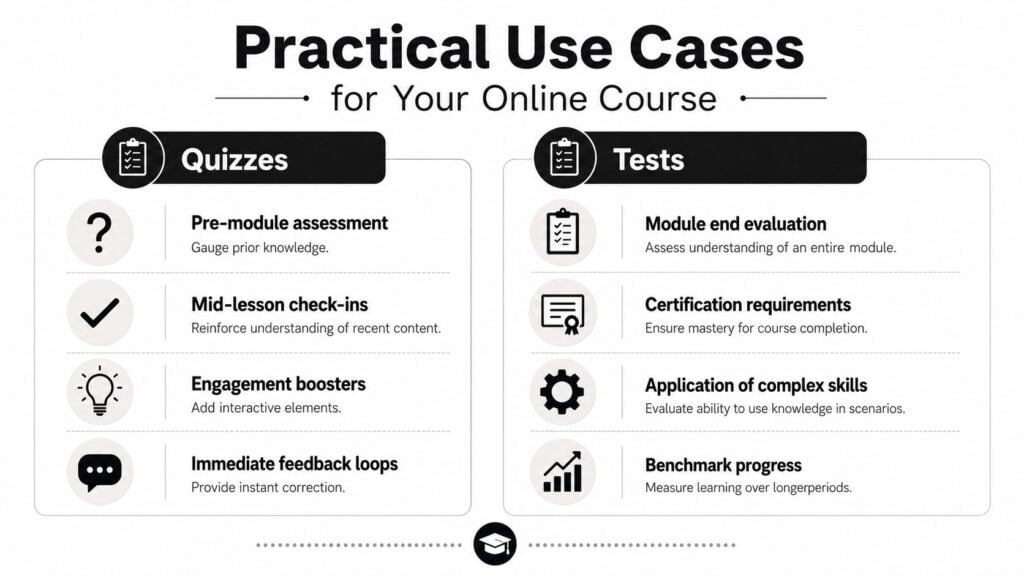
Where quizzes fit naturally
In eLearning design, quizzes are engineered as short, frequent, low-stakes formative checks (5–15 items) to facilitate spaced retrieval. In contrast, tests are mid-unit assessments (20–50 items) designed to measure cumulative mastery. Modern instructional design trends favor high-frequency quizzing to boost learner engagement, based on eLearning Industry’s analysis of quiz, test, and exam use in eLearning.
That tracks with what I’ve seen in course builds that feel smooth to learners.
Quizzes tend to work best in these places:
- Before a module begins: Use one to surface prior knowledge. This helps learners see what they already know and where to pay attention.
- Mid-lesson check-ins: Drop a quick quiz after a dense segment so learners have to retrieve, not just watch.
- Review moments: Use a short quiz to revisit vocabulary, steps, or common errors before learners forget them.
- Confidence resets: After a difficult lesson, a manageable quiz can give learners a needed sense of progress.
Where tests make the most sense
Tests belong where progression needs confirmation.
For example, if your course teaches a consulting framework across several videos, a test at the end of that module can ask learners to apply the framework to a scenario. That feels earned. It also tells the learner that this unit meant something.
I’ve found tests fit especially well here:
- End of a major module: The learner has enough material behind them for a broader check.
- Before accessing advanced content: A test can confirm that the foundation is in place.
- Before issuing a certificate: If completion means anything, there should be a meaningful demonstration.
- At benchmark points in cohort learning: Tests help instructors spot who is ready to move on and who needs support.
If a learner can fail a checkpoint and still continue without any consequence, it probably should’ve been a quiz.
A simple course map
Here’s a straightforward pattern that works well for many online programs:
- Start with a light diagnostic quiz in the opening module.
- Use short quizzes after lessons that introduce key ideas or procedures.
- Add one meaningful test at the end of a full module or skill block.
- Finish with a broader final assessment only if your course outcome justifies it.
That rhythm keeps energy up while preserving the credibility of the course.
A course packed with tests can feel exhausting. A course filled only with lightweight quizzes can feel disposable. Mixing both gives learners a better sense of pace, progress, and payoff.
Making the Right Choice for Your Learners
By this point, the answer isn’t “always use quizzes” or “tests are better.” The right choice depends on what you need the learner to do next.
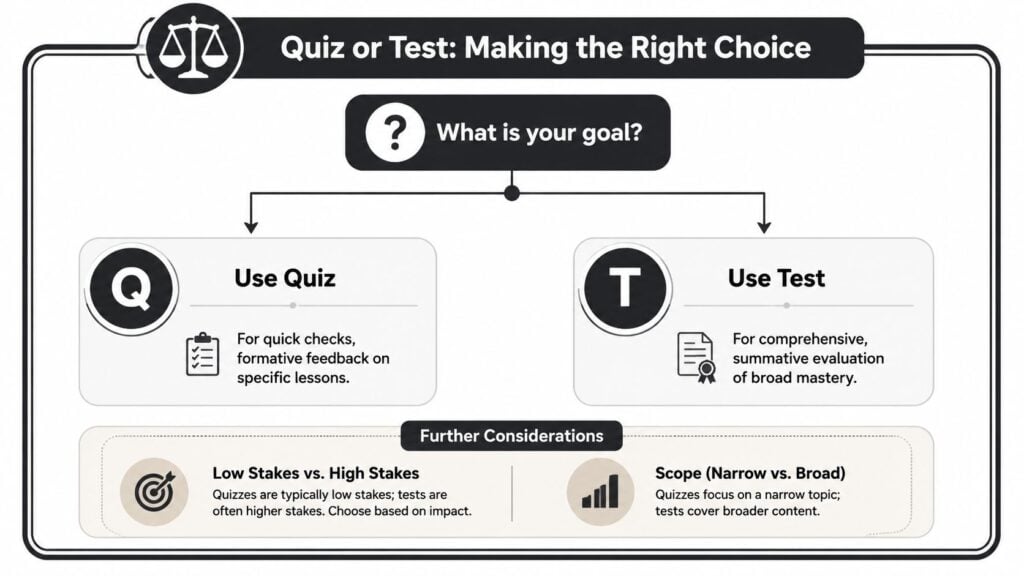
Start with the learning goal
A good rule is simple. If you need to check immediate understanding, use a quiz. If you need to evaluate broader mastery, use a test.
The difference also shows up in scheduling and perceived stakes. The weight of an assessment on a final grade differs sharply, with quizzes carrying low stakes and often serving as informal checks, while tests hold medium stakes and play a significant role in determining grades. Quizzes are given frequently for real-time checks, while tests are scheduled periodically, according to Teachfloor’s guide to quiz, test, and exam differences.
That pattern gives you a practical decision filter.
A quick decision framework
Ask yourself these questions before you build the assessment:
- What’s the scope? One lesson usually points to a quiz. A full module points to a test.
- What kind of thinking do I need? Basic recall and immediate correction fit a quiz. Application across ideas fits a test.
- How much pressure should the learner feel? Low pressure supports practice. Higher pressure should be reserved for meaningful milestones.
- What happens next? If the result changes progression, certification, or formal evaluation, a test is usually the better fit.
The learner should feel the purpose of the assessment from the design, not have to guess it from the title.
Build a rhythm, not a single event
The best online courses use both formats well.
They use quizzes to create steady interaction and reduce passive learning. They use tests sparingly enough that each one carries weight. That combination makes the course feel active without becoming oppressive.
If you’re refining your overall assessment strategy, I’d also look at broader effective learning strategies for trainers, especially when you’re trying to align engagement, feedback, and progression in a way that feels coherent for learners.
The simplest takeaway is this. Choose the format that matches the promise you’re making in that moment. If you want a quick checkpoint, call it a quiz and design it like one. If you want a real milestone, call it a test and make it worthy of the name.