
Learning Experience Platform vs LMS: How to Choose

You've got a compliance course to assign before the next reporting deadline, while employees keep asking where to find useful skills training. Your current platform handles assignments, but its catalog feels like a filing cabinet. An LXP demo looks easier to browse, until someone asks where the official completion records will live.
That's the practical question in a learning experience platform vs LMS decision. Before comparing interfaces, decide which system owns each learning record, which system helps people discover content, and how they'll exchange information without creating extra administrative work.
LXP vs LMS Side by Side
An LMS runs formal training by assigning courses, tracking enrollment and completion, grading assessments, and maintaining reportable records, while an LXP helps people find, choose, and revisit content through personalization and recommendations.
An LXP usually doesn't replace an LMS. Official completion records, certificates, and assessment results tend to remain in the LMS, even when learners start their journey somewhere else.
LMS and LXP compared on core criteria
| Criteria | LMS | LXP |
|---|---|---|
| Primary purpose | Assign, track and certify formal training | Help learners discover and choose content |
| Core strength | Compliance, records and administration | Personalization, discovery and engagement |
| Typical learner path | Assigned courses and curricula | Learner-led, goal-based paths |
| Content sources | Mostly internal content or SCORM packages uploaded by admins | Aggregates internal, external and user-generated content |
| Completion and grading | Full records and graded assessment | Usually relies on an LMS for official records |
| Data model | Enrollment, completion and scores | Searches, views, saves, recommendations and xAPI events |
| Main buyers | Universities, regulated industries and compliance teams | Large enterprises focused on skills and engagement |
The purpose and core strength rows describe who controls the learning journey. An administrator needs to assign required training to the right group and identify overdue learners. Someone developing a new skill needs a useful starting point, relevant resources, and a reason to return.
The content-source row matters just as much. Uploading an approved course package is a different workflow from gathering an internal demonstration, an external article, and a colleague's explanation into a useful learning path. Aggregation also creates an ongoing curation job, because someone must remove outdated resources and maintain meaningful labels.
The data model matters more than the homepage
The table's data model row changes what you can measure. A completion record answers whether someone met a defined requirement. A search event can reveal that people are looking for material your catalog doesn't contain, provided the platform exposes that event for analysis.
The buyer row is a starting point, not a restriction. A university can need discovery features, and a corporate learning team can need strict grading. Evaluate the actual workflows rather than assuming the product category guarantees them.
If you're also deciding how the administrative platform should be hosted, the Safety Space guide to cloud LMS is a useful companion resource. Keep hosting and learning architecture as separate decisions, because a cloud-based LMS doesn't automatically provide an LXP-style experience.
Why the LMS remains the backbone
Before centralization, learning teams combined bulletin boards, content-management systems, and locally created web pages. The LMS brought course delivery, assessment, administration, and reporting into a shared environment.
A key portability milestone was SCORM 1.2 in October 2001, which helped reusable learning packages operate across compliant vendors, as documented in the SCORM version history. That heritage explains why structured delivery and defensible records remain central to LMS selection.
The global LMS market was valued at $28.6 billion in 2025, according to Grand View Research. Its established position is a reason to inspect existing infrastructure carefully before proposing replacement.
The LMS proves someone finished the course, while the LXP can show why they came back, or help you investigate why they didn't.
What an LXP Adds for Learners
A controlled study of an AI-driven personalized learning platform reported average grades of 82.5 for the experimental group versus 76.3 for the control group, with a statistically significant difference at p < 0.001, in a study published in Heliyon. Participants also described progressing at their own pace and receiving content matched to their learning gaps.
That's evidence for a particular adaptive-learning implementation, not proof that every product labeled LXP improves grades. The useful mechanism is that learner activity influences the next resource, rather than generating another completion entry.
A learner-facing experience should make the next useful action easy to find.
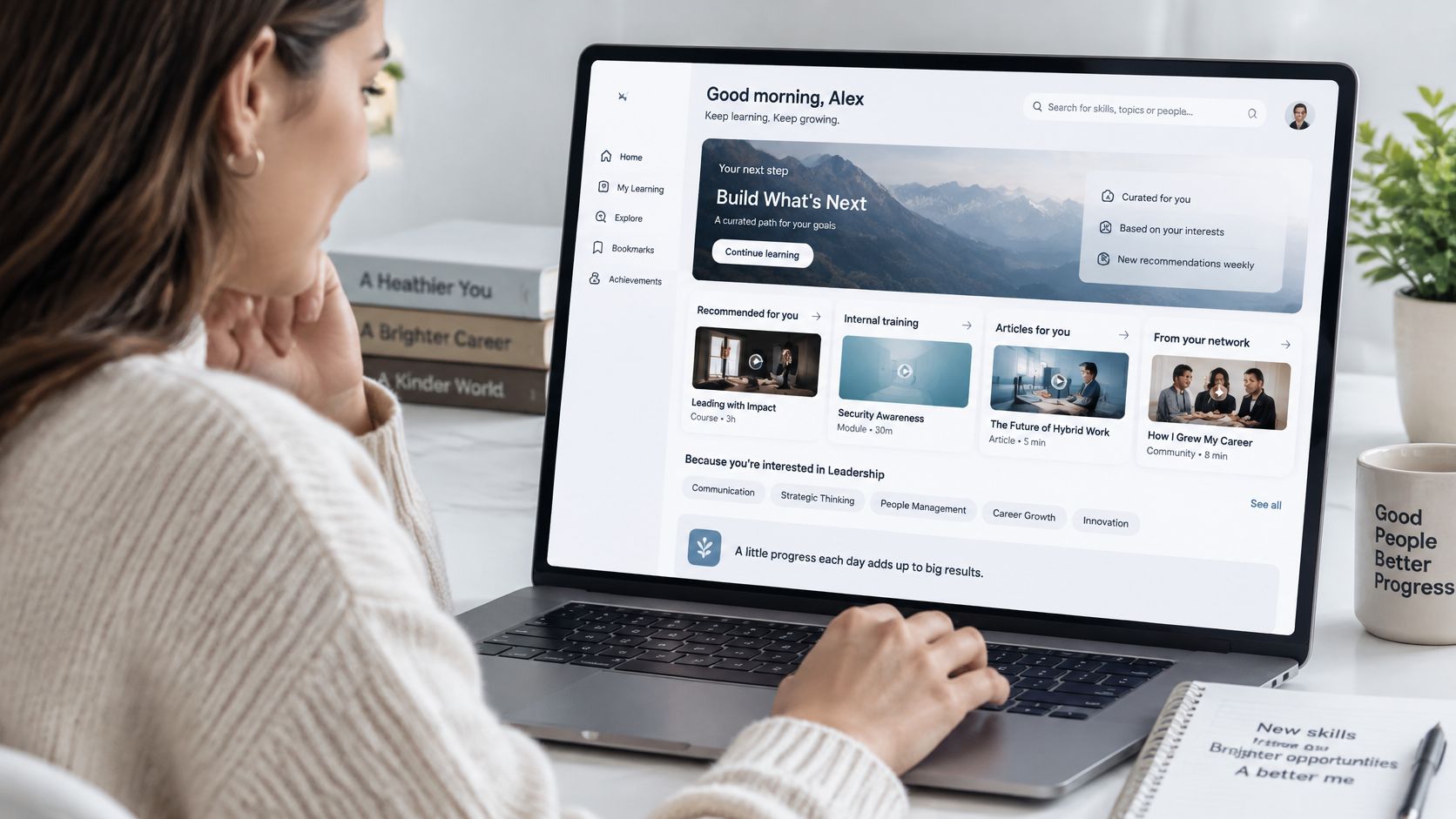
From a catalog to a useful next step
The LXP model developed around needs that extend beyond administering courses. Those include learner-led discovery, internal and external content aggregation, social learning, recommendations, and skills development.
Say a member wants to become more confident presenting to clients. A useful pathway might combine a short demonstration, a practice task, peer feedback, and a more demanding scenario. Their performance and stated goals should influence what appears next.
Practical distinction: The LMS records what a learner was assigned, while the LXP helps decide what the learner sees next.
Recommendations won't fix inaccessible content. When evaluating audio and video resources, use the iScribe Live Transcribe student captioning guide to frame questions about captioning and speech-to-text support. Learners need usable resources, not just relevant thumbnails.
Personalization comes with obligations
A systematic review of 142 empirical studies on AI-enhanced adaptive education identified persistent problems with interpretability, privacy, and scalability, according to the review in Discover Education. Personalization therefore needs scrutiny at implementation level.
Ask vendors to demonstrate the recommendation process with a realistic learner profile:
- Evidence used: Can they explain whether recommendations use assessments, declared goals, browsing behavior, or inferred interests?
- Learner control: Can someone inspect and correct their profile, dismiss a suggestion, or change direction?
- Content quality: Who checks whether recommended material is accurate, current, and appropriate?
- Learning benefit: Can the vendor show improved performance or completion, rather than increased clicking?
I'd favor a transparent, editable recommendation process over an impressive feed that nobody can explain. Feature names are easy to demonstrate. A useful next step for a learner is harder to prove.
KPIs That Differ Between LMS and LXP
Traditional LMS reporting starts with attendance, enrollments, grades, completion, and assessment results. An LXP can add searches, recommendation exposure, resource views, saves, social interactions, and repeat visits, but only when those events are available through xAPI or equivalent APIs.
The distinction is measurement coverage, not dashboard appearance. A polished chart can't recover an event the platform never captured.
Metrics each platform typically reports
| Metric | Typical LMS reporting | Typical LXP reporting |
|---|---|---|
| Enrollment and attendance | Core metric | Tracked, often linked to recommendations |
| Completion rate | Primary success measure | Secondary, often paired with return rate |
| Assessment scores | Graded results and pass rates | Limited, mostly through skills signals |
| Content discovery | Catalog activity where search logs are exposed | Search and recommendation-to-enrollment conversion |
| Time from discovery to completion | Requires linked discovery and completion timestamps | Tracked when xAPI events are exposed |
| Return rate by content type | Rarely reported | Repeat visits by content format |
| Skill-growth velocity | Requires repeated assessments mapped to skills | Tracked where a skills taxonomy is mapped |
| Predictive model accuracy | Requires validation against observed outcomes | Requires adequate event coverage and model validation |
Enrollment and attendance establish participation. Completion adds evidence that someone reached the required endpoint, while assessment scores help distinguish finishing from demonstrating knowledge.
Content discovery requires a different denominator. For recommendation-to-enrollment conversion, capture both recommendation exposure and resulting enrollment. Without exposure data, you can count enrollments but can't calculate a meaningful conversion rate.
Define the event before choosing the chart
Time from discovery to completion needs connected timestamps and a consistent learner identity. Return rate by content type needs agreed format labels, otherwise a video embedded in a course may be counted differently from a standalone video.
Skill-growth velocity requires repeated, comparable evidence mapped to the same skill. Browsing more content isn't itself evidence of faster skill development, and there's no universal benchmark in the cited literature for the custom measures in the table.
Demand for better measurement is clear. In 2024, 80% of organizations expected demand for analytics and skills capabilities in learning platforms to increase, according to Learning News's coverage of Fosway Group's Digital Learning Realities research.
Predictive dashboards deserve particular care. A learning-analytics synthesis in Higher Education found that accuracy was reported most frequently, while precision, sensitivity, specificity, and AUC appeared less consistently. Ask how the model handles the learners your team most needs to identify, not just how often it predicts correctly overall.
Before procurement, specify:
- Event coverage: Which actions are captured and exportable?
- Data latency: How quickly do events reach reporting?
- Identity resolution: How are actions joined across systems?
- Dashboard refresh: When can administrators act on changes?
- Model metrics: Which validation measures must vendors disclose?
Use the guide to LMS reporting dashboards to turn those requirements into an administrator-facing reporting checklist.
Integration, Data Ownership and Migration Risks
The better interface doesn't necessarily produce the better learning system. An attractive discovery layer can create duplicate accounts, delayed completions, and conflicting reports if nobody defines the boundary between platforms.
The deciding question is whether the LXP can access authoritative enrollment, completion, assessment, and identity data without creating competing versions. For organizations spanning countries, providers, or training systems, that boundary deserves more attention than homepage design.
Establish ownership before connecting platforms
Start with a shared learner ID that survives changes to names and email addresses. Use SSO for access, supported by the appropriate identity protocol, and OAuth where delegated API authorization is needed. Sign-in and data-access permissions are related, but they aren't the same integration task.
Agree on a controlled vocabulary for skills and content, align metadata fields, and define xAPI event exchange rules. A study of LMS integration with external learning ecosystems identifies taxonomy alignment, event communication, and secure authentication as prerequisites for reliable integration.
Score vendors against concrete tests:
- Identity federation: Can provisioning, role changes, and account removal work without manual reconciliation?
- Content portability: Can you export packages, metadata, playlists, and learner-created resources in usable formats?
- Standards support: Demonstrate the required xAPI, SCORM, and LTI workflows, rather than accepting a compatibility checkbox.
- Bidirectional synchronization: Which fields move each way, and how are failures retried?
- Reporting ownership: Which system resolves a disagreement about completion?
- Exit costs: What export work, contractual charges, and replacement integrations would departure require?
For education teams connecting enrollment and identity records, the guide to LMS integration with SIS systems provides useful context for planning those handoffs.
Migrate in an order that protects records
I'd separate discovery changes from compliance-record migration. That lets learners benefit from improved navigation while administrators verify that the underlying evidence remains intact.
- Inventory existing SCORM packages and completion data. Include course versions, certificate rules, historical exports, and inactive learner records.
- Decide which system owns each record type. Document ownership of identity, enrollment, scores, completion, consent, and deletion requests.
- Run both reporting views in parallel for one full cycle. Reconcile exceptions, including failed launches and delayed events.
- Move discovery first and compliance reporting last. Don't retire the existing report until the replacement is demonstrably trustworthy.
The European digital-learning standardization plan explicitly addresses interoperability, metadata, governance, and secure learner-data transfer. These are becoming formal infrastructure concerns, not optional technical cleanup.
An LXP may improve discovery while making compliance reporting harder unless the integration is mature.
Real Scenarios for Each Platform
Consider a regional hospital choosing where to invest. Its immediate requirement is to demonstrate completion of annual training and retain certificates, so the LMS remains the authoritative record. A browsing upgrade shouldn't disrupt the evidence its administrators must produce.
The contrast becomes clearer when recordkeeping and discovery needs sit side by side.
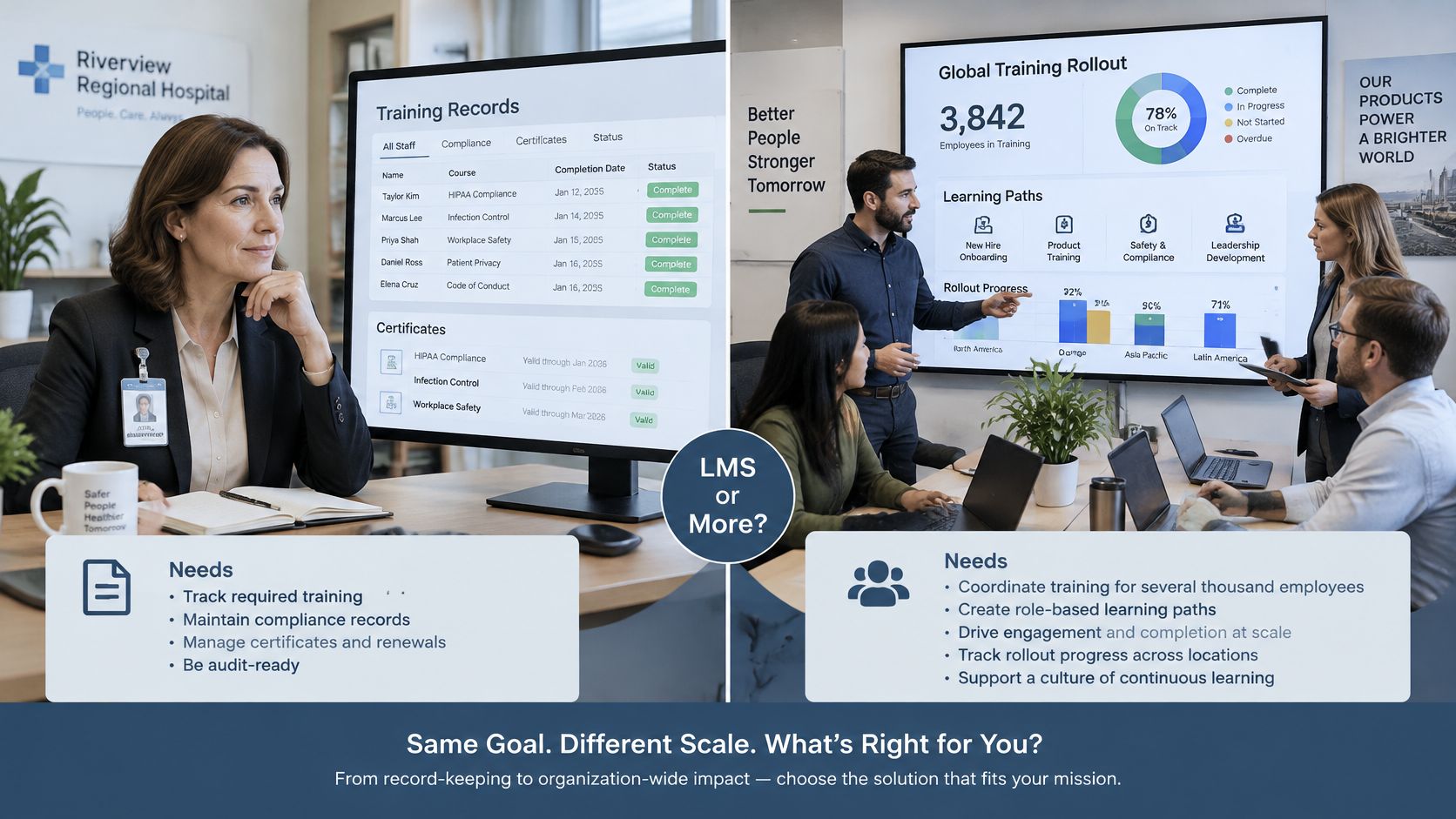
Match the platform to the operating problem
A hypothetical manufacturer with several thousand employees has a different problem. Engineers search across supplier resources, internal demonstrations, technical courses, and colleagues' notes. An LXP layer could help, provided someone owns curation and the integration doesn't turn safety-training reports into a reconciliation exercise.
A university running graded cohort courses should keep grades, assessment rules, and cohort administration in the LMS. Discovery features can support supplementary learning without becoming the official gradebook.
For a membership operator, the priority may be helping members return each week and find material relevant to their goals. Recommendation and discovery features can earn their place here, but improving navigation inside the current membership platform may be enough.
A hypothetical small team with a dozen courses and a single administrator should usually skip a second platform. I'd first improve course labels, catalog organization, and learner emails, then check whether the original problem remains.
For each setting, weigh headcount, compliance load, and content mix. Headcount indicates operating scale, compliance load determines recordkeeping rigor, and content mix reveals whether aggregation would solve a genuine problem.
This video offers another way to consider the platform distinction.

Use market figures as buyer context
The Dataintelo LXP market analysis puts cloud deployment at 68.5% of LXP activity in 2025, with organizations employing at least 1,000 people accounting for 67.3% of the market. The same source material places LMS cloud deployment at 62.3% and education institutions at 38.5% of the LMS market.
The cited forecasts project annual LXP growth above 17%, but describe different market boundaries and should be treated as projections rather than adoption guarantees. The practical reading is that LXPs are expanding alongside established LMS infrastructure, with large enterprises prominent among buyers.
Deployment still requires people to change how they find and share learning. For rollout planning, the guidance on change management with Ekipa can help frame stakeholder involvement and communication. Assign content owners and explain which destination learners should use for each task before announcing the new platform.
Choosing Between an LXP, an LMS or Both
Start with the default: if you need audit trails, certificates, and graded assessment, keep the LMS as the system of record. Add an LXP only when discovery or engagement is a demonstrated bottleneck and you can support the integration.
If learners can't find or revisit useful material scattered across sources, a discovery layer may justify its additional cost. If the problem is weak content, unclear course titles, or poor onboarding, another platform may give those problems a new homepage.
Use this decision aid to keep the purchase tied to the operating need.
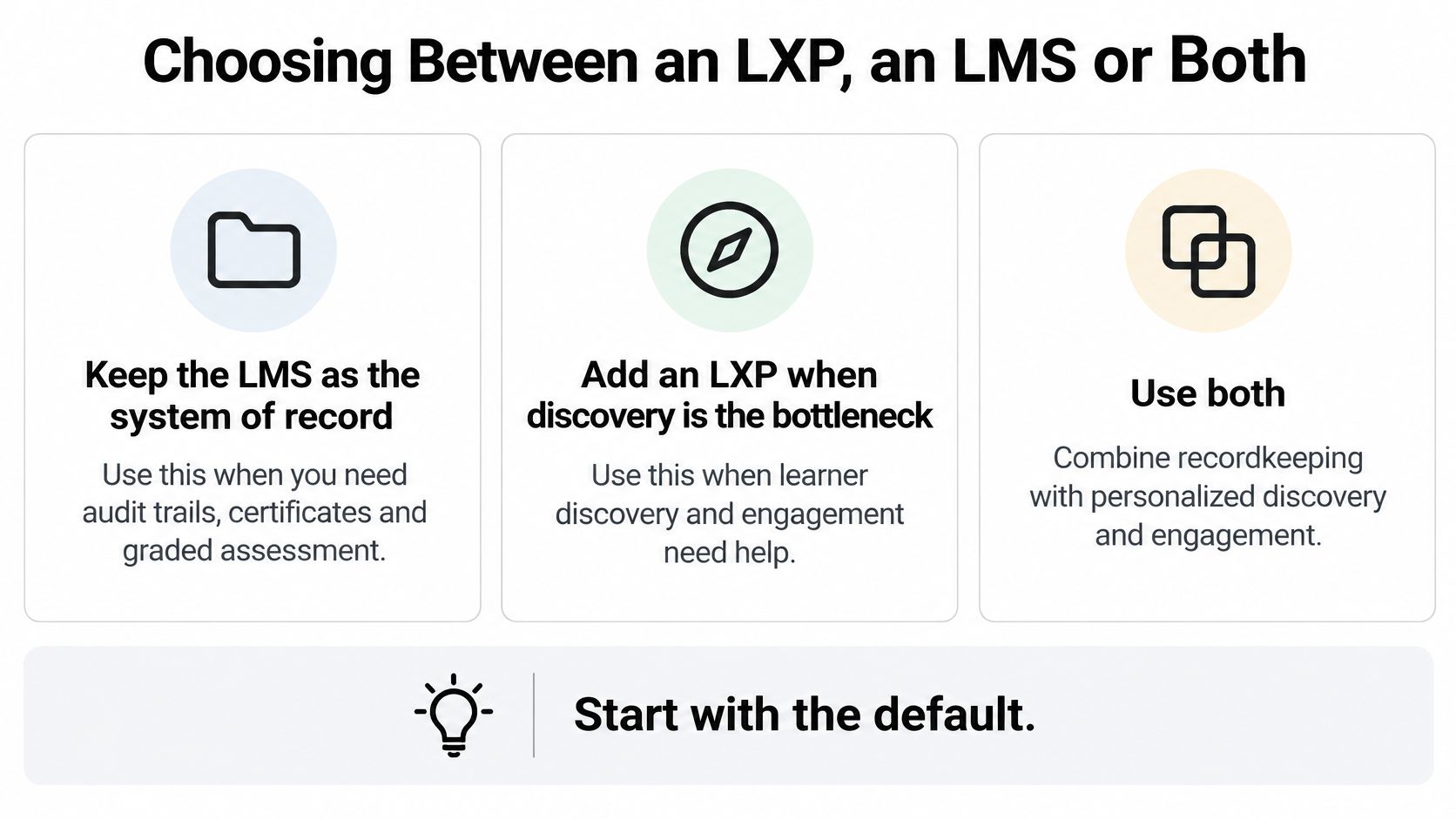
Best-fit platform by organization need
| Organization need | Better fit | Why |
|---|---|---|
| Mandatory compliance training with audit trails | LMS | Needs a system of record and certificates |
| Graded university courses with cohort control | LMS | Grades and cohort rules are core functions |
| Large workforce building skills across many sources | LXP layer over LMS | Discovery and aggregation matter more than assignment |
| Membership community wanting repeat engagement | LXP features | Recommendations can support return visits |
| Multi-provider training across countries | Integrated stack | System boundary and identity matter most |
| Small team with a few courses and one admin | LMS | Simpler administration with less overhead |
Make the vendor demonstrate your workflow
A combined product can reduce the number of connections you maintain, but a shared brand doesn't guarantee shared records. Ask vendors to demonstrate an entire journey, from account creation and content discovery through assessment, completion, reporting, and export.
Use an LMS evaluation checklist to compare candidates consistently, then add questions specific to the proposed discovery layer.
Before signing, answer these questions in writing:
- Official records: Does the platform need to maintain recognized completion evidence, or only display it?
- Learner rights: Who owns identity, consent, profile correction, and deletion across the stack?
- Personalization evidence: What supports each recommendation claim, and does it improve learning or only activity?
- Pilot outcomes: Which KPIs will prove results after a proposed 90-day pilot?
- Switching costs: Can you recover records, content, metadata, and configurations without rebuilding everything manually?
Choose an operational owner as well as a budget owner. Someone must handle failed synchronizations, maintain content labels, review recommendations, and resolve reporting discrepancies. If that work has no owner, the platform isn't ready to buy.
Write down the single question your purchase must answer, such as whether learners can find relevant resources faster without weakening completion reporting. Run a 90-day pilot against your baseline, using the KPIs you've defined, and include administrator effort in the comparison. Commit only when the results justify both the learner experience and the work required to maintain it.