Selling Online Content: A Creator’s Guide

You probably already have something people would pay for.
It might be the process coworkers keep asking you to explain. The lesson you repeat to clients every week. The spreadsheet, checklist, framework, or teaching method you’ve refined over years without thinking of it as a product.
That’s the starting point for most successful creators I know. They don’t begin with “I should build a course.” They begin with a skill that keeps solving the same problem.
That matters because the market for content-backed products is not small anymore. The global content marketing market is projected to grow from about $72 billion in 2023 to over $107 billion by 2026 according to Salesgenie’s content marketing statistics roundup. If you sell courses, memberships, guides, templates, or premium newsletters, that trend tells you something important. Content has moved far beyond audience building. It now sits much closer to revenue.
Most advice on selling online content treats each decision in isolation. Pick a niche. Build a course. Choose a platform. Post on social media. Price something. Hope it works.
That’s where people lose money.
The business gets easier when you treat monetization as one connected system. Your niche affects your format. Your format affects your pricing. Your pricing affects your platform choice. Your platform choice affects how you launch and how much support you’ll need after the sale.
That’s the roadmap I use. Start with a problem worth paying to solve. Package it in the simplest format that delivers the result. Price it based on value and delivery cost. Sell it where your buyers already pay attention. Then improve the whole thing after the first sale instead of constantly starting over.
Your Expertise Is an Untapped Business
A lot of smart people stay stuck in free advice mode for too long.
They answer DMs, help friends, write detailed posts, and jump on calls to explain the same things again and again. They’re already doing the hard part, which is building trust and solving real problems. What they haven’t done yet is turn that knowledge into an asset.
That shift matters. When you package expertise into content, you stop trading your time one conversation at a time. You build something that can be delivered repeatedly, improved over time, and sold in different forms to different buyers.
Stop thinking like a helper
If people keep asking the same questions, you don’t have a content problem. You have product signal.
That signal usually shows up in familiar ways:
- Repeated questions in email, comments, DMs, Slack groups, or client calls
- Messy DIY behavior where people are cobbling together bad solutions
- Avoidable mistakes that keep costing people time, confidence, or money
- A clear before-and-after outcome that your knowledge can help create
Those patterns are useful because they point to something teachable and sellable.
Practical rule: If you’ve explained the same fix more than a few times, it may deserve a paid format.
Think in assets, not posts
A single Instagram post disappears. A free YouTube video helps, but often sends value out into the world without capturing much back. A well-designed guide, mini-course, workshop, or membership can turn the same knowledge into a business asset.
That doesn’t mean every piece of expertise should become a giant flagship course.
Sometimes the best first product is a template pack. Sometimes it’s a short paid workshop. Sometimes it’s a compact resource for one painful problem. The point is to stop treating your knowledge like casual output and start treating it like inventory.
People often assume selling online content is only for full-time creators with big audiences. It isn’t. In practice, some of the strongest offers come from specialists with narrow expertise and a very specific buyer.
That’s why I like to begin with profitability from day one. Not vanity. Not broad reach. A real problem, a clear buyer, and an offer that makes sense to deliver.
Find a Problem People Will Pay to Solve
“Follow your passion” is weak advice if you want a business.
Passion helps you stick with the work. It does not prove demand. I’ve seen talented creators spend months building content around topics they enjoy, only to learn that nobody wanted a paid solution in that form.
The better starting point is pain. Find a problem that shows up often, costs something, and feels urgent enough that people want help now.
Use evidence, not instinct
A practical way to validate demand is to study places where your audience already talks openly. Expert guidance from Priori Digital Studio on common digital product mistakes recommends mining online communities for repeated requests and reading product reviews for unmet needs. The same guidance notes that many creators fail because they target broad markets instead of a defined audience with a clear pain point.
That’s exactly right.
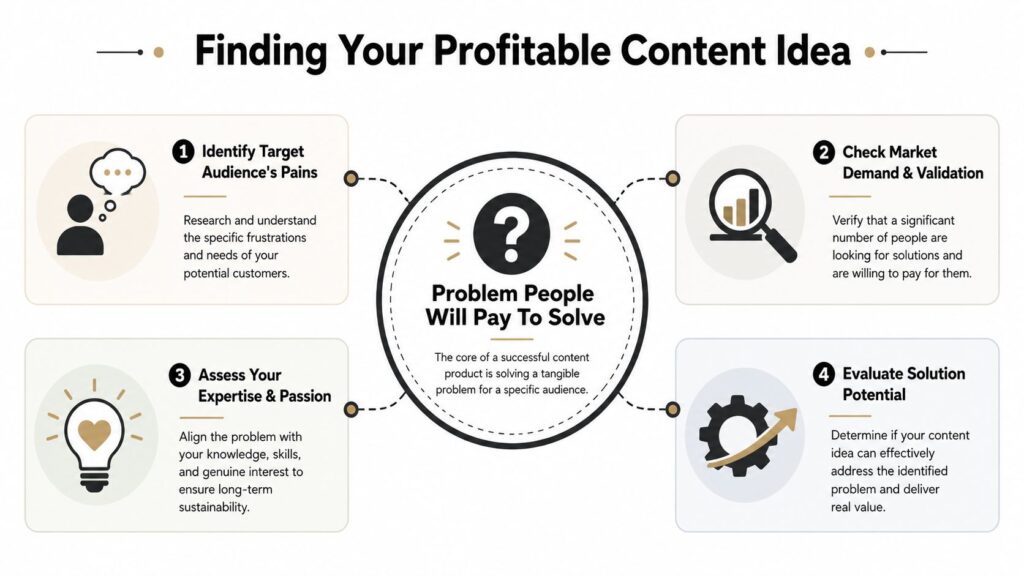
I usually look in four places before I create anything:
Reddit and niche forums
Search for repeated complaints, not just popular topics. If people keep asking how to fix the same issue, that’s useful.Facebook groups and LinkedIn comments
These are good for language. You’ll see how people describe the problem in plain words.Reviews of competing products
One-star and three-star reviews are gold. They tell you what buyers expected and didn’t get.Your own inbox or client notes
If you already work with the audience, your best market research may be sitting in old messages.
What good demand looks like
Not every problem deserves a product. The useful ones usually have a few things in common:
Specific pain
“I want to be healthier” is too broad. “I need a simple meal prep system for night shifts” is much stronger.Known buyer
You should be able to picture the person. Freelance designers. HR managers. Busy parents. Etsy sellers.A practical outcome
Buyers want a result they can recognize. Save time, launch faster, reduce mistakes, feel more confident, train a team.Signs of dissatisfaction with current options
If people complain that existing solutions are too generic, outdated, bloated, or confusing, that’s an opening.
The fastest way to waste a launch is to solve a vague problem for a vague audience.
An overlooked market with real potential
One angle more creators should consider is selling to small businesses and micro-businesses.
A lot of content about digital products focuses on creator-to-creator offers. That can work, but it’s crowded. Small business buyers are often easier to serve when you understand the actual job they need done. Bain describes this market as “enormous” and “untapped” in its piece on selling to small businesses profitably. Bain also argues that winning requires a strategy across service, segmentation, and scale.
That lines up with what I’ve seen. A small business owner usually doesn’t want more theory. They want something they can use this week. A hiring packet template. A staff training mini-course. A customer onboarding script library. A compliance checklist with examples.
Validate before you build the full thing
You don’t need to create the complete product first.
Try one of these lighter tests:
- A paid workshop with a narrow promise
- A presale page describing the transformation and delivery format
- A mini offer such as templates, swipe files, or a starter guide
- A beta version for a small group willing to give useful feedback
If buyers lean in, expand it. If they hesitate, change the angle, title, format, or audience before you sink more time into production.
Packaging and Pricing Your Content for Value
Format changes how buyers perceive value.
The exact same expertise can feel cheap, premium, simple, or overwhelming depending on how you package it. That’s why I don’t start with “Should this be a course?” I start with “What format gives the buyer the clearest path to the result?”
Match the package to the job
Some products work best as a quick download. Others need guided instruction or ongoing support.
Here’s the way I think about the main formats:
eBook or guide
Best when the buyer needs clarity, a framework, or a reference they can use immediately. Good for compact topics and lower-friction purchases.Online course
Better when the buyer needs sequence, demonstration, and structured implementation. This works well for skill building.Membership or subscription
Best when the problem keeps evolving or the buyer needs community, updates, accountability, or recurring support.
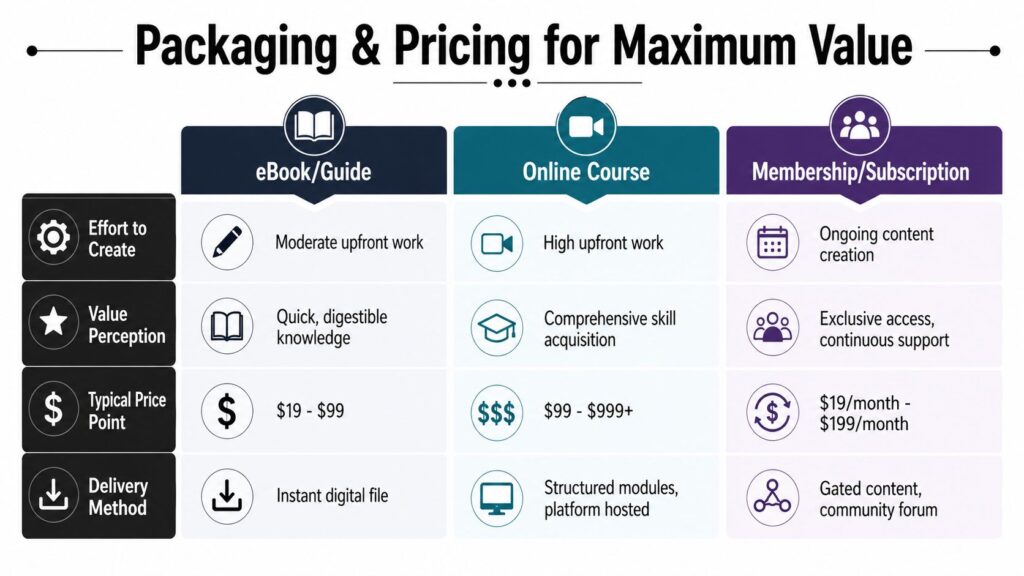
The infographic above gives typical price ranges for these common formats, but I’d treat those as rough market shorthand rather than a rule. Your actual price has to reflect the buyer, the urgency of the problem, the amount of support included, and how expensive the problem feels if left unsolved.
Pricing changes when support changes
A lot of creators underprice because they only value the files. Buyers usually value the outcome and the help around it.
That becomes even more obvious if you sell to smaller companies. As noted earlier, Bain argues that these buyers are not just a low-price segment. They’re often a distribution and support design problem. If your offer includes onboarding help, implementation guidance, office hours, or team access, your pricing needs to reflect that delivery burden.
I like to pressure-test pricing with three questions:
| Pricing question | Why it matters |
|---|---|
| What result is the buyer paying for? | Keeps you focused on outcome, not file count |
| How much support is included? | Support drives delivery cost fast |
| Can this format scale cleanly? | A profitable product has to stay manageable after more sales |
Pick a model you can operate
A one-time payment is simple and works well for clear standalone outcomes.
A subscription can be excellent for ongoing libraries, communities, or regularly updated resources, but only if you can keep delivering value without burning out. Tiered pricing works when different buyers need different levels of access or support.
If you’re unsure how to set numbers for a course, this smart way to price your online course for max profits is a useful breakdown of the trade-offs.
Charge for the transformation, then sanity-check the workload required to deliver it.
One more thing matters here. Don’t create a huge product by default. Big products feel impressive to the seller, but smaller products often sell faster because the promise is easier to understand. Clear beats thoroughness when you’re starting.
Choosing the Right Platform and Tech Stack
Platform choice shapes your margins, your marketing workload, and how much control you keep.
People often get distracted by feature lists. The core decision is operational. Who owns the audience relationship? Who handles checkout? How much flexibility do you need? How much setup friction can you tolerate right now?
Three common paths
Most creators end up choosing between marketplaces, all-in-one platforms, or a self-hosted stack.
| Platform Type | Best For | Key Pro | Key Con |
|---|---|---|---|
| Marketplace | First-time creators who want built-in discovery | Easier setup and platform traffic | Less control over branding, customer relationship, and pricing flexibility |
| All-in-one platform | Creators who want speed and simplicity | Hosting, checkout, email, and member access in one place | Monthly cost and limited customization |
| Self-hosted setup | Businesses that want control and flexibility | Greater ownership over design, data, and workflows | More moving parts and more technical responsibility |
What this looks like in practice
A marketplace like Udemy can remove a lot of friction. You can get a product live quickly, and the platform may help with discovery. The trade-off is that you’re building inside someone else’s system.
An all-in-one option like Kajabi, Podia, or Teachable usually makes sense when you want a cleaner brand experience and a simpler backend. For many people, this is the most practical middle ground. You launch faster than you would with a custom setup, but you keep more control than you would on a marketplace.
A self-hosted setup often means WordPress plus course or membership tools, payment integrations, email software, and analytics. It can be powerful. It can also become a maintenance project if you enjoy tinkering more than selling.
Choose based on stage, not fantasy
I’ve seen creators buy heavy infrastructure before they’ve proven demand. That’s backwards.
Use a lighter stack when you’re early. Expand only after your offer works.
A simple way to decide:
- If speed matters most, use an all-in-one platform
- If built-in traffic matters most, test a marketplace
- If ownership matters most, build a self-hosted stack slowly and intentionally
If you want a broader side-by-side look at platform options, this guide to the best platforms for selling online courses is worth reviewing.
Your platform should support your sales model. It shouldn’t become your hobby.
I’d also think about support before features. If you’re selling a membership, can the platform handle access cleanly? If you’re selling a one-off download, do you really need a complex learning environment? Match the tech to the offer, not the other way around.
Your First Launch and Marketing Plan
Most first launches don’t fail because the product is terrible. They fail because nobody sees it often enough, clearly enough, or close enough to the moment they’re ready to buy.
That’s why I like a simple launch model built around content, email, and direct calls to action. No giant funnel. No complicated automation maze. Just a repeatable system that gets attention, builds trust, and gives buyers a clean next step.
A big reason this works now is that discovery and buying happen closer together than they used to. In 2026, social commerce is estimated to reach $2.6 trillion globally, and TikTok, Instagram, and YouTube collectively drive over 60% of product discovery according to Sprout Social’s social media statistics. If you’re selling online content, that means your audience often finds the problem, evaluates the solution, and decides whether to click in the same platform environment.
Here’s the launch flow I use most often:
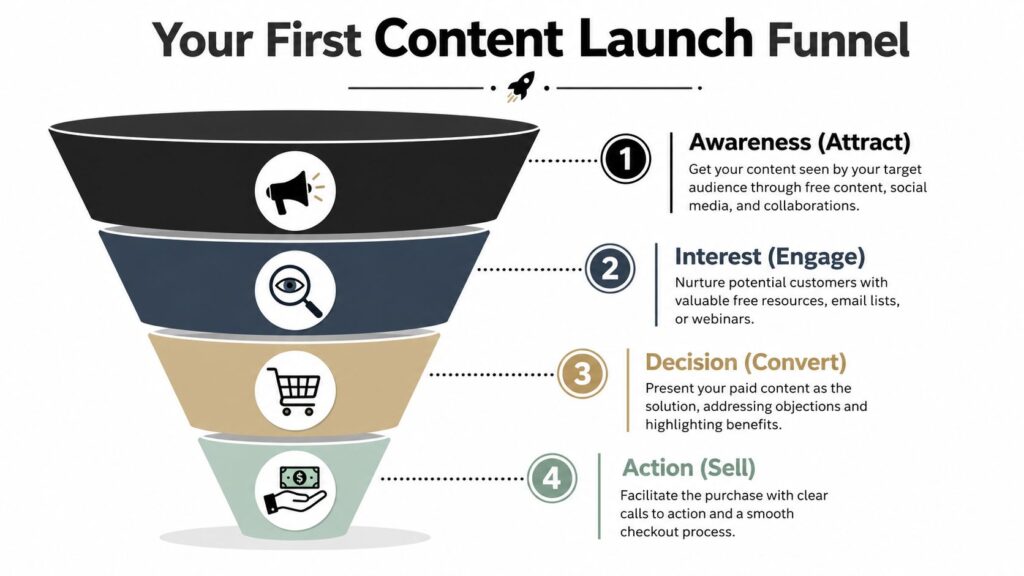
Build awareness with useful public content
Your launch content should do one of three things. Name the problem clearly, show your method, or remove hesitation.
Good examples:
- Instagram carousels that break a mistake into a step-by-step fix
- Short YouTube videos answering one tactical question your buyer already has
- LinkedIn posts aimed at small business owners or professional buyers
- Email teasers sharing a framework, checklist, or short story from your process
This kind of content works because it previews your thinking without giving away the full implementation layer.
For a practical walkthrough of launch sequencing, this guide on how to launch an online course is useful.
Capture intent before asking for the sale
You don’t need a massive email list. You do need a way to collect interest from people who aren’t ready to buy the first time they see you.
A lead magnet still works if it’s tightly matched to the paid offer. A checklist, mini training, worksheet, or short audit can do the job. The mistake is offering something broad and generic, then trying to sell a highly specific product afterward.
If your emails struggle to land in inboxes, fix that before launch week. This comprehensive guide to fix email spam is worth reading because poor deliverability ruins solid launch campaigns.
A quick explainer can help if you’re mapping your funnel visually:

Ask directly and repeat the message
A lot of creators mention their offer once and then go quiet because they don’t want to annoy people.
That’s a mistake.
During launch, people need repeated exposure. They need to hear who the offer is for, what problem it solves, how it works, and why now is a good time to act. You can say the same core message in different formats without sounding repetitive.
If buyers are confused, they wait. If they wait, most of them never come back.
Use testimonials if you have them. If you don’t, use specificity instead. Show the curriculum. Show the template pages. Show the dashboard. Show the before-and-after workflow.
Growing Beyond the First Sale
The first sale proves you can attract a buyer. The business gets built in what happens after that.
Many creators tend to drift. They keep chasing new launches while existing buyers sit in a forgotten library, never fully onboarded, never encouraged to continue, and never asked what would help them next.
Retention starts immediately
The first few days after purchase matter more than most creators realize.
Your buyer should know exactly what to do first. Not where everything is. Not every bonus included. Just the first step that gets momentum.
I like a basic post-purchase sequence that includes:
- A clear welcome message with one action to take first
- A progress prompt that nudges early use, not passive consumption
- A feedback checkpoint where buyers can share friction points
- A next-offer path that only appears after they’ve seen some value
That sequence can turn a nervous buyer into an active one.
Use small data well
You do not need a huge analytics setup to improve your product. You do need clean tracking for the basics.
Adobe reports that 1 in 7 marketers experienced financial losses from poor data quality in the past year, with an average loss of $91,000 in its overview of data-driven marketing and data quality. I take that less as a scary headline and more as an operating rule. Messy data creates bad decisions.
Track only what supports a clear goal.
If the goal is better retention, watch things like:
| Signal | What it can tell you |
|---|---|
| Early lesson completion | Whether onboarding is working |
| Resource downloads | Which assets buyers actually value |
| Support questions | Where your content is unclear |
| Renewal or repeat purchase behavior | Whether the offer keeps delivering value |
Don’t drown in dashboards. A few reliable signals beat a pile of inconsistent reports.
Expand with intention
Most creators think scaling means making more products. Often it means improving the product path you already have.
You might add:
- A template upsell for buyers who want faster implementation
- A premium tier for small teams that need extra support
- A membership layer if your topic benefits from updates and community
- A business-focused version of a consumer offer if you notice B2B demand
Each new offer should connect to the current customer journey. Random product sprawl creates support headaches and weakens your positioning.
Clean data and strong follow-up usually outperform constant new product creation.
When someone buys from you once, they’ve already crossed the hardest line. They trust you enough to pay. Respect that moment. Help them get a result. Then earn the next sale naturally.