Course Marketing Strategy That Actually Sells

You’ve published the course, collected generous testimonials, and watched people praise the material in private messages. Then launch week arrives and the sales graph barely moves. The natural response is to post more often, add another bonus, or turn on ads before you’ve found the problem.
A course marketing strategy works better when it follows the buyer’s decision path. People need to recognize a relevant problem, trust your approach, believe the promised transformation, and find a low-friction way to act. Each channel has a role in that sequence. When you assign channels to outcomes instead of chasing every platform, your marketing becomes easier to diagnose and cheaper to improve.
Why Most Courses Quietly Fail to Sell
The creator usually notices the problem after a conversation with a former student. The student says the lessons were practical, the exercises were useful, and the course delivered exactly what it promised. The creator checks the testimonials, opens the sales dashboard, and sees flat sales.
That situation feels confusing because the product may be good. The hidden issue is often broad targeting. A message written for freelancers, managers, founders, students, and career changers sounds inclusive, but each reader has to do the work of deciding whether the course applies to them.
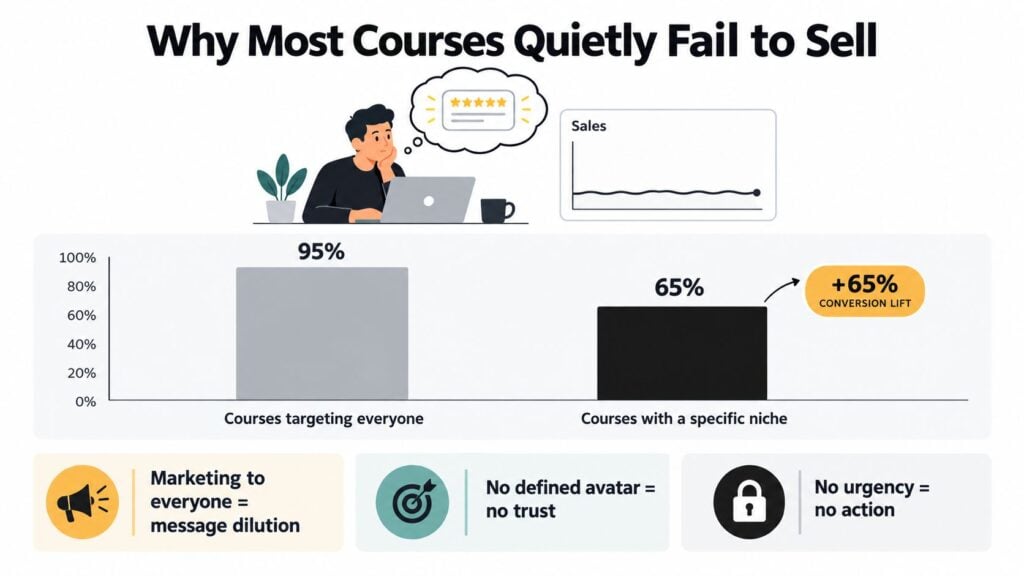
Three patterns show up repeatedly.
- The audience is made up of peers. A creator attracts other course creators because the content discusses launches, funnels, and platforms. Those people may engage enthusiastically without wanting the course itself.
- The launch happens where buyers browse, not where they decide. Social platforms can produce attention and conversation, yet many prospects still need search results, a detailed sales page, an email sequence, or a live workshop before they commit.
- The price signals a product while the offer promises a hobby. A low price can reduce perceived risk, but it won’t rescue vague positioning. If the page describes lessons instead of a meaningful outcome, buyers compare features and delay the purchase.
Practical rule: Before spending on traffic, identify the decision your ideal buyer must make and the evidence they need to make it.
A useful way to organize that evidence is with a simple KPI framework. Refport’s KPI guide is a helpful reference for connecting marketing activity to measurable conversion points instead of vanity metrics.
The operating system missing from many launches is straightforward. First, define one buyer and one transformation. Then choose a format that supports the promise, map channels to intent, connect launch emails to automation, and measure the handoffs between stages. The buyer decision path comes first. The channel list comes after.
Finding Your Audience and Positioning the Promise
Positioning starts before you write a headline. Use this sequence to turn scattered audience knowledge into a specific commercial promise.
1. Mine the language you already own
Review support tickets, sales calls, direct messages, student surveys, and replies to your emails. Copy the phrases buyers use when they describe the problem. Don’t improve their wording too early. “My emails keep landing in spam” may be more useful than “Improve deliverability performance” because it reflects a real worry.
Look for repeated situations, failed attempts, desired outcomes, and moments that create urgency. A useful guide to building an email list can support the audience-building side, but your strongest positioning clues usually come from people already close to the problem.
2. Choose one tight buyer persona
Give the persona a role, a single desired outcome, and one obstacle. Avoid demographic detail that doesn’t change the buying decision.
For example:
| Field | What to Write | Example |
|---|---|---|
| Role | The person responsible for the result | Email marketing manager at a growing online retailer |
| Desired outcome | The result they want next | Reach the inbox consistently |
| Obstacle | The barrier stopping progress | They can’t diagnose authentication, list quality, and sending problems confidently |
| Buying concern | The risk they want to avoid | Paying for another course that explains theory without a usable process |
This persona is narrow enough to guide the copy. It also gives you a test for every channel. If a post attracts people who don’t manage email performance, it may be generating engagement without qualified demand.
3. Pressure-test the transformation
Write the current state in plain language, then describe the destination. The gap should be meaningful, observable, and plausible within the course experience. A course can’t credibly promise a business-wide transformation if its lessons only teach one isolated task.
For the example above, the promise might be:
Before: “You’re guessing why campaigns miss the inbox.”
After: “You can audit the main causes, prioritize fixes, and build a repeatable deliverability workflow.”
4. Turn it into one positioning sentence
Use this structure:
For [specific buyer] who struggles with [specific obstacle], this course helps you move from [current state] to [desired state] through [distinctive method or support].
The sentence should make the audience, problem, outcome, and mechanism obvious. If it needs several paragraphs of explanation, the offer probably needs sharper boundaries before the marketing begins.
Picking the Right Format Before You Spend a Dollar on Ads
Format changes the economics of acquisition. A self-paced course can serve more learners without adding live delivery time, but the learner must create momentum alone. A cohort provides deadlines, interaction, and accountability, yet it requires stronger scheduling, facilitation, and pre-sale nurture.
The completion data makes the trade-off visible. One benchmark reports 12.5% completion for self-paced courses compared with 65% for cohort-based formats. The same source reports an 18.2% free-trial-to-paid conversion rate for online education offers. See the online education benchmarks for the underlying context.
| Format | Completion Rate | Typical Price | Conversion Rate | Marketing Implication |
|---|---|---|---|---|
| Self-paced | 12.5% benchmark | Often positioned as a lower-cost product | Free-trial-to-paid benchmark of 18.2% | Needs strong activation, clear first lessons, and scalable traffic |
| Cohort | 65% benchmark | Can support a higher price when coaching or community is included | Usually needs more nurture before purchase | Works for outcome-driven buyers who value accountability and live support |
| Hybrid | Depends on the balance of self-paced and live elements | Can sit above a basic course when support is meaningful | Depends on the offer and delivery promise | Combines scalable lessons with selected live touchpoints |
Price should follow the learning experience. Public course summaries note that many paid courses sell for under $200, while businesses with coaching, community, or certification can sustain higher pricing. Lesson-level discussion is associated with a 50.9% completion rate compared with 37.3% without discussion, according to Ruzuku’s course research.
A self-paced course is a sensible choice when the problem is well defined and the buyer can act independently. A cohort makes more sense when feedback, practice, or peer accountability affects the result. Hybrid delivery suits a promise that needs both a reusable curriculum and moments of human guidance.
Choose the format whose completion potential and price point match the traffic volume you can reliably produce.
That decision determines the channel mix. A self-paced offer may rely on search and evergreen email automation. A cohort often needs partnerships, webinars, and longer nurture because the buyer is evaluating both the curriculum and the support system.
The Core Channel Mix and What Each One Actually Does
Each channel should have one job in the buyer journey. If you can’t name the decision it supports, you’re probably measuring activity rather than progress.
| Channel | Funnel Stage | Primary Job | Cost or Effort | Kill Criteria |
|---|---|---|---|---|
| Consideration and purchase | Nurture, segment, and convert an owned audience | Consistent writing, list hygiene, and automation | Subscribers engage but qualified prospects never reach the offer | |
| Organic content | Awareness and trust | Answer intent-led questions through SEO, YouTube, or short-form content | Slow, cumulative production effort | Topics attract the wrong audience or never connect to the course promise |
| Paid ads | Retargeting and acceleration | Revisit warm visitors and scale a proven message | Ongoing media spend and creative testing | Cold traffic consumes budget without qualified actions |
| Partnerships and affiliates | Awareness and consideration | Borrow trust from an adjacent audience | Relationship building, commissions, and partner assets | Partner traffic produces attention but no meaningful downstream action |
| Webinars | High-intent consideration | Demonstrate the method, handle objections, and invite action | Planning, promotion, delivery, and follow-up | Registration looks strong but attendance or sales remain weak |
Email is the backbone. Launch benchmarks report 30% to 50% open rates, 8% to 25% click-through to the sales page, and 1% to 5% sales-page conversion for a typical course launch. Warm email lists have been reported at 2.4% to 5.2% conversion, compared with 0.3% to 0.8% from social media traffic, in course creator conversion benchmarks. Treat those as directional ranges, not guarantees.
Organic content earns attention before a buyer knows your offer. SEO articles can capture problem-aware searches, YouTube can demonstrate your teaching style, and short-form content can expose a useful idea. The kill criterion isn’t low immediate sales. It’s a persistent mismatch between the audience consuming the content and the buyer described in your positioning.
Paid ads work best after the offer and message have shown signs of conversion. Start with retargeting people who visited the sales page, watched a substantial portion of a workshop, or joined the waitlist. Broad cold campaigns often look productive because impressions and clicks are easy to report, but they can fail when the purchase requires trust and explanation.
Partnerships and affiliates help when the partner serves the same buyer without selling the same promise. Give them a short email, a workshop angle, and clear tracking. Webinars bridge curiosity and commitment. Webinar benchmarks report 30% to 40% registrant-to-attendee show-up, 20% to 40% attendee-to-lead conversion, and 5% to 20% attendee-to-payer conversion, with educational webinars often reaching 15% to 25% attendee-to-action, according to webinar analytics benchmarks.
Launch Funnels and Drip Campaigns Working Together
A launch funnel and a drip campaign should behave like one conversation. The prospect receives the right next message based on what they did, not a random broadcast because the calendar says it’s Tuesday.
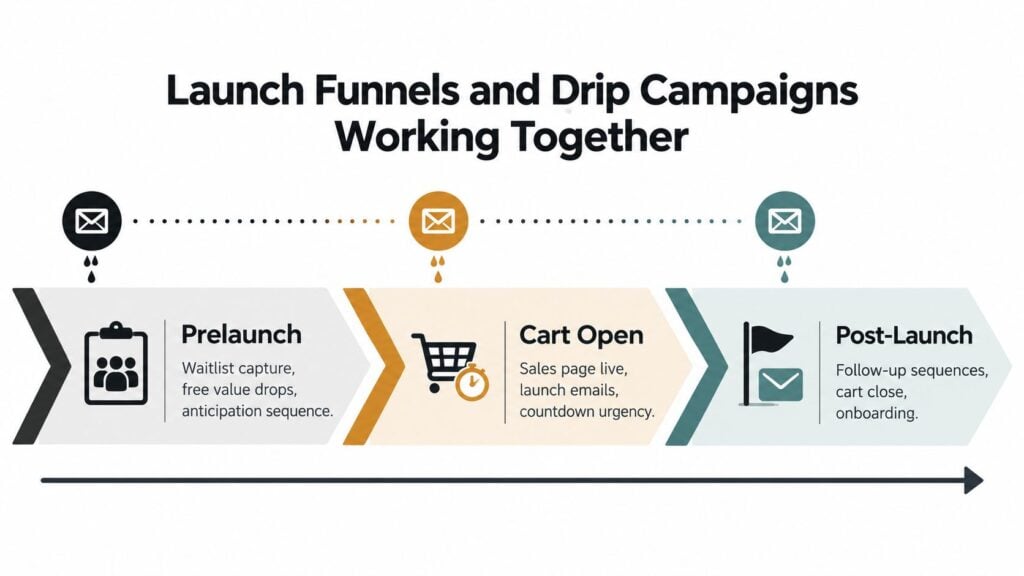
Prelaunch creates context
Use a 14-day prelaunch to collect a waitlist and teach the problem. A practical sequence looks like this:
- Days 1 to 3: Publish the lead magnet and send the welcome email.
- Days 4 to 7: Share a short lesson, diagnostic, or mistake audit.
- Days 8 to 10: Explain your method and show what changes when learners apply it.
- Days 11 to 12: Invite prospects to the workshop or webinar.
- Days 13 to 14: Send reminders, answer common objections, and set expectations for the offer.
The three email types that consistently carry the campaign are story, proof, and offer. Story gives the problem emotional context. Proof shows the method in use through testimonials, examples, or student work. Offer explains the curriculum, support, price, deadline, and next step.
Cart open handles objections
When the sales page goes live, automate around behavior. Send the first offer email to the full eligible segment, move clickers into an objection sequence, and remove buyers immediately. A prospect who watched the webinar needs a different follow-up from someone who only downloaded the lead magnet.
Registration pages often convert at 25% to 35% on average, with 45% to 60% for high performers, and sales conversion should be calculated as buyers divided by attendees, according to webinar conversion benchmarks. Use the live Q&A to address implementation concerns, then send the replay and deadline reminders.
For subject-line mechanics, the practical reference on email subject line capitalization is useful when reviewing consistency and readability.
Post-purchase protects the promise
The first automation after payment should welcome the learner, direct them to one quick win, and explain where to ask for help. Later messages can invite community participation, remind learners about milestones, and surface relevant add-ons.
This LMS drip content guide for webinars offers a useful way to connect scheduled lessons with event-based follow-up.
Segment buyers out of launch promotion as soon as they purchase. Keep non-buyers in a learning sequence, then invite them to the next launch with a message based on their behavior, such as webinar attendance, sales-page visits, or an unanswered objection.
Retention, Upsell, and Referral After the Sale
Acquisition gets attention because it happens before payment. Activation determines whether the learner reaches the promised result, talks about the course, and buys something else.
Use the benchmark carefully. One source reports an average completion rate of 15% and a top-quartile rate of 60% or higher, as summarized in the required retention visual below. The gap makes onboarding a commercial priority, not just a support task.
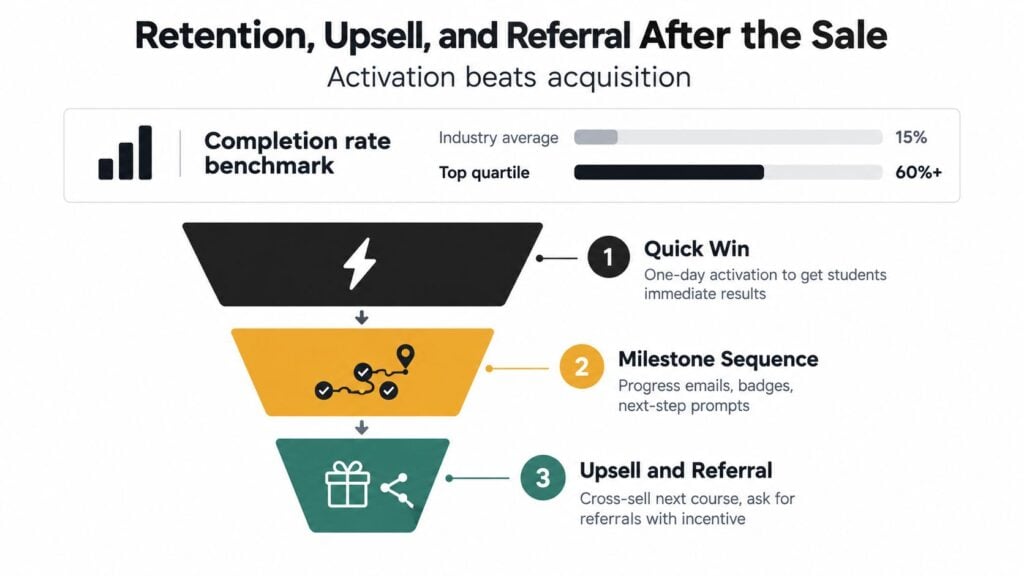
Make the first result easy to reach
Give students a one-day quick win. It should produce a visible improvement without requiring the entire curriculum. Then build milestone-based progression around completed actions, not passive viewing.
- Activation: Send a welcome message with one task and a clear definition of done.
- Progress: Trigger reminders after inactivity and celebrate completed milestones.
- Support: Add office hours or structured discussion when learners need feedback to continue.
Track completion, milestone participation, and learner satisfaction. A short survey after the first result can reveal whether the course is delivering the promised transformation or creating unnecessary friction.
Design the upsell around the next obstacle
The natural ladder moves from the core course to a cohort add-on, templates pack, community access, or a done-for-you offer. Present the next step after the learner has encountered the relevant limitation, not immediately after checkout.
A learner who has completed the foundational lessons may want feedback. Someone who has applied the method but lacks speed may want templates. Someone with a working process but no capacity may want implementation help. Customer retention resources, including Silver Spoon Agency’s customer retention guide, can help teams think beyond the first transaction.
Ask for referrals at the transformation moment
Send the referral request after a student reports a result, completes a meaningful milestone, or gives positive feedback. Offer a reward to both the existing student and the referred learner when the economics support it.
Measure NPS, completion, repeat purchase rate, and referral activity together. A generic affiliate link in the first welcome email rarely carries the same credibility as a personal request made when the student can describe what changed.
KPIs, Dashboards, and Fixing a Flatlining Funnel
Metrics are diagnostic signals. A dashboard should tell you where the buyer stopped moving and which small change is worth testing first.
The three weekly numbers I’d prioritize are email opt-in rate, sequence-to-call or webinar show-up rate, and offer conversion rate. Supporting measures add context, including cost per lead, cost per acquisition, attendance, completion, and refunds. Google Ads benchmarks for online education report an average CPC of about $2.95 and an average CPA of $62.80, while organic search accounts for 34.2% of traffic to online education platforms, according to online learning market benchmarks.
| Stage | Primary KPI | Healthy Range | Common Bottleneck |
|---|---|---|---|
| Acquisition | Cost per lead | Compare against your offer margin and downstream conversion | Broad targeting or weak lead magnet |
| Opt-in | Email opt-in rate | Establish a baseline, then improve through focused testing | Message and landing-page mismatch |
| Nurture | Open and click behavior | Launch benchmarks show 30% to 50% opens and 8% to 25% sales-page clicks | Weak subject lines or low relevance |
| Webinar | Show-up rate | 30% to 40% average, with higher results possible through stronger reminders | Poor calendar placement or weak anticipation |
| Offer | Sales-page conversion | Typical launch benchmark of 1% to 5% | Unclear promise, objections, or price friction |
| Delivery | Completion rate | Self-paced benchmark of 12.5%, cohort benchmark of 65% | Weak onboarding or insufficient support |
| Economics | Cost per acquisition | Must fit contribution margin and expected repeat purchase | Cold traffic or low-value offer structure |
A slipping opt-in rate points first to traffic quality, creative fatigue, or a lead magnet that no longer matches the promise. A weak show-up rate suggests reminder cadence, calendar friction, or insufficient value in the event framing. A poor offer conversion rate directs attention to proof, objection handling, delivery format, or price.
Cheapest-fix decision tree: Test the message before the media, the reminder sequence before the webinar platform, and the offer structure before increasing ad spend.
Use a one-page dashboard with three groups. Inputs include traffic, spend, subscribers, and registrations. Conversions include opt-ins, clicks, attendance, calls, and purchases. Revenue includes sales, refunds, repeat purchases, and acquisition cost. A reporting framework such as this beginner’s guide to LMS dashboards can help organize learner and delivery data alongside marketing results.
Run a 30-day recalibration after each launch. In the first week, clean the data and identify the largest drop-off. In the second, interview buyers and non-buyers. In the third, test one message, reminder, or offer change. In the fourth, document the result and update the next campaign. Harvard’s marketing analytics course reinforces the same operating principle, marketing metrics should support strategic decisions rather than decorate a report.
A course marketing strategy becomes dependable when every stage has a buyer, a promise, an asset, and a measurable next action. Map your current funnel this week, find the first meaningful drop-off, and test the cheapest fix before buying more traffic. Then use the next launch to validate the change, not to start from scratch.
Ready to turn a flat course launch into a measurable system? Audit your buyer persona, offer promise, email sequence, and funnel KPIs today, then build your next campaign around the stage where prospects are stopping.