
Early Bird Pricing for Courses & Memberships

I’ve seen this go wrong more times than I can count. A course creator gets excited, picks a discount, slaps “early bird” on the sales page, and opens the cart to a list that barely knows what’s coming.
Then the panic starts. Sales feel slow, so they extend the deadline. Buyers notice. Trust drops. The offer that was supposed to create momentum ends up training people to wait.
Early bird pricing can work for courses and memberships, but digital products play by different rules than conferences and in-person events. You don’t have catering counts, venue deposits, or seat maps. You have fixed production costs, ongoing delivery, and a buyer who can smell fake urgency from a mile away. That changes everything.
If you sell a course, cohort program, workshop series, or membership, the best early bird strategy usually isn’t “copy what event marketers do.” It’s building anticipation, choosing the right offer type, and making the deadline feel real.
Build Your Waitlist and Buzz First
The biggest mistake happens before pricing ever enters the conversation. You launch before you’ve built enough demand.
That problem shows up as poor conversion, but underlying this is weaker trust. If buyers don’t understand the transformation, the format, or why your offer matters right now, a discount won’t rescue the launch. One of the clearest warnings in the space is that launching before building sufficient buzz erodes trust because people don’t understand the value proposition, and ending the early bird period without clear warnings can reduce conversions by up to 25% according to Webnus on failed early bird ticket strategies.
Start with a small, focused waitlist
Don’t overcomplicate this. You need one page, one promise, and one reason to join early.
Your waitlist page should answer four things fast:
- What it is: Say whether this is a self-paced course, a live cohort, or a membership.
- Who it’s for: Be specific enough that the wrong people opt out.
- What changes after joining: Talk about the outcome, not the table of contents.
- Why join the waitlist: Early access, first notice, or a launch-only bonus preview.
If you’re still treating list growth as an afterthought, Email List Building Is Critical for Growth is a useful read because it gets back to the basics that most creators skip.
A waitlist without nurturing is just a holding pen. Send useful notes before launch. Share a framework, a short lesson, a behind-the-scenes decision, or a common mistake your course fixes. Buyers don’t need endless hype. They need evidence that you understand the problem better than they do.
Practical rule: If your audience first hears from you when the cart opens, you’re already late.
Warm people up before the offer appears
I like to think of pre-launch as laying kindling. The early bird sale is the match, not the firewood.
A simple pre-launch rhythm works well:
- Teach one core idea that reframes the problem.
- Show the method in action with a mini example, checklist, or short demo.
- Name the gap between trying it alone and following a full system.
- Invite people onto the waitlist so they know when registration opens.
Social media can support this, but it shouldn’t carry the whole launch. Use posts to create curiosity and replies. Use email to close the loop. If you need a tighter email system for launches, this guide on email marketing for course creators is worth keeping open in another tab.
Build anticipation without sounding theatrical
Buzz doesn’t mean fake excitement. It means repeated exposure to a clear promise.
A few examples that work better than generic “big news soon” posts:
- Curriculum teasers: Share one lesson title and why it matters.
- Student readiness posts: Talk about who will get the most out of the program.
- Decision transparency: Explain why you built it now and what problem pushed you to create it.
- Launch date reminders: Tell people exactly when the waitlist gets first access.
Then, when the offer opens, nobody is confused. They already know what you’re selling, why it matters, and whether it’s for them.
Design Your Irresistible Early Bird Offer
Most creators jump straight to percentage discounts because they’re easy to explain. That’s fine for some launches, but digital products need a different lens.
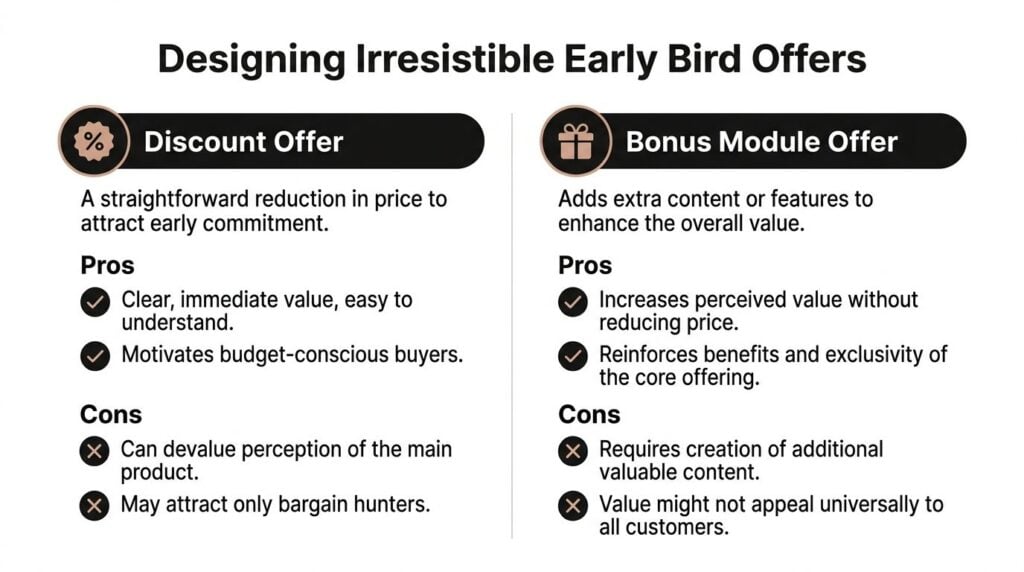
With a course or membership, your marginal delivery cost is usually low. That sounds like a reason to discount aggressively, but it often creates a perception problem. Buyers start anchoring on the lower number, and your regular price feels inflated later.
For digital learning specifically, early bird pricing often backfires, while fixed-per-bonus models can outperform percentage discounts by 22% in conversion according to IttyBiz on early bird pricing for digital offers.
When a discount makes sense
A direct discount works best when the offer is already easy to understand and price resistance is the main barrier.
That usually fits offers like:
- A proven flagship course with a clear transformation
- A membership with a known format and established content library
- A lower-friction workshop series where buyers compare options quickly
In event marketing, early bird discounts commonly range from 10% to 40%, with many sources pointing to 20% to 30% as a strong balance between attraction and revenue preservation, as summarized by Eventgroove’s guide to early bird pricing strategy. For digital creators, I’d treat that as context, not a default.
A discount is simple. It communicates instantly. But simplicity comes with trade-offs.
| Offer type | Best use | Risk |
|---|---|---|
| Straight discount | Price-sensitive buyers, simple offer | Can cheapen perceived value |
| Bonus-based offer | Premium education products, expert-led programs | Requires a bonus people actually want |
When a bonus beats a discount
This is usually the stronger play for courses.
If someone joins early and gets a bonus workshop, office hours session, implementation sprint, private Q&A, or resource pack, you’re increasing perceived value without cutting your core price. That protects positioning. It also attracts people who care about outcomes, not just bargains.
A bonus works especially well when the extra is tightly linked to action. Good examples include:
- A live onboarding session for new members
- A templates pack that helps students implement faster
- A private Q&A replay library
- A short companion mini-course that removes a known sticking point
If you run a recurring offer, it’s also smart to compare this against other entry mechanics. This breakdown of free trials versus low entry fees for memberships can help you decide whether early bird pricing is even the best fit.
The best early bird offer doesn’t just make the price easier to swallow. It makes the result feel closer.
A simple decision filter
Before choosing your early bird offer, ask three questions.
First, is my buyer more sensitive to price or certainty?
If they’re nervous about wasting money, a bonus that supports implementation may win.
Second, do I need fast cash or strong positioning?
If you cut price too often, regular pricing gets harder to defend.
Third, will this offer still look smart six months from now?
That’s the test I use most. If future buyers would feel silly paying full price, your early bird is probably too aggressive.
Create Your Early Bird Launch Timeline
A good offer can still flop if the calendar is sloppy. Timing shapes urgency more than most creators realize.
Event marketers often set early bird deadlines about two to three months before an event, then move from discounted access to standard pricing and finally to an on-site premium that runs 15% to 20% higher, according to RainFocus on the logic behind scarcity and value. Digital products don’t need an on-site tier, but the structure is useful. Buyers respond well when the price path is clear and the cutoff is visible.
Use a calendar that feels tight, not frantic
Creators often leave early bird open too long. The longer it drags, the weaker it feels.
For digital launches, I like a short window paired with a longer pre-launch. The anticipation phase does the heavy lifting. The pricing window should convert the demand you’ve already built.
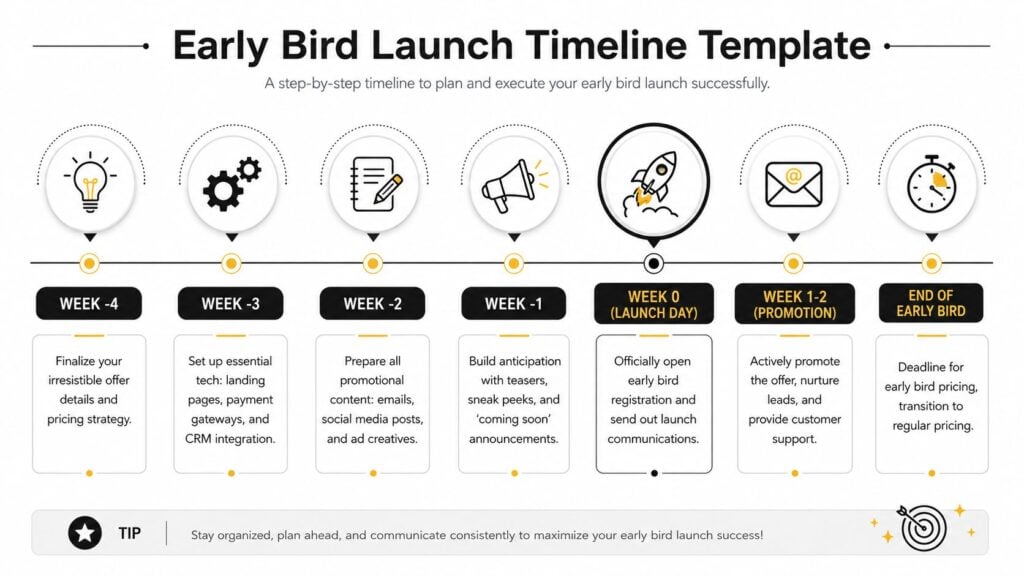
Here’s a clean planning model:
- Week -4: Lock the offer, pricing, bonus, and deadline
- Week -3: Set up your landing page, checkout, tagging, and email automation
- Week -2: Write launch emails, short-form posts, FAQ replies, and support macros
- Week -1: Start teasers, waitlist reminders, and “opens soon” messaging
- Launch week: Open cart, answer objections, and stay visible
- Final days: Shift from explanation to reminder and deadline-driven messaging
If you want a broader recurring system instead of rebuilding your launch calendar every time, this resource on a launch calendar for recurring product creators can help.
Match the window to the type of offer
Not every digital product needs the same pace.
A cohort-based course benefits from a firmer launch window because the start date gives people a real reason to commit. A membership can still use early bird pricing, but you need a stronger reason for the deadline to matter. That reason might be founding-member perks, a live onboarding round, or a limited bonus that disappears after launch.
I generally sort launches like this:
- Cohort course: Best for time-bound early bird offers
- Membership: Best when tied to founding access or bonus experiences
- Evergreen self-paced course: Usually better with periodic campaigns than constant “early bird” language
What to protect: Don’t let your timeline stretch just because you’re nervous. A soft deadline teaches buyers to wait you out.
Keep the middle of the launch simple
A lot of creators obsess over launch day and closing day, then wing the days in between. That’s where momentum usually gets lost.
You need a middle phase that answers practical objections. Post examples. Share quick wins. Clarify who the program is for and who should skip it. If buyers need hand-holding because the offer is still fuzzy, that’s not a timeline issue. That’s a positioning issue.
Your timeline should support clarity, not compensate for a weak pitch.
Write Promotional Copy That Creates Urgency
Weak early bird copy usually sounds one of two ways. Either it feels timid and vague, or it sounds like a late-night infomercial. Neither works for a serious digital product.
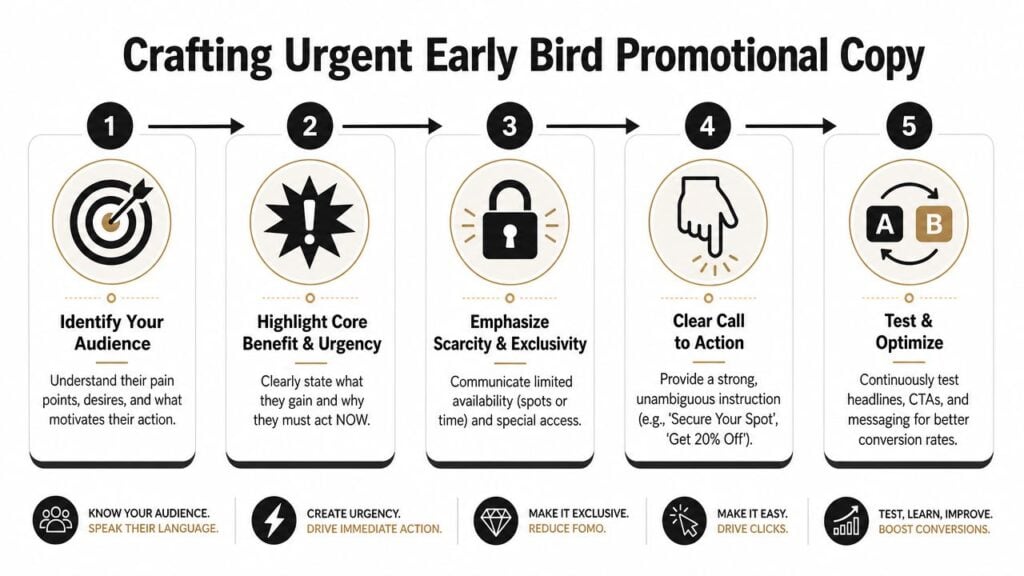
The better approach is calm urgency. You tell people what they get, why it matters, and what changes when the deadline passes. Then you repeat that clearly enough that nobody misses it.
A solid model comes from event campaigns, where a proven drip sequence includes four key emails: a launch announcement, a 1-week reminder with a highlight, a 48-hour countdown, and a final-day “last chance” email. Extending deadlines unannounced can reduce late-stage conversions by 15% to 20%, according to RegFox on early bird sales.
The four-message sequence I keep coming back to
Let’s say you’re launching a course for freelance designers who want a repeatable client onboarding system.
Email one is the open cart email. The job here is clarity, not drama.
Subject line style:
- Enrollment is open for Client Systems Bootcamp
- Join early and get the onboarding templates pack
- Now open. Save your spot before bonuses close
Body angle:
Explain the outcome, who it’s for, and what early buyers get. Keep the call to action plain. Don’t cram every detail into this email.
Email two is the 1-week reminder. Pick one feature and make it concrete.
You might highlight the lesson that helps students stop rewriting proposals, or the bonus workshop that walks through intake forms. This email should make the offer feel more real than the first one did.
The countdown emails do the real urgency work
The third email lands at 48 hours left.
This one should sound firmer. Not louder, firmer. Remind people exactly what ends and when. If the early bird includes a bonus, say that bonus disappears at the deadline. If the price increases, say so clearly.
A rough structure looks like this:
- Opening line: Quick reminder that the deadline is close
- Middle section: One reason to join now
- Objection answer: Time, fit, or readiness
- CTA: Join before the early bird closes
The final-day email is short. Very short.
Doors close tonight. If you’ve been meaning to join, this is the email that matters.
That’s enough, as long as the page itself does the rest.
Social posts should echo, not reinvent
A common mistake is writing emails one way and social posts another way. Your audience ends up seeing a dozen different messages about the same launch.
Keep the social version aligned:
- Teaser post: Open enrollment starts tomorrow
- Mid-launch post: Share one lesson, bonus, or student fit signal
- Final reminder post: Deadline tonight, bonus gone after cutoff
Notice what isn’t in that list. No fake scarcity. No “I’ve had so many people asking.” No mysterious countdown with no explanation.
Good urgency is specific
Specific language beats broad hype every time.
Try lines like:
- Join by Friday to get the live setup workshop
- Enrollment closes tonight and the templates pack is removed
- The current price ends at midnight
Avoid language that trained buyers have learned to distrust:
- “Act fast”
- “Don’t miss out”
- “Last chance” with no real consequence explained
If your early bird copy feels pushy, it usually means the offer isn’t clear enough. Clear offers don’t need verbal fireworks.
The Simple Tech You Need to Make It Work
You don’t need a giant stack to run early bird pricing well. You need a few tools that enforce the rules so you don’t have to manually babysit the launch.
The minimum setup
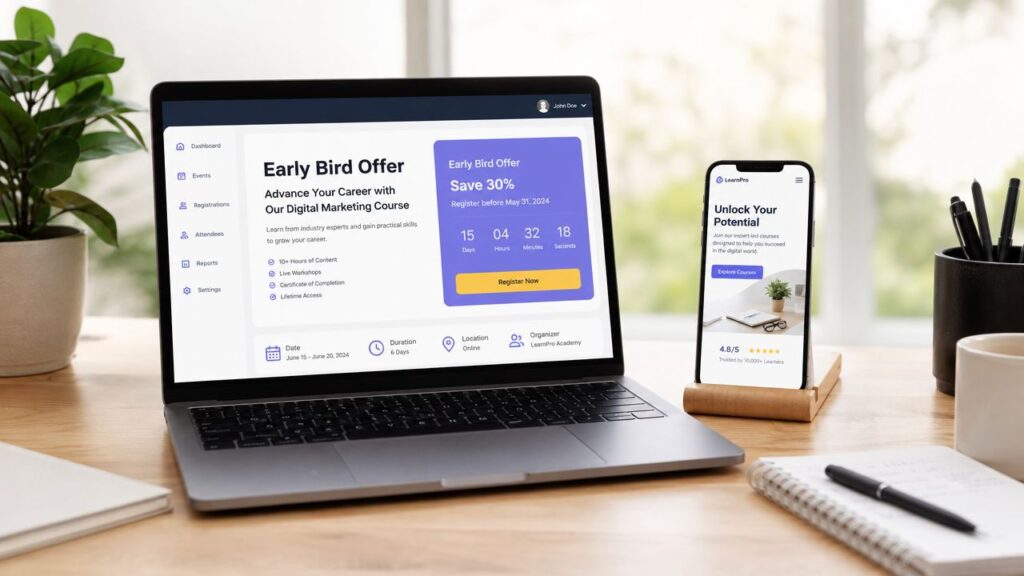
Start with these pieces:
- Checkout that can switch pricing automatically: Your cart should move from the early bird offer to the regular offer at the deadline without manual edits.
- Email automation: Queue the launch, reminder, countdown, and close emails ahead of time.
- A visible timer or deadline banner: Only use this if the deadline is real.
- Basic CRM tagging: Tag waitlist joins, clicks, buyers, and non-buyers so your follow-up makes sense.
If you work independently and want a lightweight contact system instead of a bulky sales platform, CRM for independent designers and consultants is a good example of the kind of simple setup that keeps outreach organized without turning your launch into an operations project.
Make the tech protect your credibility
The point of tech isn’t flash. It’s consistency.
Your timer should match your checkout deadline. Your email reminders should stop when someone buys. Your sales page should update when the offer changes. If those pieces don’t line up, buyers notice. And once they notice, urgency becomes harder to believe.
For most creators, boring reliability beats clever automation every single time.
How to Measure Success and Plan Your Next Launch
After the launch, don’t just ask whether you hit your revenue goal. Ask whether your early bird structure improved the launch.
Look at the full picture
Review the launch in layers:
- Waitlist quality: Did the people who joined early buy?
- Email performance: Which message got replies, clicks, and sales activity?
- Offer fit: Did people respond better to the price break or the bonus framing?
- Deadline behavior: Did sales bunch up near the close, or stay flat throughout?
Those answers tell you more than the headline number.
A good launch review doesn’t just tell you what happened. It tells you what to change next time.
Change one variable, not five
Most creators ruin the next launch by rewriting everything at once. Keep it tighter than that.
Pick one thing to test. Maybe it’s a bonus instead of a discount. Maybe it’s a stronger waitlist sequence. Maybe it’s a shorter sales window. The point is to learn what moved buyer behavior, not to create a brand new experiment every quarter.
If your audience buys because the offer is well positioned and the deadline is credible, you can repeat that. If they only buy when you slash the price, you don’t have an early bird strategy. You have a discount dependency problem.
Early bird pricing should create momentum without weakening the value of your course or membership. That’s the line worth protecting.