Knowledge and Skills in Course Design: A Practical Guide

You’ve probably seen this happen. A learner completes a course, passes the quiz, downloads the certificate, and still hesitates when the actual task appears. They can define a process, recognize the right answer, and explain the theory, but they can’t use it under pressure.
Course creators often treat that gap as a motivation problem. I’ve found it’s usually a design problem. Knowledge and skills support each other, but they’re different learning outcomes, so they need different objectives, activities, and assessments.
The distinction also matters beyond individual courses. The OECD Learning Compass 2030 defines knowledge as facts, concepts, ideas, theories, and practical understanding gained through performing tasks. The OECD separates knowledge into disciplinary, interdisciplinary, epistemic, and procedural forms. A strong course respects that foundation while giving learners enough structured practice to perform.
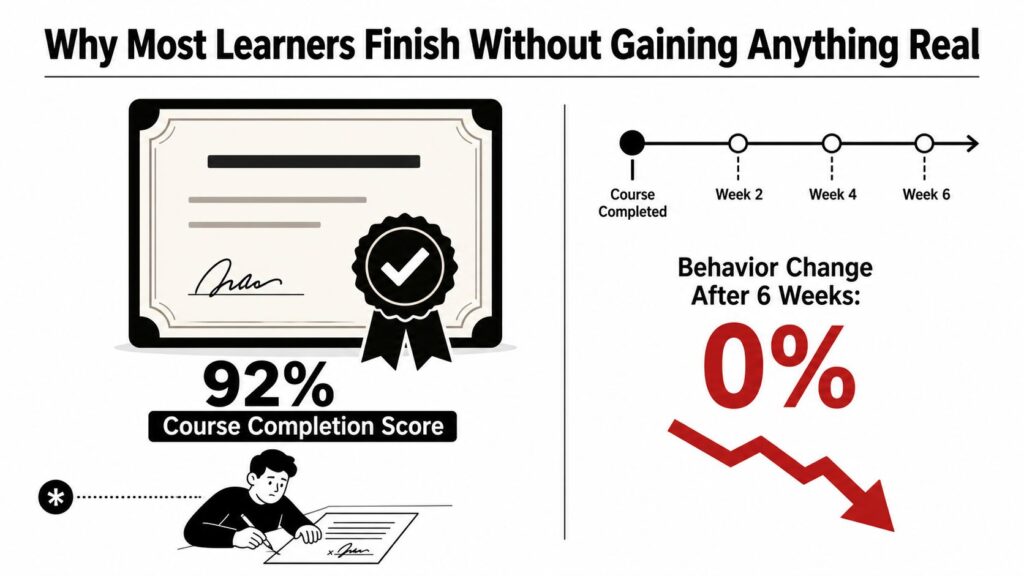
Why Most Learners Finish Courses Without Gaining Anything Real
A team lead completes a four-hour compliance course and scores 92% on the final quiz. Six weeks later, the same person signs off on a policy they haven’t read. The certificate is genuine. The expected behavior never appeared.
That pattern shows why course completion and competence are separate metrics. Completion tells you that a learner reached the end of the experience. A quiz score tells you whether they recognized or recalled the material in that assessment. Neither result proves that they can make a sound decision inside a messy workplace situation.
Where the gap forms
Many modules deliver declarative content in a neat sequence. Learners watch a video, read a policy summary, answer a few multiple-choice questions, and move on. That structure works reasonably well for storing information, but it leaves out the conditions that make performance reliable.
A learner may know the definition of a conflict of interest and still fail to identify one in an email thread. They may remember the steps in a customer escalation process and still choose the wrong step when three issues arrive at once.
Practical rule: If the job requires a visible behavior, the course needs a visible opportunity to rehearse that behavior.
Across course launches, I’ve seen creators overestimate what recall proves because recall is easy to score. A quiz produces clean data. A role-play, submitted artifact, or recorded response takes more planning to review. That convenience can turn the assessment into a test of what’s easiest for the course team to measure.
The learner usually isn’t lazy. They followed the signals the course gave them. If every activity rewards recognition, they’ll prepare for recognition. If the course never asks them to act, it hasn’t established action as part of success.
The practical fix is to identify what should change in the learner’s work, then separate the information they need from the performance they must demonstrate. The sections that follow apply that split to objectives, sequencing, practice, and assessment without requiring an entirely separate course for each outcome.
What Knowledge and Skills Actually Mean
Knowledge is information a learner can recall, recognize, describe, or explain. Skills are capabilities a learner can apply to produce an outcome under realistic conditions.
The distinction becomes clear with driving. Knowing the rules of the road, understanding what road signs mean, and explaining how a gearbox works are forms of knowledge. Reversing into a tight bay while a passenger counts down is a skill. The driver must interpret the space, control the vehicle, adjust to feedback, and finish within the conditions of the task.
The OECD uses a related labor-market distinction. Its Skills Outlook 2021 describes knowledge as an organized body of factual or procedural information that supports adequate job performance. It describes skills as proficient manual, verbal, or mental manipulation of data or things.
| Dimension | Knowledge | Skills |
|---|---|---|
| What is stored | Facts, concepts, rules, models, and procedures | Coordinated actions and decisions |
| How it appears | A learner recalls, recognizes, labels, or explains | A learner performs, creates, adapts, or solves |
| How it changes without practice | Recall can become less accessible | Fluency, timing, and confidence can weaken |
| How it’s assessed | Quiz, short answer, explanation, or diagram label | Simulation, role-play, artifact, observation, or rubric |
| Typical learner statement | “I know what this means.” | “I can do this in context.” |
Why the distinction matters
The same learner can score highly on knowledge checks and perform poorly in a live situation. The outcomes depend on different mental processes. Recall asks the learner to retrieve information. Performance asks them to coordinate information with judgment, timing, tools, communication, and environmental constraints.
That’s why a course on GCSE subjects may need both clear subject knowledge and opportunities to apply it. Learners looking for a structured starting point can find your GCSE subjects here, then use practice tasks that require explanation, comparison, calculation, or problem-solving rather than relying on recall alone.
Knowledge still matters. Skills without relevant knowledge become brittle because learners lack the concepts needed to interpret a new situation. Knowledge without practice remains inert, especially when the workplace adds interruptions, ambiguity, or consequences.
A useful design test is simple. Ask, “Could someone pass the knowledge check without doing the task?” If the answer is yes, you’ve identified two outcomes that should be designed and measured separately.
How the Knowledge Versus Skills Split Changes Course Design
Once you separate knowledge from skills, the course blueprint changes in three places: objectives, assessments, and practice.
Start with two objectives
A weak objective says, “Understand the sales funnel.” That phrase doesn’t tell the learner or instructor what success looks like. Split it into a knowledge objective and a skill objective:
- Knowledge objective: Identify the stages of a sales funnel and explain the purpose of each stage.
- Skill objective: Open a discovery call that surfaces three relevant customer pain points and records them accurately.
The first outcome can use a short reading, diagram, or video. The second needs a scenario, a conversation, and criteria for judging the result.
Match the assessment to the outcome
A multiple-choice item can check whether a learner recognizes the correct funnel stage. It can’t reliably show whether they can open a call naturally, ask useful questions, and capture what they hear.
For the skill layer, use a role-play, simulated call, or scored transcript. A reviewer might assess whether the learner asked an open question, followed up on an answer, and documented the pain point without adding unsupported assumptions.
Designers building video-based courses can use short videos for models and explanations, then place an application prompt immediately after the clip. The video provides access to the concept. The task reveals whether the learner can use it.
Change the instructional rhythm
A knowledge-only module often follows this pattern:
- Explain the concept.
- Add more explanation.
- Deliver a quiz.
- Move to the next topic.
A knowledge-and-skills module uses a tighter loop:
- Introduce one concept.
- Show what it looks like in context.
- Ask the learner to make a small decision.
- Give feedback.
- Increase the complexity.
That approach takes more upfront work and can make a module slightly longer. It also gives learners a chance to correct weak performance before the final assessment, which reduces the need to reteach the entire topic later.
A completion report tells you who reached the finish line. A performance task tells you whether the course prepared them to cross it.
Writing Learning Objectives That Cover Both
A single course outcome often hides two targets. “Understand project management” sounds efficient, but it combines knowing the framework with using the framework to make something useful.
Bloom’s-style verbs help separate the outcomes. Remember, understand, and basic analyze generally support knowledge objectives. Apply, evaluate, and create generally describe skill performance when the learner must use judgment or produce an artifact.
Consider this paired example:
- Knowledge: Identify the five process groups of project management.
- Skill: Build a project charter for a real scenario using the five process groups.
The first objective has a clear knowledge target. The learner must identify the groups. The second requires creation, context, and a product that another person can inspect.
For more background on using cognitive levels to shape observable objectives, see this guide to Bloom’s taxonomy and learning objectives.
| Outcome Type | Action Verb | Object of Learning | Proof Artifact |
|---|---|---|---|
| Knowledge | Identify | The five process groups | Correctly labeled response |
| Knowledge | Explain | The purpose of each group | Short written or spoken explanation |
| Skill | Build | A project charter for a scenario | Completed charter |
| Skill | Evaluate | Risks and assumptions in the charter | Justified review with revisions |
Use verbs that reveal evidence
“Know,” “understand,” and “be familiar with” are difficult to assess because they describe an internal state. Replace them with actions such as identify, classify, explain, compare, draft, perform, evaluate, or revise.
Then add a completion condition. “Draft a project charter” is stronger than “understand project charters,” but “Draft a project charter for a scenario and justify two assumptions” gives the reviewer more useful evidence.
Avoid duplicating the same objective in two forms. “Explain the sales process” and “demonstrate understanding of the sales process” may sound different, but both could lead to another recall activity. The second objective should require a different behavior, such as conducting a call, configuring a tool, or producing a decision-ready document.
Try two tests before publishing:
- Knowledge-only test: Could a learner pass the knowledge check without performing the task?
- Skill-only test: Could a learner perform the task by copying steps without understanding the underlying concept?
If both answers are yes, keep the objectives separate and design evidence for each. The learner should know what they’re expected to remember and what they’re expected to do.
Sequencing Knowledge and Skill Practice in Microlearning
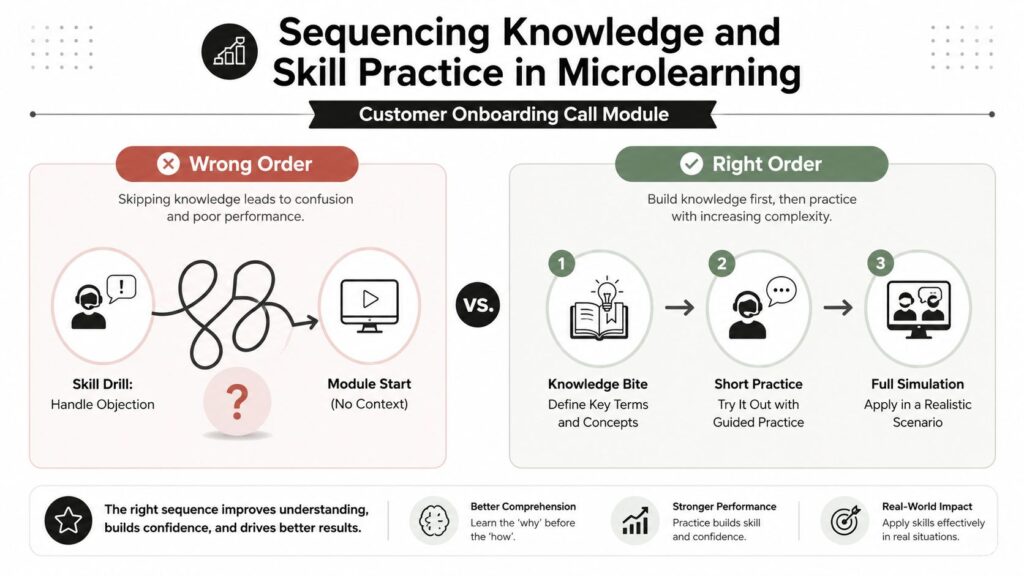
A customer onboarding course shows the difference clearly. In the wrong sequence, learners begin with an objection-handling drill before they know the product terms, customer stages, or escalation boundaries. They’re forced to guess at the language while trying to manage the conversation.
The stronger sequence is smaller and more deliberate:
- A short knowledge bite defines one key term.
- A 30-second check confirms basic recall.
- A 90-second practice task places that term inside a realistic onboarding scenario.
- Feedback identifies one correction.
- A later simulation asks the learner to use the term without a prompt.
Build small learning loops
I usually divide a larger module into five-to-seven-minute micro-units when the content suits that format. Each unit has one main idea, one quick knowledge check, and one application task. The learner gets a reason to retrieve the information immediately instead of storing it for a final quiz.
For example, an onboarding module might begin with the definition of “activation event.” The check asks the learner to select the correct event from three descriptions. The practice task then presents a new customer’s activity and asks the learner to decide whether the customer has reached activation, explaining the decision in one or two sentences.
Creators working on how to structure microlearning content should resist turning every short unit into a compressed lecture. Shorter content still needs a job. If a unit only delivers information, it may improve familiarity without improving performance.
Too much knowledge at the start can also overload working memory. Distribute recall across later skill drills. Ask learners to retrieve a term while they complete a scenario, then revisit it when they handle a more complex case. That creates spaced retrieval inside the performance path.
The sequence shouldn’t be rigid for every topic. Some skills require a demonstration before learners can name all the parts. Even then, the course should make the underlying knowledge explicit and give learners a chance to apply it soon after seeing the model.
This video can help course creators visualize the relationship between short explanations and active practice:
After the video, ask learners to perform a small version of the target task. A prompt such as “Write the first question you’d ask this customer” produces more useful evidence than another request to summarize the lesson.
Measuring Knowledge and Skills Separately
A single final assessment often blends recall and performance, then reports one score. That number can hide the most useful finding, such as a learner who remembers the policy but can’t apply it, or a learner who performs the routine correctly but can’t explain why the decision matters.
Use two parallel tracks.
Track one for knowledge
Knowledge checks work well as low-stakes gates throughout the course. Use multiple-choice questions, short answers, matching, or diagram labels to test whether learners can retrieve the necessary concepts.
A one-minute teaching-back prompt adds depth. Ask the learner to explain one concept as if they were briefing a colleague. You can assess accuracy, clarity, and whether they included the conditions that change the answer.
Track two for performance
Skill assessments should require an observable action or artifact. Examples include:
- Role-play: Conduct a difficult customer conversation.
- Artifact build: Create a project charter, report, or lesson plan.
- Peer critique: Review a colleague’s work against stated criteria.
- Recorded response: Submit a short screen recording that shows the decision process.
A four-level rubric makes expectations visible:
| Measurement Method | Captures Knowledge | Captures Skill | When to Use |
|---|---|---|---|
| Multiple-choice check | Recall and recognition | No direct evidence | During learning |
| Short explanation | Accuracy and understanding | Limited communication evidence | After a concept |
| Scenario decisions | Applied interpretation | Partial performance | Before a full task |
| Role-play or simulation | Some contextual knowledge | Live application and judgment | At skill checkpoints |
| Scored artifact | Supporting concepts | Quality of the created output | At project milestones |
You might label the levels needs model, developing, consistent, and coaches others. “Needs model” means the learner requires a demonstration or substantial prompting. “Developing” means they can complete parts of the task but miss important criteria. “Consistent” means they meet the standard independently. “Coaches others” means they can perform reliably and explain useful adjustments to someone else.
Read the gap between the tracks carefully. High knowledge and low skill usually point to insufficient practice, weak feedback, or an unrealistic task. Low knowledge and low skill suggest that the learner needs clearer instruction before more drills. Strong skill with weak explanation may indicate procedural fluency that needs conceptual reinforcement.
The Skills Mismatch Trap Most Course Creators Miss
When learners finish a module and still can’t perform, creators often add more content. That response makes sense only if the course taught the wrong knowledge. Frequently, the deeper issue is a mismatch between the skill taught and the job the learner needs to do.
The OECD describes skills mismatch as widespread and links it with reduced productivity. Its research notes that up to 25% of workers can be mismatched on average across OECD countries, and a 2025 OECD-linked study estimated that removing mismatch frictions could raise output by 3% to 4% across 17 OECD economies. These findings concern labor markets, but they offer a useful warning for course designers. More training doesn’t automatically solve poor allocation between capability and work.
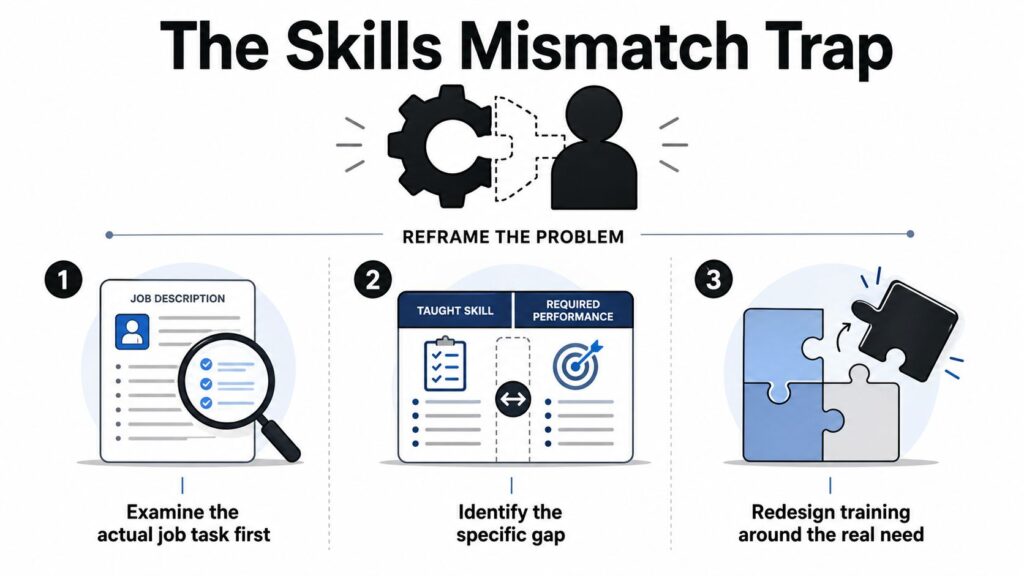
Audit the real task first
“Understands onboarding” describes a topic. “Runs a 30-minute onboarding meeting with a new hire” describes behavior. The second statement gives you something to observe, practice, and score.
Use four diagnostic questions before rebuilding the module:
- Tomorrow’s behavior: What will the learner do differently at work?
- Current failure: Where does the learner currently get stuck?
- Visible success: What would a manager observe when the task is done well?
- Practice match: Which activity mirrors the work environment?
If every assessment is multiple choice, the course measures knowledge and labels it a skill. If practice uses drag-and-drop exercises while the job requires judgment in a live conversation, the transfer problem may sit in the environment rather than the learner’s effort.
The OECD also notes that green and digital transitions create region-specific mismatches in local labor markets. That reinforces a practical point for course creators. Skills need context, including the role, tools, decisions, and constraints where learners will use them. A sharper skills-gap process can help you identify that difference through a skills gap analysis template.
Your One-Page Course Design Checklist
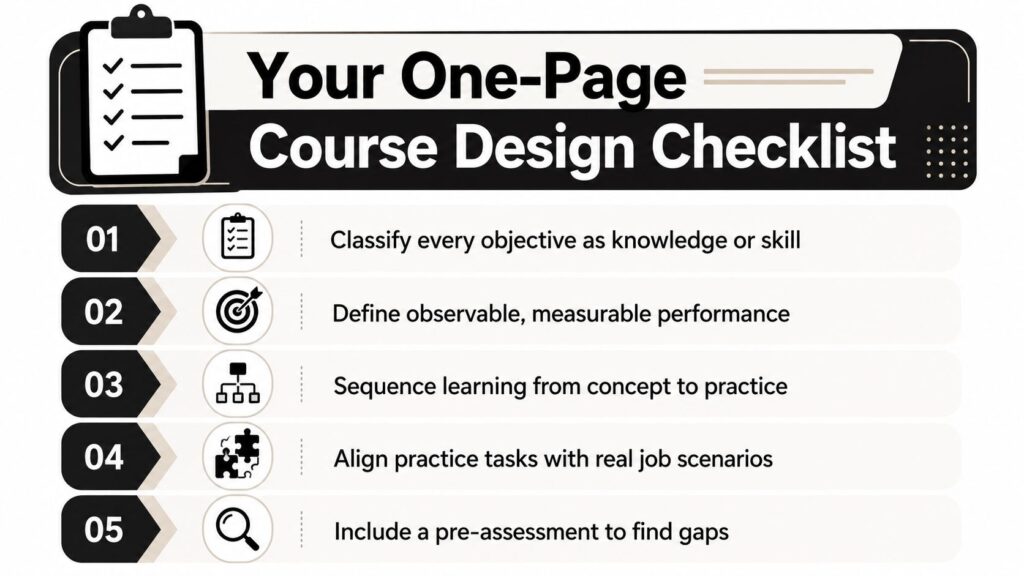
I keep the following checklist beside the course storyboard. It catches many knowledge-and-skills errors before learners encounter them.
- Classify every objective: Mark each objective K for knowledge or S for skill. Check that every skill objective describes an observable behavior.
- Align the assessment: Use recognition or recall questions for knowledge objectives. Use performance tasks and rubrics for skill objectives.
- Sequence concept before practice: Deliver the necessary knowledge, then ask learners to use it. Keep each microlearning unit under ten minutes when the content works in that format.
- Mirror the workplace: Build at least one practice task for every skill objective. Match the tools, decisions, communication patterns, and constraints learners will face.
- Schedule spaced review: Revisit knowledge items across the module. Repeat skill tasks with increasing complexity rather than placing all practice in one lesson.
- Add a closing performance check: Require learners to combine at least two skills without prompts. Share the rubric before they begin.
- Resolve fuzzy objectives: Log any objective that still feels vague after review. Rewrite it before publishing.
Keep the checklist in your workflow
UNESCO-UNEVOC defines a skills taxonomy as an exhaustive inventory of skill sets relevant to an organization or industry. Its Global Skills Tracker structures skills data using recognized classifications for occupations, economic activity, and education, including ISCO-08, ISIC, and ISCED, as described in its skills taxonomy glossary. Course teams can borrow the same discipline by naming capabilities precisely instead of grouping unrelated behaviors under broad labels.
For a worked example of how a subject area can be organized into learning components, influencer marketing curriculum explained provides useful context for thinking about knowledge topics, practical activities, and evidence of performance.
You can save this checklist as a reusable review sheet in your learning platform or project workspace. LearnStream is one option for managing digital learning experiences and course content, while tools such as a document template, rubric spreadsheet, or LMS quiz builder can handle the same workflow.
The OECD’s PIAAC program measures literacy, numeracy, and adaptive problem solving as foundational information-processing skills. Its latest cycle assessed about 160,000 adults across 31 countries and economies, with results released on 10 December 2024, according to the OECD PIAAC overview. That scale highlights why educators need precise language. If large systems distinguish foundational capabilities, course creators should distinguish what learners know from what they can demonstrate.
Take your next course module and label every objective K or S today. Then replace one knowledge-only quiz with a realistic performance task, add a simple rubric, and review the results separately. Your learners will get clearer expectations, and you’ll have better evidence of whether the course changed capability rather than merely recording completion.