Course Assessment Methods: A Practical Guide

You've built the lessons, added a quiz to each module, and set up a final project. Then the submissions arrive. Learners can choose the right definitions, but they struggle to use them. Your gradebook looks complete, yet you still can't tell who's ready to do the work.
Choosing course assessment methods starts with that gap. You need evidence of what learners can do, plus a plan for what happens when they can't do it yet. A useful assessment changes the next practice task, explanation, or revision, rather than adding another score.
Course Assessment Methods at a Glance
No single method measures everything. A 2024 review of undergraduate assessment found that most courses across science, social sciences, humanities, and arts combined coursework, examinations, and practical assignments, and none of the degree courses reviewed relied on examinations alone.
That's a sensible starting point for online courses too. Use quizzes where you need a quick knowledge check, and submitted work where you need evidence of judgment or performance. Don't choose a favorite format and force every outcome into it.
Course assessment methods compared
| Method | Main purpose | Typical format | Main limit |
|---|---|---|---|
| Formative | Guide learning during the course | Practice quizzes, drafts, exit tickets | Only useful if feedback leads to action |
| Summative | Check what was learned at the end | Final exam, capstone, final report | Leaves little time to fix gaps |
| Diagnostic | Find each learner’s starting point | Pre-test, entry survey | Helps only if results change the path |
| Authentic | Test performance in real-world tasks | Case study, simulation, portfolio | Slower and harder to grade |
| Peer assessment | Practise judging work against criteria | Peer review of drafts or projects | Scores vary by reviewer |
| Self assessment | Build reflection and planning | Reflection journal, checklist | Learners may overrate or underrate themselves |
| Automated quiz | Run fast checks at scale | Multiple choice, matching, auto-graded items | Mostly tests recall |
| Project or portfolio | Show application over time | Capstone project, e-portfolio | Hard to score consistently without a rubric |
Build a purposeful mix
These categories overlap. A portfolio describes the evidence learners submit, while formative describes how you use that evidence. An automated quiz can be diagnostic at entry or summative at the end.
Read the table by purpose first. If you need to uncover prerequisites, use a diagnostic check. If you need learners to practise making decisions, give them a case with constraints rather than another terminology quiz.
For a membership course, I'd start with a manageable combination: an entry check, practice tied to each major skill, and a final demonstration. Adding more formats creates more administration, so each addition should supply evidence you're currently missing.
Practical rule: Every assessment method should answer one clear question about learning.
Mark the methods already present in your course. Then identify the missing function, not merely the missing format. A course full of quizzes might need an application task, while a project-heavy course might need earlier checks that prevent learners from carrying misunderstandings into their final work.
Formative and Summative Assessment Timing
Could the learner use this result to change their next attempt? If yes, you're using the assessment formatively. If the result mainly records achievement after instruction, it's serving a summative purpose.
The University of Illinois Chicago's assessment-planning guidance distinguishes formative assessment during learning, including homework, reflections, drafts, and practice quizzes, from summative assessment at the end, such as exams, reports, presentations, and major projects. The format alone doesn't settle the question. Timing and follow-up matter.
A worked online module
Say you're building a four-week module on email campaign planning. This is how I'd arrange the assessment schedule:
- Opening week: Learners complete a practice quiz, read explanations, and retry with fresh questions.
- During development: They submit an audience-selection draft and use comments to revise their choices.
- Before submission: They check their campaign against the assignment criteria and identify an unresolved weakness.
- At the end: They submit the completed campaign plan for a summative grade.
Keep practice ungraded or lightly weighted. Learners need room to expose uncertainty without turning every mistake into a permanent penalty. You can still require completion or a revision note when participation matters.
The draft and final campaign can be stages of the same assignment. That reduces disconnected busywork and makes the feedback immediately relevant to something learners must finish.
Schedule the response, not just the assessment
A practice test becomes useful when learners have time to act on the result. For exam preparation, Makon AI's full-length SAT practice test is an example of a resource you could place before targeted review, rather than treating the score as the end of the activity.
Likewise, the difference between a quiz and a test matters less than the decisions you attach to it. A short check can carry high stakes, and a lengthy practice test can guide further study.
Leave space between feedback and the next judged performance. Otherwise, learners receive advice they can't use in time.
List every assessment in your course and label its primary role formative or summative. For anything formative, add the next action beside it. If there's no revision, targeted practice, or instructional adjustment, the feedback loop is unfinished.
Matching Each Method to the Outcome You Measure
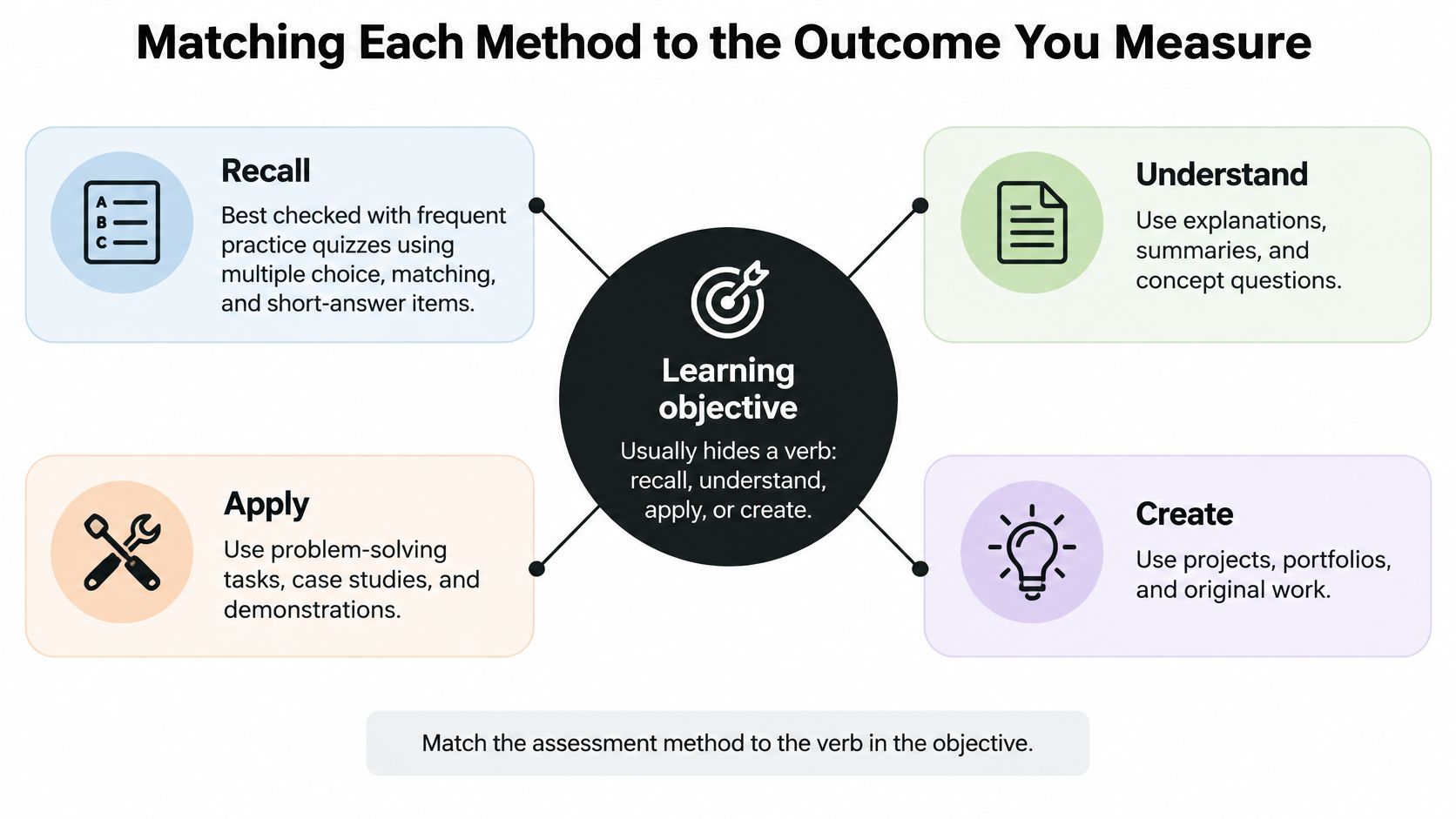
A learning objective usually contains the verb you need: recall, understand, apply, or create. Start there, before opening the quiz builder in Moodle or setting up an assignment in Canvas.
Cornell University's assessment recommendations connect recall with frequent practice quizzes, understanding with methods such as short answers and concept maps, and creating with portfolios, projects, papers, and presentations. The practical lesson is straightforward: choose evidence that lets learners perform the intended action.
Use this map to check whether the task matches the objective.
Move from recognition to performance
Consider a marketing course. To check recall, you might use a hypothetical 10-question quiz on segmentation, deliverability, and conversion terms. Matching or multiple-choice questions make sense because you're checking whether learners can retrieve or recognize those terms.
To assess understanding, ask learners to explain why an email campaign's open rate might change. Give them context and ask what they can and can't conclude. A short explanation reveals reasoning that selecting a definition won't expose.
For application, provide a customer dataset and ask learners to build audience segments using a named procedure. Require the segmentation rules, not just the finished audience labels.
For creation, give them a client brief and ask for a campaign with a landing page, audience rationale, and measurement plan. Now they must make choices under constraints rather than reproduce a model answer.
Learning outcome and suitable assessment methods
| Learning outcome | Suitable methods | Example task |
|---|---|---|
| Recall facts and terms | Practice quizzes, multiple choice, matching, true or false | A hypothetical weekly 10-question retrieval quiz |
| Understand concepts | Short answer, concept maps, problem sets, discussion | Explain a concept in your own words in a forum thread |
| Apply skills | Problem sets, lab tasks, case responses | Solve a scenario using a named procedure |
| Create or design | Portfolio, research project, website design, video presentation | Build a landing page for a client brief |
| Communicate or collaborate | Presentations, group projects with peer review | Record a hypothetical five-minute walkthrough reviewed by peers |
Name the evidence you need
A quiz can efficiently check terminology. It can't, by itself, prove that someone can design a coherent campaign. Equally, a polished campaign doesn't necessarily tell you whether every group member understands the underlying decisions.
For collaborative work, ask for visible individual contributions or a short rationale attached to each person's decisions. Keep that evidence proportionate. Requiring a detailed diary for a small task can create more work than the assessment warrants.
I'd write the objective's verb beside each planned task, then finish this sentence: The learner will demonstrate this by… If the answer describes clicking through content rather than showing competence, revise the task.
Before launch, confirm that every assessment points back to a named objective. Remove orphan questions that are interesting but don't help you judge the promised learning.
Feedback and Rubrics That Change What Learners Do
Correctness-only feedback produced a mean effect size of 0.05, compared with 0.49 for explanatory feedback, in a meta-analysis of computer-based learning environments covering 40 studies and 70 effect sizes. Presenting the correct answer reached 0.32 in that analysis.
More comments aren't automatically better. Learners need an explanation that identifies the reasoning error and a task that lets them repair it.
Make the next attempt different
For a quiz item, build feedback around these actions:
- Name the concept: Identify the rule or distinction the question tested.
- Explain the error: Show why the selected answer doesn't fit this situation.
- Require a response: Ask for a revision or a fresh problem that uses the same principle.
Say a learner chooses the largest audience segment because it contains the most contacts. Explain that audience size doesn't establish relevance to the campaign objective. Then ask them to select a segment for a different brief and justify the choice.
Avoid a retry that only invites learners to remember which button was correct. Change the scenario or ask for the missing reasoning step.
The meta-analysis also found that delayed feedback reduced effects overall, with explanatory feedback particularly useful for higher-order outcomes. For complex work, a brief reflection pause can be reasonable, but don't leave learners waiting through the next task without guidance.
Make quality visible before submission
A rubric lists the criteria you'll judge and describes performance levels for each. Yale's formative and summative assessment guidance recommends making expectations visible early, so learners understand what strong work looks like before they submit.
For the marketing project, separate audience rationale, evidence use, message alignment, and measurement planning. Don't hide several judgments inside a vague criterion such as overall quality.
A comment tied to evidence use can say that the learner chose a metric without explaining how it supports the campaign objective. That tells them what to revise. An overall score or a comment such as needs depth doesn't.
Use the guide to creating rubrics to structure criteria and performance descriptions, then check whether each distinction is observable in the work.
Feedback test: Could the learner tell what to change without asking you to translate the comment?
Open a quiz item that learners commonly miss. If its feedback only identifies the correct answer, add the reason and a meaningful follow-up attempt.
Peer, Self and Automated Assessment Limits
Peer scores aren't fair by default. A 2021 study of 5,722 submissions and 56,794 review scores from 18 peer assessments across three courses on the Chinese University MOOC platform found that learners tended to give extreme scores, with reliability affected by reviewer allocation and reviewing workload.
Assignment format mattered too, with e-portfolios producing more reliable peer scores than papers and proposals. The study recommended keeping peer assessment at a relatively low weight and avoiding it as the sole summative measure.
Assign responsibility carefully
Peer review is easier to justify when learners use it to improve drafts. Give reviewers an annotated example, clear criteria, and prompts that require evidence from the submission.
For example, ask them to identify where a campaign's audience choice supports the brief and where the reasoning breaks down. A request to leave helpful feedback is too open-ended. For organizing handoffs and review stages, Planstone's guide to peer review can help you think through the workflow.
Grade weight and safeguards by method
| Method | Best role in grade | Reliability safeguard |
|---|---|---|
| Peer assessment | Formative, or low weight in summative grades | Clear criteria and several reviewers per submission |
| Self assessment | Formative reflection | Checklist plus instructor check on a sample |
| Automated quiz | Formative checks and recall in summative | Item review for ambiguity and defined retry rules |
| Project with rubric | Main summative weight | Published rubric and a second grader on borderline cases |
| Proctored exam | High-stakes summative | Clear policy and an accessibility review before use |
Keep automation within its limits
For self assessment, ask learners to compare their work with an instructor-scored sample before judging their own performance. Require them to point to evidence, such as the paragraph that supports their claimed achievement.
Automated quizzes work best when the answer can be specified clearly. Open reasoning is harder to judge with a fixed key, especially when a learner reaches a defensible answer by an unexpected route.
Check whether the system accepts equivalent wording, how it handles partially correct responses, and whether retries reveal answers before learners have done any new work. Consistent scoring isn't the same as sound judgment.
List every assessment scored by someone other than the instructor, including software. Decide whether each should guide practice, contribute modestly to a grade, or require instructor confirmation before the result becomes final.
Checking Validity and Reliability Before Launch
Before trusting a score, ask whether the task measures what you claim it measures. That's validity. A chemistry question wrapped in a dense passage may demand more reading endurance than the chemistry objective requires.
Reliability asks whether the judgment is consistent. Would another grader interpret the criteria similarly? Would an equivalent version of the task produce a comparable judgment?
Run a pre-launch rehearsal
I'd use a small sample of submissions to calibrate grading with a colleague. Score independently, compare the reasoning behind disagreements, and rewrite criteria that allow conflicting interpretations.
Use this routine before opening the assessment:
- Trace the evidence: Match every item or criterion to a named objective.
- Inspect the wording: Remove irrelevant complexity and check for answer options that are technically defensible.
- Calibrate judgments: Compare sample grading and document how borderline work should be handled.
- Test the learner route: Complete the assessment using a learner account, including submission, feedback, and resubmission.
For peer-reviewed tasks, check that reviewer assignments don't leave a submission dependent on an isolated judgment. For automated questions, ask a colleague to explain how they reached each answer. Their explanation may uncover an interpretation you didn't anticipate.
Keep a decision log
Record why you removed an item, changed a grading boundary, or accepted an alternative solution. Include the affected objective and how you'll treat learners who already completed the task.
This doesn't need to become a long report. A shared document with the issue, decision, rationale, and responsible person is enough to make the process traceable.
A defensible grade needs a clear trail from the learning objective to the evidence and the judgment.
After launch, inspect questions that nearly everyone answers correctly or incorrectly. Those patterns are prompts for review, not automatic reasons to delete a question. An easy prerequisite check may be doing exactly what you intended.
Fair and Inclusive Assessment With AI and Access Needs
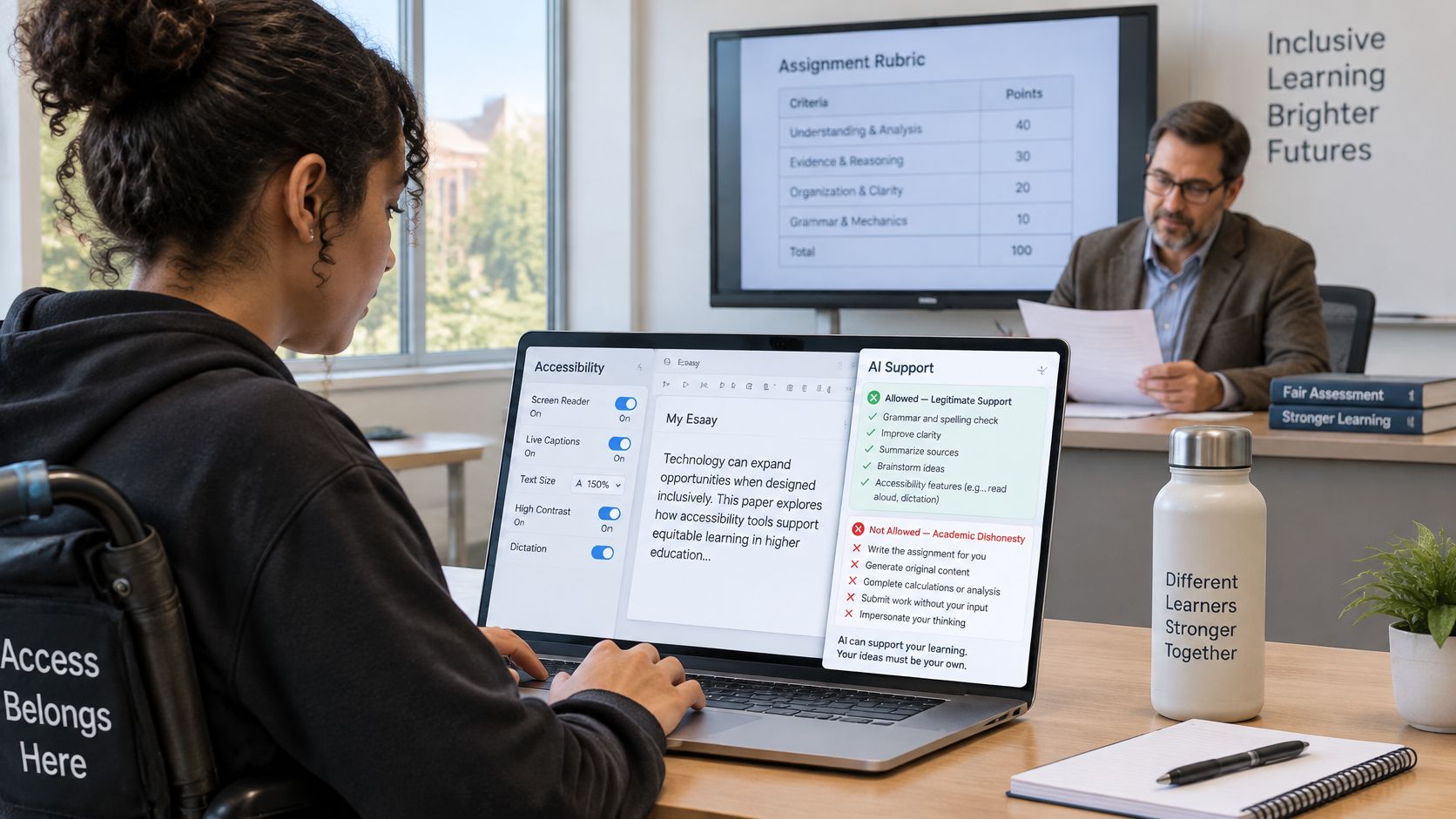
A blanket ban removes useful feedback capacity. Blind trust leaves learners unable to challenge a score. Define what learners must demonstrate themselves, then decide which forms of support fit that purpose.
Access belongs in that decision from the beginning. Consider the learner's tools and submission environment before setting the task.
A five-university mixed-methods study of 300 students and 100 instructors found that 73% of students received faster feedback through AI-supported assessment and instructor grading time fell by an average of 40%, while 52% of students didn't fully understand how AI-derived scores were calculated; it also flagged algorithmic bias and unequal tool access. That combination calls for transparency. An unexplained automated score gives learners nothing to act on, so name the evidence, the judgment, and the route to a review.
Use an outcome-first decision tree
- Start with the outcome: Must learners independently produce an answer, or evaluate and improve a supported output?
- Assess the stakes: If the grade controls progression or certification, require stronger human oversight.
- Specify permitted AI use: Distinguish brainstorming, editing, analysis, and prohibited outsourcing.
- Require disclosure: Ask for relevant drafts, prompts, source checks, or decision logs.
- Set the review point: Name who checks AI-supported judgments and handles appeals.
Score problem framing, source evaluation, revision, and contextual judgment when those are the intended skills. Polished language should never substitute for evidence of reasoning. The grade should also point to the next move: resubmit the weak criterion, explain the prompt chain, or defend the final choice without AI help.
Use the video to pressure-test your course rules against a real AI policy discussion.

Keep the standard fixed and remove irrelevant barriers
Research on inclusive assessment involving students with disabilities supports designing out barriers rather than relying only on adjustments after problems occur. Where the medium isn't the competency, allow an accessible written explanation, audio submission, or captioned presentation under equivalent criteria.
Language access needs similar care. The same principle shows up in other high-stakes tests, including G1 prep for non-English speakers: instructions, translation, and response format can distort a score. Avoid assessing language fluency accidentally when the objective concerns subject knowledge.
Use our accessibility guidance for online courses to support an audit of barriers, representative learner testing, and appeal patterns.
Confirm that learners can obtain the tools your task assumes, and provide a no-AI route to the same outcome. Keep the criterion identical across routes so support changes the pathway, not the standard.
Measure Results and Pick Your First Change
Course assessment methods need review after each run. A finished gradebook tells you what scores learners received, but you still need to inspect how they reached those scores and where the assessment got in their way.
I'd review these checks together rather than changing questions based on a single signal.
Check the evidence after delivery
- Item difficulty: Examine the share of learners who answered each question correctly. Questions everyone passes or nobody passes may provide little differentiation, though some still serve a necessary prerequisite check.
- Discrimination: Check whether learners who perform strongly overall succeed on an item more often than learners who struggle. An unexpected pattern can indicate ambiguity or poor alignment.
- Completion and drop-off: Find where learners stop. Inspect instructions, workload, file requirements, and technical errors at that point.
- Rubric scores by criterion: Identify where learners lose marks. Decide whether the problem lies in instruction, practice, expectations, or the criterion itself.
- Appeals and resubmissions: Look for recurring disputes or repeated submission failures. Review the wording and workflow before assuming learners did not read.
Don't interpret a difficult item as evidence of rigorous teaching. Read the responses and compare them with the intended objective. Equally, don't remove a demanding task just because learners need better preparation for it.
Check the LMS settings too
Release dates, attempt limits, feedback timing, and gradebook weights should match your assessment design. Feedback released after the next quiz opens can prevent learners from using it, even when the explanation itself is excellent.
Test the workflow from a learner account and confirm that resubmissions update grades as intended. If you're evaluating a platform change, our employee-training LMS guide compares options by team size, pricing, SCORM and xAPI support, and use case, and includes a pilot plan.
Keep a record of what you change and what you expect that change to improve. That makes the next review more useful than a general impression that the course felt smoother.
This week, choose the assessment with the weakest evidence and change one thing. Add an explanation to a confusing quiz item, clarify an ambiguous rubric criterion, or repair a feedback-release setting. Then review the next run to see whether learners can take the intended next step.